
Pictus Catfish Care Guide: Tank Size, Diet, Water Parameters and Temperament
The pictus catfish (Pimelodus pictus) is a striking, active bottom-and-mid-water fish that looks easy to keep but has a reputation for crashing suddenly in tanks that seem fine on the surface. This guide gives specific numbers for tank size, water chemistry, feeding, and tankmate selection, along with the two details most care sheets skip: nitrate sensitivity as the leading cause of death, and mouth width as the real test for whether a tankmate is safe.
Species Snapshot
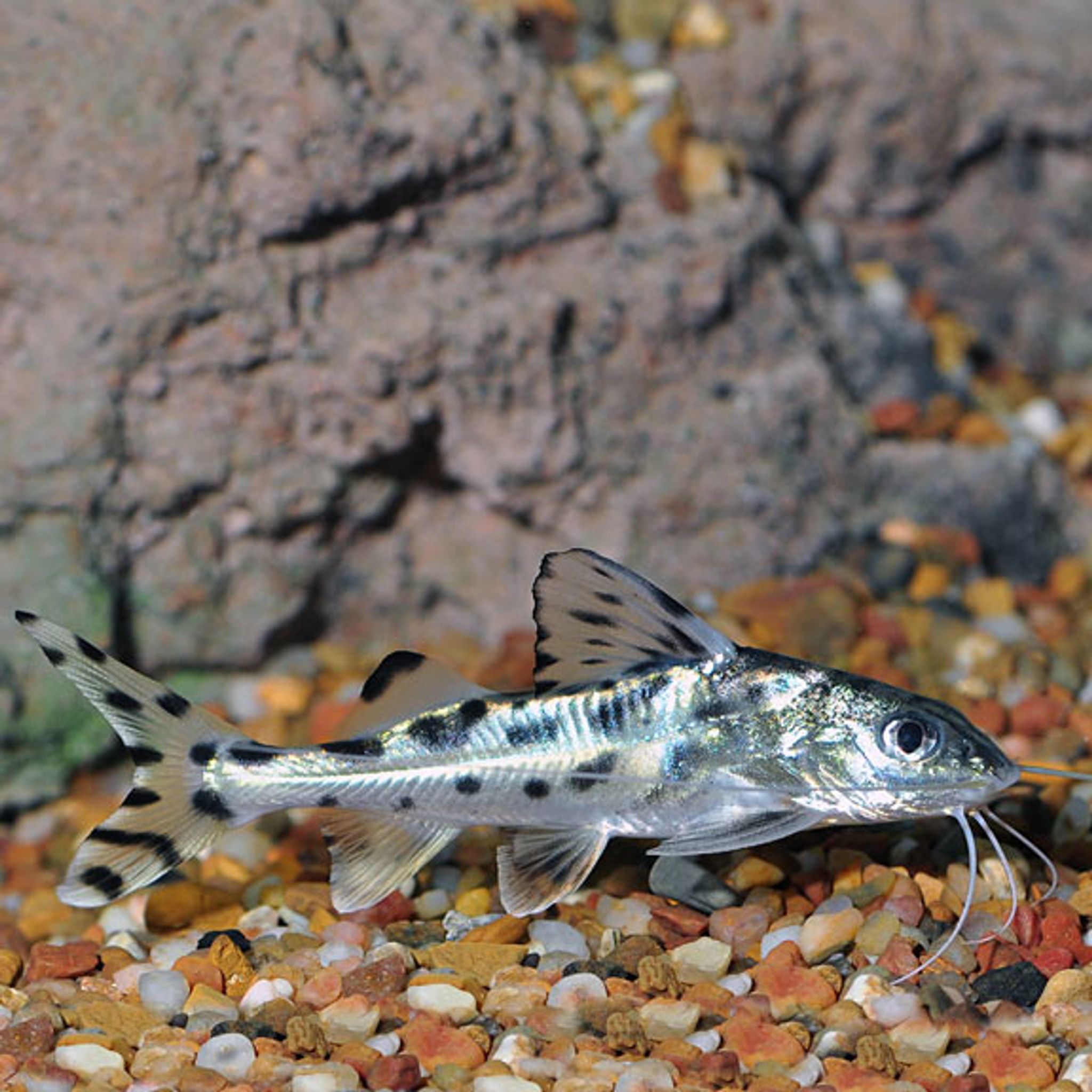
Pictus catfish come from the Amazon and Orinoco river basins in South America. They have a silver body covered in irregular black spots, transparent spotted fins, and three pairs of long white barbels that give them the common nickname "angel catfish" or "pictus cat."
| Trait | Detail |
|---|---|
| Scientific name | Pimelodus pictus |
| Adult size | 4–5 in (10–13 cm) in home aquaria |
| Lifespan | 8–10 years with good care |
| Temperament | Peaceful with same-size-or-larger fish; predatory toward small fish |
| Activity pattern | Semi-nocturnal, active at dusk and in dim light |
| Origin | Amazon and Orinoco river systems |
Tank Size and Group Size
Pictus catfish are horizontal swimmers built for open water with current, so floor space matters far more than height. A tall, narrow tank wastes volume they can't use.
- Minimum for one fish: 55 gallons (208 L). Some sources cite 50 gallons, but 55 is the safer, more common minimum US retailers recommend.
- Adding fish: budget roughly 40–50 additional gallons per extra pictus, but don't treat that as simple addition once you're building a school — filtration capacity and bioload matter more than raw gallons.
- A proper school of 3–6: plan for 125–150+ gallons, not a scaled-up version of the single-fish minimum. A larger group produces more waste per water change cycle than the "gallons per fish" math implies, because pictus feed aggressively and produce more solid waste than a similarly sized shoaling tetra.
- Long and wide beats tall. A 6-foot, 55-gallon tank suits them better than a taller 55-gallon "show tank" footprint.
Group Size
Pictus are shoaling fish. A single fish can survive indefinitely but tends to hide more, color up poorly, and stay skittish. Three fish is the absolute floor; 5–6 is the real recommendation for natural schooling behavior and calmer fish that spend more time out in the open.
Water Parameters
Give pictus a stable, warm, slightly acidic-to-neutral tank with strong flow, since they're river fish that expect current.
| Parameter | Range |
|---|---|
| Temperature | 74–81°F (23–27°C) |
| pH | 6.5–7.5 |
| General hardness | 5–15 dGH |
| Nitrate | Under ~20 ppm |
| Water change | 25–30% weekly minimum |
Temperature and pH note: some references push the low end of temperature down to 70°F and the pH range as low as 5.5 or as narrow as 7.0–7.5. In practice, 74–81°F is the range where pictus are most active and least stressed; they can tolerate brief dips to around 72°F but do best kept warmer and stable. For pH, 6.5–7.5 is the safe consensus middle, and pictus generally tolerate slightly outside it as long as the value stays consistent rather than swinging.
Nitrate Sensitivity Is the Real Threat
This is the single most important water parameter for this species, and it's the one most guides underplay. Pictus catfish are unusually intolerant of nitrate buildup, and rising nitrates are the leading cause of sudden, unexplained pictus deaths — more so than disease. A tank can look clean, with clear water and no algae, while nitrates climb well past a safe level.
- Test nitrate weekly with a liquid test kit rather than judging water quality by appearance.
- Keep nitrates under roughly 20 ppm.
- Larger groups with heavier bioloads need more frequent water changes and stronger filtration and current, not just bigger water changes on the same schedule.
- Introduce pictus to a tank with an established, mature biofilter rather than a freshly cycled one — their sensitivity to ammonia and nitrite spikes is out of proportion to their actual bioload, so a young filter that would handle a similarly sized tetra can still crash on pictus.
Substrate, Décor, and Lighting
Pictus navigate largely by touch and taste using their barbels, so substrate choice directly affects their health.
- Use fine sand, not coarse gravel. Sharp or rough gravel wears down and can infect the barbels over time, which shows up as stubby, frayed, or reddened whiskers.
- Add driftwood, rocks, and caves for daytime hiding spots, since pictus are semi-nocturnal and shyer under bright light.
- Keep lighting dim to moderate. Floating plants or shaded areas help them feel secure enough to be active during the day.
- Provide strong filtration and water flow — a canister or external filter that creates noticeable current suits their river origin better than a gentle sponge filter alone.
Diet and Feeding
Pictus are omnivorous scavengers and not fussy eaters, but they are fast and aggressive at feeding time, which creates its own management issue.
- Base diet: sinking pellets or wafers. A carnivore-formula sinking pellet suits them better than a standard algae wafer, since pictus are more predatory than typical algae-eating catfish.
- Supplement with: frozen or live bloodworms, brine shrimp, daphnia, and tubifex.
- Occasional vegetables: blanched spinach or zucchini, accepted by some individuals but not essential.
- Feeding frequency: once daily for adults; small feedings 1–2 times a day for juveniles.
- Target-feed at the bottom. Pictus are quick, competitive eaters, but if you only scatter flakes at the surface, slower or more bottom-oriented tankmates can lose out while pictus dart up to grab food meant for others. Drop sinking food directly near where the pictus are resting to make sure it reaches the bottom before faster surface fish clear it out.
Temperament and Tankmates
Pictus catfish are genuinely peaceful toward fish their own size or larger, but they are opportunistic predators toward anything smaller — this isn't occasional bad behavior, it's baseline instinct.
The Mouth-Width Test
The right way to screen tankmates isn't body length, it's mouth width. Pictus have a surprisingly wide gape relative to their body size, so a fish that looks "too big to eat" by length alone can still fit if it's slim-bodied. When evaluating a potential tankmate, picture whether that fish's body diameter — not its overall length — could fit through a pictus's open mouth. Neon-tetra-sized and similarly slim-bodied small fish are at risk even at a size that looks borderline safe on paper.
Good tankmates:
- Larger tetras
- Giant danios
- Gouramis
- Rainbow sharks
- Larger platies and barbs
- Other robust catfish, such as corydoras species at a similar size
Avoid:
- Neon-tetra-sized or similarly small fish
- Very slow swimmers
- Long-finned fish (fins get nipped, and collisions with pictus spines can injure them)
You can browse compatible options in FishyHub's small community fishes category when sizing up a stocking plan, keeping the mouth-width rule in mind rather than length alone.
Handling Caution
Pictus have sharp, mildly venomous, serrated spines on their pectoral and dorsal fins. These can sting a hand on contact and can tear a soft aquarium net. Never handle them bare-handed, and use a cup or wide container to move them rather than a standard net whenever possible.
Breeding
Breeding pictus catfish in a home aquarium is not realistic for hobbyists. It requires very large tanks (200+ gallons), external hormone induction, and reliable sexing that's difficult even for experienced breeders since males and females look nearly identical externally. Treat this as background knowledge, not a project to attempt.
Health, Disease, and Medication Sensitivity
Pictus catfish are scaleless, which changes how they need to be treated for disease compared to scaled community fish.
- Unusually sensitive to ich (white spot disease).
- Avoid copper-based medications and high-salt treatments. Standard ich treatments containing copper can be toxic or lethal to a scaleless catfish. Use catfish-safe, copper-free, or reduced-dose treatments labeled safe for scaleless species instead.
- They crash fast once sick. Unlike some hardier community fish that decline gradually, pictus can go from apparently fine to critical quickly. Water-quality vigilance before illness sets in matters more than trying to treat after symptoms appear.
- Quarantine carefully. Use a bare or minimally decorated quarantine tank with soft substrate, and handle fish with a container rather than a net to avoid barbel or spine injury during the move.
Common Mistakes
- Undersized tank or a single long-term fish — causes stress, excessive hiding, and dull coloration.
- Ignoring nitrate creep — the leading cause of sudden pictus deaths; test weekly rather than trusting clear-looking water.
- Using copper-based ich medication — can be dangerous for a scaleless species; choose a catfish-safe alternative.
- Mixing with small nano fish — a pictus that seems peaceful at first will eventually eat anything that fits its mouth.
- Handling with bare hands or a standard net — risks painful spine stings and torn nets; use a container.
- Coarse gravel substrate — irritates and can infect barbels; use sand.
- Feeding only at the surface — pictus may out-compete slower fish for food, or bottom-feeding food never reaches them if it's not target-fed.
Related Catfish Species Worth Comparing
Hobbyists researching pictus often look at other catfish with very different size and temperament profiles. Here's how some common alternatives compare:
| Species | Adult size | Min. tank | Temperament | Notes |
|---|---|---|---|---|
| Pictus catfish | 4–5 in | 55 gal | Predatory toward small fish | Active, shoaling, fast |
| Upside-down catfish (Synodontis nigriventris) | 3–4 in | 20–30 gal | Much less predatory | Swims inverted; groups of 4+ |
| Bumblebee catfish (Microglanis iheringi) | 2–3 in | 20 gal +10 gal/fish | Peaceful, burrowing | Nocturnal, beginner-friendly, 4–5 yr lifespan |
| Banjo catfish (family Aspredinidae) | Small, flat-bodied | 20–25 gal | Very peaceful, shy | Camouflaged, nocturnal feeder, 8–12 yr lifespan |
| Striped Raphael / talking catfish (Platydoras armatulus) | 6–9+ in | 50+ gal | Hardy, tougher | Makes audible sounds when stressed; 10–15 yr lifespan |
| Dwarf Synodontis (Tanganyikan dwarf cuckoo/leopard/pink petricola) | 3–4 in | Varies, social | Peaceful, social | Also swims upside down; audible squeaking |
Beyond these, the wider catfish family includes eclipse catfish, driftwood catfish, sun catfish, featherfin squeaker, spotted Raphael, and anchor catfish — each with its own size and temperament, so it's worth checking a specific species profile before assuming it behaves like a pictus. FishyHub's plecos, corys and bottom dwellers category covers many of these alternatives if you want a smaller or gentler catfish option instead.
Frequently Asked Questions
Can pictus catfish live in a 20 or 29 gallon tank?
No. The realistic minimum is 55 gallons even for a single fish. Smaller tanks stunt growth, restrict swimming space, and raise stress levels.
Do pictus catfish eat other fish?
Yes, if the other fish is small enough to fit in their mouth. They're opportunistic predators despite being peaceful toward similarly sized or larger tankmates.
Why do pictus catfish die suddenly?
Usually poor water quality, especially elevated nitrates, along with inappropriate medication (particularly copper-based treatments, which are toxic to scaleless fish) or stress from being kept alone or in too small a tank.
Can you keep just one pictus catfish?
They can survive alone, but pictus are shoaling fish that behave more naturally, hide less, and show better color in groups of 3 or more, with 5–6 being ideal.
Are pictus catfish nocturnal?
They're semi-nocturnal — most active at dusk and at night or in dim lighting, though a settled pictus will also feed and swim during the day.
What do pictus catfish eat?
They're omnivorous scavengers. Feed a base of sinking pellets or wafers, supplemented with frozen or live bloodworms, brine shrimp, and daphnia, plus occasional vegetables.
Can pictus catfish breed in a home aquarium?
Not realistically. Breeding requires very large tanks (200+ gallons), external hormone induction, and reliable sexing, which is difficult even for experienced breeders.
Do pictus catfish sting?
Their pectoral and dorsal spines can prick and mildly envenomate, which is painful but not medically dangerous to most people. Always move them with a cup or container rather than a bare net or hand.
If you're ready to start stocking, FishyHub's freshwater livestock category is a good place to browse pictus catfish and compatible tankmates together.


