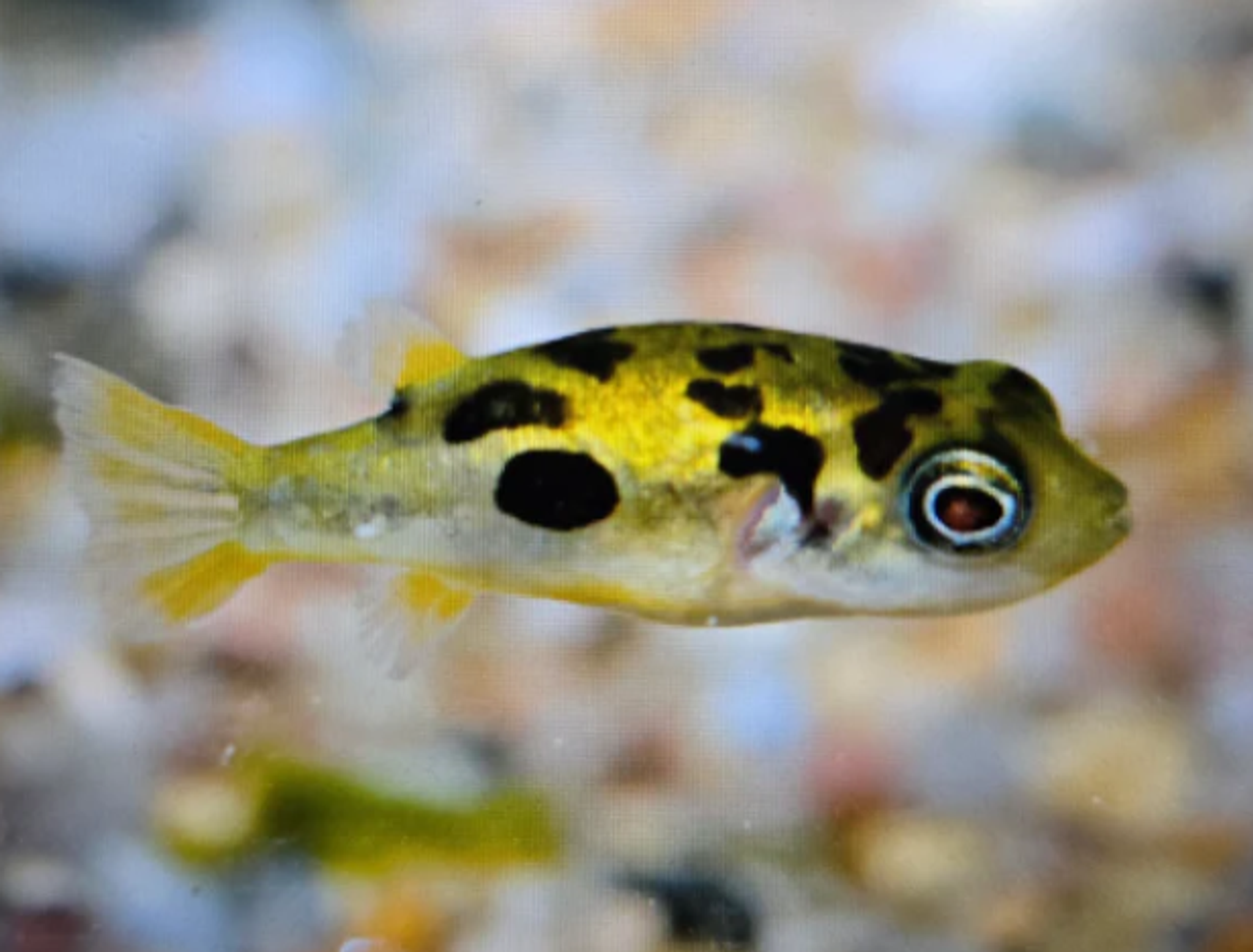
Pea Puffer Care Guide: Tank Size, Diet, Water Parameters and Temperament
Pea puffers (Carinotetraodon travancoricus) are among the smallest freshwater fish in the hobby, but their tiny size hides a specialist's needs and a genuinely territorial personality. This guide covers realistic tank sizing, water parameters, a diet built around live and frozen food, and the temperament quirks that make this a "small tank, big responsibility" fish rather than a beginner starter species.
What Is a Pea Puffer?
Also sold as the dwarf, pygmy, or Malabar puffer, the pea puffer is native to slow-moving freshwater rivers and wetlands in the Kerala backwaters of southwestern India. Unlike many puffer species that need brackish or marine water at some life stage, the pea puffer is a true freshwater fish for its entire life — no aquarium salt required.
Key facts:
- Adult size: about 1–1.4 inches, among the smallest puffers kept in aquaria
- Lifespan: roughly 4 years with stable water quality and a proper diet
- Classification: obligate carnivore, territorial, solitary-leaning but not strictly antisocial
Because they're farmed in relatively large numbers and sold cheaply, it's tempting to treat pea puffers as an easy nano fish. They're not. Their combination of a specialized diet, sensitive water needs, and unpredictable aggression makes them better suited to keepers who already have some freshwater experience.
Tank Size: How Big a Tank Does a Pea Puffer Need?
Sources disagree on the minimum, and the honest answer is that it depends on how much margin for error you want. A 5-gallon (19 L) tank is a bare minimum for a single, well-maintained fish, but it leaves no room for mistakes. A more practical baseline is 10 gallons (38 L) for one fish or a bonded pair, with a 20-gallon long (76 L) tank as the realistic minimum for any group.
Why the range is so wide: bioload and territory both scale with the tank's footprint, not just its volume. A tall, narrow 10-gallon tank gives a puffer less usable floor space to claim as territory than a low, long 20-gallon tank, even though the volumes are closer than they look. Surface area and sightline-breaking decor matter more than raw gallons for a fish this territorial.
| Setup | Minimum tank size | Notes |
|---|---|---|
| Single pea puffer | 5–10 gallons (19–38 L) | 5 gallons only works with excellent, consistent maintenance |
| Pair or trio | 10 gallons (38 L) | Favor extra females over males |
| Small group (4–6 fish) | 20-gallon long (76 L) | Add roughly 5 gallons per additional puffer |
| Larger group | 20+ gallons, scaled up | More floor space and visual barriers needed as numbers grow |
As a rule of thumb, budget about 5 gallons per additional puffer beyond the first, and prioritize length and width over height when choosing a tank shape.
Stocking Ratios for Groups
Pea puffers can be kept in groups, but male aggression needs to be diluted across more females. A workable ratio is 1 male to 2–4 females. Multiple males in the same tank, especially in a small footprint, usually leads to chronic fighting and torn fins. A single specimen also does perfectly well and is often the lowest-stress option for a smaller tank.
Water Parameters
Pea puffers are noticeably more sensitive to water quality than typical nano fish. Part of the reason is anatomical: much of a puffer's body lacks the protective scale coverage that most fish rely on, so ammonia and nitrite spikes affect them faster and more severely. Zero ammonia and zero nitrite isn't a nice-to-have here — it's the baseline for keeping this species alive long-term.
- Temperature: 74–82°F (23–28°C), with 77–79°F (25–26°C) as an ideal steady-state range; breeders often nudge toward the upper end to encourage spawning
- pH: 6.5–7.5 is the safe target; some sources report tolerance up to 8.4, but stability at a consistent value matters more than hitting an exact number
- General hardness: soft to moderate, roughly 4–10 dGH
- Ammonia/nitrite: must read zero; nitrate kept low through regular water changes
Weekly water changes and a fully mature, cycled filter matter more here than for most nano species. Because tanks this small can fluctuate quickly, test parameters weekly rather than relying on how the fish looks.
Tank Setup
A densely planted tank does double duty for pea puffers: it improves water quality and gives each fish territory to claim, which measurably reduces aggression. Good plant choices include Java fern, Java moss, hornwort, and anacharis, plus floating plants for overhead cover and shade.
Other setup essentials:
- Substrate: sand or another fine substrate suits their natural habitat and bottom-foraging behavior
- Flow: low to moderate — pea puffers are comparatively weak swimmers despite their bold attitude, and strong current stresses them
- Hardscape: driftwood and rocks arranged to break sightlines between fish, which helps prevent one puffer from constantly seeing and chasing another
- Filtration: a mature sponge or hang-on filter sized for a nano tank works well; browse filters if you're setting up a new tank
Diet: What Do Pea Puffers Eat?
Pea puffers are obligate carnivores and will often refuse flakes or pellets outright. Plan the diet around live and frozen foods from day one — waiting to see if a puffer "comes around" to dry food risks slow starvation.
Staple foods include:
- Bloodworms (live or frozen)
- Brine shrimp
- Blackworms
- Daphnia and cyclops
- Mysis shrimp
- Small snails — bladder snails and Malaysian trumpet snails
Snails deserve special mention because they serve two purposes at once: nutrition, and natural wear for the puffer's teeth. Feed small portions once or twice daily, offering only what's fully cleared in 2–5 minutes. Overfeeding fouls water quickly in a tank this size, compounding the water-quality risks already discussed above.
Some keepers do train individual puffers onto freeze-dried options like blood worm cubes over time, but treat this as a possible bonus rather than a reliable plan — the safe default is to build feeding around live, frozen, and snail sources.
The "Teeth" Explained
What look like teeth on a pea puffer are actually a fused beak that grows continuously throughout its life, not individual teeth like most fish have. Regularly feeding hard-shelled snails wears this beak down naturally through normal chewing. If a puffer refuses snails or gets an all-soft diet, the beak can overgrow to the point where the fish struggles to eat — at which point a vet or an experienced hobbyist may need to trim it. Keeping snails in the regular rotation is the simplest preventive step.
Temperament and Tank Mates
Pea puffers are territorial and frequently described as nippy rather than outright vicious, though behavior varies noticeably from fish to fish and isn't fully predictable. Males spar with other males, and either sex may nip at the fins of slow or flowing-finned tankmates.
The safest default is a species-only tank. Community stocking is a real option only for experienced keepers working with a larger, heavily planted tank (15–20+ gallons) — it carries genuine bite and fatality risk, not just occasional fin damage, so it isn't a beginner recommendation.
If you do attempt tank mates, favor small, fast fish with short fins:
- Ember tetras
- Small danios
- Certain killifish
- Otocinclus
- Kuhli loaches
- Larger, faster shrimp such as Amano shrimp (survival isn't guaranteed)
Avoid guppies, bettas, other fancy-finned fish, other puffer species, and anything small enough to be treated as prey. Smaller shrimp and snails will typically be eaten — a downside if you're keeping them as pets, but a useful side effect if you're using the puffer for pest-snail control. You can browse fast-moving, short-finned options like tetras or danios if you're planning a larger, cautious community attempt.
Breeding Pea Puffers
Pea puffers are among the easier puffer species to breed at home, achievable in a species tank with the correct sex ratio and stable parameters. Courtship involves males chasing and nudging females toward fine-leaved plants such as Java moss or guppy grass, where spawning takes place. This process can be rough on females — provide plenty of escape cover to reduce bullying and biting during and after spawning.
Eggs hatch in roughly 2 days. Fry need infusoria initially, then graduate to baby brine shrimp as they grow. Separate fry from adults promptly, since adult puffers — including the parents — will eat them given the chance. These same principles (dense plant cover, favorable sex ratios, live foods for fry) apply broadly across other easier-to-breed puffer species as well.
Quarantine Before Adding a Pea Puffer
Most pea puffers sold in the US are still wild-caught or imported rather than captive-bred, though captive-bred lines are increasingly available and generally preferable — they tend to have steadier temperaments and lower parasite loads than wild-caught stock. Either way, quarantine new arrivals for 2–4 weeks before adding them to a display tank.
A basic quarantine or hospital setup doesn't need to be elaborate:
- A bare 5–10 gallon tank with no substrate, for easy cleaning
- A sponge filter for gentle, mature biological filtration
- A heater to hold a stable temperature
Watch for a sunken belly, clamped fins, or refusal to eat during quarantine — these are common signs of internal parasites in new stock. Treat proactively under the guidance of an experienced hobbyist or vet rather than guessing at dosing.
Common Mistakes and Troubleshooting
| Mistake | Consequence | Fix |
|---|---|---|
| Feeding flakes/pellets as the staple | Slow starvation | Switch to live/frozen meaty foods and snails immediately |
| Undersized or unplanted tank | Visible stress, hiding, more aggression | Add cover and increase footprint |
| Multiple males or unbalanced sex ratio | Chronic fighting, torn fins | Rehome extra males or add tank size and hiding spots |
| Mixing with fancy-finned or slow fish | Nipped fins, stress, sometimes death | Go species-only or use fast, short-finned tankmates |
| Ignoring water quality | Faster, harsher impact due to limited scale coverage | Weekly testing and water changes |
| No hard foods in the diet | Overgrown beak, difficulty eating | Feed snails regularly; seek help trimming if needed |
| Sudden appetite loss / sunken belly | Usually parasites in new stock | Quarantine new arrivals; consider a preventive dewormer under guidance |
| Cold snap followed by cloudy eye, clamped fins, white spots | Classic ich outbreak | Treat promptly and stabilize temperature |
A Note on Tetrodotoxin
Pea puffers, like many puffer species, can carry tetrodotoxin in the wild by accumulating it through their diet. For aquarium purposes this is essentially a non-issue: the toxin only matters if the fish itself were consumed, not from normal handling, and captive-bred specimens raised on a controlled diet largely lack the toxin-producing inputs in the first place.
Other Puffers You Might See Alongside Pea Puffers
Pea puffers are one small piece of a much larger and more varied puffer family, which is why care advice for "puffers" online varies so widely. Knowing where the pea puffer sits helps set realistic expectations before buying.
- Red eye puffer (Carinotetraodon lorteti): a related but larger, more aggressive Southeast Asian species that must be kept alone, unlike pea puffers, which can sometimes live in same-sex-skewed groups.
- Amazon puffer (Colomesus asellus): larger (up to about 3 inches), more sociable, and can be kept singly or in groups of 6 or more; needs 30–55 gallons, pH 6–8, and 72–82°F. A good option if you want to keep several puffers together with more room to spare.
- Figure-8 puffer: a mid-size species that needs a larger tank than a pea puffer and, unlike the pea puffer, tolerates or requires some brackish water.
- MBU puffer and Congo puffer: large African species — MBU puffers can exceed 20 inches and require a very large, dedicated tank. These are not remotely comparable to a pea puffer despite sharing the "puffer" name.
- Freshwater flounder: not a puffer at all, but another "oddball nano fish" sometimes searched alongside them; it needs brackish water and a sand substrate, which makes its care unrelated to pea puffers beyond the shared novelty-fish appeal.
If you're weighing options, browsing the broader freshwater livestock selection can help you compare footprint and space requirements before committing to a species.
Pea puffers reward keepers willing to plan around their diet and territory needs rather than treat them as a set-and-forget nano fish — get the tank size, water quality, and snail-based diet right, and they're a genuinely engaging, long-lived species. When you're ready to source stock or supplies, start with FishyHub's freshwater livestock category.
Frequently Asked Questions
Can pea puffers live with other fish?
Generally risky. Species-only tanks are the safest default, though experienced keepers sometimes succeed with fast, short-finned dither fish in larger, heavily planted tanks. Even then, bite risk is real and not every puffer will tolerate tankmates.
Can I keep more than one pea puffer together?
Yes, in a tank of 10 gallons or more, with more females than males and plenty of visual barriers to break sightlines. Behavior is still individual and somewhat unpredictable, so watch new groupings closely.
What do pea puffers eat if they won't take pellets?
Live or frozen bloodworms, brine shrimp, daphnia, and snails form the core diet. Some individuals can eventually be trained onto freeze-dried alternatives, but this isn't reliable enough to plan around.
Do pea puffers need their teeth trimmed?
Only if their diet doesn't include enough hard-shelled snails to wear down their continuously growing beak naturally. Regular snail feeding is usually enough to prevent overgrowth.
Are pea puffers poisonous to touch or keep?
The toxin risk is essentially a non-issue for aquarium keeping. It only matters if the fish were eaten, and captive-raised puffers largely lack the toxin-producing diet inputs found in the wild anyway.
How big do pea puffers get and how long do they live?
Adults reach about 1–1.4 inches and typically live around 4 years with stable water quality and a proper diet.
Why is my pea puffer hiding or not eating?
Usually stress from an undersized or under-planted tank, poor water quality, or parasites in a recently acquired fish. Check parameters first and consider a quarantine period if the fish is new.
Can shrimp live with pea puffers?
Small or juvenile shrimp will typically be eaten. Only larger, faster shrimp like Amano shrimp have a reasonable chance of survival, and it's not guaranteed even then.


