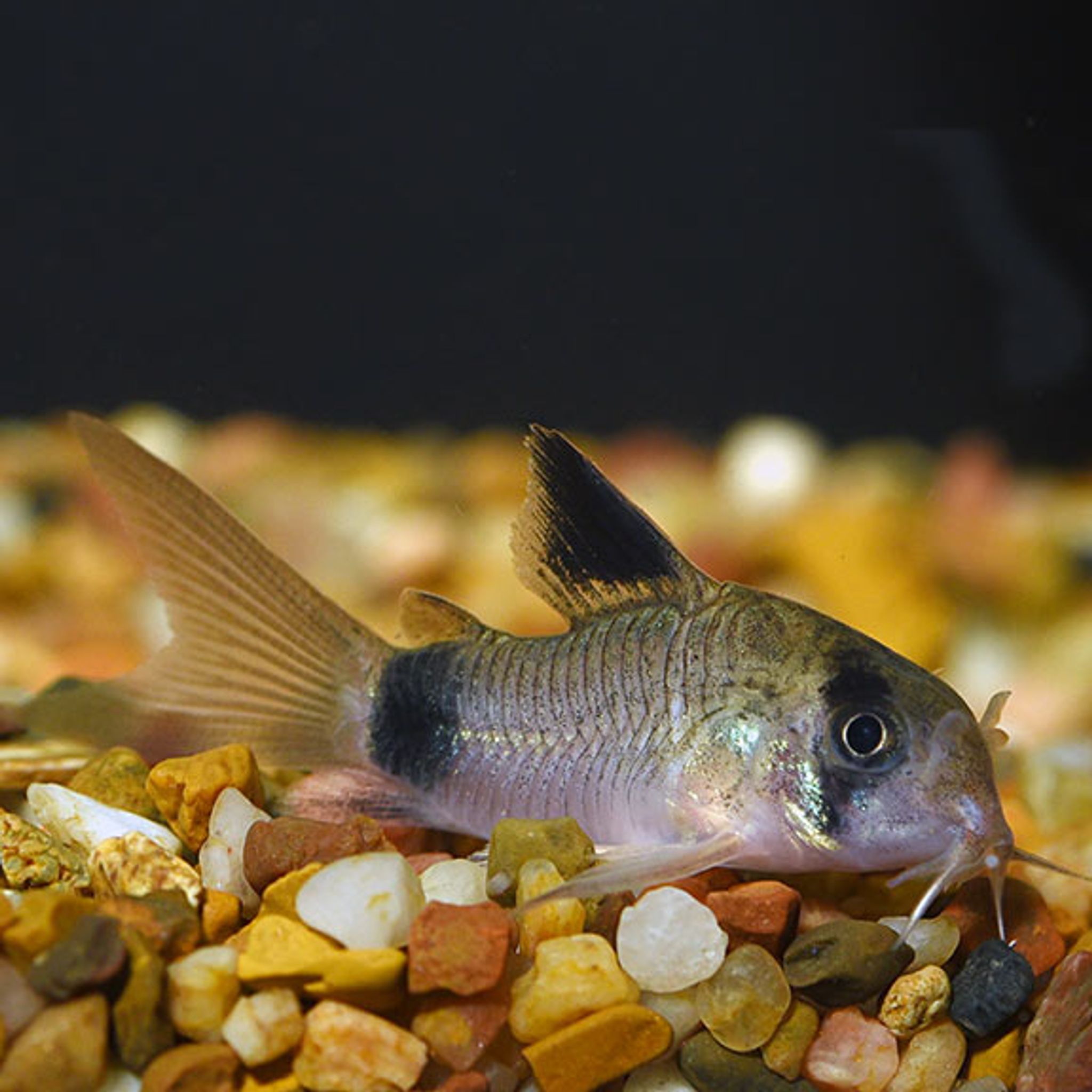

Panda Cory Care Guide: Tank Size, Diet, Water Parameters and Temperament
Panda corys are sold as an easy beginner catfish, but they're pickier about temperature and water quality than bronze or peppered cories. This guide covers the exact tank size, temperature, pH and group numbers that keep them healthy, plus feeding, breeding, tankmates and the health issues most owners run into.
Quick Reference
| Parameter | Recommended Range |
|---|---|
| Scientific name | Corydoras panda (recently reclassified into Hoplisoma) |
| Adult size | About 2 in (5 cm); females slightly larger |
| Lifespan | 5+ years, with 10+ years reported in stable setups |
| Group size | 6 minimum, 8-12 ideal |
| Tank size | 20 gal long (76 L) for a group of 6; 30-40 gal (114-151 L) for a mixed community |
| Temperature | 68-77°F (20-25°C), ideally 72-75°F (22-24°C) |
| pH | 6.0-7.5 |
| General hardness | 2-12 dGH |
| Ammonia / nitrite | 0 ppm |
| Nitrate | Under 20 ppm |
| Substrate | Fine, rounded sand, 1-2 in (2.5-5 cm) deep |
Identity and Natural Habitat
The panda cory is a small, pale pink catfish marked with a black mask across the eyes, a black blotch on the dorsal fin, and a black patch at the base of the tail. It has recently been moved from the genus Corydoras into Hoplisoma, though most retailers and hobbyists still use the older name.
In the wild, pandas live in cool, snowmelt-fed streams in the Andean foothills of Peru and Ecuador, over sand and leaf litter. That origin explains almost every care requirement below: pandas evolved for cooler, well-oxygenated, gently flowing water over a soft substrate, not the warm, still conditions many tropical community tanks run at.
Why the Numbers Matter: Tank Size and Group Behavior
A single panda cory or a pair will spend most of its time hiding. This isn't a personality quirk - it's a stress response. Corys are shoaling fish that use body language and constant contact with tankmates of their own kind to feel secure.
- Minimum group: 6 fish. Fewer than that and pandas hide, refuse food, and show duller color.
- Ideal group: 8-12, which gives the shoal enough numbers to spread out and still forage together.
- Minimum tank: a 20-gallon long tank (30 x 12 x 12 in / 76 x 30 x 30 cm) comfortably houses a group of 6. A 10-gallon tank is too small for a permanent group - reserve it for breeding setups or quarantine only.
- Community tank: step up to 30-40 gallons once you're adding dedicated mid- and top-water tankmates.
Floor space matters far more than depth for a bottom-dwelling fish. A long, low footprint beats a tall tank of the same volume.
Water Parameters and Why They're Non-Negotiable
Temperature
Keep panda corys at 68-77°F (20-25°C), with 72-75°F (22-24°C) as the sweet spot. This is noticeably cooler than the 78-80°F many tropical community fish tolerate. Running a panda cory tank warm long-term - to suit tropical tankmates - is one of the most common ways owners shorten this fish's lifespan, since a faster metabolism at high temperatures appears to wear the fish out sooner.
pH and Hardness
Aim for pH 6.0-7.5 and general hardness of 2-12 dGH, with stability as the real goal rather than hitting an exact number. A tank that holds steady at pH 7.2 does better than one that swings between 6.5 and 7.8 every week.
- Wild-caught panda corys are more sensitive and do best in soft, slightly acidic water toward the lower end of that range.
- Farm-raised stock, which makes up most of what's sold in the US today, is noticeably more tolerant of moderate, harder tap water - useful to know if your municipal supply runs alkaline.
Ammonia, Nitrite and Nitrate
Ammonia and nitrite must read 0 ppm at all times; any detectable level signals an uncycled or overloaded tank. Keep nitrate under 20 ppm through regular water changes.
US Tap Water Considerations
Much of the US has hard, alkaline tap water and municipal supplies treated with chloramine rather than plain chlorine. Chloramine doesn't gas off by sitting out the way chlorine does, so a dechlorinator rated to neutralize chloramine (not just chlorine) is worth checking for before water changes. If your tap water runs hard and alkaline, farm-raised pandas will generally adjust better than wild-caught imports.
Substrate and Tank Setup
Panda corys forage by sifting through the substrate with sensitive barbels, so substrate choice directly affects their health.
- Best choice: fine, rounded, inert sand such as play sand or aquarium-grade sand, rinsed thoroughly before use, at a depth of about 1-2 in (2.5-5 cm).
- Avoid: sharp gravel and coarse crushed substrates, which abrade barbels and bellies over time, and aragonite or other reactive sands that push pH and hardness upward.
- Smooth fine gravel can work as a compromise, but sand remains the safer default for barbel health.
Round out the layout with plants, driftwood, leaf litter and caves for cover, alongside an open sand patch for foraging. Keep lighting low to moderate - pandas are most comfortable without a glaring, bright tank. You can browse rinsed, aquarium-ready sand and gravel substrates to set this up correctly from the start.
Provide oxygen-rich water with gentle to moderate flow, and cover any intake with a sponge guard to protect barbels and fry. An occasional quick dash to the surface for air is normal cory behavior, not a sign of distress on its own.
Maintenance Routine
- Water changes: 20-30% weekly, using dechlorinated water matched to the tank's temperature. Weekly changes outperform a biweekly schedule for keeping nitrate and general water quality stable.
- Substrate care: light vacuuming to remove waste without disturbing the whole sand bed or destroying beneficial bacteria colonies.
- Never add a fresh batch of cold or untreated water directly - abrupt temperature or chemistry swings stress the whole shoal.
Diet
Panda corys need their own dedicated food - they do not survive on algae or other fish's leftovers, despite the common assumption that bottom dwellers are "cleanup crew."
- Staple: sinking pellets or wafers formulated for bottom feeders.
- Supplement: frozen or live bloodworms, blackworms, brine shrimp and daphnia several times a week for protein and conditioning.
- Occasional: blanched vegetables like zucchini or cucumber.
- Feeding method: feed after lights-out or target-feed the group directly, since pandas are most active at dusk and night and faster tankmates will otherwise beat them to the food.
Temperament and Tankmates
Panda corys are peaceful, social, and most active in low light. They're generally safe with shrimp, though a hungry shoal may pick off shrimp eggs or very young fry.
Good tankmates:
- Small tetras, rasboras and danios
- Hatchetfish and pencilfish
- Small gouramis
- Kuhli loaches and otocinclus
- Other peaceful cory species
Avoid: fin-nippers, large or aggressive cichlids, and bottom-dwelling bullies that will compete for space and food. If you're stocking a community around them, FishyHub's small community fishes selection covers most of the compatible options above.
One handling note: the fin spines on cory catfish can snag aquarium nets and give a mild sting if handled carelessly. Scoop pandas with a cup instead of a net whenever possible.
Panda Fish: Avoiding Name Confusion
"Panda" isn't exclusive to this catfish. A panda garra, a panda guppy strain, a panda loach, and panda-marked tetra variants all carry the same nickname in the aquarium trade. This guide covers only Corydoras (Hoplisoma) panda, the cool-water Andean catfish described above - double-check the scientific name on any listing before buying.
Signs of Stress and Color Loss
Watch for fading color, clamped fins, hiding, rapid gill movement, dashing at the surface, and loss of appetite. These usually point to:
- Too few fish in the group
- Bright light with no cover
- A new, immature tank that hasn't finished cycling
- Water change shock from a large temperature or chemistry swing, or leftover chlorine/chloramine
Fading that appears right after a water change is usually temperature- or chemistry-related and should fade within a day. Fading that persists points to a chronic water quality problem worth testing for.
Acclimating New Fish
Floating an unopened bag only equalizes temperature - it does nothing for pH or hardness differences. Use a slow drip acclimation over 30-60 minutes instead, and discard the bag water rather than pouring it into the tank. Keep tank lights dim during acclimation, and quarantine new arrivals before adding them to an established group.
Health Issues and Sensitivities
Panda corys are prone to ich, columnaris, flukes, fungus, and barbel erosion. They are also notably sensitive to salt, copper, and full-strength medications, so always check dosing against scaleless/catfish-safe guidance before treating a tank that contains them.
Columnaris vs. Ich
These two are easy to confuse but need different treatment:
- Columnaris is bacterial - gray-white patches, saddle-shaped lesions, a cottony appearance around the mouth, and fast spread through a tank. Treat with an antibacterial medication, and do not raise the temperature, since heat can accelerate this infection.
- Ich is parasitic - visible as salt-grain-sized white spots plus flashing against decor. The usual heat-based ich treatment directly conflicts with a panda's need for cool water. A modest, gradual temperature rise combined with a half-dose medication is a safer compromise than pushing heat aggressively.
- True fungus appears fluffy and cottony but typically follows a physical injury rather than spreading tank-wide like columnaris.
Quarantine any new fish for 2-4 weeks before introducing them to your main tank, since this window catches most of the above issues before they spread.
Barbel Erosion
Short, stubby, or reddened barbels are a direct sign of sharp substrate or poor water quality, not a disease on their own. Switching to soft sand and tightening up the maintenance schedule is the fix, and existing barbels can regrow slowly once the cause is removed.
Breeding Panda Corys
Panda cory breeding follows the same general pattern as related look-alike species (melini, black cory, blochi, and weitzmani cories):
- Condition the group on meaty foods like bloodworms and daphnia, with more females than males in the breeding group.
- Trigger spawning with a large water change using water a few degrees cooler than the tank. Pairs spawn in the characteristic "T-position."
- Eggs are sticky, about 1.5 mm, laid in small clutches - often fewer than 10 at the first spawning.
- After spawning, remove the eggs to a separate container, treat with methylene blue to deter fungus, and cull any eggs that turn fuzzy or white.
- Hatching takes 3-5 days at around 75°F (24°C). Start fry on microworms, then move to baby brine shrimp once they're free-swimming.
Realistically, panda corys reach breeding maturity around 8-12 months, not the widely repeated claim of 5 years - that figure is a common error worth ignoring.
Common Mistakes to Avoid
- Keeping too few fish, which causes constant hiding
- Using sharp gravel instead of sand, which erodes barbels
- Running the tank warm to suit tropical community fish
- Feeding only leftovers, leaving corys thin and undernourished
- Adding pandas to a tank that hasn't finished cycling
- Using salt or full-dose copper medications
- Changing water abruptly instead of matching temperature
- Ignoring constant surface gulping, which usually means low oxygen or high nitrate - test the water, add aeration, and do a water change
Frequently Asked Questions
How many panda corys should I keep?
Six is the minimum for a stable, confident shoal. Eight to twelve is ideal if your tank size allows it, since larger groups hide less and forage more actively.
Can I keep panda corys in a 10-gallon tank?
Only as a breeding or quarantine setup, not as a permanent home. A group of 6 or more needs at least a 20-gallon long tank for adequate floor space.
Can panda corys live with bettas?
It's possible in a 15-20+ gallon tank at around 76°F, but the temperature overlap between the two species is narrow, so treat this as a workable compromise rather than an ideal setup.
Do panda corys eat algae or leftover food?
No. They need their own sinking pellets or wafers plus regular protein feedings - relying on scraps from other fish leaves them underfed over time.
Why are my panda corys hiding all the time?
The most common causes are too few fish in the group, overly bright lighting, lack of cover, or a tank that's still cycling. Address the group size and decor first.
How do I tell males from females?
Viewed from above, females appear broader-bodied, especially when carrying eggs. Males are slimmer, with more pointed pelvic fins.
Are panda corys good for beginners?
Yes, but only in a fully cycled, stable tank with soft sand and cool, clean water - they're less forgiving of rushed setups than bronze or peppered cories.
Do I need a heater for panda corys?
Usually yes in US homes, set to 72-74°F, since indoor temperatures often run cooler than that. In summer, watch for the opposite problem - use fans or air conditioning to keep the tank from climbing above 77°F.
Ready to start a panda cory shoal? Browse available corydoras catfish on FishyHub to find healthy, farm-raised stock for your setup.


