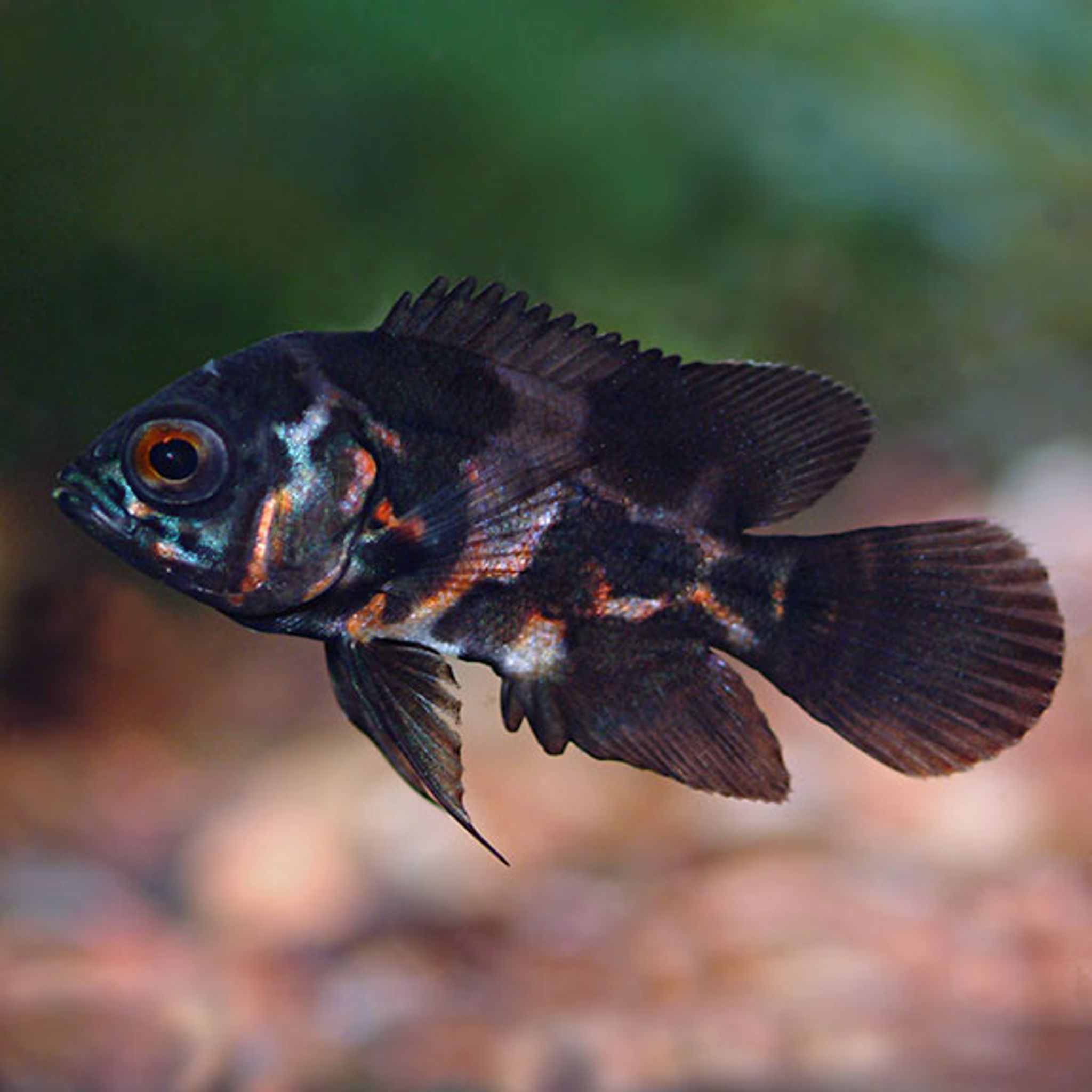

Oscar Care Guide: Tank Size, Diet, Water Parameters and Temperament
An oscar sold as a 2-inch juvenile can reach 10–12 inches within a couple of years, so the tank, filter and budget you plan for on day one should match the adult fish, not the baby in the bag. This guide covers realistic tank sizing, water parameters, filtration, feeding, temperament and the health issues most oscar keepers eventually run into.
Meet the Oscar
The oscar, Astronotus ocellatus, is a South American cichlid from the slow, warm, soft, tannin-stained waters of the Amazon basin. In the aquarium it grows into a heavy-bodied fish reaching 10–12 inches (25–30 cm), with some individuals pushing past 14 inches. Growth is fast early on — roughly 1 inch per month during the first year — which is exactly why a tank bought for a juvenile is usually outgrown within months.
Oscars are also a long-term commitment. With good care they typically live 10–15 years, and some individuals reach 20. Buying one means planning around a fish that will still be with you a decade from now.
Tank Size: Plan for the Adult
The single most common oscar mistake is buying a juvenile for a 20–40 gallon tank. It leads to stunted growth, spinal deformities and chronic stress. Sources online disagree wildly on the minimum, with figures anywhere from 55 to 100 gallons — but a 55-gallon tank is a grow-out setup at best, not a permanent home.
- One adult oscar: 75 gallons (284 L) is the realistic floor; 100–125 gallons is better.
- Footprint over height: aim for at least 48 inches long and 18 inches front-to-back so the fish has room to turn around. A tall, narrow tank is worse than a long, shallow one of the same volume.
- A pair or small group: budget 100–125+ gallons, adding roughly 25–30 gallons per additional oscar.
- Tank mates: only consider them in 125+ gallon setups (see below).
| Setup | Minimum Volume | Notes |
|---|---|---|
| Juvenile grow-out (temporary) | 40–55 gal (151–208 L) | Upgrade within months as growth accelerates |
| One adult oscar | 75 gal (284 L) | 100–125 gal recommended |
| Oscar pair | 100–125+ gal (378–473+ L) | Bonded pair or raised together |
| Oscar + tank mates | 125+ gal (473+ L) | Only with large, robust species |
You can browse full-grown specimens and stock plans against the oscar listings on FishyHub's oscar category page before committing to a tank size.
Water Parameters
Oscars come from warm, slow-moving water, and stability matters more than chasing a perfect number.
- Temperature: 74–80°F (23–27°C)
- pH: 6.0–8.0, with 6.5–7.5 ideal
- Hardness: 5–20 dGH
- Ammonia and nitrite: 0 ppm, always
- Nitrate: under 20 ppm, 40 ppm at the outside
Because oscars are large predators producing a heavy bioload, nitrate can climb fast between water changes. Test weekly rather than assuming the tank is stable.
Filtration
Undersized filtration is the second-biggest oscar mistake after undersized tanks. Aim for total turnover of at least 4–5 times the tank volume per hour, achieved with a large canister filter, two hang-on-back units, or a sump, backed up by a sponge filter for extra biological capacity. Oscars don't need strong current, so keep outflow gentle even with high turnover — spray bars or baffles work well. A canister or HOB filter sized generously for a 100+ gallon tank is worth buying before the fish rather than after.
Weekly Maintenance
- Change 25–40% of the water weekly and vacuum waste from the substrate.
- Test nitrate weekly — large predators foul water quickly.
- Use a dechlorinator on US tap water; chloramine, not just chlorine, is common in municipal supplies and needs a conditioner rated to neutralize it.
Some sources recommend lighter changes — 25% every two to four weeks — but that pace under-corrects for how much waste an adult oscar produces. Weekly changes at the higher end of the range are the safer default.
Diet and Feeding
Oscars are omnivores that lean carnivorous. Build the diet around a quality large-cichlid pellet or stick as 60–70% of intake, then rotate in variety:
- Frozen or freeze-dried krill, shrimp, silversides and bloodworms
- Earthworms or nightcrawlers
- Crickets
- Occasional vegetables: peas, zucchini
Feeding frequency depends on age. Feed juveniles 2–3 times a day to support their rapid growth; feed adults once a day or every other day, since overfeeding a full-grown oscar leads to obesity and water-quality problems. Offer only what the fish finishes in about two minutes, and remove leftovers promptly.
Skip the Feeder Fish
Feeder goldfish and rosy reds are still recommended by some older sources, but avoid them. They commonly carry parasites, are high in fat and thiaminase, and teach an oscar to hunt tank mates rather than accept prepared food. If you want to offer live food occasionally, quarantine gut-loaded mollies or ghost shrimp for two to four weeks first and treat them as a rare treat, not a staple.
Temperament and Personality
Oscars are territorial and predatory rather than randomly aggressive — anything that fits in their mouth is fair game as food, and they become most aggressive when spawning or when the tank is cramped. Give them enough space and they're generally more possessive than vicious.
What sets oscars apart is personality. They recognize their owner, beg at the glass at feeding time, will take food from a hand, sulk visibly after a water change or decor rearrangement, and rearrange gravel and ornaments to suit themselves. This is part of why oscars top many "most interactive freshwater fish" lists, alongside flowerhorns, red devils, arowanas and puffers — but that same intelligence means a bored oscar needs enrichment: varied decor, occasional rearranging on your terms, and food variety to prevent stress-driven behavior.
Tank Mates
Because of their size and temperament, oscars are safest kept species-only. If you do want tank mates, only add them in a 125+ gallon tank, and only large, robust species that can't be swallowed or bullied out of food:
- Silver dollars
- Large plecos
- Bichirs
- Severums, Jack Dempseys and firemouths
Avoid anything under about 5 inches, invertebrates, and other highly aggressive cichlids. Suitable large American cichlid tank mates like severums and Jack Dempseys are a reasonable starting point for a big, mixed setup.
Decor and Setup
Oscars are hard on aquascaping. Use sand or a bare bottom — a thin sand layer is a good middle ground, giving easier siphoning and cleaner water than gravel while avoiding the unsettling reflections some fish show on fully bare glass. Add smooth rocks and heavy, well-anchored driftwood with no sharp edges.
Guard heaters carefully: oscars are strong enough to break glass heaters and are known jumpers, so a protective guard and a secure lid are non-negotiable. Live plants are usually uprooted or eaten, so stick to floating plants or tough epiphytes like anubias and java fern tied to driftwood rather than planted in substrate.
Types of Oscar
Tiger, red, albino, lutino (often sold mislabeled as albino), lemon, black, blue and veil-tail oscars are all the same species, Astronotus ocellatus, with identical care requirements — the differences are purely cosmetic. Veil-tail varieties have delicate, trailing fins and do best with calmer tank mates that won't nip them. Be cautious of oscars marketed as "blue" at unusually low prices; genuine blue coloration is rare, and some are dyed, which raises both ethical and health concerns since the dyeing process can damage skin and shorten lifespan.
Common Health Problems
Skin Peeling
Peeling or raw patches can come from injury during fights or against sharp decor, ammonia burns, pH swings outside the safe range, or skin parasites and fungus. First response: test the water, perform a large water change, dose a dechlorinator that also binds ammonia, and remove whatever caused the injury.
Hole in the Head (HLLE)
Hole-in-the-head disease shows as pits along the head and lateral line. It's linked to Hexamita/Spironucleus protozoans, a monotonous diet lacking vitamins and minerals, high nitrate, stress, and possibly overuse of activated carbon. Treatment centers on metronidazole, ideally delivered through medicated food, alongside a more varied diet and consistent water changes.
Other Common Issues
- Ich: raise temperature gradually and treat with salt or a medication labeled for ich.
- Fin rot: improve water quality and treat with an appropriate medication.
- Popeye: usually a water-quality or bacterial issue; address the underlying cause.
- Bloat/dropsy: fast the fish for a day or two, then reintroduce fiber-rich food.
Breeding
Oscar breeding is rated anywhere from easy to very hard, and both are true depending on the approach. Forcing a specific pair is difficult; letting a natural pair form is comparatively easy. Raise 6–8 juveniles together and watch for pairing behavior — lip-locking, tail-slapping and rock-cleaning are the signs a pair has formed. Spawning happens at 79–84°F, with 1,000–3,000 eggs per spawn. Fry eat baby brine shrimp or crushed flake once free-swimming.
Common Mistakes to Avoid
- Buying a juvenile for a 20–40 gallon tank, leading to stunting and spinal problems.
- Feeding only one pellet type, or relying on feeder fish.
- Panicking when an oscar lies on its side or turns pale — this is often a sulk after a water change or rearranging, but check ammonia and temperature first to rule out a real problem.
- Assuming refused food means illness — check water quality, fast the fish for 1–2 days, then offer something new. Oscars can turn picky after a stretch of live food.
A Realistic Cost Picture
A 125-gallon setup with stand, a canister filter rated for that volume, heater, lid and basic decor is a substantial upfront investment before the fish itself. Ongoing costs include a higher water bill from weekly 25–40% changes, dechlorinator, and a steady supply of pellets plus frozen and fresh foods. Budget for a backup plan too — a spare heater or a second filter — since a heavy-bodied predator can turn a small equipment failure into an emergency fast. New keepers should also plan a 2–4 week quarantine tank for the oscar and any potential tank mates before combining them.
How Oscars Compare to Other Large Cichlids
Keepers weighing an oscar against other big personality fish often ask about these alternatives:
- Red devil cichlid: Central American, 12–15 inches, considerably more aggressive than an oscar. Needs 75–125 gallons kept alone and is a poor tank-mate candidate.
- Peacock bass (Cichla): reaches 24–30+ inches, is a dedicated fish-eater, and needs 300+ gallons. Some US states restrict ownership. Not a practical "step up" from oscars for most home aquarists.
- Pike cichlids (Crenicichla): slim ambush predators; dwarf species suit 55–75 gallons, larger species need 125+. They generally leave decor alone but can be very territorial toward other fish.
- Piranhas: red-bellied piranhas are the common choice, living 10–15 years in groups of 4–6+ within 100–125+ gallons on a diet of fish fillet, shrimp and pellets. They're actually skittish rather than aggressive toward keepers, and several states — including Texas, Florida and California — restrict or ban ownership, so check local law before considering one.
None of these are drop-in replacements for an oscar's tank or temperament — treat them as separate research projects, not upgrades.
A Legal and Ecological Note
Never release an oscar into local waterways. Escaped and released oscars are already established in South Florida canal systems, where they compete with native fish. The same caution applies doubly to piranhas and peacock bass given their state-level restrictions — rehome an unwanted fish through a local aquarium club or retailer instead.
Frequently Asked Questions
Can an oscar live in a 55-gallon tank?
Only temporarily, as a juvenile grow-out tank. Adults need 75 gallons at minimum, with 100–125 gallons preferred, especially for a pair or any tank mates.
How fast do oscars grow?
Expect roughly 1 inch of growth per month during the first year, with many oscars reaching 8–10 inches by their first birthday. Growth slows after that but continues toward the adult 10–12 inch range.
Can two oscars live together?
Yes, in 125+ gallons, if they're a bonded pair or were raised together from juveniles. Unrelated adults introduced later may fight seriously, so monitor any new pairing closely and have a backup tank ready.
How can I tell if my oscar is male or female?
You can't reliably sex an oscar by external appearance. Venting (examining the genital papilla) or observing spawning behavior are the only dependable methods, and even those require some experience.
Are oscars good for beginners?
The fish itself is hardy and forgiving of minor parameter swings. What isn't beginner-level is the commitment: a 75–125 gallon tank, strong filtration, and a weekly maintenance routine are demanding for someone new to the hobby.
What's causing my oscar's hole-in-the-head pits?
The leading causes are Hexamita/Spironucleus protozoan infection, a diet too narrow in vitamins and minerals, chronically high nitrate, and stress. Improve diet variety, get nitrate down through water changes, and treat with metronidazole — ideally in medicated food — if pitting is active or worsening.
Ready to plan your setup? Browse available oscars and other large freshwater cichlids in FishyHub's Monster Fishes category to compare options before you buy.


