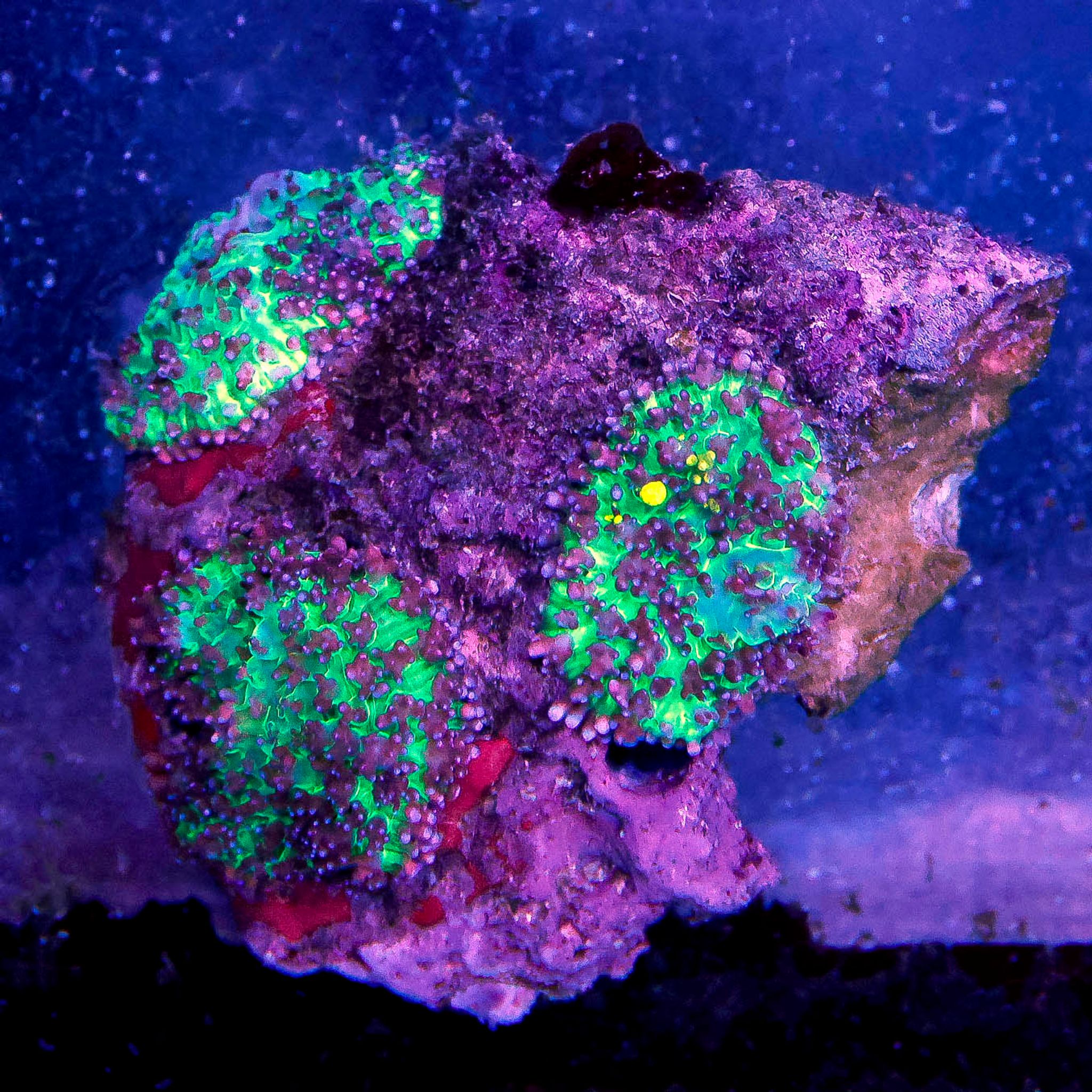

Mushroom Corals Care Guide: Lighting, Flow, Feeding and Placement
Mushroom corals are one of the most forgiving corals a beginner reef keeper can add to a tank, tolerating a wide range of lighting, flow, and water conditions while still rewarding attentive care with fast growth and bold color. This guide covers exactly how much light and flow mushrooms need, whether you should feed them, where to place them on the rockwork, and how to troubleshoot the most common problems.
What Exactly Is a Mushroom Coral?
Despite the name, mushroom corals aren't true stony corals. They belong to the order Corallimorpharia — close relatives of both true corals and anemones — and are typically sold and grouped alongside soft corals in the hobby. In practice this distinction matters little for husbandry: mushrooms are cared for almost identically to other easygoing soft corals.
Common genera you'll see for sale include Discosoma (flat, smooth-disc mushrooms, often the hardiest and cheapest starting point), Rhodactis (textured, "hairy" or bumpy-surfaced mushrooms), Ricordea — yuma and Florida types — (highly saturated, tentacle-covered discs that respond strongly to feeding), Actinodiscus (another common flat-disc genus close to Discosoma), Amplexidiscus (the giant elephant ear mushroom, which can grow to dinner-plate size), and Pseudocorynactis (a semi-aggressive, predatory relative more often a tank hitchhiker than a deliberate purchase).
You can browse live options in FishyHub's mushroom coral selection to see the range of colors and genera typically available.
Is Your Tank Ready for Coral?
Before adding any coral, including mushrooms, your tank should already be fully cycled (zero detectable ammonia and nitrite), running stable parameters for at least a few weeks rather than a single good test result, and equipped with adequate lighting and flow hardware. Some general tank maturity helps too — a system running weeks to months tends to have more stable biology than a brand-new setup. Mushrooms are tolerant, but that isn't the same as immune to a crashing cycle, so confirm the basics first.
Why Add Coral to a Reef Tank?
Coral adds aesthetic depth and ecological function to a reef aquarium, giving fish and invertebrates shelter and grazing surfaces while making the display more dynamic than bare rock. Choosing aquacultured (farm-raised) frags over wild-collected pieces has real practical benefits: they're typically hardier and better acclimated to captive lighting and flow since they were raised under artificial conditions from the start, they carry lower disease and pest risk, and buying them reduces collection pressure on wild reefs. For mushrooms specifically, aquacultured frags settle into a new tank's light and flow schedule faster than wild-collected pieces, which may need a longer acclimation period and more careful quarantine before joining the display.
Lighting: Low to Moderate Is the Target
Mushroom corals do best under low to moderate light, generally in the 50–150 PAR range. Sources vary on the ideal ceiling — some cap it around 100 PAR, others tolerate up to 150 PAR — so a practical target is 75–100 PAR as a safe sweet spot, with room to acclimate a specimen slowly toward the upper end if it's thriving. Too much light causes bleaching, shrinking, or a mushroom that stays closed; too little causes pale color and slow growth. Start new mushrooms low in the tank or in partial shade, then raise intensity or move them up the rockwork gradually over several weeks.
Mushrooms do fine under T5, LED, or VHO fixtures as long as intensity is dialed back relative to what an SPS-dominant tank would run. Without a PAR meter, a reasonable rule of thumb on a common reef LED fixture is to start on a lower-tier intensity setting (roughly 20–40% on many popular units), low or mid-height on the rock, then observe color and posture for a week or two before adjusting.
Reading Coloration as a Diagnostic Tool
Mushroom color doubles as an informal feedback signal: bleaching or washed-out pastel color points to too much light and calls for a shadier spot; browning or dull, muddy color points to too little light or excess nutrients; and vivid, fully expanded color means current placement is working — leave it alone.
Flow: Gentle and Indirect
Mushrooms need low, gentle, indirect flow to fully open and stay open. Strong, direct current — especially a powerhead or return-line blast — can tear delicate tissue or keep the mushroom clamped shut in self-defense. Place mushrooms out of the direct line of powerheads and return outlets; turbulent or alternating flow is fine, even beneficial, as long as it's gentle rather than a focused jet. If a mushroom stays closed or looks shriveled, check whether it's sitting in a flow path before assuming anything else is wrong.
Water Parameters and the Nutrient Exception
Standard reef parameters apply as a baseline:
| Parameter | Target range |
|---|---|
| Temperature | 74–80°F (23–27°C) |
| pH | 8.1–8.4 |
| Salinity | 1.023–1.026 SG |
| Alkalinity | 8–11 dKH |
| Calcium | 380–450 ppm |
| Magnesium | 1250–1350 ppm |
Mushrooms are notably tolerant of parameter swings compared to many stony corals, which is part of their beginner-friendly reputation. There's also a genuine exception worth knowing: while most reef advice pushes toward ultra-low nitrate and phosphate, mushrooms often color up and grow faster with mildly elevated nutrients than in a scrubbed, ultra-low-nutrient system. This doesn't mean chasing high nutrients — excessive levels invite nuisance algae — but don't panic if levels sit a bit above "pristine SPS-tank" territory, and don't drive nutrients to near zero specifically for mushrooms, since that can leave them pale and slow-growing.
Feeding: Optional but Beneficial
Mushroom corals get the majority of their nutrition from photosynthesis via zooxanthellae living in their tissue, so supplemental feeding is not required for survival. That said, target feeding 1–2 times per week can meaningfully boost growth and coloration, particularly for Ricordea and Amplexidiscus, which have larger mouths and a stronger feeding response than flatter Discosoma or Rhodactis types.
Good food choices include mysis or brine shrimp, reef pellets sized to the mouth, rotifers, and a coral-specific frozen or gel-based blend. Use a turkey baster or pipette to place a small amount directly onto the oral disc while it's open, then remove any uneaten food afterward — leftovers break down and contribute to nutrient spikes beyond the moderate range mushrooms actually prefer.
Placement: Space, Height, and Mobility
Mushrooms generally do best on rockwork in the low-to-mid zones of the tank, out of direct powerhead and outflow paths. Leave at least 2 inches (about 5 cm) of spacing between a mushroom and its neighbors — mushrooms can sting or out-compete slower-growing corals over time, and are themselves easily overgrown or stung by more aggressive ones like torches and hammers. Watch for slow retraction over several days as an early warning sign of a stinging conflict, and relocate one of the two corals if you see it.
Mushrooms Move on Their Own
Mushrooms are genuinely mobile. They can detach from the rock and drift or slowly crawl to a spot with flow and light they prefer better. If one disappears from where you placed it, check nearby before assuming it died — it likely relocated, and a piece that breaks off can reattach and grow into a new individual elsewhere.
Stocking Density
Because mushrooms spread by budding and can carpet a rock surface over time, avoid placing frags too densely. A loose guideline is to give each frag enough bare rock to double or triple in footprint before meeting a neighbor — dense clusters of unrelated colonies tend to end up in slow-motion territorial disputes rather than a tidy garden.
Compatibility, Aggression, and Beginner Hardiness
Mushrooms are generally peaceful toward fish, shrimp, and snails, but aggression shows up coral-to-coral. Discosoma, Corynactis, and Pseudocorynactis can be territorial and sting neighboring corals or even other mushrooms, while Amplexidiscus (giant elephant ear) can actually trap and consume small fish by folding its oral disc shut — keep it away from very small nano fish. Pseudocorynactis is more often an unplanned hitchhiker on live rock than a deliberate purchase; it carries a stronger, more predatory sting than typical mushrooms and needs extra spacing.
Hardiness also varies by genus: Discosoma and Rhodactis are the toughest, most common starting points, tolerant of parameter swings and lighting mistakes; Ricordea is a step more sensitive but showier and highly responsive to feeding; Amplexidiscus is manageable but needs careful stocking around small fish.
Overall, mushrooms rank among the top three beginner coral choices, alongside zoanthids and green star polyps (GSP). A broader beginner shortlist of easy softies includes mushrooms, zoanthids, GSP, leather (toadstool) corals, and Kenya tree. Rock flower anemones and palm tree polyps are worth a brief mention too, as comparably hardy, low-light companions that suit the same easygoing philosophy. If you want to diversify a starter reef beyond mushrooms, FishyHub's soft coral category covers several of these options.
Best Picks for Nano or Low-Light Tanks
For small setups like a 20-long with a basic LED fixture, mushrooms are a top recommendation. They tolerate the modest output of entry-level nano fixtures better than most SPS or LPS corals, and pair well with zoanthids and GSP in the same low-light footprint. If you're building or upgrading a nano tank's lighting, an LED lighting fixture rated for reef use is a reasonable starting equipment purchase before stocking corals.
A Natural Reef Approach
Mushrooms thrive under the principles that benefit any reef tank: stable parameters, quality live rock for microhabitat and biological filtration, and a lighting/flow gradient that mimics a natural reef slope rather than uniform blasting from one point. A naturalistic, lower-intervention system suits how forgiving mushrooms are by nature.
Propagation: One of the Easiest Corals to Frag
Mushrooms reproduce on their own in the tank through budding, splitting, or pedal laceration, sometimes spreading quickly enough to be described as weed-like in a happy system. Deliberately fragging one is simple: once it's healthy and well-attached, cut through the center (the mouth) with a clean razor blade or scalpel and place each half on its own frag plug. Mushrooms are forgiving of imprecise cuts — even small leftover tissue fragments can regenerate into a new individual, which is exactly why they're one of the most commonly traded coral frags among hobbyists.
Acclimation, Dipping, and Quarantine
New mushrooms should go through a standard drip acclimation to match your tank's salinity, pH, and temperature before introduction, and shouldn't be dipped immediately — let a fresh arrival settle for roughly 10–24 hours before applying a coral-safe iodine or dip solution. Never exceed labeled dip dosing — overdosing dip solution is one of the most common, entirely avoidable causes of new-coral death, more often from good intentions than negligence. Quarantine new corals for 2–4 weeks, dipping during that window, to catch pests before they reach the display. Mushroom-specific pests to watch for include small nudibranchs that graze on mushroom tissue and sundial-type snails; both are easier to spot and remove during quarantine than after they've established in a display tank.
Common Mistakes and Troubleshooting
| Problem | Likely cause | Fix |
|---|---|---|
| Slow tissue recession near another coral | Stinging from an aggressive neighbor | Increase spacing; separate the two corals |
| New coral dies within days of dipping | Dip solution overdosed | Follow product dosing exactly; dip only after acclimation, not immediately |
| Mushroom hasn't opened in a day or two after being moved | Normal adjustment period | Wait several days before troubleshooting further |
| Mushroom "disappeared" from its spot | Natural mobility — it detached and relocated | Check nearby rock; this is normal behavior, not a sign of death |
Frequently Asked Questions
How much light do mushroom corals need?
Mushrooms do well under low to moderate light, roughly 50–150 PAR, with 75–100 PAR as a safe target range. Most standard reef LED or T5 fixtures work fine on a lower intensity setting.
Do mushroom corals need to be fed?
No. Mushrooms get most of their nutrition from photosynthetic zooxanthellae, so feeding is optional. Target feeding 1–2 times per week with meaty foods can improve growth and coloration, especially for Ricordea and Amplexidiscus.
What flow is best for mushroom corals?
Gentle, indirect flow. Avoid placing mushrooms directly in the path of a powerhead or return pump outlet, since strong direct current can tear tissue or keep the mushroom closed.
Are mushroom corals aggressive or reef safe?
Generally peaceful toward fish, shrimp, and snails, but they can sting close coral neighbors and spread to out-compete space over time. Keep a few inches of buffer, and note that Pseudocorynactis and Amplexidiscus are more aggressive or predatory than typical mushrooms.
Why did my mushroom coral close up or shrink?
Usually a response to too much light or flow, recent movement, or a swing in water parameters. Give it several days to readjust and double-check placement before assuming anything worse is wrong.
How do you propagate or frag mushroom corals?
Cut through the center of the polyp, where the mouth is located, using a sharp razor or scalpel, then place each piece on its own frag plug. Mushrooms are forgiving of imprecise cuts and regenerate readily, making them one of the easiest corals to propagate.
What's the difference between Discosoma, Rhodactis, and Ricordea mushrooms?
Discosoma and Rhodactis are the hardiest, most common starter species. Ricordea are showier and more color-saturated but a bit more sensitive, and they respond especially well to feeding.
Can beginners keep mushroom corals in a nano or low-light tank?
Yes. Mushrooms are a top pick for small, low-light setups such as a 20-gallon long tank with a basic LED fixture, pairing well with zoanthids and GSP in the same low-light footprint.
Ready to start or expand a mushroom coral collection? Browse FishyHub's full range of marine coral livestock to compare genera, colors, and price points before you buy.


