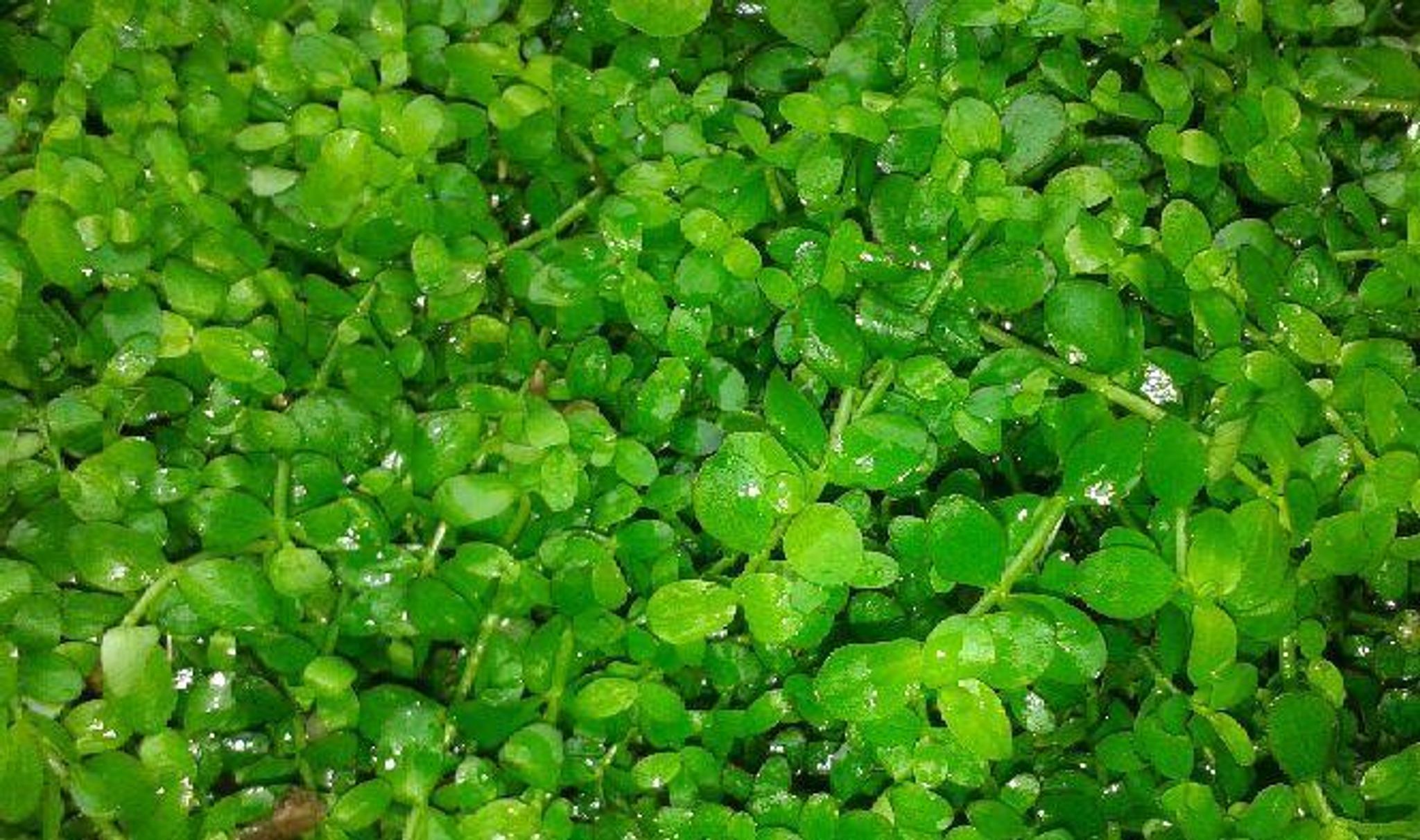

Monte Carlo Care Guide: Light, CO2, Substrate and Growth Tips
Monte Carlo (Micranthemum tweediei) is one of the easiest true carpeting plants to grow, but a thin, patchy lawn usually comes down to just a few variables: light intensity, CO2, substrate, and how it was planted. This guide walks through each one with concrete numbers so you can build either a low-tech patch or a fast, dense high-tech carpet with realistic expectations.
What Is Monte Carlo?
Monte Carlo, sold under the trade name for Micranthemum tweediei (formerly grouped under Micranthemum sp.), is a small, round-leaved creeping stem plant that spreads low across the substrate rather than growing upward. Its bright green, coin-shaped leaves are noticeably larger and hardier than those of HC Cuba (dwarf baby tears), which is exactly why it has become the go-to beginner's carpet plant. It tolerates a wider swing in water parameters and lower light than HC Cuba, making it far more forgiving for a first attempt at a planted foreground.
Water Parameters and Tank Requirements
Monte Carlo is genuinely flexible, though it grows best when conditions sit near the middle of its range rather than at the extremes.
| Parameter | Tolerated Range | Best Target |
|---|---|---|
| Temperature | 68–82°F (20–28°C) | 72–77°F (22–25°C) |
| pH | 5.5–7.5 | 6.5–7.0 (neutral) |
| GH | 2–15 dGH | 4–8 dGH |
| Tank size | 5 gallons (19 L) and up | 10–20 gallons (38–76 L) for a first carpet |
Sources vary on pH, with some quoting a tighter 6.0–7.5 band. Treat the wider range as the tolerance zone and aim for neutral pH for the fastest, most consistent growth rather than chasing an exact number.
Lighting: How Much Does Monte Carlo Need?
Light is the single biggest factor separating a tight, low carpet from a leggy, sparse one.
- Medium to high light produces the fastest, densest mat and keeps growth flat rather than upward.
- Lower or moderate light still works — Monte Carlo will survive and spread — but growth slows noticeably and the plant tends to reach toward the light instead of hugging the substrate.
- Aim for a consistent 6–8 hours per day, ideally on a timer. Photoperiod consistency matters almost as much as intensity; a fixture that runs at random hours encourages algae more than one that runs the same schedule every day.
Understanding PAR Instead of Watts
Watts and lumens tell you almost nothing about how much usable light reaches your substrate — PAR (photosynthetically active radiation) is the metric that actually predicts plant growth. As a rule of thumb rather than a hard number, carpet and foreground plants like Monte Carlo generally want roughly 30–50+ PAR at the substrate, noticeably more than low-light epiphytes such as Anubias or Java fern, which sit higher in the water column and closer to the fixture.
Two things change how much PAR actually reaches the ground:
- Tank depth — a taller tank loses more intensity by the time light reaches the substrate, so a deep tank needs a stronger fixture than a shallow one to hit the same PAR at the bottom.
- Fixture mounting height — raising a light further above the water reduces PAR at the substrate even if the fixture itself hasn't changed.
When shopping for a fixture, look for adjustable intensity, a spectrum tuned for plant growth rather than pure fish coloration, and a built-in timer or app for a steady photoperiod. A low-PAR fixture is fine for epiphyte-only tanks, but a true carpet tank benefits from a medium-to-high PAR unit. You can browse planted-tank fixtures in FishyHub's LED lighting category.
Does Monte Carlo Need CO2?
This is where sources genuinely disagree, and the honest answer is nuanced: CO2 is not required to grow Monte Carlo, but it is required to grow it fast and tight.
CO2 is a limiting nutrient for photosynthesis in submerged plants. Background CO2 from fish respiration and surface gas exchange is far lower than what an injection system delivers, so without supplementation the plant is working with a bottleneck no amount of light or fertilizer fully removes. Adding CO2 lifts that ceiling — plants can use higher light intensity without tipping into algae, and cell division (meaning new leaves and runners) speeds up considerably.
- Without CO2: Monte Carlo still carpets, but slower and needs more patience and consistent nutrient dosing. Set your expectations in months, not weeks.
- With CO2 injection: growth becomes markedly faster, denser, and more compact. A common rule-of-thumb target is 20–30 ppm, monitored with a drop checker rather than guessed at, since going too high stresses fish and livestock before it helps the plant.
Mismatched light and CO2 — running high light without enough CO2 to match it, or vice versa — is the single most common cause of algae outbreaks in carpet setups, so if you add one, plan to add or adjust the other in step.
Substrate: What Monte Carlo Actually Needs
Monte Carlo has a fine, delicate root system, so substrate choice affects both anchoring and nutrition.
- Nutrient-rich, fine-grained active substrate (an aqua soil type) is the ideal choice. These substrates buffer pH slightly acidic and release nutrients to the root zone over time. Their cation exchange capacity (CEC) — a measure of how well the substrate holds and releases charged nutrient ions — is what makes them outperform inert options for root feeders like carpet plants.
- Fine sand or fine gravel also works, but it's inert, so you'll need to supplement with root tabs and liquid fertilizer to get comparable results. Expect noticeably slower growth than with aqua soil.
- Avoid coarse gravel. The thin, delicate roots can't anchor well in large gaps, and plants uproot far too easily.
You can browse substrate options, including soil-type products, in FishyHub's substrate category.
Fertilization
- Root tabs pushed into the substrate feed the root zone directly, which matters more for Monte Carlo than water-column dosing alone.
- Add a balanced liquid or macro fertilizer to the water column as well.
- Under high light and CO2, dose weekly; under low-tech conditions, biweekly is usually sufficient since growth (and nutrient demand) is slower.
- As the carpet fills in and biomass increases, nutrient demand rises — don't stop root tabs just because the tank looks established.
Planting Methods
Submerged Planting
- Separate a tissue-culture mat or pot into small clumps — roughly 6–10 pieces, each about pea- to marble-sized.
- Use tweezers to insert each clump shallow but secure into the substrate.
- Space clumps about 1 inch (2.5 cm) apart in a grid pattern rather than scattering them loosely.
- Expect some pieces to float free in the first few days; simply re-press them with tweezers as needed.
Planting too sparsely is one of the most common beginner mistakes — wide gaps mean a much longer, patchier fill-in. Dense, close clumps close in far faster than a few big pieces spread thin.
Dry Start Method (DSM)
The dry start method plants Monte Carlo emersed (out of water) so it grows terrestrially before ever dealing with submerged-growth stress. It tends to produce a faster, denser initial mat and skips most of the early melt seen with submerged planting.
- Press small clumps into moist (not flooded) substrate.
- Mist the substrate 2–3 times daily to keep it humid without waterlogging it.
- Cover the tank with plastic wrap or a glass lid to trap humidity.
- Run the light for about 8 hours a day.
- Wait 3–6 weeks for a thick, even mat to form before flooding.
Transitioning out of DSM: raise the water level gradually rather than flooding all at once, and keep an eye on the emersed-grown leaves — some melt after flooding is normal as the plant converts to submerged growth. It's reasonable to start CO2 and fertilizer dosing as soon as the tank is flooded rather than waiting, since the plant has already built a strong root and runner network and can use the extra input right away.
Melting After Planting: Normal or a Problem?
Some yellowing or melting in the first 1–3 weeks after submerged planting is a normal transition/adjustment shock, especially for tissue-culture-grown plants moving from a sterile, nutrient-gel environment into aquarium water. Keep parameters stable, don't uproot to "check," and don't panic. If melting continues well past three weeks or spreads to new growth, that points to a light or nutrient deficiency rather than normal transition stress.
Growth Rate, Trimming, and Propagation
- Timeline: A full carpet typically fills in over 4–8 weeks under good light, CO2, and nutrients. In a true low-tech setup, expect months rather than weeks.
- Trimming: Once the carpet reaches roughly 3/4 to 1 inch (2–3 cm) tall, trim every 1–2 weeks with curved carpet scissors, cutting horizontally to encourage lateral spreading instead of vertical stacking.
- Trim before it gets too thick: guidelines vary between about 1.5 and 2 inches (4–5 cm), so treat that as a rough ceiling rather than an exact cutoff. Beyond that, light can't reach the base, and the lower layer browns, rots, and can detach as a floating mat.
- Propagation: Monte Carlo spreads naturally via runners (stolons). To fill gaps or start a new area, cut a runner section and replant the trimmed portion elsewhere in the layout.
- Maintenance: Periodically vacuum debris trapped within the carpet, working gently around the roots — this matters more in tanks without a strong bottom-dwelling cleanup crew.
Common Mistakes and Troubleshooting
| Symptom | Likely Cause | Fix |
|---|---|---|
| Slow, patchy fill-in | Clumps planted too sparsely | Replant closer together, smaller clumps |
| Pieces float free | Not buried deep enough | Re-press with tweezers repeatedly for week one |
| Yellowing/melting after planting | Normal transition shock | Wait 2–3 weeks before judging |
| Base browning, mat lifting | Carpet grown too thick, no trimming | Trim back to roughly 3/4–1 inch |
| Leggy, upward growth | Insufficient or inconsistent light | Increase PAR or fix photoperiod with a timer |
| Algae in the carpet | Light and CO2 out of balance | Match CO2/nutrients to your light level, or vice versa |
| Roots won't anchor, plants uproot | Substrate too coarse | Switch to fine sand, gravel, or aqua soil |
| Growth stalls after carpet fills in | Fertilization stopped too early | Resume root tabs as biomass and demand increase |
| Freshly planted clumps get dug up | Bottom-dwelling fish disturbing new roots | Add loaches or corydoras after the carpet establishes |
If a carpet simply isn't filling in and you're not sure why, work through it in order: check light intensity and photoperiod first, then CO2/algae balance, then nutrient dosing — rather than guessing at all three at once.
Carpet Plant Comparison
Monte Carlo isn't the only carpeting option, and each alternative trades off differently on difficulty, look, and CO2 dependence.
| Plant | Difficulty | CO2 Needed? | Look |
|---|---|---|---|
| Monte Carlo | Easy–moderate | No, but helps a lot | Round leaves, dense flat lawn |
| HC Cuba (dwarf baby tears) | Moderate–hard | Strongly recommended | Tiny leaves, very fine "moss-like" carpet |
| Dwarf Hairgrass | Easy–moderate | Optional | Grassier, taller blades, lawn look |
| Marsilea hirsuta | Easy | No | Clover-like leaves, less dense mat |
| Hydrocotyle tripartita (Dwarf Pennywort) | Easy | Optional | Thicker leaves, fast but less "lawn-like" |
Monte Carlo's larger, hardier leaves make it noticeably easier to keep flat and full than HC Cuba, which is why it's generally considered the better beginner carpet. Marsilea hirsuta is even more low-tech tolerant and needs no CO2 at all, but its clover-shaped leaves give a looser, less uniform mat. Dwarf Hairgrass works in both low- and high-tech setups but reads as a grassy lawn rather than a flat carpet. Hydrocotyle species fill in quickly with thicker leaves but look chunkier than a true fine-leaved carpet.
For a harder alternative once you've mastered Monte Carlo, Utricularia graminifolia (UG) is a finer, more demanding carpet plant often established via the dry start method. It needs a richer substrate and is slower to establish than Monte Carlo, so it's worth treating as a "next step up" rather than a first carpet plant.
A Warning About "Carpet Seed" Products
Bagged products marketed online as "aquarium carpet seeds" are almost always a scam or a mistake: they're typically generic terrestrial grass seed or moss spore mixes that will not germinate or grow submerged in an aquarium at all. True aquatic carpet plants like Monte Carlo don't come from seed packets — buy live plants, tissue-culture cups, or emersed-grown pots from a reputable source instead. If you're buying a tissue-culture cup online, give it a quick rinse and a brief inspection for pests before planting, the same as you would with any new plant coming into an established tank.
Combining Monte Carlo With Other Layout Elements
Monte Carlo works well as a low, tidy border against taller carpeting plants like Dwarf Hairgrass, or as a foreground lawn in front of mid-ground stem plants. Because it stays so low once trimmed regularly, it also pairs cleanly with hardscape, filling gaps around rocks and driftwood without hiding them.
Frequently Asked Questions
Does Monte Carlo need CO2?
No — it will still grow and carpet without CO2 injection, but noticeably slower and less dense. CO2 is recommended if you want a full, tight carpet look within weeks rather than months; it's optional if you're happy with a slower, casual low-tech patch.
How long does Monte Carlo take to carpet?
Roughly 4–8 weeks under good light, CO2, and consistent nutrient dosing. In a low-tech, no-CO2 setup, plan for considerably longer — often several months.
Can Monte Carlo grow in low light?
Yes, it survives and can still spread under lower light, but growth is slower and thinner, and the plant may grow more upward than flat. Expect a longer timeline and looser, less uniform coverage.
Why is my Monte Carlo melting or turning yellow after planting?
This is usually normal transition shock as the plant adjusts from its tissue-culture or emersed form to submerged growth, and it typically resolves within 1–3 weeks. If yellowing or melting continues beyond that window, suspect a light or nutrient deficiency instead.
What's the best substrate for Monte Carlo?
A fine-grained, nutrient-rich aqua soil is the ideal choice for fast, healthy root growth. Fine sand or gravel supplemented with root tabs also works, just with a slower growth rate.
Is Monte Carlo easier than HC Cuba (dwarf baby tears)?
Yes. Monte Carlo has larger, hardier leaves, tolerates a wider range of parameters and lower light, and is generally considered the more forgiving beginner carpet plant of the two.
How often should I trim Monte Carlo?
Trim every 1–2 weeks once the carpet reaches your target height, cutting it back to keep it low and push horizontal spreading rather than vertical stacking.
Can I use the dry start method with Monte Carlo?
Yes — DSM is a popular and effective way to establish a dense, even carpet before flooding, typically taking about 3–6 weeks to form a solid mat.
Ready to start your own carpet layout? Browse FishyHub's full substrate selection to find the right base for a dense, healthy Monte Carlo carpet.


