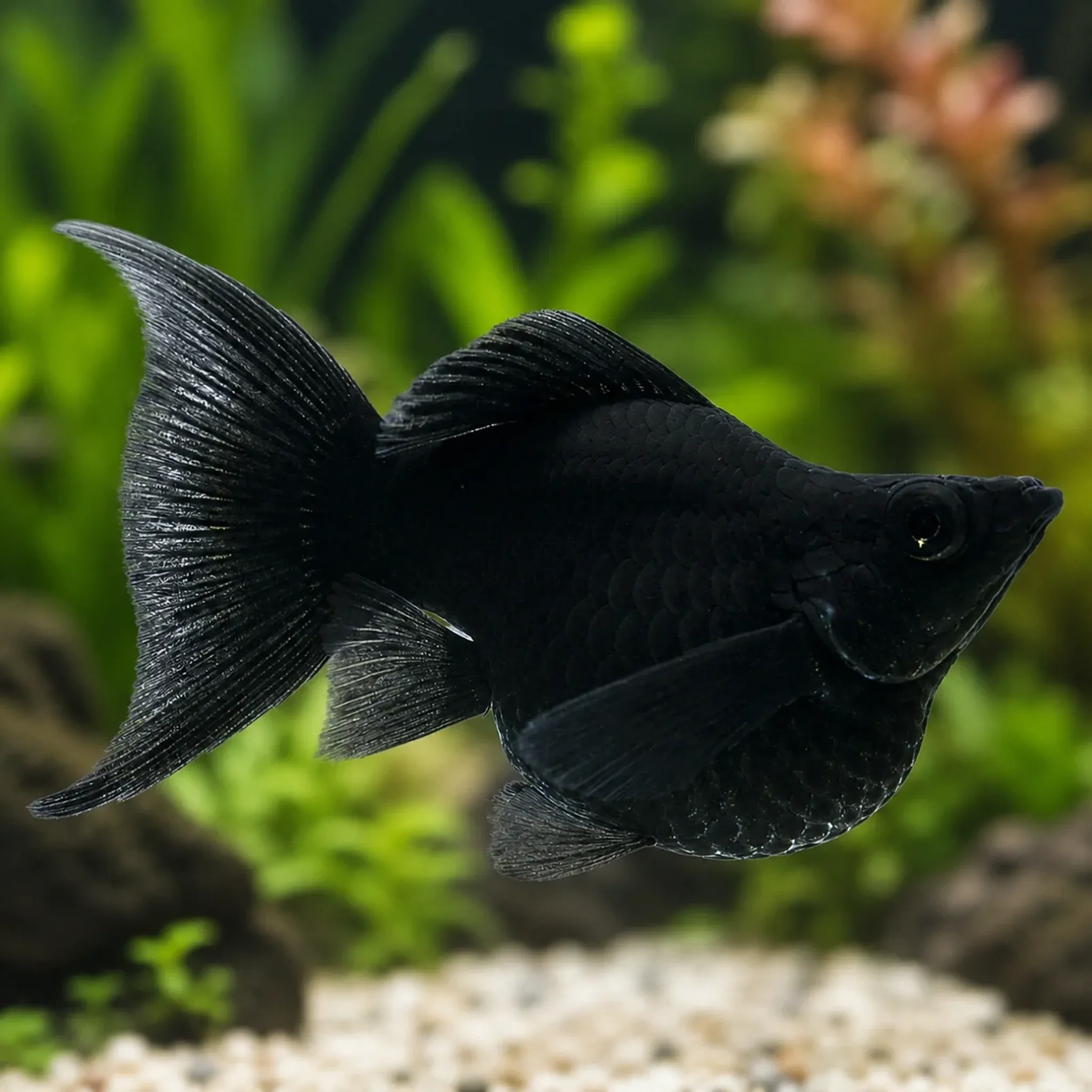

Molly Care Guide: Tank Size, Diet, Water Parameters and Temperament
Mollies are hardy only when they get what they need: a tank of 20 gallons (76 L) or more, hard, alkaline water (pH 7.5–8.5) kept at 75–80°F (24–27°C), and a diet heavy on plant matter. Get those three things right and they're peaceful, busy community fish that can live 3–5 years. Miss them, and mollies become one of the fish most often lost in a beginner's first month.
What Mollies Are (and Why Store Mollies Die Early)
Mollies are livebearers in the genus Poecilia. Most mollies sold in US pet stores are hybrids of three species: P. sphenops (short-fin), P. latipinna (sailfin) and P. velifera (Yucatan or giant sailfin). In the wild they live in coastal fresh and brackish water from the southern US down through Mexico and Central America.
That origin explains a lot. Many commercially raised mollies grow up in hard or slightly brackish farm water. If they're dropped straight into soft, neutral or acidic tap water, they often decline within days, which is where their "easy but they keep dying" reputation comes from.
- Size: females reach about 4–4.5 in (10–11 cm); males usually stay near 3 in (7.5 cm). Sailfin and velifera types can pass 5 in (13 cm).
- Lifespan: typically 3–5 years. Stable hard water and low nitrate help them reach the top of that range. Balloon types often live less.
Molly Types You'll See
| Type | Adult size | Notes |
|---|---|---|
| Short-fin (black, gold dust, Dalmatian) | 3–4.5 in (7.5–11 cm) | Best fit for a 20-gallon tank. Black mollies are the classic and appreciate a little salt most. |
| Sailfin | 4–5+ in (10–13+ cm) | Tall dorsal fin on males; plan on 29–40+ gallons. |
| Lyretail | 3–4.5 in (7.5–11 cm) | Long, forked tail lobes; keep away from fin nippers. |
| Balloon | 2–3 in (5–7.5 cm) | Bred body shape; shorter life, more health issues. |
| Yucatan (P. velifera) | Up to about 6 in (15 cm) | Largest sailfin; 40+ gallons, warmer water, ideally brackish. |
Limia, such as the black-barred limia, are close cousins with similar hard-water needs but a smaller adult size.
Balloon mollies get their round shape from a bred spinal compression, similar to scoliosis. They live around 1–3 years and are prone to swimming and digestive problems. Feed them fiber-rich food and don't overfeed. Their shape is permanent, so don't confuse it with a pregnant belly or with dropsy (covered below).
Yucatan mollies are mostly herbivorous and need more room and warmth than common mollies, so treat them as a project for an experienced keeper.
Tank Size and Setup
Sources recommend anything from 10 gallons for about four fish up to 25+ gallons. A safer rule:
- 20 gallons (76 L) minimum for a small group of short-fin mollies.
- 29–40+ gallons (110–150+ L) for sailfins or a breeding colony.
- After the first group, add roughly 3 gallons (11 L) per extra fish.
- A 10-gallon tank works only as a fry or quarantine tank.
Pick a long tank over a tall one. Mollies cruise the full length of the tank and use the footprint more than the height.
Starter Stocking Plans
| Tank | Mollies | Example companions |
|---|---|---|
| 20 gal (76 L) | 1 male + 3–4 females (short-fin) | A few platies, nerite snails |
| 29 gal (110 L) | 1–2 males + 4–6 females | Small group of hard-water tetras or danios, bristlenose pleco |
| 40 gal (150 L) | 2 males + 6 females, or sailfins | Swordtails, corydoras (in unsalted water), rainbowfish |
Starting a Molly Tank, Step by Step
- Cycle the tank fully before any fish go in.
- Test and set hardness and pH (see the next section).
- Install a heater and a filter rated for your tank size.
- Add sand or fine gravel, hardy plants and open swimming lanes.
- Add a group at the right sex ratio, acclimated slowly.
Aquascape
Hardy plants handle hard water well: anubias, java fern, vallisneria, and hornwort (which also gives fry cover). Leave open water in the middle and front for swimming. Mollies graze soft leaves and algae but rarely damage healthy plants.
Water Parameters
| Parameter | Target |
|---|---|
| Temperature | 75–80°F (24–27°C); tolerated about 70–82°F (21–28°C) |
| pH | 7.5–8.5; aim for 7.5–8.2, never below about 7.0 |
| GH | About 12–25 dGH |
| KH | 8+ dKH to hold pH steady |
| Ammonia / nitrite | 0 ppm |
| Nitrate | Under 20–40 ppm |
Sources differ on the details. Some list a low temperature of 64–72°F or a pH range of 7.0–8.0. Keep temperature in the 75–80°F band, because cooler water raises the risk of ich and the shimmies. With pH, stability matters more than hitting an exact number.
Do Mollies Need a Heater?
In almost every US home, yes. Indoor temperatures drop at night and in winter, and swings below about 72°F (22°C) invite disease. A preset or adjustable heater is standard equipment for mollies.
Fixing Soft or Acidic Tap Water
US tap water hardness varies a lot by region. The Pacific Northwest and parts of the Southeast tend to have soft water, and RO water has almost no minerals. Test GH and KH with test strips or a liquid kit before buying fish. To raise hardness and buffer pH:
- Add crushed coral or aragonite to a filter media bag or mix it into the substrate.
- Use a GH/KH remineralizer in RO or very soft water.
Make changes gradually and retest after a few days.
Filtration, Oxygen and Maintenance
Mollies eat a lot and produce a lot of waste, and they're sensitive to nitrate buildup. Use solid filtration with gentle surface agitation.
- Weekly 25–30% water changes, up to 50% in heavily stocked tanks.
- Match the new water's temperature and hardness to the tank.
Do mollies need an air pump? Usually not. A filter that ripples the surface provides enough gas exchange. Gasping at the surface points to low oxygen or ammonia. How long mollies can last without aeration depends on stocking, so don't treat it as something to test.
Salt: Optional, Not Required
This is the biggest disagreement among keepers. Some say salt is unnecessary; others report healthier fish in lightly brackish water. The practical default is hard, alkaline freshwater. In a molly-only tank, a low dose is an option: about 1 teaspoon of aquarium salt per 5 gallons (19 L), or marine salt to a specific gravity of 1.002–1.005. Don't use salt with salt-sensitive tank mates such as corydoras or with most live plants.
Saltwater mollies: mollies can be converted to full marine water gradually over several weeks and are sometimes used as cycling or dither fish in reef and fish-only tanks. Never move them abruptly.
Diet and Feeding
Mollies are omnivores that lean herbivorous. Their mouths are built for grazing algae, so plant matter should form the base of their diet.
- Staple: a quality flake or pellet with spirulina or vegetable content.
- Vegetables: blanched zucchini, spinach, cucumber or shelled peas, plus algae wafers.
- Treats (1–3 times a week): frozen or live brine shrimp, daphnia or bloodworms.
Feed two small meals a day, only what they finish in about 1–2 minutes, and skip one day a week. Overfeeding fouls the water and causes bloat. You can browse staple and freeze-dried options in Food & Supplements.
Temperament and Tank Mates
Are Mollies Aggressive?
Not really. Mollies are peaceful but busy and nosy. Most trouble is males chasing females without letup, plus occasional sparring between males. They may also nip slow, long-finned fish. The fixes are a better sex ratio, more space and more plants to break up sight lines.
Sex Ratio and Group Size
- Keep at least 2–3 females per male; some keepers use 1:4. In small tanks, use at least 1:3.
- Never keep one female with one male. She'll be harassed constantly.
- All-male or all-female groups avoid fry entirely.
- Keep groups of 3–6 or more. Mollies are social but don't school tightly.
Good Tank Mates
- Platies, swordtails and guppies (watch for fin nipping either way). Livebearers like these are in Small Community Fishes.
- Danios, larger rasboras and peaceful tetras that tolerate hard water
- Corydoras and bristlenose plecos (unsalted tanks only for corys)
- Nerite and mystery snails
- Rainbowfish in bigger tanks
- In lightly salted tanks: bumblebee gobies and some other brackish-tolerant gobies
Tank Mates to Avoid
- Fin-nipping barbs, especially with sailfin or lyretail mollies
- Aggressive cichlids
- Bettas, because of fin disputes
- Tiny shrimp, since shrimplets get eaten (and adult mollies eat their own fry too)
Acclimation and Quarantine
Because store water may be brackish or very hard, drip-acclimate slowly. Float the bag to match temperature, move the fish and water to a container, then drip tank water in over roughly an hour until the volume has at least doubled. If the store keeps mollies in salted water, ask about it and bring your quarantine tank close to that salinity, then lower it over days. Quarantine new mollies for 2–4 weeks before adding them to your main tank.
Breeding, Pregnancy and Fry
Do Mollies Lay Eggs?
No. Mollies bear live young. Fertilization is internal, and females store sperm for several broods, so a female bought from a mixed store tank is often already pregnant. Plan for fry.
Signs of a Pregnant Molly
- A belly that looks squared-off from the side
- A darkened gravid spot near the vent
- Hiding or staying near plants
Gestation is about a month, though sources cite anything from 30 to 60+ days depending on temperature; around 28–40 days at 78°F (26°C) is typical. Broods range from 20 to over 100 fry.
Pregnancy vs. Dropsy vs. Balloon Body
| Sign | Pregnancy | Dropsy | Balloon molly |
|---|---|---|---|
| Belly shape | Squared, deepens over weeks | Swollen, often sudden | Always round and short |
| Scales | Normal | Raised like a pinecone | Normal |
| Behavior | Active, may hide before birth | Lethargic, stops eating | Normal, may swim awkwardly |
| Outlook | Fry in weeks | Usually fatal | Permanent body shape |
Fry Care
Adults eat fry, so give them cover.
- Use a densely planted tank with floating plants, or move fry to a separate nursery tank.
- Opinions on breeder boxes are split. They stress pregnant females, so use one only for fry, not the mother.
- Feed fry crushed flake, baby brine shrimp or powdered food 3–5 times a day.
- Keep fry at about 78–80°F (26–27°C) with a sponge filter so they aren't pulled into the intake.
- Fry can rejoin the adults at about ¾ in (2 cm), usually after a few weeks, or once they're too big to swallow.
Managing Overpopulation
Mixed-sex mollies can overstock a tank fast. Rehome extra fish through a local fish store or hobby club, or switch to single-sex groups. Never release mollies into ponds, streams or ditches. They're invasive in some states, and releasing aquarium fish is illegal in many places.
Why Mollies Keep Dying: Troubleshooting
Most losses come back to a handful of causes: soft or acidic water, no acclimation from brackish farm water, an uncycled tank, cold water, overfeeding, and stress from male harassment.
- Shimmies (rocking in place without moving forward): usually soft water, cold water or poor water quality. Test GH, KH and pH, warm the tank and do water changes.
- Clamped fins or gasping: test ammonia and nitrite and do a large water change right away.
- White spots: small, salt-grain spots are ich. Raise the temperature gradually to about 82–86°F (28–30°C), add salt or an ich medication, and treat the whole tank. Fuzzy, cotton-like patches point to fungus or Columnaris instead, which need different treatment.
- Constant fry surprises: the store female was already pregnant. Plan for it.
- Overstocking from breeding: rehome or keep single-sex groups.
- Stressed corys or melting plants after adding salt: they don't tolerate it. Remove salt through water changes or keep salt only in molly-only tanks.
Molly Fun Facts
- Mollies are among the few community fish that actively eat algae.
- They can live in fresh, brackish and fully marine water when converted slowly.
- Females store sperm and can give birth several times from one mating.
- A wild relative, the Amazon molly, exists only as females that reproduce as clones.
Frequently Asked Questions
How many mollies can go in a 20-gallon tank?
About 4–6 adult short-fin mollies, with only one male. That leaves some room for fry and keeps waste manageable. Sailfins need a larger tank.
Do mollies need salt?
No, not if your water is hard and alkaline. Salt is optional in a molly-only tank, but skip it if you keep corydoras or live plants.
Can mollies live with guppies or bettas?
Guppies, yes. They share similar water needs, though you should watch for fin nipping. Bettas are not recommended because of fin disputes on both sides.
How can you tell a male molly from a female?
Look at the anal fin. Males have a gonopodium, a narrow, rod-like fin used for mating. Females have a fan-shaped anal fin and are usually larger.
Why is my molly sitting at the bottom or shimmying?
The cause is almost always water chemistry or temperature. Test pH, GH, KH, ammonia, nitrite and nitrate first, then correct low hardness or cold water gradually and do a water change.
Can mollies live in an outdoor pond?
Only during warm US summers when nights stay above about 70°F (21°C). Bring them indoors before fall temperatures drop, and never let them escape into local waterways.
Ready to Build Your Molly Tank
Mollies reward keepers who set up the water first: hard and alkaline, warm, and clean, with enough room for a proper group. Once that's in place, browse Freshwater Livestock on FishyHub to plan your mollies and their tank mates.


