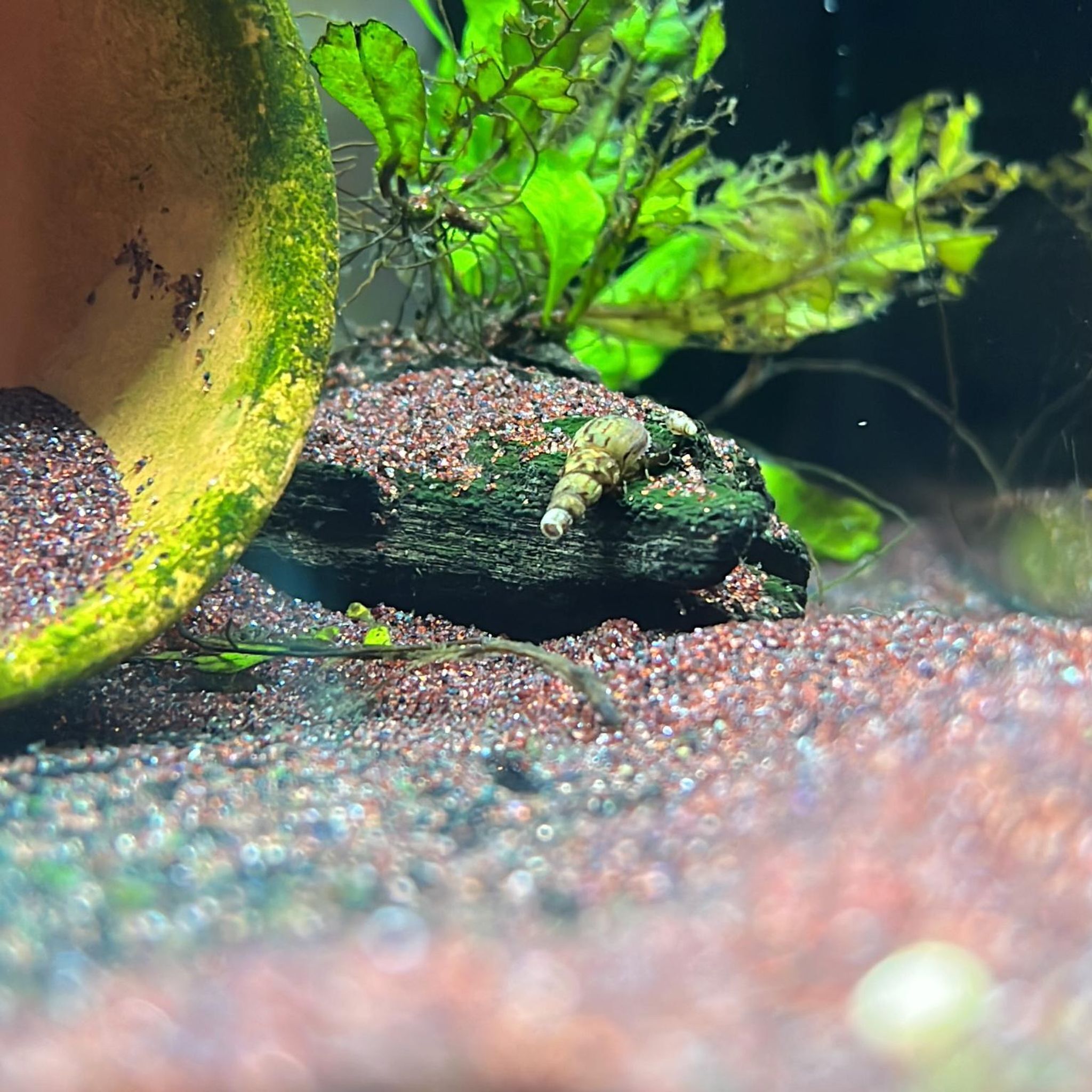

Malaysian Trumpet Snail Problems: Common Causes of Stress, Death and Poor Growth
Malaysian trumpet snails have a reputation as nearly indestructible, so a sudden die-off, mass surfacing, or shriveled shell usually means something in the tank has changed. This guide walks through the real causes of stress, death, and stunted growth, plus what to do about the opposite problem: a population that has exploded.
What Is a Malaysian Trumpet Snail?
The Malaysian trumpet snail (MTS), scientifically Melanoides tuberculatus, is a freshwater snail in the family Thiaridae, native to Southeast Asia and parts of Africa. It's also sold or discussed under the names red-rimmed melania or trumpet livebearer snail, all referring to the same long, cone-shelled species.
MTS are prized less for their looks than for what they do: they burrow through substrate by day and emerge at night to feed on algae, biofilm, detritus, leftover food, and already-decaying plant tissue. That burrowing activity aerates the substrate, breaking up compaction and preventing anaerobic pockets that release hydrogen sulfide — gas buildup that can otherwise damage roots and stress fish. This is the main reason many keepers add MTS on purpose rather than tolerate them as an accident.
Tolerance Range and Basic Biology
| Trait | Range / Detail |
|---|---|
| Temperature | Roughly 65–85°F (18–29°C); tolerates near-freezing water briefly on the low end |
| pH | Broad tolerance, but low pH / very soft water impairs shell growth and causes pitting |
| Salinity | Survives from pure freshwater into brackish conditions — unusual for a "freshwater" snail |
| Reproduction | Livebearer; reproduces sexually or via parthenogenesis (self-cloning) starting around 10mm shell length |
| Brood size | Up to roughly 70 live young per brood |
| Lifespan | Roughly 1–3.5 years depending on water quality and food availability |
Because MTS reproduce both sexually and asexually, a single snail can seed an entire colony — which explains why populations can boom seemingly overnight even though each individual is slow-moving and mostly hidden.
MTS as a Bioindicator: Your Tank's Early-Warning System
Malaysian trumpet snails are hardy enough that when they visibly struggle, it's rarely about the snail — it's about the water. Treat a mass daylight exodus from the substrate, snails piling up at the surface, or a sudden wave of deaths as a signal to test your water immediately, not as an isolated snail problem. Because MTS tolerate more abuse than most fish or shrimp, trouble in the snail population often shows up before it shows up in your fish.
Common Causes of Stress, Death, and Poor Growth
The following causes are ranked roughly by how often they're responsible for a die-off, based on how MTS behave and what conditions actually damage them.
1. Ammonia and Nitrite Spikes
Even a species this tolerant has limits. A spike from an uncycled tank, overstocking, or a crashed filter doesn't need to be lethal to cause damage — sublethal ammonia exposure harms gill tissue, suppresses immune response, and impairs feeding and reproduction well before it kills outright. If snails are surfacing, fleeing the substrate in daylight, or dying in clusters, test ammonia and nitrite first.
2. Copper Exposure
Copper is highly toxic to snails, MTS included, and it doesn't need to come from a labeled "snail killer" to cause harm. Common sources include copper-based fish medications, some plant fertilizers, and copper leaching from old tap water pipes. Always check ingredient lists before treating a tank that houses snails, and consider whether tap water source could be a factor if snails decline shortly after a large water change.
3. pH Crashes or Very Soft, Acidic Water
Sudden pH swings stress snail tissue directly, and sustained low pH or very soft water erodes shell material over time, leading to visible thinning and pitting even in snails that otherwise survive.
4. Long-Term Calcium Deficiency
Calcium is a building block for shell material. Extended deficiency produces soft, pitted, or cracked shells and noticeably slower growth, even when the snail itself is otherwise alive and active.
5. Substrate Problems (Compaction, Fine or Sharp Grain)
MTS need to burrow. Substrate that's too compacted can trap them; sharp or overly fine grain can physically injure the soft foot as they dig. Both reduce activity and can cause slow decline that looks like unexplained lethargy.
6. Low Oxygen (Anoxic Water)
Overstocked tanks, poor circulation, and warm water — which holds less dissolved oxygen — all push snails toward the surface for air more often, or cause outright death in severe cases. Increased surface activity paired with warm temperatures is a strong clue.
7. A Rotting Shell Left in the Tank
A dead, unremoved snail decomposes and spikes ammonia locally, which can then kill nearby snails in a cascade that looks like a mysterious "disease sweeping through" the colony. It isn't disease — it's water chemistry, and removing shells promptly breaks the chain.
8. Sudden Temperature Swings
Large, fast temperature changes during water changes — especially in winter when tap water runs cold — stress snails just as they stress fish. Matching new water to tank temperature before adding it is a simple preventive step.
Shell Health as a Diagnostic Tool
Because MTS shells are made largely of calcium carbonate, their condition is one of the best visual indicators of long-term water chemistry, separate from the day-to-day behavior signs above.
| Shell sign | Likely cause | What to check |
|---|---|---|
| Pitting or rough patches | Low pH, soft water, calcium deficiency | GH/KH, pH, calcium supplementation |
| Cracking near the growing edge | Physical trauma or brittle shell from calcium deficiency | Substrate sharpness, GH |
| Thin, translucent new growth | Insufficient calcium during growth | Add crushed coral or a calcium/GH supplement |
| Chalky white eroded tip | Chronic soft/acidic water over time | Long-term GH/pH trend, not a single test |
Adding crushed coral, aragonite, or a liquid calcium/GH-boosting supplement to soft-water setups gives snails the raw material to rebuild and grow new shell material properly.
Will MTS Eat My Live Plants?
Under normal feeding conditions, no. MTS target algae, biofilm, detritus, and tissue that's already dying — they generally leave healthy leaves alone. There's a caveat worth knowing: in a chronically overfed, overcrowded, food-starved tank, MTS have been observed opportunistically grazing on soft new plant growth as a last resort. If you're seeing plant damage alongside a visible population boom, treat it as a symptom of overpopulation and excess organic waste, not a species trait to worry about under normal care.
Are Malaysian Trumpet Snails Actually Pests?
MTS often get lumped into the broader "pest snail" category, but the label is mostly cosmetic. They don't harm fish, they don't meaningfully damage healthy plants, and their burrowing provides genuine substrate benefits. The "problem" most keepers report is really just a visible population — an aesthetic or psychological issue rather than a hazard to the tank. Understanding this distinction matters before reaching for anything drastic.
Adding MTS to an Uncycled Tank
MTS, along with pond and bladder snails, are among the hardiest livestock choices for an unfinished nitrogen cycle, which leads some keepers to use them to help jump-start a new tank. That said, "can survive" is not the same as "thrives." Ammonia and nitrite tolerance in MTS is relative, not absolute — sublethal exposure still causes gill damage and suppresses reproduction and growth even when it doesn't kill outright.
If snails must go in early, MTS is a reasonable choice, but waiting for a full cycle is still best practice. At minimum, test ammonia and nitrite before stocking anything, and watch shell condition and activity level closely in the first few weeks as an early signal of stress.
A gentle way to keep tabs on both cycling progress and shell-building minerals is to test parameters regularly with a reliable water conditioner on hand to buffer sudden shifts during water changes.
Population Booms: The Other "MTS Problem"
Just as often as die-offs, keepers search for MTS help because of the opposite issue — a colony that has exploded into the hundreds. Population growth in MTS is driven almost entirely by one factor: excess food. Overfeeding fish, uneaten food sinking into substrate, and general organic detritus accumulation feed the colony directly. Cut the food supply and the population shrinks over the following weeks — not overnight, but reliably.
Practical Feeding Guidance
A concrete rule beats vague advice to "feed less": offer only what fish visibly clear in 2–3 minutes, and siphon out anything left after that window. If you're routinely finding food debris in the substrate during weekly maintenance, you're overfeeding, and the snail population will reflect it within a few weeks.
How to Control MTS Numbers Without Harsh Chemicals
In a Shrimp Tank
Shrimp keepers generally want to reduce snail numbers without harming shrimp, which rules out medicated snail-killers — the chemicals affect shrimp too, and the resulting die-off decomposes right in the substrate, spiking ammonia. Instead:
- Cut feeding volume and frequency first. This is the root-cause fix and works even without any trapping.
- Use blanched vegetable traps overnight. Zucchini, cucumber, or lettuce dropped in after lights-out draws snails out to feed; remove and discard the vegetable (with attached snails) each morning.
- Remove dead snails and empty shells promptly. A decomposing shell left in the substrate is a common, overlooked cause of ammonia spikes that get blamed on "disease."
General Population Control
Manual picking is inefficient against MTS specifically, since they're nocturnal and spend daylight hours burrowed out of sight. A red or blue night-light lets you observe actual activity levels before assuming a problem exists — low daytime visibility is normal behavior, not a sign of decline.
Consistent husbandry outperforms one-time purges: regular substrate vacuuming, disciplined feeding, and removing uneaten food within a couple of hours will control numbers far more reliably than any single cleanup effort. Predator fish such as certain loaches and puffers, or assassin snails, can help manage larger populations, though assassin snails can themselves become a secondary population to manage if left unchecked.
Common Mistakes That Make MTS Problems Worse
- Panic-dosing a snail-killing chemical without a plan for the resulting die-off, which fouls the water with a fresh ammonia spike and stresses fish and remaining snails — often the actual "problem" people end up reporting.
- Overfeeding "to be safe," which drives both population booms and the water-quality decline that later causes a crash.
- Leaving dead shells in the tank after any die-off, letting decomposition spike ammonia and trigger secondary deaths that look like a mystery illness.
- Blaming disease for a die-off when the real cause is almost always a parameter swing: ammonia, pH, temperature, or copper exposure.
- Mistaking normal nocturnal behavior for decline. Low daytime activity is standard for MTS; check at night before assuming trouble.
- Assuming toughness means invincibility when stocking a brand-new, uncycled tank — some losses despite MTS's hardy reputation are common and don't necessarily indicate an error.
A Note on Sourcing and Quarantine
Wild-collected or pond-sourced MTS, and snails from unverified sellers, can carry parasites such as trematodes. If you're adding snails from an outdoor pond setup or an unfamiliar source, a brief quarantine period in a separate container before introducing them to your main tank is a reasonable precaution for US keepers. Sourcing snails through an established supplier reduces this risk considerably; you can browse healthy freshwater snails and other freshwater livestock options to compare stock before adding anything new to your tank.
Frequently Asked Questions
Why are my Malaysian trumpet snails dying suddenly?
The most common causes are an ammonia or nitrite spike, copper exposure (from medication, fertilizer, or tap water), a pH crash, or a prior die-off cascading through the colony as a rotting shell spikes ammonia. Test your water parameters first before assuming disease.
Why do my trumpet snails float or clump at the surface?
This is often a sign of poor water quality, low dissolved oxygen, or an escape response to substrate gas buildup from compaction. Check ammonia, nitrite, and oxygen-related factors like temperature and circulation before anything else.
How do I get rid of too many Malaysian trumpet snails?
Cut feeding volume and frequency first, since population size is directly tied to available food. Vacuum substrate to remove detritus, set out blanched vegetable traps overnight and discard them each morning, and consider a compatible snail-eating predator if numbers stay high.
Are Malaysian trumpet snails safe for shrimp?
Yes, generally — MTS and shrimp coexist without conflict. The main concern shrimp keepers have is competition for food and simply wanting to manage snail numbers without chemicals that could also harm the shrimp.
Will Malaysian trumpet snails eat my live plants?
Not under normal feeding conditions. They target algae, biofilm, detritus, and tissue that's already decaying. Live plant damage is rare and usually points to overpopulation combined with insufficient food, pushing snails toward tender new growth as a last resort.
Can Malaysian trumpet snails survive an uncycled tank?
They're among the most ammonia- and nitrite-tolerant snails available, but they aren't immune. Sublethal exposure can still damage gills and suppress reproduction and growth, so a fully cycled tank remains best practice even for MTS.
Why are my trumpet snails' shells cracked, pitted, or eroding?
This usually points to low pH, very soft water, or a long-term calcium deficiency. Adding crushed coral, a calcium supplement, or a GH-boosting mineral product gives snails the material needed to rebuild and grow healthy shell.
How long do Malaysian trumpet snails live?
Roughly 1 to 3.5 years, depending largely on water quality and consistent food availability over that lifespan.
Whether you're troubleshooting a die-off or trying to bring a booming colony back under control, the fixes almost always trace back to water quality and feeding habits. Browse FishyHub's freshwater livestock selection to find healthy snails, tankmates, and cleanup crew additions for your setup.


