Kole Tang Care Guide: Tank Size, Diet, Compatibility and Reef Safety
The Kole tang is one of the few tangs most reef keepers can recommend without hesitation — a compact, peaceful algae grazer that rarely bothers coral. This guide settles the tank-size debate with a straight answer, lays out a real feeding routine, and gives a clear reef-safety verdict along with the one caveat worth knowing before you buy.
What Is a Kole Tang?
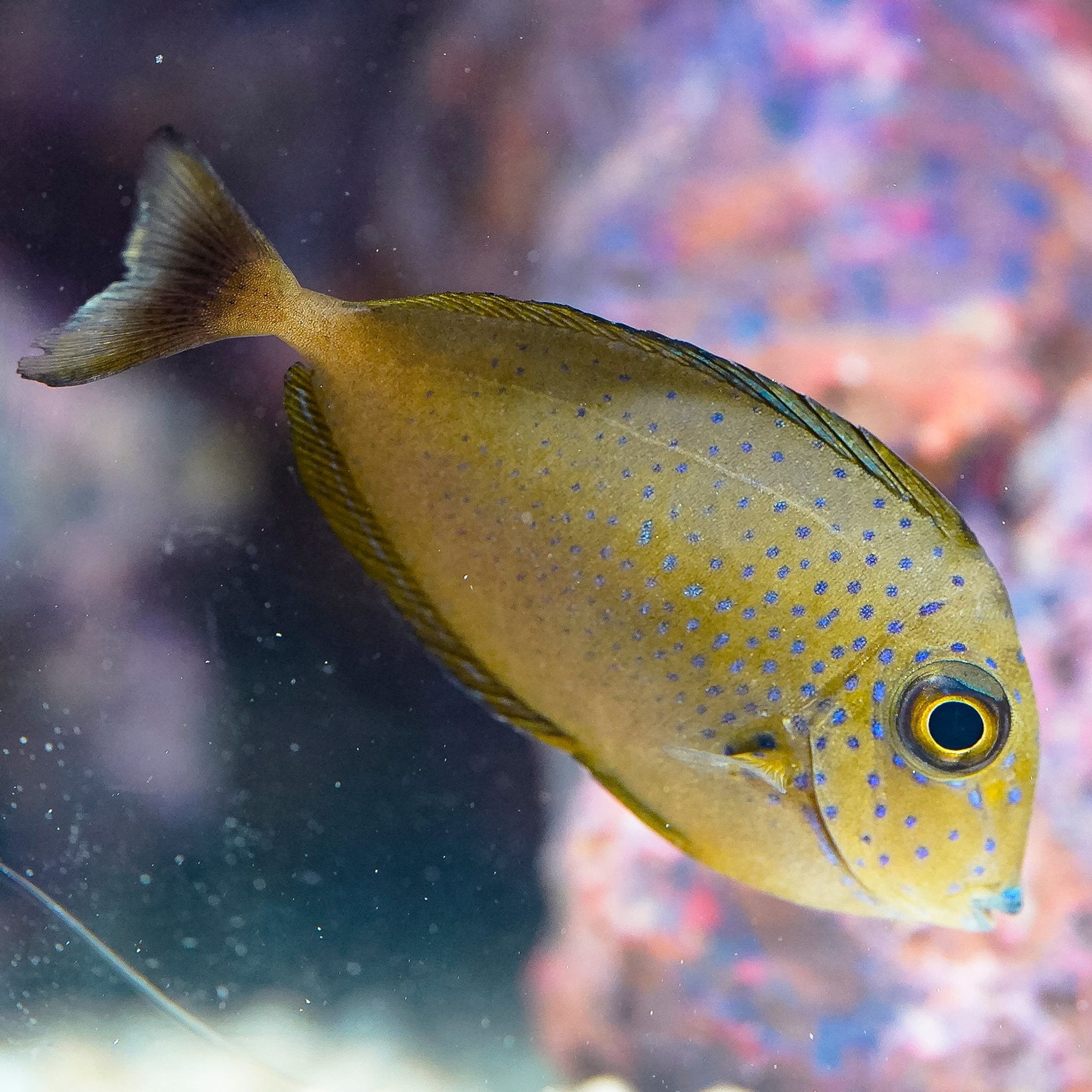
The Kole tang (Ctenochaetus strigosus) is also sold as the Yellow-Eye Tang, Yellow-Eye Kole Tang, or Yellow-Eye Bristletooth. It has a dark brown to olive body covered in fine pale or orange speckles, with a bright yellow ring around the eye that gives it its common name. Its mouth carries comb-like, flexible bristle teeth adapted for combing film algae, diatoms, and detritus off rock and sand — a very different feeding style from tangs with rigid, scraping teeth.
In captivity, Kole tangs typically reach 6–7 inches (15–18 cm). Wild specimens have been reported up to 10 inches (25 cm), but aquarium fish rarely approach that maximum, since growth is shaped heavily by tank size, diet, and water quality over the fish's lifetime.
Tank Size: What's the Real Minimum?
This is where sources disagree most, so here's the practical answer: 75 gallons (284 L) is the realistic minimum for a single adult Kole tang kept long-term. A 55-gallon (208 L) tank is sometimes cited as workable, but treat that as an absolute floor for a juvenile in the short term, not a permanent home — this is a fish that swims constantly, and cramped conditions show up as stress and stunted growth over time.
If you plan to keep more than one tang, or pair a Kole tang with other dedicated grazers, step up to 125–200 gallons (473–757 L). For comparison, the Kole tang is genuinely one of the more compact, less-demanding tangs — species like the sohal or achilles tang need 200–400+ gallons just to feel comfortable, so a Kole tang is a reasonable entry point into tang-keeping.
Tank shape matters as much as volume. A long, shallow footprint gives a tang more open swimming lanes than a tall cube holding the same gallon count, so favor length over height when choosing a tank.
| Scenario | Recommended tank size |
|---|---|
| Single Kole tang, long-term | 75 gal (284 L) minimum |
| Juvenile, short-term only | 55 gal (208 L) floor |
| Two or more tangs | 150–200+ gal (568–757+ L), 6 ft+ long |
| Paired with sohal/achilles-type tangs | 200–400+ gal (757–1,514+ L) |
Aquascape and Water Parameters
A Kole tang's main food source is the film algae and detritus growing on mature live rock, so the rock itself is functionally part of its diet, not just decor. Beyond rock, provide:
- Open water column for swimming
- Strong, varied water flow
- Efficient filtration paired with a properly sized protein skimmer
Live rock quantity is commonly estimated at 1–2 lb per gallon as a starting point — roughly 1–30 lb for small tanks, 20–80 lb for mid-size setups, and 50–450 lb for 50–225 gallon tanks. Treat this as a guideline, not a hard rule: rock density and porosity vary, and a lighter aquascape that still looks and functions well is perfectly fine. More rock generally means more grazing surface and biological stability.
Reef-standard water parameters apply:
| Parameter | Target range |
|---|---|
| Temperature | 75–82°F (24–28°C) |
| pH | 8.1–8.4 |
| Specific gravity | 1.020–1.025 |
| dKH (alkalinity) | ~8–12 |
Stability matters more than chasing an exact number — swings in salinity or temperature stress a Kole tang far more than sitting slightly off the "ideal" figure. When mixing saltwater, a reef-formulated marine salt mix that reliably hits your target pH, alkalinity, and salinity — fully dissolved before use — does more for long-term health than brand loyalty.
Because tangs graze and produce waste continuously, size filtration and skimming for 1.5–2x your actual tank volume, not the bare minimum rated for the tank size on the box.
Diet and Feeding
Kole tangs are grazers first. In the wild they pick at film algae almost constantly, so a once-a-day feeding schedule leaves them underfed. Build a routine around:
- Nori or dried seaweed clipped to the glass or rock
- Algae-based pellets or flakes
- Occasional meaty frozen food (such as mysis) for variety
Feed small amounts 2–3 times a day, or at minimum several times a week if a daily schedule isn't realistic. It's genuinely hard to overfeed a tang given how much they'd naturally graze — the bigger risk is underfeeding. A soaked food supplemented with vitamin C and a fatty-acid source helps prevent head-and-lateral-line erosion (HLLE), a condition linked to nutritional gaps in tangs.
If you've acquired a wild-caught individual that's initially only grazing live rock and ignoring prepared foods, leave some algae-covered rock or live rock rubble in the tank while training it onto nori and pellets — it gives the fish a familiar food source to fall back on during the transition.
Reef Safety: The Verdict and the Caveat
The Kole tang is widely considered one of the better reef-safe tang choices, which is a large part of its popularity. It doesn't target coral tissue as a normal part of its feeding behavior.
The caveat: an underfed Kole tang may pick at soft coral polyps or clam mantles out of hunger. "Reef safe" doesn't mean "will never touch coral" — occasional polyp picking happens when the diet is thin. A varied, consistent feeding schedule (per the routine above) resolves this in nearly all cases.
If you're building out a mixed reef and want other coral-friendly additions alongside a well-fed Kole tang, you can browse soft corals and see what pairs well with your current stocking.
Compatibility and Tankmates
Kole tangs are peaceful toward fish outside their own family. They generally coexist well with:
- Clownfish
- Gobies
- Blennies
- Dartfish
- Cardinalfish
- Chromis
- Peaceful angelfish
- Wrasses
The friction, when it happens, is almost always tang-on-tang. If you're stocking a mixed marine community, marine wrasses and gobies are among the calmer companions that won't compete with a Kole tang for the same grazing niche.
Keeping Multiple Tangs
Stick to one tang per tank unless your setup is 150–200+ gallons and at least 6 feet long. If you do combine tangs in a large enough system:
- Add all tangs at the same time, not sequentially — a tang introduced later into an established territory faces far more aggression.
- Choose species with different body shapes, colors, and genera to reduce visual competition.
- If staggering is unavoidable, add the smallest or most peaceful species first.
- Add tangs after peaceful community fish but generally before or alongside similarly-sized semi-aggressive species.
- Consider three or more tangs rather than exactly two — an odd number spreads out aggression more evenly than a single rival pair.
Introducing a Kole Tang to an Established Tank
- Quarantine first (see below).
- Rearrange existing rockwork before release to break up established territories.
- Use an acclimation box or floating container so residents can see the newcomer without direct contact.
- Release during low light or dusk to reduce stress and aggression.
- Feed heavily at introduction to reduce food-guarding behavior from existing fish.
Health and Quarantine
Tangs, Kole tangs included, are among the first fish to visibly show stress-related disease — ich and marine velvet in particular. That sensitivity makes quarantine non-negotiable rather than optional.
- Run a dedicated quarantine period of at least 4 weeks before adding any new Kole tang to a display tank.
- Watch closely for signs of ich or velvet, which tend to appear early under stress.
- Maintain stable water quality and good nutrition throughout quarantine — both reduce disease susceptibility.
As optional extra disease control, some keepers run ozone or UV sterilizers. Both reduce free-floating pathogens and improve water clarity, but they work differently:
| Method | Pros | Cons |
|---|---|---|
| UV sterilizer | Simple, safer for beginners | Less effective against everything |
| Ozone | More powerful pathogen control | Requires a controller/ORP monitor and carbon to prevent gas buildup; risk of overdosing |
Neither is essential specifically for keeping a Kole tang — they're supplemental tools, not requirements.
Lifespan
With good care, Kole tangs commonly live 6–10+ years or more in captivity. Wild reef fish as a group can live far longer — record-holding individuals of long-lived reef species have been documented at over 80 years old — which illustrates the gap between a species' biological ceiling and typical aquarium outcomes. That gap is mostly about husbandry: a properly sized tank, stable water parameters, and a full quarantine before introduction are what close it, turning a "few good years" into a decade-plus healthy fish.
Related Bristletooth Tangs Worth Knowing
The Kole tang belongs to the Ctenochaetus genus — the bristletooth tangs — generally regarded as the most peaceful and compact subgroup among tangs, thanks to their comb-like, flexible teeth built for grazing film algae and detritus rather than confrontation.
Chevron Tang
A closely related but pricier and more strikingly patterned bristletooth. It needs similar housing to a Kole tang, just slightly larger, and is generally considered more delicate and expensive to keep. Worth considering if you like the Kole tang's grazing habits but want a bolder look.
White Tail Bristletooth Tang
Another Ctenochaetus cousin, typically described with a dark chocolate-brown to black body and a contrasting pale or white tail base (color descriptions vary somewhat by source, likely due to lighting and regional variation, so treat exact shading loosely). It's an efficient algae grazer but can be territorial toward other tangs occupying the same shape and feeding niche — another reminder of the one-tang-per-tank rule for anything short of a very large system.
Common Mistakes to Avoid
- Buying for a tank under 55–75 gallons, then dealing with a stunted, stressed fish that eventually needs rehoming.
- Keeping two tangs in too small a tank — this leads to chasing, torn fins, and stress-related illness; the fix is rehoming one fish or upgrading the tank, not waiting for them to "work it out."
- Underfeeding — feeding once a day or skipping days is a common trigger for HLLE, coral nipping, and hunger-driven aggression.
- Skipping quarantine — tangs are often the first visible casualties in a new-fish disease outbreak.
- Adding a tang last with no rockwork changes — sudden aggression from established residents defending territory; rearranged rock and a dusk release largely prevent this.
Frequently Asked Questions
What is the minimum tank size for a Kole tang?
75 gallons (284 L) is the safe, realistic minimum for a single adult kept long-term. A 55-gallon tank can work short-term for a juvenile, but bigger is always better for a fish that swims continuously.
Is the Kole tang reef safe?
Yes — it's considered one of the more reef-safe tangs available. The only real risk is occasional coral or clam mantle nipping if the fish is underfed, which a consistent, varied feeding schedule prevents.
Can I keep two Kole tangs together?
Only in large tanks of 150–200+ gallons that are at least 6 feet long, and ideally added at the same time. In anything smaller, stick to one tang per tank to avoid ongoing aggression.
What do Kole tangs eat?
An algae-based diet of nori, algae pellets, and flakes, supplemented occasionally with meaty frozen food such as mysis. Feed small amounts 2–3 times daily since they graze near-continuously in the wild.
How long do Kole tangs live?
Typically 6–10 or more years in captivity with good care — a properly sized tank, stable parameters, and a full quarantine period before introduction all help close the gap toward that upper range.
Do Kole tangs get along with other fish?
Yes, they're peaceful toward non-tang tankmates like clownfish, gobies, blennies, and wrasses. Nearly all friction seen with this species is tang-versus-tang rather than tang-versus-community-fish.
How much live rock does a reef tank need for a Kole tang?
Roughly 1–2 lb per gallon as a starting guideline, though the right amount depends on rock density and the aquascape you want — prioritize enough grazing surface over hitting an exact number.
A well-fed Kole tang in a properly sized reef tank is one of the lowest-drama tangs you can keep. If you're ready to add one, browse available tangs and surgeonfish along with algae-based food and supplements to get feeding right from day one.

