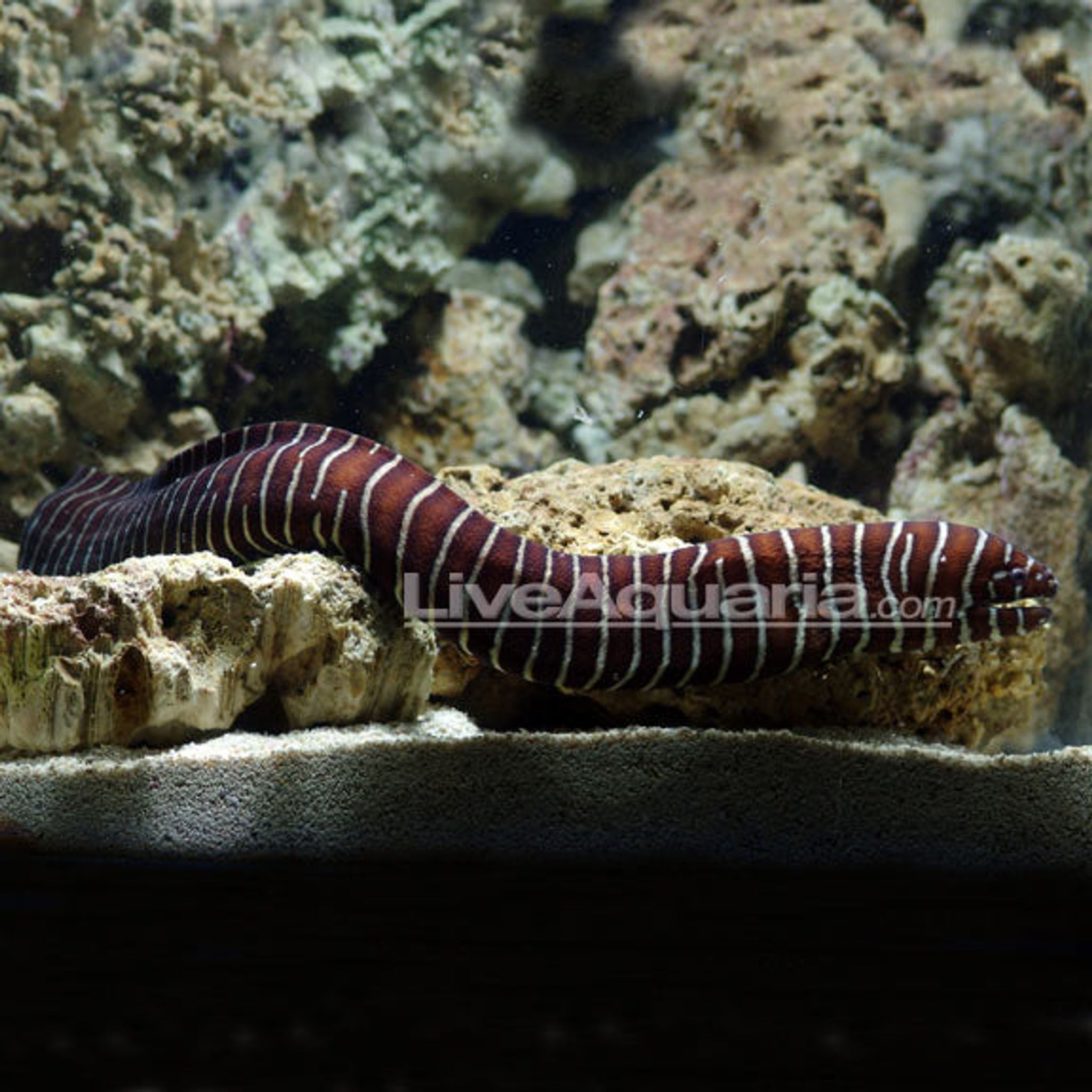
Is Zebra Moray Eel Reef Safe? Coral and Invertebrate Compatibility Explained
The short answer: a zebra moray eel (Gymnomuraena zebra) is reef safe when "reef safe" means coral, but it is absolutely not invertebrate safe. It will leave your polyps, anemones, and rockwork alone while systematically eating any crab, shrimp, snail, or clam it can catch. Whether that makes it a good fit for your reef tank depends on how you've built that tank and what else lives in it.
What "Reef Safe" Actually Means Here
Hobbyists often use "reef safe" as a single label, but it really covers two separate questions:
- Coral safe — will the animal eat, nip, or otherwise damage coral tissue and polyps?
- Invertebrate safe — will the animal eat mobile invertebrates like shrimp, crabs, snails, and clams?
A zebra moray answers those two questions very differently. It is genuinely coral safe: it has no interest in coral tissue, soft coral polyps, LPS, SPS, or anemones, and it won't uproot frags the way a large digging fish might. But it is not invertebrate safe in any sense — it is, by diet and dentition, a dedicated invertebrate predator. Keeping this distinction straight is the key to deciding whether the species fits your setup.
Species Snapshot
Zebra morays are native to Indo-Pacific reefs and are easy to identify by their bold, dark-and-cream banding — a pattern that gives them their common name (also written as "zebra eel"). In the wild they can reach roughly 5 feet (150 cm), though captive specimens more commonly top out around 3–4 feet. Growth is relatively slow, but the eventual adult size should be planned for from the day you buy a juvenile, not after it's outgrown its tank.
| Trait | Detail |
|---|---|
| Scientific name | Gymnomuraena zebra |
| Adult size | Up to ~5 ft (150 cm) in the wild; usually 3–4 ft in captivity |
| Lifespan | 15–20+ years with good care |
| Temperament | Docile, shy, nocturnal/crepuscular |
| Coral compatibility | Safe |
| Mobile invertebrate compatibility | Not safe |
| Minimum tank size | 100 gal (juvenile) to 180+ gal (adult) |
Why Diet Drives the Whole Compatibility Question
Most true moray eels — snowflake, honeycomb, and similar species — have long, sharp, piercing teeth built to grab and swallow fish whole. That dentition makes them a threat to small fish and, in many cases, to ornamental shrimp they can corner.
The zebra moray is the exception. Its teeth are blunt and molar-like, evolved specifically for crushing the hard shells of crabs, mollusks, and other armored invertebrates. This single anatomical difference explains everything about its reef compatibility:
- Coral tissue has nothing a crushing tooth is built to exploit, so corals are ignored entirely.
- Shelled and soft-bodied invertebrates are exactly what those teeth evolved to process, so shrimp, crabs, snails, and clams are treated as food, not tankmates.
If you remember one fact from this article, make it this: the same trait that makes a zebra moray unusually safe for corals is what makes it unusually dangerous for a cleanup crew.
Tank Requirements
Size
Sources vary here, and the disagreement is worth resolving plainly. A 100-gallon (380 L) tank is commonly cited as a workable starting point for a small juvenile, and some hobbyists treat that as the standing minimum. Others, accounting for the animal's eventual near-5-foot length and bioload, recommend 180+ gallons (680+ L) outright. The sensible middle ground: 100 gallons is acceptable only as a temporary home for a small juvenile with a clear, funded upgrade plan; a tank meant to house an adult long-term should be 180–200+ gallons.
Rockwork and Hiding Spots
Zebra morays are largely nocturnal or crepuscular and want dense rockwork with caves to retreat into during the day. Build the aquascape with this in mind:
- Use heavy, stable rock, since eels will dig and rearrange substrate around the base of the structure.
- Avoid loosely stacked rock that could collapse if the eel burrows underneath it.
- Provide multiple cave options rather than one — this reduces stress and territorial disputes with other cave-dwelling fish.
Escape-Proofing
Morays are strong, flexible, and notorious escape artists. A tight-fitting, weighted lid with zero gaps is non-negotiable. Common escape points include loose lids, cutouts left open for cords or return pumps, and gaps around overflow boxes — all worth double-checking before the eel goes in, not after it's gone.
Water Parameters
Standard reef parameters apply, and zebra morays are hardy relative to many reef fish, but that doesn't mean water quality is optional over the long term:
| Parameter | Target range |
|---|---|
| Temperature | 72–78°F (22–26°C) |
| Specific gravity | 1.020–1.025 |
| pH | 8.1–8.4 |
| Nitrate | Low |
Filtration and Bioload
These eels are large, messy eaters that produce significant waste. Strong filtration and protein skimming, plus a larger total water volume, matter more here than in a typical fish-only reef — another reason a bigger tank pays off both in headroom and in water-quality stability.
Feeding Without Incidents
Feed 2–3 times per week, not daily — daily feeding tends to cause obesity and degrades water quality faster than the filtration can keep up. A varied diet of silversides, shrimp, squid, clams, mussels, and crab legs covers their nutritional needs well.
Always feed with tongs or a feeding stick, never by hand. Zebra morays have poor eyesight and rely heavily on smell to locate food, which means a hand near the water at feeding time can be mistaken for a meal. This risk isn't limited to feeding time, either — a moray can strike defensively if a hand enters rockwork or a cave unexpectedly during routine tank maintenance or coral placement, so move slowly and predictably around known hiding spots.
Acclimating wild-caught specimens: many wild-caught morays initially refuse frozen or prepared foods. Offering live or fresh whole shrimp or fish first, then gradually mixing in frozen items scented with the same juices, is a common way to transition a reluctant eater onto a prepared diet.
Temperament and Tankmates
Zebra morays are generally docile and shy around divers and aquarists, retreating to their caves rather than confronting anything larger than food. Compared to more predatory moray species, their aggression level toward fish tankmates is low — but "low aggression" doesn't mean "no risk to everything."
Good tankmates:
- Tangs, larger wrasses, and other robust reef fish too big to swallow
- Angelfish and groupers
- Fish that can hold their own around rockwork
Poor tankmates:
- Small or thin-bodied fish — gobies, small blennies, small clownfish — that can be mistaken for prey, especially at night
For stocking a compatible community, browsing options in Marine Fish or specifically Tangs & Surgeons is a reasonable starting point for fish large enough to coexist safely.
Quarantine
As with most wild-caught marine fish, quarantining a new zebra moray before introducing it to the display tank is recommended. This screens for parasites and disease before they can spread to established livestock, and it also gives a shy eel time to settle and start eating in a lower-stress environment.
Saltwater Eels at a Glance
Zebra morays are the exception in the moray world, not the rule, so it helps to see where they sit relative to other commonly kept species:
| Species | Typical dentition | Coral safe | Invertebrate/shrimp safe |
|---|---|---|---|
| Zebra moray | Blunt, crushing | Yes | No |
| Snowflake moray | Sharp/blunt mix | Yes | Mostly no (will eat crustaceans) |
| Honeycomb (snake) moray | Sharp, piercing | Yes | No |
| Ribbon eel | Sharp, piercing | Yes | No (eats small fish, some shrimp) |
| Garden eel | Small, fine | Yes | Generally yes (plankton feeder) |
Most true morays — snowflake, honeycomb, ribbon eels — have sharp, piercing teeth suited to catching fish and will readily eat ornamental shrimp given the chance. The zebra moray's shell-crushing dentition and its narrow focus on crustaceans and mollusks is the outlier worth understanding before assuming any moray behaves the same way around invertebrates.
Common Mistakes to Avoid
- Adding a cleanup crew and hoping for the best. Cleaner shrimp, hermit crabs, snails, and similar invertebrates will eventually be eaten — there's no acclimation period that changes this outcome.
- Undersized or open-top tanks. Loose lids and gaps around cords, pumps, or overflow boxes are the most common escape points.
- Hand-feeding. This is the leading cause of accidental bites; tongs or a feeding stick remove the risk entirely.
- Overfeeding daily. Stick to 2–3 feedings per week to avoid obesity and water-quality decline.
- Housing small, thin-bodied fish that can be mistaken for prey, particularly during nighttime activity.
- Not planning for adult size. A juvenile purchased for a modest tank needs a documented upgrade path, not a hope that growth will be slow enough to ignore.
- Insufficient or unstable rockwork. Too few caves causes stress; loosely stacked rock can collapse when the eel digs beneath it.
Alternatives for Cleanup Duty
Since a display tank with a zebra moray can't safely hold a conventional invertebrate cleanup crew, consider:
- Manual removal of algae and detritus via regular maintenance
- Housing larger, hardier snails or a cleanup crew in a separate refugium or sump where the eel has no access
- Leaning on herbivorous fish for algae control instead of invertebrates
If you're planning coral placement around this kind of setup, the Corals and LPS Hard Corals categories are worth browsing for coral-safe additions, since nothing about the eel limits your coral choices — only your invertebrate ones.
Frequently Asked Questions
Will a zebra moray eel eat my corals?
No. Zebra morays don't eat coral tissue or polyps, so hard corals, soft corals, and anemones are generally safe to keep with them.
Can I keep shrimp or crabs with a zebra moray?
No. Their blunt, molar-like teeth are specifically adapted to crush crustacean and mollusk shells, so shrimp, crabs, snails, and clams will eventually be eaten.
What size tank does a zebra moray eel need?
At least 100 gallons (380 L) for a juvenile with a clear upgrade plan, and ideally 180+ gallons (680+ L) for a full-grown adult, with a tight, weighted, gap-free lid.
Are zebra moray eels aggressive?
They're generally docile and shy compared to other moray species, retreating to caves when not feeding. They are predatory toward crustaceans and small fish but not typically aggressive toward larger tankmates.
How often should I feed a zebra moray eel?
About 2–3 times per week, not daily, using tongs or a feeding stick with shrimp, clams, squid, or crab. Daily feeding tends to cause obesity and water-quality issues.
Can zebra morays escape tanks?
Yes. They're strong and flexible enough to push through surprisingly small gaps, so a weighted, gap-free lid is essential — check cord cutouts and overflow box openings especially closely.
Are zebra moray eels good for reef tanks?
They're coral safe but best suited to large, fish-dominant reef systems rather than nano reefs or invertebrate-heavy setups, given their size, waste output, and appetite for mobile invertebrates.
If a zebra moray fits the reef system you're planning, you can browse compatible livestock and coral options under Marine Livestock on FishyHub to start building out a large, fish-dominant reef around it.

