Is Tuxedo Urchin Reef Safe? Compatibility With Fish, Coral and Invertebrates
Yes, the tuxedo urchin is reef safe. It doesn't eat healthy coral tissue and gets along with most fish, corals, and invertebrates, but it can still bump, dislodge, or wear items on its body as it roams the tank at night. Here's what that means in practice, plus the tankmates to avoid and the setup it needs to thrive.
What Is a Tuxedo Urchin?
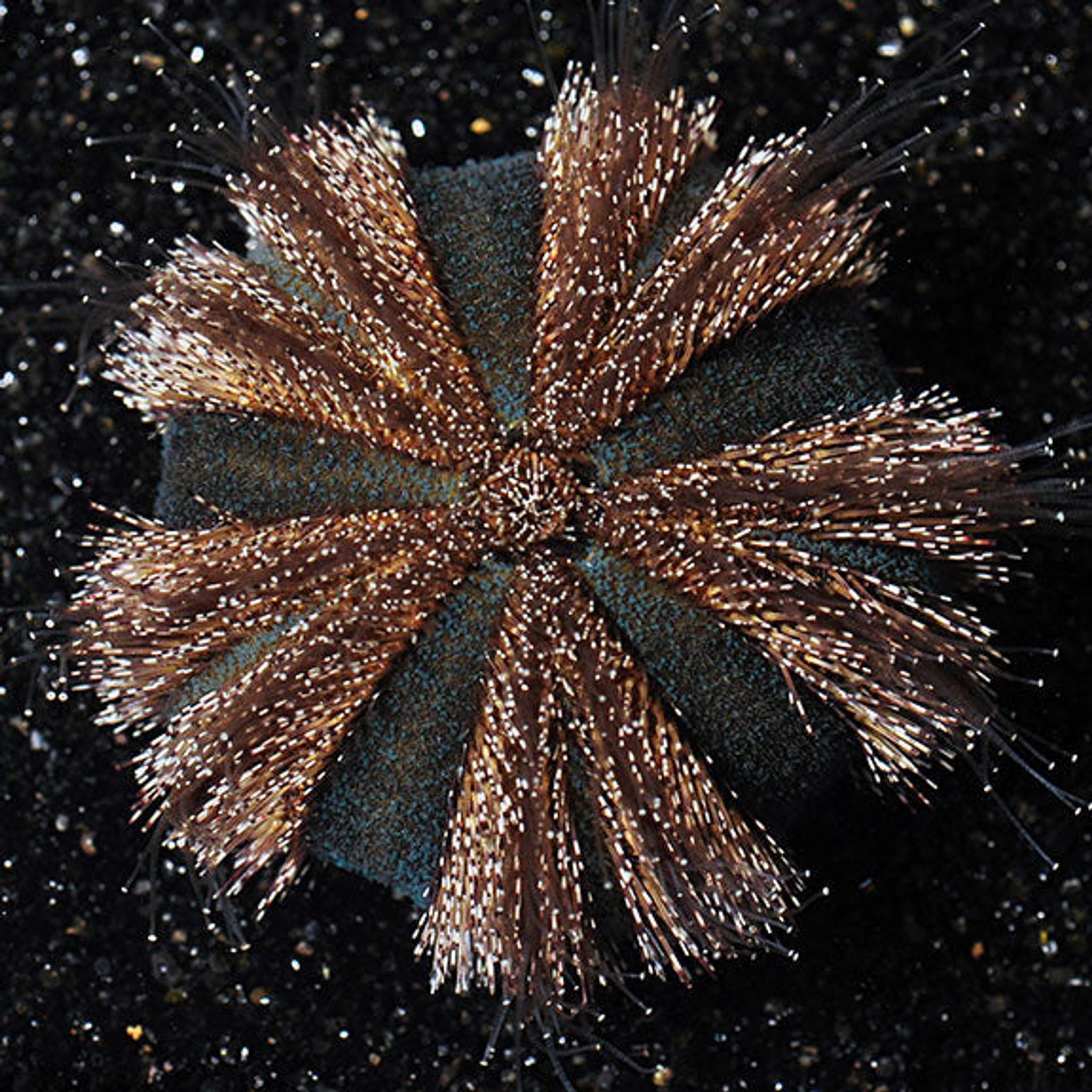
The tuxedo urchin (Mespilia globulus) is a round-bodied sea urchin native to Indo-Pacific reefs, popular in the marine aquarium trade as a clean-up crew specialist rather than a display centerpiece. Its name comes from the banded pattern of alternating dark (often blue-black) and brightly colored (orange, red, green, or white) spines that circle its rounded test, or shell, giving it a formal, striped look.
At the store, look for:
- A rounded, globe-like test (shell), roughly 2–3 inches (5–7.5 cm) across in adults, not counting spines.
- Short, evenly spaced spines in an alternating banded pattern — distinct from the long, thin, all-dark spines of a long-spine urchin or the dense, uniform, pincushion look of a pincushion urchin.
- Spines that respond to a light touch by moving toward the stimulus, and a firm grip on the glass or rock.
Getting the ID right matters, because some visually similar urchin species are more aggressive grazers or have longer, more hazardous spines. If a dealer tank isn't labeled, ask, or compare the spine pattern and test shape against reference photos before buying.
Is a Tuxedo Urchin Reef Safe? The Real Answer
The short answer is yes: a tuxedo urchin is considered reef safe with soft corals, LPS, and SPS. It's an herbivore-leaning omnivore that grazes algae and detritus off rock and glass, and it has no interest in eating healthy coral polyps.
The nuance is that "reef safe" doesn't mean "harmless to everything in the tank." The actual risk with this species is mechanical, not predatory:
- As it forages, it moves across rockwork and glass, sometimes climbing over frags, loose rubble, or shells.
- It commonly picks up empty shells, small snails, or bits of rubble and holds them on its spines for camouflage — completely normal foraging behavior, not aggression.
- In the process, it can knock over unsecured frags, dislodge loose rock, or nudge LPS heads while climbing past them.
Some grazing trials also suggest the opposite effect: by keeping rock surfaces clear of competing algae, a healthy urchin population can modestly support coral growth and survival rather than hinder it. So the coral relationship is generally positive, provided the aquascape underneath it is stable.
Practical fix: glue or firmly wedge every frag and piece of rockwork in place before adding a tuxedo urchin, or any bottom-grazing invertebrate for that matter. Treat this as a standing rule, not an urchin-specific one.
Fish Compatibility
Tuxedo urchins are peaceful and largely ignored by, and indifferent to, the vast majority of reef fish. Clownfish, gobies, blennies, most tangs, and most wrasses coexist with them without issue.
Two groups are worth avoiding on purpose:
| Fish group | Risk to tuxedo urchin |
|---|---|
| Clownfish, gobies, blennies, most tangs, most wrasses | Low — generally ignore urchins |
| Triggerfish | High — known to pick apart or eat urchins despite spines |
| Puffers and other crushing-jaw fish | High — crushing jaws can break through spines and test |
| Larger, invertebrate-crunching wrasses | Moderate — case-by-case, but worth screening for |
If you're stocking a mixed reef and want to keep a tuxedo urchin long-term, screen new fish additions against this list before you buy. FishHub's triggerfish and puffers listings are useful for double-checking a species before it goes in the same tank as an urchin.
Invertebrate Compatibility
Tuxedo urchins are generally compatible with most other reef invertebrates:
- Cleaner shrimp — no conflict under normal conditions.
- Hermit crabs and snails (trochus, cerith, nassarius) — coexist fine; different feeding niches mean minimal competition.
- Other urchins and starfish — compatible, and multiple tuxedo urchins can be kept together (see stocking density below).
The one caveat: hermit crabs and some opportunistic fish may pick at an urchin that is already stressed, injured, or mid-molt and shedding spines. A weakened urchin looks vulnerable, and tankmates that would normally leave it alone may take advantage. This is a symptom of an already-struggling animal, not a sign that those tankmates are generally dangerous.
One thing a tuxedo urchin will not do is control pests. It won't touch flatworms, aiptasia, or other nuisance organisms — don't rely on it as a cure-all clean-up crew member if you're dealing with a pest outbreak; address those separately.
Tank Requirements and Water Parameters
Tuxedo urchins need an established tank with mature live rock, not a freshly cycled setup. A brand-new tank hasn't built up the algae film and biofilm the urchin depends on for food, and adding one too early is a common way owners end up with a slowly starving animal.
Tank size: Sources disagree here — some cite 15 gallons as workable, others recommend 30+ gallons. A sensible middle ground: treat 20 gallons (76 L) as an absolute floor, and aim for 30+ gallons (114+ L) established for realistic long-term success, since a bigger tank sustains more natural grazing area. For multiple urchins, budget roughly one per 30–50 gallons (114–190 L) depending on how much natural algae the tank produces.
Water parameters:
| Parameter | Target range |
|---|---|
| Temperature | 72–80°F (22–27°C) |
| Specific gravity / salinity | 1.021–1.026 |
| pH | 8.0–8.4 |
| Alkalinity | ~8–11 dKH |
| Ammonia / nitrite | 0 ppm |
| Nitrate | Under 10–20 ppm; aim for 0–5 ppm |
Nitrate deserves special attention. Sources vary between a 10 ppm and 20 ppm ceiling — treat 20 ppm as an absolute upper limit, not a target, and keep nitrate as close to 0–5 ppm as your system allows. Tuxedo urchins are notably nitrate-sensitive and are often described as a bioindicator of overall tank water quality: when parameters drift, they tend to show it before fish do.
Diet and Feeding
Tuxedo urchins are omnivores that lean herbivorous, grazing on:
- Filamentous hair algae
- Film and diatom algae
- Cyanobacteria, to some extent
- Coralline algae
- General detritus on rock and glass
If coralline algae is the only food source left in the tank, the urchin will eat that too — the bald patches this leaves on rockwork can look alarming but aren't harming any livestock. If you notice coralline being grazed down faster than it regrows, that's a sign to supplement feeding and give coralline time to recover, rather than removing the urchin.
Supplemental feeding: when natural algae growth is thin, offer dried seaweed or nori sheets, algae wafers, or blanched vegetables two or three times a week. Since tuxedo urchins are mostly nocturnal, spot-feeding after lights-out reduces competition with fish and takes pressure off coralline algae.
Acclimation, Lifespan, and Health Signs
Acclimation: Use a slow drip acclimation over 1–2+ hours minimum. Tuxedo urchins are highly sensitive to sudden salinity or pH shifts, and fast acclimation is one of the most common causes of early death or rapid spine loss after purchase.
Lifespan: Typically 1 to 3 years in a home aquarium with stable water quality, though wild specimens can live considerably longer. Where a tuxedo urchin falls short of that range, poor water quality or rough acclimation and shipping stress are the usual culprits — not simply old age.
Health red flags to watch for:
- Spine loss or thinning
- Tube feet that no longer grip rock or glass firmly
- Sitting motionless out in the open during daylight hours (a mostly nocturnal animal doing this is a warning sign)
If you see any of these, test nitrate and salinity first before assuming the worst — these are the two parameters most often behind a struggling urchin.
Choosing a Healthy Specimen
Before buying, check for:
- A firm grip on rock or glass in the dealer tank — an urchin that's loose, sliding, or sitting upside down is a poor sign.
- Spines held upright and responsive — gently observe (don't handle) and look for spines that move toward a nearby touch or shadow.
- No bald patches or areas of missing spines on the test.
Ongoing Maintenance
Keep up with 10–25% partial water changes every 2–4 weeks and consistent dosing to hold alkalinity and salinity steady. Because tuxedo urchins react early to water quality decline, treating them as a bioindicator — checking on them as part of your regular tank walk-through — can flag problems before they show up in fish.
A Note on Sourcing and Handling
Most tuxedo urchins sold in the US aquarium trade today are aquacultured (captive-bred) rather than wild-collected, which tends to mean sturdier, better-acclimated stock and a lighter footprint on wild reef populations — worth factoring in when comparing suppliers.
Quarantine protocols for echinoderms are rarely discussed because most inverts, urchins included, don't tolerate typical QT medications well and are usually acclimated directly into the display. If you do want a buffer period, a bare, algae-fed holding tank with matched parameters (no medication) for a week or two is a more realistic approach than a standard fish QT routine.
When handling a tuxedo urchin — for aquascaping or moving it — use gloves or tongs. Its spines are short and considered low-risk compared to long-spine urchins, but they can still pierce skin, and some urchin species carry mild venom or irritation.
Common Mistakes to Avoid
- Adding one to a brand-new or low-algae tank and then wondering why it's constantly wandering or losing condition — stock only once algae film is established, or supplement feed from day one.
- Skipping slow acclimation — leads to spine loss or death within days.
- Leaving frags and rockwork unglued — the urchin will knock them over or carry pieces off as it forages.
- Letting nitrate creep up unnoticed — spine loss is often the first visible symptom, so test before assuming age or shipping stress.
- Mixing with known invertebrate-crunchers like triggerfish or puffers — pick tankmates deliberately.
- Assuming "reef safe" means "risk-free" — it won't eat coral, but it can still physically disturb an unsecured aquascape.
Frequently Asked Questions
Will a tuxedo urchin eat my coral?
No. It doesn't consume healthy coral tissue. The real risk is physical — bumping or dislodging unsecured frags while grazing — not predation on coral itself.
Is it reef safe with SPS, LPS, and soft corals?
Yes, it's generally compatible with all three coral types. The main precaution is securing frags and rockwork so the urchin can't knock anything loose while climbing.
What fish should I avoid keeping with a tuxedo urchin?
Avoid triggerfish, puffers, and other crushing-jaw or invertebrate-eating fish, which will pick at or eat urchins despite their spines. Most other reef fish, including clownfish, gobies, blennies, tangs, and wrasses, coexist peacefully.
How big of a tank do I need?
At least 20 gallons (76 L) as a minimum, but 30+ gallons (114+ L) established with mature live rock and existing algae growth gives better long-term results.
What do tuxedo urchins eat?
Mainly filamentous hair algae, film and diatom algae, coralline algae, and detritus. If natural algae runs low, supplement with dried seaweed, nori, algae wafers, or blanched vegetables a couple of times a week.
How long do tuxedo urchins live?
Commonly 1 to 3 years in a home aquarium with stable water quality, though they can live longer under excellent conditions. Shorter lifespans usually trace back to poor water quality or rushed acclimation.
Why is my urchin losing spines?
Usually elevated nitrate, poor acclimation, or general water quality stress. Test nitrate and salinity first, then correct with a water change rather than assuming it's simply aging.
Can I keep multiple tuxedo urchins together?
Yes, they're generally compatible with each other and with other urchin species. Stocking density should scale with available algae, roughly one urchin per 30–50 gallons (114–190 L).
Ready to add one to your clean-up crew? Browse available specimens and reef-compatible tankmates in FishyHub's Marine Invertebrates category, and check current stock in Corals before you finalize your aquascape.


