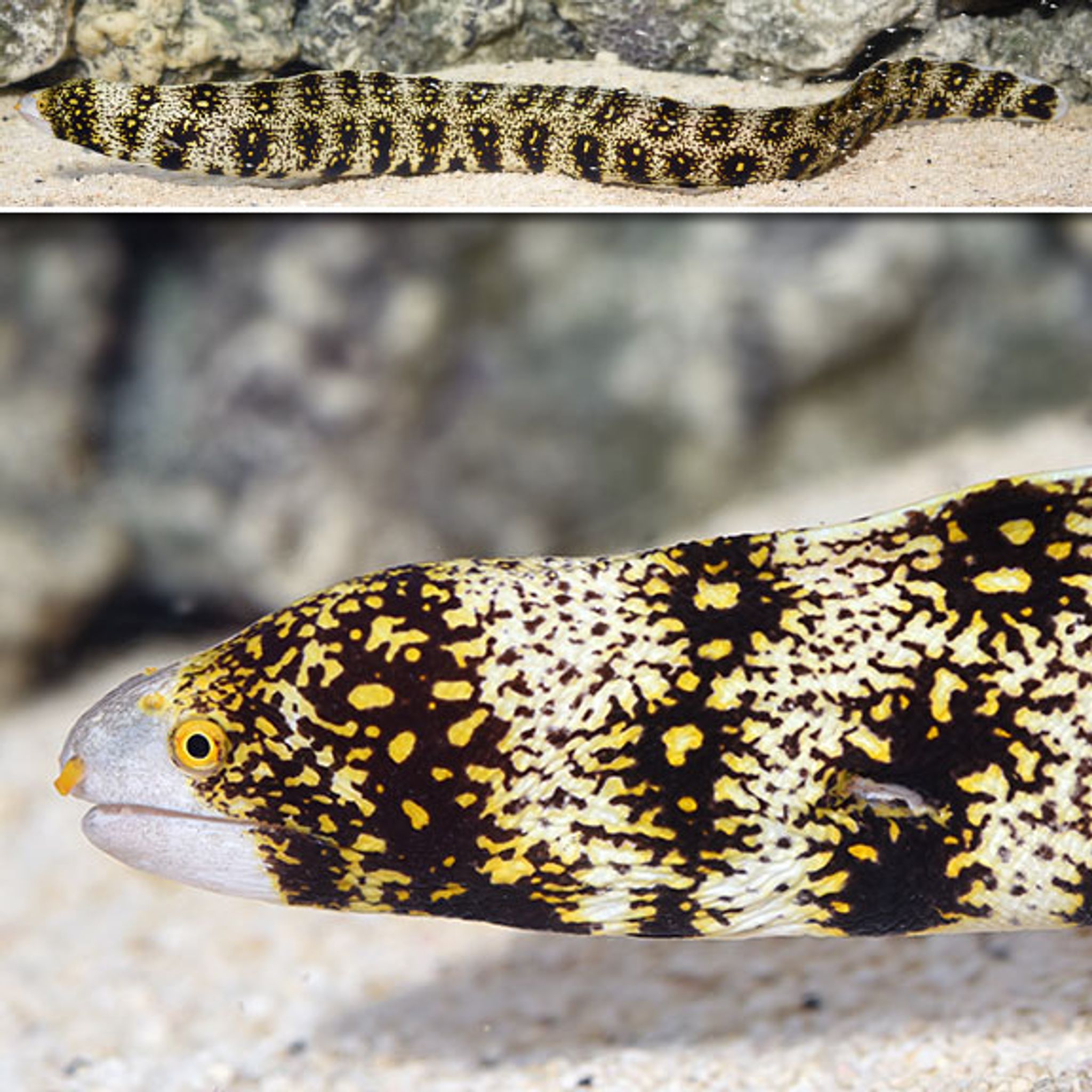
Is Snowflake Eel Reef Safe? Coral and Invertebrate Compatibility Explained
A snowflake eel (Echidna nebulosa) is fully coral-safe but not fully reef-safe — those are two different questions. It will leave every SPS frag, LPS colony, soft coral, and anemone completely alone, but it will happily eat cleaner shrimp, crabs, and snails if given the chance. The honest label is "reef safe with caveats," and this guide breaks down exactly what that means for stocking decisions.
Coral Safety: Why the Answer Is a Clear Yes
Corals and other sessile invertebrates are simply not on a snowflake eel's radar as food. Its hunting behavior is driven almost entirely by smell and movement — it tracks scent trails released by injured or moving prey and strikes at things that swim, crawl, or twitch. A coral polyp has no scent trail worth chasing and doesn't move, so it never triggers a feeding response.
Physically, the eel also poses no structural threat to coral:
- It doesn't graze on coral tissue or skeleton the way some fish species do.
- It has no interest in polyps, mucus, or zooxanthellae as a food source.
- Its body is smooth and flexible enough to move through rockwork without abrading coral colonies, provided the aquascape is stable (more on that below).
This is why a snowflake eel can share a tank with SPS and LPS corals, soft corals, mushrooms, and anemones with essentially zero risk to the coral itself. Anxious reef keepers can stock corals around a snowflake eel without hesitation — the risk in this hobby is entirely on the invertebrate side, not the coral side.
Why "Reef Safe" Is the Wrong Question for Invertebrates
The confusion starts because "reef safe" gets used as a single yes/no label, when it really needs to be split into two separate compatibility questions: safe with corals, and safe with mobile invertebrates. Some care guides call snowflake eels "not reef safe" outright, lumping coral safety and invertebrate safety together. Others draw the distinction clearly. The more useful framing is this: coral-safe, invertebrate-risky — and the decision comes down to what else lives in your tank, not a blanket verdict.
In the wild, a snowflake eel's diet is crustaceans first (crabs and shrimp), with small fish and mollusks eaten opportunistically. That natural diet doesn't change in captivity just because the crustacean in question is an ornamental cleaner shrimp instead of a wild crab.
Invertebrates at Risk
| Invertebrate | Risk level | Notes |
|---|---|---|
| Cleaner shrimp, peppermint shrimp | High | Natural prey item; frequently eaten |
| Camel shrimp, coral banded shrimp | High | Same crustacean profile as natural prey |
| Emerald crabs, sally lightfoot, arrow crabs | High | Ornamental crabs are readily hunted |
| Hermit crabs | High | Shell offers little protection from an eel's jaws |
| Snails | Low-moderate | Not a preferred prey item, but larger eels may disturb or crush them |
| SPS/LPS/soft corals, anemones | None | Not part of the diet at any life stage |
If your reef relies on a cleanup crew of shrimp and crabs, a snowflake eel is a poor match. If your cleanup crew leans on snails and you can accept occasional losses among faster-moving crustaceans, compatibility improves substantially.
How Risk Changes as the Eel Grows
One thing most care guides skip is that predation risk isn't fixed — it scales with the eel's size and age, and it's worth planning around rather than discovering the hard way.
- Juvenile (under 12 in / 30 cm): Lower hunting drive, smaller mouth gape. Small invertebrates and slender fish are at somewhat reduced risk simply because the eel can't yet handle larger prey efficiently.
- Subadult (12–24 in / 30–61 cm): Hunting behavior becomes more confident and food-motivated. This is typically when shrimp and crab losses start showing up in mixed reefs.
- Adult (24–36 in / 61–91 cm): Full adult size and appetite. Nearly any crustacean or bite-sized fish in the tank is fair game, especially at night.
A practical rule: treat 18–24 inches as the point to reassess your stocking list. Inhabitants that coexisted peacefully with a young eel may no longer be safe once it matures.
Fish Tank Mates
Snowflake eels are generally peaceful toward fish too large to swallow, and many reef keepers successfully house them alongside larger, faster community fish. The risk concentrates on small, slender, or slow-moving species — think gobies, small wrasses, firefish, and clownfish — particularly:
- At night, when the eel is most active and fish are less alert.
- When the eel is underfed and more opportunistic about supplementing its diet.
- As the eel approaches full adult size and can handle larger prey.
Behavioral cues that predation risk is rising are worth watching for before you lose a fish: increased daytime activity outside its hiding spot, the eel repeatedly patrolling the glass or substrate at feeding time, and noticeably more aggressive lunging during feeding. A well-fed, calm eel that stays reclusive by day is a lower-risk eel; one that's constantly cruising and food-seeking is telling you it wants more calories than it's getting.
Tank Size, Aquascape, and Escape Prevention
Snowflake eels commonly reach 24–36 inches as adults, and their housing needs to be planned for that adult size from the start, not the size they arrive at.
- Minimum tank size: 30 gallons (114 L) is workable for a small juvenile short-term, but 75–100+ gallons is the realistic long-term minimum once the eel approaches adult length. Ranges as low as 30 or 55 gallons show up across different sources as "the minimum" — the safest read is that 30 gallons buys time, not permanence.
- Aquascape: Provide abundant rockwork with caves and crevices for daytime hiding. Snowflake eels burrow, so rock should be secured or epoxied together — loose rock can topple overnight, cracking glass or crushing corals underneath it.
- Lid: A tight-fitting, weighted, or clipped lid is non-negotiable. Snowflake eels are notorious escape artists that can exploit surprisingly small gaps, including around cords, overflow boxes, and unsealed corner seams.
- Plumbing protection: Cover intakes, overflow gaps, and powerhead openings. These are strong swimmers and diggers, and an unprotected opening can injure or trap an eel.
You can browse live specimens and compare sizing options among the marine eels available on FishyHub before deciding on tank dimensions.
Water Parameters
The eel itself has no special reef-chemistry requirements — standard reef parameters work fine, and corals should drive your target ranges, not the eel:
| Parameter | Target range |
|---|---|
| Temperature | 72–80°F (22–27°C) |
| pH | 8.1–8.4 |
| Specific gravity | 1.020–1.025 |
| Alkalinity, calcium, magnesium | Standard reef ranges |
Feeding Without Losing Fingers or Tank Mates
Snowflake eels are strict carnivores. Offer meaty marine foods — silversides, shrimp, squid, clam, and mussel — 2–3 times per week using feeding tongs or a feeding stick, never bare hands. Eels have poor eyesight and hunt largely by smell, so a hand that smells like food can get bitten by mistake, not aggression.
Two feeding mistakes drive most of the invertebrate and fish losses reported in mixed reefs:
- Underfeeding. A hungry eel is a more opportunistic hunter. Keeping a consistent 2–3x weekly schedule reduces the incentive to pick off tank mates.
- Overfeeding. Leads to obesity over time; portion meals rather than feeding to excess.
Introducing a Snowflake Eel Into an Existing Reef
Sequencing matters more than most guides mention. Adding a snowflake eel to an already-established reef with resident shrimp and crabs means those animals are immediately at risk from day one — there's no "settling in" period where the eel ignores them. The lower-risk approach is to decide on your invertebrate cleanup crew around the eel from the start: stock hardier, faster snails and skip shrimp and small ornamental crabs entirely, rather than adding an eel to a tank that already has an established shrimp population.
If you already have a shrimp- or crab-heavy cleanup crew and want an eel anyway, expect losses and plan a cleanup crew alternative — larger, faster-moving snail species tend to fare better than shrimp or crabs, since they're not a preferred prey item and can retreat into their shells.
Quarantine and Acclimation
Like most moray relatives, snowflake eels are prone to bacterial and fungal skin issues from handling and shipping stress. Drip acclimate new arrivals slowly and quarantine before introducing them to the display tank — skipping this step is one of the more common causes of early losses in wild-caught morays.
Snowflake Eel vs. Banana Eel: Not the Same Animal
These two get confused often enough to warrant a direct comparison. The banana eel (Gymnothorax miliaris, sometimes sold as the yellow form of the fire or fireworks eel) is a distinct species — bright yellow with black spots, more aggressive in temperament, and requiring a larger tank of 100+ gallons. It is decidedly not invertebrate-safe and should not be treated as a reef-community substitute for the snowflake eel. If invertebrate compatibility matters to your stocking plan, don't assume the two are interchangeable.
Frequently Asked Questions
Will a snowflake eel eat my coral?
No. Corals are not part of a snowflake eel's diet, and it's considered fully coral-safe for SPS, LPS, soft corals, and anemones alike.
Can I keep shrimp with a snowflake eel?
Not reliably. Cleaner shrimp, peppermint shrimp, and similar ornamental shrimp are natural prey items and are frequently eaten, especially as the eel matures.
What about hermit crabs and snails?
Hermit crabs and other crabs are at high risk since their shells offer little real protection. Snails are generally safer because they're not a preferred prey item, though larger eels may still disturb or crush them.
Is a snowflake eel reef safe overall?
Yes for corals, no for most crustaceans. The most accurate description is "reef safe with caveats," not fully reef safe.
How big of a tank does a snowflake eel need?
A minimum of 30 gallons (114 L) works for a juvenile, but plan for 75–100+ gallons as it approaches its adult length of 2–3 feet.
Can snowflake eels live with fish?
Yes, most fish too large to swallow are safe. Avoid very small or slender fish like gobies and firefish long-term, since risk increases as the eel grows and becomes more food-motivated.
Do snowflake eels really escape tanks?
Yes. They're known escape artists that can exploit small gaps around lids, cords, and overflow boxes, so a secure, weighted or clipped lid is essential.
Is the banana eel the same as a snowflake eel?
No. It's a separate, more aggressive species that needs a larger tank and is not a reef-community-friendly substitute for the snowflake eel.
If you're weighing a snowflake eel against your existing invertebrate stock, it helps to review compatible options directly — browse marine invertebrates and coral species on FishyHub to plan a stocking list that fits your tank's specific mix of tank mates.

