
Is Queen Angelfish Reef Safe? Coral and Invertebrate Compatibility Explained
No, the Queen Angelfish (Holacanthus ciliaris) is not reef safe. This isn't a "sometimes" case the way it is with many dwarf angelfish — nearly every source agrees this species will target soft corals, LPS, SPS, clam mantles, and other sessile invertebrates on sight. If you love the color but want to keep a reef, the good news is there are practical alternatives below.
Why Queen Angelfish Eat Corals
The coral-nipping isn't random bad behavior — it's biology. In the wild, Queen Angelfish feed heavily on sponges, along with algae, tunicates, hydroids, and coral polyps. Sponge material makes up a large share of their natural diet, and that feeding instinct doesn't switch off in an aquarium.
When a captive Queen Angelfish encounters a coral colony, it's reading the same cues that tell it "food" on a wild reef. Zoanthids, mushroom corals, and LPS polyps look and taste like the sessile invertebrates it has evolved to graze on. This is also why diet matters so much in captivity: a fish that isn't getting enough sponge-based or algae-based nutrition is more likely to redirect that foraging drive toward whatever corals are in the tank.
What Corals and Invertebrates Are at Risk
Essentially any sessile (non-mobile) invertebrate should be considered vulnerable. The table below breaks down relative risk based on consistent reports across the hobby.
| Invertebrate Type | Risk Level | Notes |
|---|---|---|
| Soft corals | Very high | Frequently targeted and often stripped down |
| LPS corals | Very high | Fleshy polyps are a preferred target |
| SPS corals | Very high | Polyps picked at even on hard skeletons |
| Zoanthids | Very high | Commonly grazed to bare rock |
| Mushroom corals | Very high | Soft tissue is an easy target |
| Clam and bivalve mantles | Very high | Exposed mantle tissue is a preferred food |
| Anemones | High | Some anemone species are damaged or consumed |
| Ornamental sponges | High | Directly matches natural wild diet |
| Tube worm crowns | Moderate-high | Feathery crowns often nipped when extended |
| Feather dusters, rock-dwelling crustaceans | Lower, not guaranteed | Left alone more often, but not a safe bet long-term |
The pattern across sources is consistent: total loss of most soft, LPS, and SPS corals, plus clam mantles, is the expected outcome — not an occasional nip here and there. Rock-dwelling fauna like feather dusters have somewhat better survival odds simply because they're less exposed, but nothing sessile in the tank should be assumed safe.
Tank Size and Water Parameters
Queen Angelfish grow large — up to about 18 inches, making them one of the biggest marine angelfish species commonly kept. That size alone rules them out of most reef tanks, which tend to be smaller, more delicately balanced systems built around coral health rather than a large, waste-producing fish.
Tank size guidance:
- Juveniles can start in a tank around 180 gallons (680 L), but they will outgrow it.
- Adults need 220–250+ gallons (830–950+ L). Treat 250 gallons as the safe target for a fully grown fish rather than the minimum.
- Sources vary between 220 and 250 gallons as the cited minimum, so planning for the higher number avoids having to upgrade later.
Water parameters are standard for Atlantic reef fish, but this species is noted as particularly sensitive to instability:
| Parameter | Target Range |
|---|---|
| Temperature | 72–78°F (22–26°C) |
| pH | 8.1–8.4 |
| Specific gravity | 1.020–1.025 |
| dKH | 8–12 |
Because Queen Angelfish are sensitive to poor or fluctuating water quality, the system needs to be pristine and well-established before adding one — not a tank still cycling or working through early nitrate spikes.
A Fish-Only or FOWLR Setup That Actually Works
Since a mixed reef is off the table, the realistic path is a fish-only-with-live-rock (FOWLR) display built around this fish rather than around corals.
Key elements:
- Ample rockwork for grazing, hiding, and establishing territory — this also supports the fish's natural foraging behavior in a way that doesn't put corals at risk.
- Strong filtration and skimming. A fish this large is a heavy waste producer relative to typical reef-tank bioload, so oversize the protein skimmer and filtration compared to what a coral-focused tank of the same volume would need, and stay on top of regular water changes.
- Quarantine before adding. Given how sensitive this species is to water quality and disease stress, a dedicated quarantine period before introduction is worth the extra weeks, even though it's often skipped for hardier fish.
- Stocking order matters. Queen Angelfish are semi-aggressive and territorial as adults, so add them last, after other tankmates are established. Introducing one too early can trigger aggression toward everything added afterward.
Suitable tankmates are other large, sturdy, non-corallivorous species that can hold their own in a big system: tangs, larger wrasses, triggerfish, and groupers. Avoid combining multiple large, aggressive angelfish species in the same tank. You can browse options for a large FOWLR build, including large marine angelfish and compatible tangs and surgeonfish, on FishyHub.
A Middle-Ground Option for Existing Owners
If you already own a Queen Angelfish and want some invertebrate life without expecting full reef compatibility, a strictly all-or-nothing approach isn't the only option. Hardy macroalgae and some snail or hermit crab species living deep in rockwork can survive better than sessile corals, since they're mobile or less exposed. This isn't a guarantee — treat it as a modest addition, not a stocking plan — but it's a more realistic middle ground than expecting corals to coexist.
Diet and Feeding Schedule
A varied diet fed 2–3 times daily is the standard recommendation, and it directly affects coral-nipping behavior. Foods should include:
- Marine algae and spirulina
- Mysis or frozen shrimp
- Angelfish preparations containing sponge material
- Other meaty marine foods
The sponge-based component matters most. A diet that's low in marine algae or sponge material can worsen coral predation, since the fish continues seeking the nutrition it isn't getting, and can also lead to poor coloration and general health decline over time. Consistent, varied feeding is one of the few levers an owner has to reduce (not eliminate) nipping behavior in a fish-only setting.
Juveniles vs. Adults
Queen Angelfish look and behave differently as they mature:
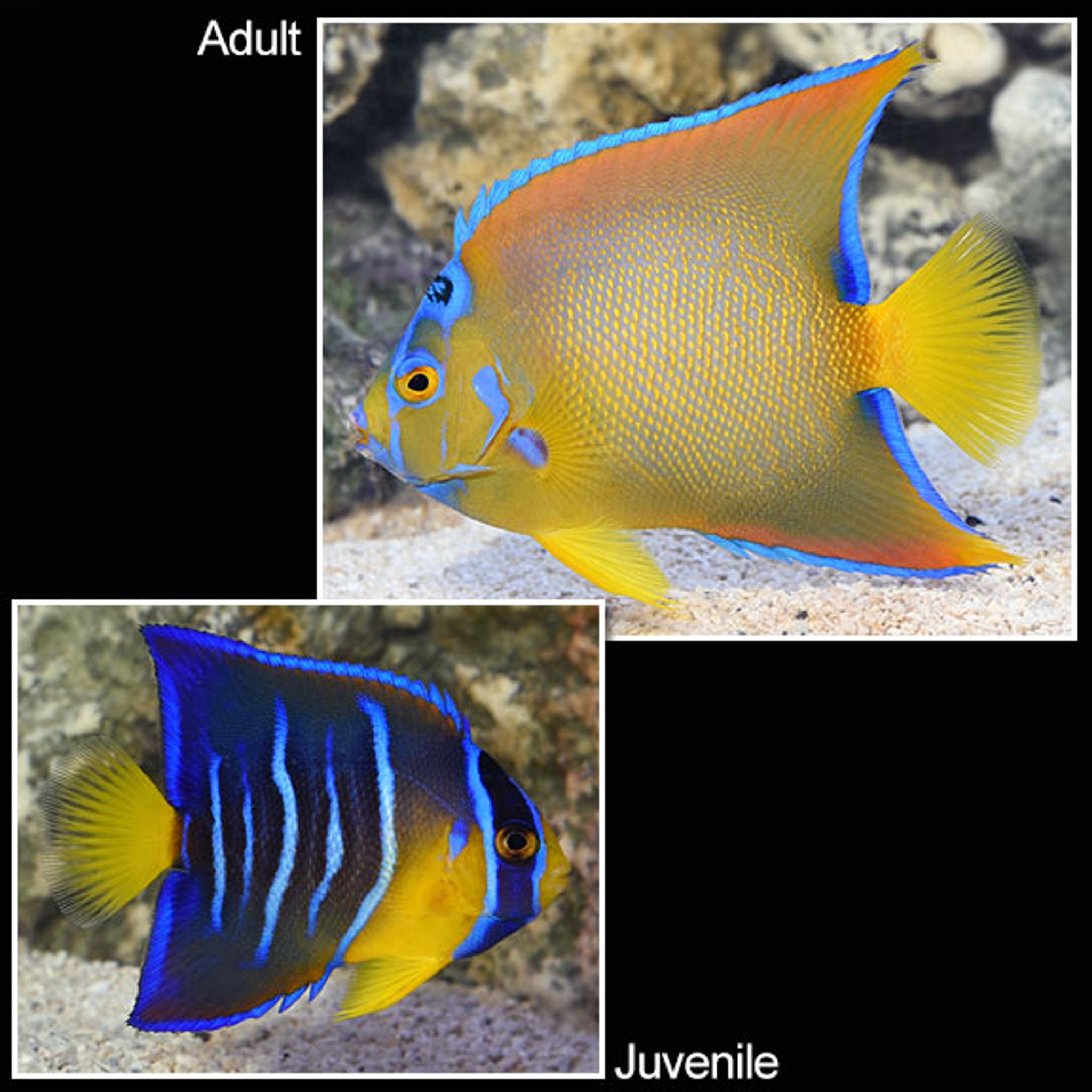
- Juveniles have a dark blue body with a yellow tail, yellow pectoral fin trim, and vertical blue bars. They also function as cleaner fish, picking parasites off larger reef fish at cleaning stations.
- Adults transition to the recognizable blue-and-yellow coloration with a distinctive crown-like spot on the forehead, and the cleaner-fish behavior fades as they mature.
Importantly, there's no reliable "safe window" during the juvenile stage the way there sometimes is with certain dwarf angelfish. Coral-targeting behavior can appear early, and buying a small, inexpensive juvenile without planning for the eventual 250-gallon adult tank is one of the most common mistakes new owners make.
As a brief aside: Queen Angelfish are also known to hybridize with the Blue Angelfish in the wild where their ranges overlap. It's not relevant to reef compatibility, but it's a fact many people researching this species come across.
Common Mistakes to Avoid
- Buying a juvenile without a plan for the 250-gallon system it will eventually need.
- Assuming dwarf angelfish rules apply. "Reef safe with caution" language used for Centropyge species does not transfer to Queen Angelfish — the risk level is categorically higher, not moderate.
- Adding corals "just to test it." Expect significant loss of soft, LPS, and SPS corals and clam mantles, not occasional nipping you can manage around.
- Underfeeding or skipping sponge-based foods, which tends to increase coral-targeting and can dull coloration.
- Adding the fish too early in stocking order, which increases aggression toward tankmates introduced later.
- Letting water quality slip. This species needs stable, high-quality water; instability shows up as stress, disease susceptibility, and poor color.
Reef-Safe Alternatives for Angelfish Color
If the goal is angelfish color and personality in an actual reef tank, dwarf angelfish (genus Centropyge) are the better fit. They're generally rated reef safe with caution rather than outright incompatible, meaning some individual variation exists but the baseline risk is far lower than with large Holacanthus or Pomacanthus species. Options worth considering include:
- Coral Beauty
- Flame Angelfish
- Potter's Angelfish
None of these are guaranteed to ignore every coral in every tank, but the risk profile is a different category entirely from a Queen Angelfish. You can browse the current selection of dwarf angelfish on FishyHub if you want angelfish color without giving up your coral collection.
Frequently Asked Questions
Will a Queen Angelfish eat clams?
Yes. Clam and bivalve mantles are a preferred, frequent target for Queen Angelfish, consistent with the feeding behavior seen in other large angelfish species.
Can I keep a Queen Angelfish with just soft corals or with just LPS?
No. Sources consistently treat essentially all coral types — soft, LPS, and SPS — as at risk, not just the more delicate SPS species. Limiting yourself to one coral category doesn't meaningfully reduce the danger.
Do juveniles behave differently around corals than adults?
Behavior and coloration do shift with age, but there's no reliably reported "safe window" for juveniles the way there sometimes is with certain dwarf angelfish. Coral-targeting can occur at any life stage.
What tank size do I actually need?
Plan for 250+ gallons (950+ L) for a fully grown adult. A tank around 180 gallons (680 L) can house a juvenile temporarily, but the fish will outgrow it.
What should I feed a Queen Angelfish to reduce coral nipping?
Offer a varied diet including marine algae, spirulina, mysis or frozen meaty foods, and sponge-based angelfish preparations, fed 2–3 times daily. This won't guarantee coral safety, but a nutrient-poor diet tends to make nipping worse.
Are there any angelfish that are actually reef safe?
Certain dwarf angelfish (Centropyge species) such as the Coral Beauty, Flame Angelfish, and Potter's Angelfish are commonly rated reef safe with caution. Large Holacanthus and Pomacanthus species like the Queen Angelfish are not in the same risk category.
Can live rock invertebrates like feather dusters survive with a Queen Angelfish?
They have better survival odds than corals since they're less exposed, but they aren't guaranteed safe, especially over the full lifespan of the fish.
Is the Queen Angelfish good for a beginner reef tank?
No. The combination of large adult size, territorial aggression, strong coral-predation instincts, and sensitivity to water quality makes it a poor fit for most home reef tanks, regardless of the keeper's experience level.
If you're planning a large FOWLR display built around a fish like this, or want to compare coral-safe alternatives instead, you can explore the full range of marine livestock available on FishyHub to find the right fit for your system.


