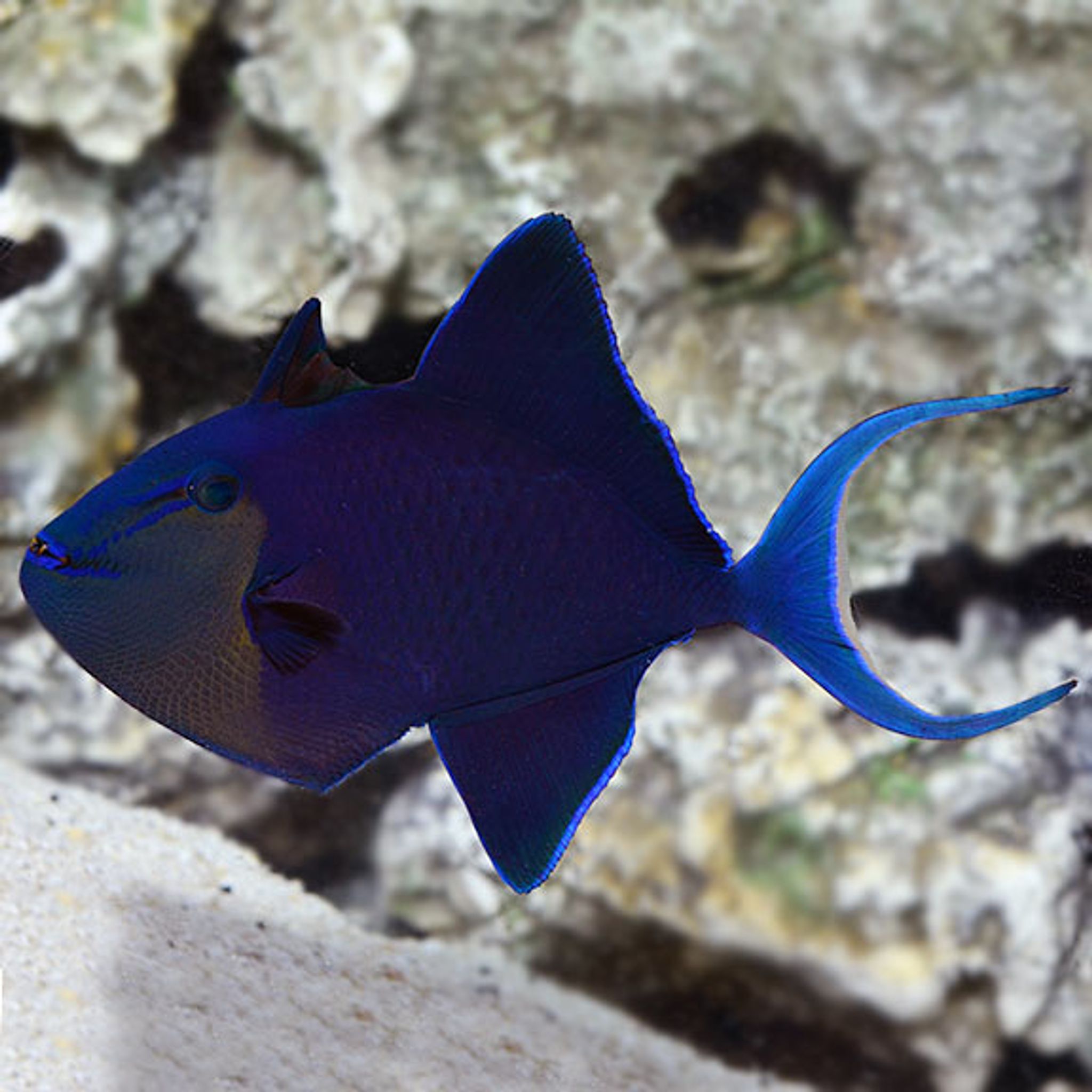
Is Niger Triggerfish Reef Safe? Coral and Invertebrate Compatibility Explained
A Niger triggerfish (Odonus niger) is coral-safe but not invertebrate-safe, which makes "reef safe" a misleading label for this fish. It will generally ignore hard and soft coral colonies because plankton and sponges make up its natural diet, but it treats shrimp, crabs, snails, and other motile invertebrates as food. The honest answer depends on what you mean by "reef" — and this guide breaks that down so you can stock accordingly.
Species Basics
The Niger triggerfish is sold under several common names — redtooth triggerfish, blue triggerfish, purple triggerfish, and black triggerfish — all referring to the same species, Odonus niger. It's native to reef systems across the Indo-Pacific and Red Sea, where it schools in open water above reef structure, picking zooplankton out of the current.
Key identification and biology points:
- Adult size reaches 16–20 inches (41–51 cm), with some individuals cited as growing to a full 20 in / 50 cm.
- Growth accelerates with age, and the fish becomes noticeably more assertive as it approaches adult size.
- In the wild, its diet consists of zooplankton and sponges — not coral polyps. This is the biological reason keepers often call it "coral safe."
Coral Safe vs. Reef Safe: The Distinction That Matters
These two terms get used interchangeably in the hobby, but they mean different things, and conflating them is the single most common mistake buyers make with this species.
- Coral safe means the fish won't eat coral polyps or tissue. A Niger triggerfish qualifies here for the most part.
- Reef safe implies the fish can live in a fully stocked reef tank — corals, a cleanup crew, ornamental shrimp, and small fish — without doing meaningful harm.
A Niger triggerfish is the first without reliably being the second. It's more accurate to describe it as reef-tolerant: safe around coral colonies, but hostile to nearly everything else that moves along the sand or rockwork.
Coral Compatibility
Most keepers find that a Niger triggerfish leaves established LPS and SPS coral colonies alone, since it isn't hunting coral tissue for food. That said, a few caveats are worth planning around:
- Occasional reports describe nipping at soft coral or LPS flesh, particularly from larger or bored individuals.
- The fish uses coral rubble and skeleton material to file down its beak-like teeth, which grow continuously. This habit can topple frags or shift rock structure even when the coral itself isn't being eaten.
- Indirect damage — a frag knocked loose, a plug buried under displaced sand — is far more common than direct predation on coral tissue.
If you're building out a coral display, browsing options in corals with an eye toward securely mounted colonies rather than loose frags will reduce the risk of accidental toppling.
Invertebrate Compatibility: Where the "Reef Safe" Label Breaks Down
This is the part of the equation most new keepers underestimate. A Niger triggerfish is not safe with motile or ornamental invertebrates. Anything small enough to fit in its mouth, or that moves across the substrate, tends to get treated as a snack sooner or later.
Invertebrates commonly lost to a Niger triggerfish include:
- Cleaner shrimp and peppermint shrimp
- Emerald crabs and hermit crabs
- Snails and small crustaceans generally
- Clams and tunicates
A minority of keepers report a specimen that ignored shrimp or crabs for years. Treat that as luck, not a rule — it isn't a pattern you can plan around, and stocking expensive inverts on the assumption that your fish will be the exception is a gamble, not a strategy.
Rock-Moving and Digging Behavior
Niger triggerfish are active diggers. They rearrange substrate, flip rocks and decor while foraging or establishing nesting sites, and this behavior can crush or bury sessile invertebrates and knock coral frags loose. Deep sand beds are more vulnerable to this kind of disruption than a thin sand layer or bare-bottom setup, since there's more loose material for the fish to excavate and toss around.
Bonded or mated pairs take this further — they can become notably more territorial and dig nesting pits, adding another layer of long-term risk to rockwork and any sessile inverts nearby.
Temperament and Tank Mates
As juveniles, Niger triggerfish rate as one of the more peaceful triggerfish species. That changes with maturity: territoriality and aggression increase as the fish grows and claims space, and adults can bite handlers or other fish, and spit water at the glass or at people nearby.
Good tank mate candidates are similarly sized, robust fish that can hold their own:
| Tank mate type | Examples | Why it works |
|---|---|---|
| Large angelfish | Emperor, queen | Size and temperament match |
| Big tangs | Sohal, unicorn | Fast, not easily bullied |
| Large wrasses | Various robust species | Active swimmers, tough |
| Groupers | Various | Large-bodied, unfazed |
| Moray eels | Various | Occupy different tank zone |
Avoid small, slow, or timid fish — they're at real risk of being chased, bullied, or eaten outright. Browsing the triggerfish category alongside sizing notes for prospective tank mates helps confirm compatibility before you buy.
Tank Size Requirements
Because sources cite different maturity sizes (some as low as 12–16 in, others up to 20 in / 50 cm), it's safest to plan around a conservative 16–20 in adult length and size the tank accordingly. Actual adult size depends partly on tank size and diet, but undersizing the enclosure is the more common failure mode.
- 150 gallons (570 L) is an acceptable starting point for a young or small specimen.
- 180–240 gallons (680–910 L) is recommended long-term, once the fish approaches full adult size.
- The tank needs open swimming room in addition to rockwork with caves and hiding spots — this isn't a fish that thrives packed into heavily aquascaped, tight quarters.
Cramming an adult Niger triggerfish into an undersized tank tends to increase aggression and stress, and can stunt or otherwise compromise healthy growth.
Water Quality and Maintenance
A Niger triggerfish in a reef setup adds a heavier bioload than most reef fish its size, and its messy eating habits put more strain on water parameters than a comparable fish-only system. Plan for:
- Strong filtration and protein skimming sized for a large, messy predator.
- Regular water changes to keep dissolved organics in check.
- Consistent testing of alkalinity, calcium, and pH, since swings here stress coral even when the trigger itself isn't the direct cause.
Adding a Niger Triggerfish to an Existing Reef Tank
If you already have a reef running and want to add a Niger triggerfish, sequencing and process matter more than they would for a smaller, calmer fish.
- Quarantine new arrivals for 2–4 weeks before adding them to the display, to catch disease before it reaches an established system.
- Acclimate slowly — float the bag to match temperature, then use a drip acclimation method rather than a quick dump.
- Rearrange live rock right before or at the moment of introduction. This disrupts existing territorial fish and invertebrates' established boundaries so the newcomer isn't immediately targeted.
- Add the trigger late in the stocking order — after corals and peaceful fish are already established — to reduce the chance it claims the whole tank and bullies everything added afterward.
- Monitor closely for the first 1–2 weeks for aggression toward tankmates or invertebrate disappearances, and have a backup plan (a separate tank, or a return arrangement) ready in case the fish proves incompatible with your setup.
Common Mistakes to Avoid
- Assuming "reef safe" covers invertebrates. It typically refers to coral only — shrimp, snails, and crabs are a separate question entirely.
- Undersized housing. Anything under 150 gallons invites aggression, stress, and poor growth.
- Stocking delicate or expensive inverts anyway. Cleaner shrimp and clams alongside a Niger trigger are a bet you're likely to lose.
- Unsecured rockwork and frags. Digging and rubble-chewing habits topple loose rock; use reef-safe epoxy or structural rock supports (rock stands, egg-crate bases) built to withstand a large fish's excavation.
- Poor stocking order. Introducing the trigger too early lets it claim the tank before others arrive; introducing it too late without rearranging the rockscape can trigger aggression toward established residents.
- Skipping quarantine, risking ich, flukes, or other disease reaching an established reef.
- Underestimating bioload as the fish grows — filtration and skimming need to scale up, not stay fixed at juvenile-stage capacity.
Realistic lifespan in captivity runs 10–20 years, which matters more than it might seem: even a specimen that tolerates invertebrates early on has a long timeline over which that tolerance can change.
Bottom Line
A Niger triggerfish is "reef safe" only in the narrow sense of leaving coral colonies alone. It is not safe for a full reef tank stocked with an ornamental cleanup crew and delicate motile invertebrates. It's best suited to a FOWLR (fish-only-with-live-rock) system, or a reef tank stocked exclusively with coral and no valuable inverts or small fish you'd mind losing.
Frequently Asked Questions
Will a Niger triggerfish eat my coral?
Generally no — it isn't a coral-eating species and mainly feeds on plankton and sponges in the wild. That said, occasional nipping at soft coral or LPS flesh happens, and rock-toppling from its digging habit can indirectly damage coral even when it isn't being eaten.
Can I keep a Niger triggerfish with cleaner shrimp or crabs?
Not reliably. Most Niger triggerfish will eventually eat or harass shrimp, crabs, and snails, so it's best to treat any invertebrate you add as expendable rather than protected.
What tank size does a Niger triggerfish need?
At least 150 gallons (570 L) for a young fish, and ideally 180–240 gallons (680–910 L) for a full-grown adult, given its adult size and need for open swimming room.
Is the Niger triggerfish reef safe overall?
It's coral-safe but not invertebrate-safe, which makes "reef-tolerant" a more accurate description than fully "reef safe."
What fish make good tank mates for a Niger triggerfish?
Similarly large, robust species such as big angelfish, large tangs, big wrasses, groupers, and moray eels. Avoid small or timid fish that could be bullied or eaten.
How aggressive is a Niger triggerfish?
Relatively mild for a triggerfish as a juvenile, but it grows more territorial and assertive with age and size, sometimes nipping tankmates or biting hands during maintenance.
How do I safely add a Niger triggerfish to an existing reef tank?
Quarantine it for 2–4 weeks, acclimate slowly with a drip method, rearrange rockwork at the time of introduction, and add it later in the stocking order after corals and calmer fish are already settled.
What should I feed a Niger triggerfish?
A varied carnivore diet of meaty foods — mysis, silversides, krill, and marine pellets — replicates its natural zooplankton and sponge diet and helps reduce its interest in hunting tankmates.
If you've weighed the trade-offs and a FOWLR or coral-only reef fits your plans, you can browse available specimens under marine fish and pair your stocking list with compatible marine invertebrates sized and chosen with this fish's habits in mind.


