Is Longnose Hawkfish Reef Safe? Coral and Invertebrate Compatibility Explained
A longnose hawkfish is reef safe in the sense that matters most to coral keepers: it does not eat coral tissue and generally leaves stony and soft corals alone. But "reef safe" and "invertebrate safe" are two different questions, and for this species the answers diverge sharply — small ornamental shrimp, crabs, and worms are a genuine risk. This guide breaks down exactly where the danger lies so you can stock around it instead of finding out the hard way.
What Is a Longnose Hawkfish?
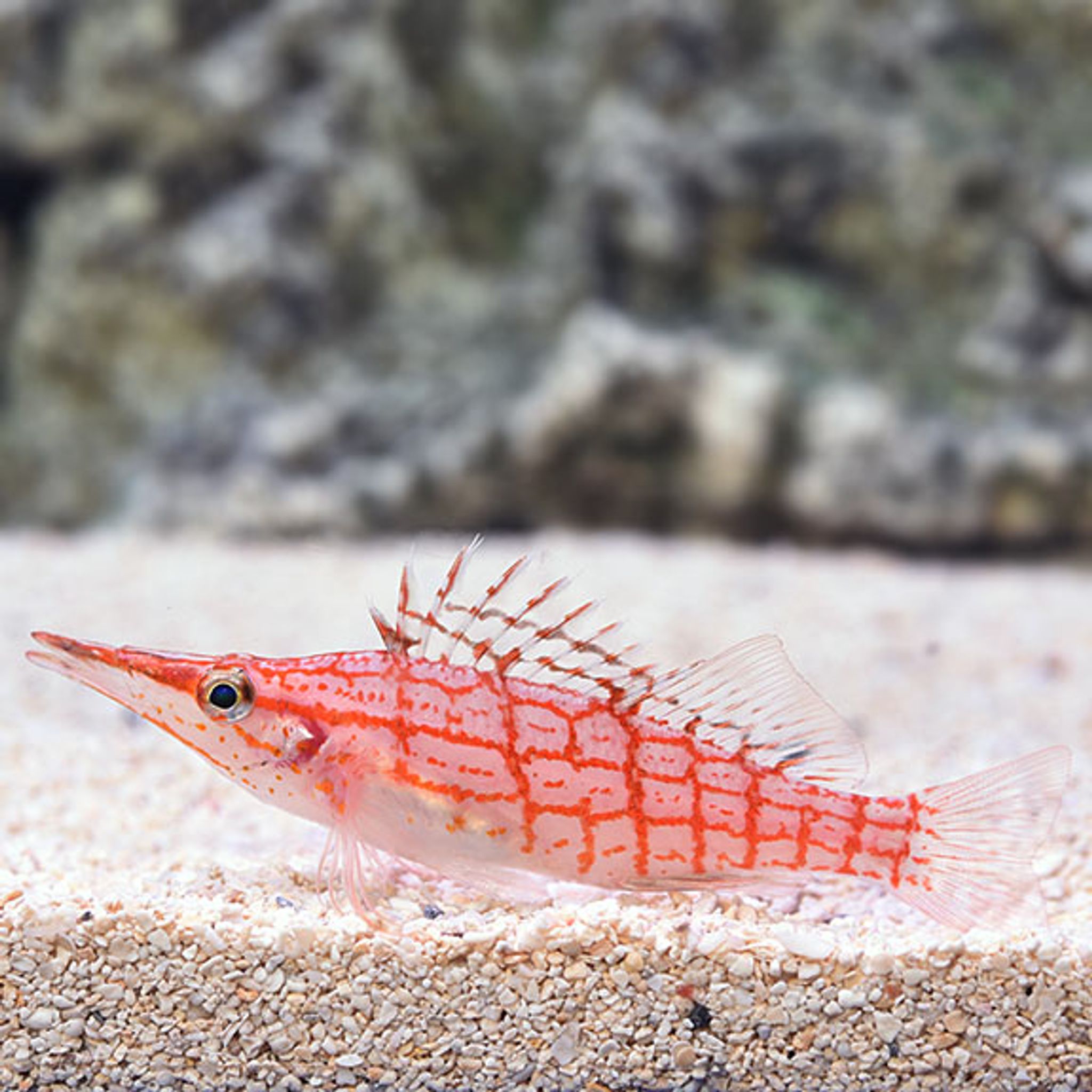
Oxycirrhites typus is easy to identify: an elongated, tweezer-like snout, a mottled red-to-orange lattice pattern over a white body, and a perching posture that sets it apart from typical reef fish. It's native to Indo-Pacific reef slopes and gorgonian fields, where it clings to branches rather than swimming freely.
That perching behavior isn't a quirk — it's biology. Longnose hawkfish lack a functional swim bladder, so sustained open-water swimming is inefficient for them. Instead, they hop from perch to perch and rely on their branches or coral heads as home base, using pectoral fins to brace against coral and rockwork.
This same body plan explains their camouflage strategy. Their lattice pattern breaks up their outline against gorgonian fans and branching coral, letting them disappear into the structure they're resting on. In the wild, that crypsis serves two purposes: hiding from larger predators, and sitting motionless as an ambush predator waiting for smaller prey to wander too close. Keep that dual purpose in mind — it's the key to understanding everything else in this article.
Are Longnose Hawkfish Reef Safe for Corals?
Mostly yes, with a caveat tied directly to their perching habit. A longnose hawkfish doesn't graze on polyps or feed on coral mucus the way some butterflyfish or angelfish do. However, this species tends to adopt one favorite perch — often a gorgonian, birdsnest coral, Stylophora, or another branching SPS colony — and return to it repeatedly.
The issue is mechanical, not dietary:
- Repeated weight and grip on the same branch can cause localized polyp retraction or tissue irritation over weeks and months.
- Delicate or fleshy species (thin-branching SPS, soft-tissue gorgonians) tolerate this poorly and can show tissue recession at the contact point.
- Hardy, encrusting corals (montipora plating forms, many zoanthid mats, thick-branched hardy SPS) generally shrug off occasional perching with no visible damage.
The practical fix is to manage where the fish perches rather than assume it will leave corals alone entirely. Add dead rock, coral skeletons, or a hardy sturdy piece as an obvious, appealing perch site before your prized delicate colonies go in — hawkfish tend to settle on whatever structure is available early and don't relocate often once established.
Anemones and Aggressive Stinging Corals
This pairing flips the usual risk direction. With strong LPS like elegance or torch corals, and with anemones, the hawkfish is often the one at risk. If it brushes against or perches on a heavily-stinging animal, it can get stung and irritated — occasionally fatally in the case of anemones. Keep longnose hawkfish away from aggressive stingers rather than assuming the coral needs protection from the fish.
Invertebrate Compatibility: The Real Risk Category
This is where "reef safe" stops meaning "tank safe." A longnose hawkfish is an opportunistic ambush predator, and its camouflage exists specifically to let it strike at small, mobile invertebrates without warning. Anything that fits in its mouth is fair game — the same lattice pattern that looks decorative while it rests on a branch is the reason a nearby shrimp doesn't see the attack coming.
| Risk level | Invertebrates | Notes |
|---|---|---|
| High risk | Sexy shrimp, anemone shrimp, peppermint shrimp, small hermit crabs, feather duster worms, bristle worms, molting crabs | Soft-shell (molting) crustaceans are especially easy targets |
| Moderate / variable | Cleaner shrimp, fire shrimp | Long-term coexistence is reported often, but not reliable — can turn predatory without warning |
| Lower risk / often safe | Snails, hard-shelled adult hermit crabs, established/burrowed pistol shrimp, sessile invertebrates (corals, sponges, tunicates) | Pistol shrimp should be burrowed in before the hawkfish arrives |
| Caution | Sea stars | Some keepers report targeted predation; treat as unpredictable |
Cleaner Shrimp: Proceed With Caveats, Not Confidence
Cleaner and fire shrimp sit in a genuinely disputed middle ground. Plenty of keepers run them alongside a longnose hawkfish for years without incident; others lose a shrimp within days. There's no reliable rule for predicting which outcome you'll get — it depends on tank size, the amount of cover available, feeding consistency, and the individual fish's temperament. Treat any cleaner shrimp pairing as "possible, not guaranteed," and never advise a customer or fellow hobbyist that it's a safe combination without that caveat attached.
Snails and Hermit Crabs: Usually Fine
Snails and hard-shelled, adult hermit crabs are generally left alone — their shells make them poor targets compared to soft-bodied shrimp. The exception is small or freshly-molted crabs, which lose their protective shell temporarily and become an easy meal during that window.
Tank Setup That Reduces (Not Eliminates) Predation Risk
No amount of rockwork makes a longnose hawkfish fully invertebrate-safe, but setup choices measurably change the odds:
- Tiered live rock with overhangs in the upper two-thirds of the tank gives small crustaceans places to retreat that the hawkfish can't easily reach.
- Larger, more established tanks with abundant rockwork outperform bare or small setups — more surface area means more hiding spots and more natural prey to satisfy hunting instinct.
- A mature tank with a healthy copepod and amphipod population can partially redirect predatory drive away from ornamental shrimp, since the hawkfish has smaller, self-sustaining prey to pick off. This is rarely mentioned but genuinely useful: a young, sparsely-stocked tank offers little pod population and pushes the fish toward your display shrimp instead.
- Spread perch options around the tank rather than concentrating rockwork near one delicate coral colony — this also reduces the mechanical stress problem described above.
Feeding Strategy
A longnose hawkfish should get a varied, meaty carnivore diet: frozen mysis, enriched brine shrimp, chopped krill or other crustacean meat, and marine pellets. Feed adults twice daily, and juveniles more frequently. A well-fed fish is somewhat less motivated to hunt tankmates, but the instinct doesn't go away — heavy feeding reduces predation risk, it does not eliminate it.
Avoid feeding live feeder shrimp or other live invertebrates. Doing so actively reinforces hunting behavior and teaches the fish to view similar-looking tankmates as food.
Tank Size and Physical Setup
| Scenario | Recommended size |
|---|---|
| Single longnose hawkfish, species-only focus | 30 gallons (114 L) minimum |
| Long-term stability | 40+ gallons (150+ L) preferred |
| Mixed with other semi-aggressive fish, or trying to protect invertebrates | 55–75+ gallons (208–284+ L) |
Beyond volume, shape matters. This species perches high and hops between points of structure, so a tall tank (18+ inches / 46+ cm) with vertical rockwork suits it better than a shallow, wide footprint. Longnose hawkfish are also strong jumpers — a tight-fitting lid isn't optional, and a loose or missing one is one of the more common ways this species is lost.
Water Parameters
Nothing unusual here — a longnose hawkfish thrives in standard reef-tank conditions:
- Temperature: 72–81°F (22–27°C)
- pH: 8.1–8.4
- Specific gravity: ~1.023–1.025
- Stable alkalinity, calcium, and magnesium as required for coral health generally
The fish itself is hardy and adaptable; parameter stability matters more for your corals and invertebrates than for the hawkfish specifically.
Temperament and Tankmates
Longnose hawkfish are semi-aggressive but not bullies toward differently-shaped or niche fish. They're territorial mainly toward other hawkfish or similarly-shaped perching species, so keep only one per tank unless the aquarium is large enough to divide territory. They generally coexist fine with larger, confident tankmates that won't be intimidated by their presence.
Lifespan and Breeding
With good care, a longnose hawkfish typically lives 5–7 years in captivity, matching wild population estimates. Breeding, on the other hand, is essentially off the table for home aquarists — a handful of documented spawning events with courtship displays and external fertilization exist, but there are no reported cases of captive fry surviving to date. Treat captive breeding as not achievable rather than a realistic goal.
Quarantine Before Reef Introduction
Longnose hawkfish are hardy fish, but that doesn't mean quarantine is unnecessary. Standard quarantine practice before introducing any new fish to an established reef still applies — it protects your existing coral and invertebrate population from parasites or disease the fish might be carrying, independent of the compatibility questions covered above.
A Quick Go/No-Go Checklist
Before adding a longnose hawkfish to a reef tank, run through this:
- Tank size: At least 30 gallons, ideally 40+, and 55–75+ if invertebrates are a priority.
- Existing invert stock: Are there small ornamental shrimp, small hermit crabs, or feather dusters already in the tank? If yes, understand you're accepting real risk to them.
- Coral type: Is your primary coral collection hardy/encrusting, or delicate branching SPS and gorgonians? The latter needs a dedicated sturdy perch site set up in advance.
- Rockwork: Tiered, with multiple overhangs and hiding spots — not a sparse or bare-bottom setup.
- Lid: Tight-fitting, no gaps.
- Feeding plan: Twice-daily meaty diet ready from day one, no live feeder inverts.
If most of these check out, a longnose hawkfish can be a striking, low-maintenance addition. If you're stocking valuable ornamental shrimp first and building around them, consider sourcing those invertebrates from FishyHub's marine shrimp selection before, not alongside, the hawkfish.
Common Mistakes to Avoid
- Assuming "reef safe" covers invertebrates too. For this species, the two categories are not the same — stock ornamental shrimp before adding a longnose hawkfish, not casually alongside it.
- Using delicate or fleshy corals as the only perch option, concentrating mechanical stress on one colony instead of distributing rockwork.
- Keeping the fish in an undersized or bare-bottom tank, which removes invertebrate hiding spots and raises both predation and jumping risk.
- Skipping the lid, or using a loose-fitting one — a leading cause of losing this species.
- Underfeeding or feeding inconsistently, which increases hunting drive toward tankmates.
- Adding a pistol shrimp/goby pair after the hawkfish is already established rather than letting the shrimp burrow in first.
- Expecting successful home breeding — treat it as essentially not achievable.
Frequently Asked Questions
Will a longnose hawkfish eat my corals?
No — it doesn't consume coral tissue. The real risk is mechanical: repeated perching on the same delicate or fleshy coral can cause localized polyp retraction or tissue recession over time, while hardier encrusting species usually tolerate it without issue.
Is a longnose hawkfish safe with cleaner shrimp?
Sometimes. Many keepers report long-term success, but outcomes are inconsistent, and a cleaner shrimp can be eaten without warning — especially in smaller tanks with limited hiding spots. Treat it as a possible pairing, not a guaranteed one.
Can I keep snails and hermit crabs with a longnose hawkfish?
Generally yes for snails and larger, hard-shelled hermit crabs, since their shells make them poor targets. Small or recently-molted crabs are more vulnerable and should be considered at risk.
What tank size does a longnose hawkfish need?
A minimum of 30 gallons (114 L) for a single fish, with 40+ gallons (150+ L) preferred for long-term stability. If you're mixing with other semi-aggressive fish or trying to protect invertebrates, aim for 55–75+ gallons (208–284+ L).
Do longnose hawkfish jump out of tanks?
Yes. Their perching, hopping style of locomotion makes them strong and frequent jumpers, so a tight-fitting lid is essential rather than optional.
What do longnose hawkfish eat?
A varied, meaty carnivore diet works best: frozen mysis, enriched brine shrimp, and chopped crustacean meat, fed once or twice daily for adults and more often for juveniles.
How long do longnose hawkfish live?
Around 5–7 years in captivity with proper care and stable water parameters, which lines up with wild lifespan estimates.
Can longnose hawkfish be bred in a home aquarium?
It's extremely difficult and not a realistic goal for hobbyists. A few spawning events with courtship behavior have been documented, but no captive-raised fry are known to have survived to date.
If you're weighing a longnose hawkfish against your current stock list, browse FishyHub's marine fish category to compare tankmates, or check the coral selection for hardy species that make better perch sites than a prized delicate colony.

