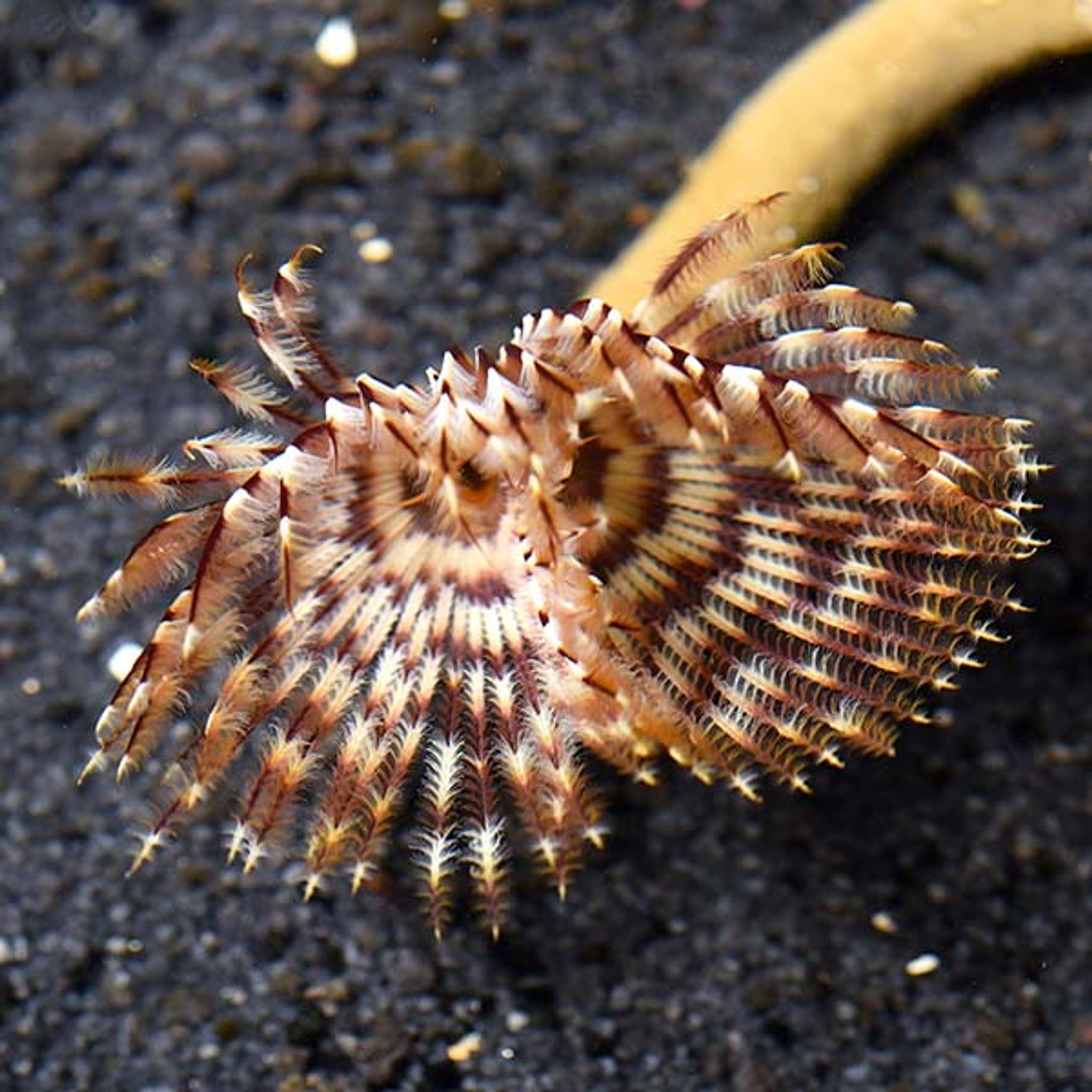

Is Feather Duster Worm Reef Safe? Compatibility With Fish, Coral and Invertebrates
A feather duster worm is genuinely reef safe — it has no stinging cells and will never harm a coral colony. The real compatibility question runs the other way: several common fish, shrimp and crabs will happily eat or shred its crown. This guide breaks down exactly which tankmates are safe, which are risky, and what keeps a feather duster alive long enough to enjoy.
What Is a Feather Duster Worm?
A feather duster worm is a filter-feeding tube worm (a polychaete), not a coral, not an anemone, and not a plant. It builds or secretes a tube and lives inside it permanently, extending a feathery crown of radioles to strain plankton from the water and to exchange gases. Touch the water near it, cast a shadow over it, or startle it, and the crown vanishes into the tube almost instantly.
Trade species vary mainly by tube material and size:
| Type | Tube | Approx. length | Crown size | Notes |
|---|---|---|---|---|
| Sabellastarte (common feather duster) | Leathery/parchment | Up to ~10 in (25 cm) | 2–4 in (5–10 cm) | Hardier, more forgiving, better for beginners |
| Protula / coco worm | Hard, calcareous | Up to ~8 in (20 cm) | Up to ~3 in (7.5 cm) | Pricier and more failure-prone; less tolerant of instability |
Because the coco worm's calcareous tube and finer crown structure are less forgiving of swings in water quality or feeding gaps, first-time keepers are usually better off starting with a Sabellastarte-type duster before spending more on a coco worm.
Is It Reef Safe With Corals?
Yes. A feather duster worm has no nematocysts (stinging cells), doesn't release sweeper tentacles, and doesn't compete aggressively for space the way some soft corals or anemones do. It simply filters passing food particles and leaves coral tissue completely alone.
The only real coral-related issue is physical, not chemical or predatory: over time a duster's tube can grow tall enough or wide enough to press against or crowd out an adjacent coral's base. That's a spacing and placement problem, easily avoided by giving the worm room to grow and checking on it as your coral colonies expand. When you're stocking a reef tank with both, browse LPS hard corals or soft corals with future footprint in mind rather than packing everything in tight from day one.
Compatibility With Fish
Most peaceful community fish completely ignore a feather duster's crown. The risk list is short but important.
Fish That Are Generally Safe
- Gobies
- Clownfish
- Most tangs and surgeonfish
- Damselfish
- Cardinalfish
Fish to Avoid or Watch Closely
| Fish | Risk level | Why |
|---|---|---|
| Butterflyfish | High | Notorious crown-nippers; almost none reliably leave dusters alone |
| Angelfish | High | Regularly pick at feathery, exposed tissue |
| Triggerfish | High | Will test and eat almost any invertebrate |
| Pufferfish | High | Opportunistic invertebrate feeders |
| Moorish idols | High | Similar grazing behavior to butterflyfish |
| Longnose hawkfish | Moderate–high | Known to eat small dusters and molting hermit crabs |
| Some wrasses | Variable | Species-dependent; research the specific wrasse |
If you're planning a tank around a feather duster as a long-term feature animal, it's worth choosing your fish first. Browse marine fish with this predator list in hand rather than adding a duster to an existing tank that already houses a butterflyfish or angelfish and hoping for the best.
Compatibility With Shrimp and Crabs
This is where hobbyist opinions genuinely diverge, so treat it as a spectrum rather than a flat yes/no.
- Cleaner shrimp — generally low risk; most leave dusters alone.
- Peppermint shrimp and coral banded shrimp — higher risk; both have been observed picking at duster crowns.
- Arrow crabs — higher risk; opportunistic and known to bother small tubeworms.
- Emerald/Mithrax crabs — can nibble small dusters, though this is inconsistent.
- Hermit crabs — mild, occasional risk rather than a hard no. Small or molting hermits are more likely to bother a duster than large, well-fed ones; in some cases hermits are more often victims of the same predatory fish than actual attackers of the worm.
The honest middle ground: a feather duster is genuinely low-conflict with most reef invertebrates, but a handful of species — mostly the ones already known for picking at coral flesh or sessile inverts — are real risks worth screening out before you buy.
Bristle Worms vs. Feather Dusters
These two are constantly confused by newer reef keepers, so it's worth being precise: bristle worms are free-crawling scavengers that eat detritus and leftover food, while feather dusters are stationary filter feeders permanently anchored inside a tube. Bristle worms don't prey on feather dusters — they're unrelated in both behavior and role. Predatory snails (some whelk species) and, in some cases, serpent or brittle stars can bother a duster that's already sick or dying, but they're not a threat to a healthy one. Urchins are also commonly flagged by hobbyists as unsafe roommates, since their grazing can disturb a duster's tube and surrounding substrate.
Water Parameters and Placement
Feather dusters do best in stable, reef-standard conditions:
| Parameter | Target range |
|---|---|
| Temperature | 74–83°F (23–28°C); 72°F (22°C) marginally tolerated |
| pH | 8.1–8.2 |
| Specific gravity | 1.024–1.026 |
| Calcium | 380–430 ppm |
| Alkalinity | ~2.5–3.5 meq/L (dKH ~7–10) |
Stability matters more than hitting an exact number. A slow drift within range is far less stressful than a sharp swing during a water change or after adding new livestock.
Placement should be lower-to-mid tank, in a shaded or dimly lit spot, with moderate, indirect flow — enough current to carry food particles to the crown, but not a direct powerhead blast or bright spotlighting that keeps the worm retracted or damages the crown over time.
Acclimation should be slow and drip-based. Sudden parameter changes are one of the most common triggers for crown loss shortly after a new duster is introduced.
Feeding: The #1 Survival Factor
Most captive feather duster deaths in the first year come down to starvation, not genetics or bad luck. Tank detritus alone rarely provides enough suspended food.
- Target-feed phytoplankton and zooplankton (rotifers, cyclops, marine snow-type foods) daily or every other day.
- Dispense food into the current near the crown — never squirt it directly onto the crown, which triggers an immediate retraction and wastes the food.
- A tank with an established population of copepods and a mature phytoplankton culture naturally supports a duster far better than a sterile, heavily skimmed system. Feeding the whole tank's food web, not just the individual animal, pays off here.
Consider browsing freeze-dried food alongside a liquid plankton product to build a rotating feeding routine rather than relying on one food type alone.
Nano Reef Tank Considerations
Feather dusters suit nano and pico reefs well because of their small footprint, but small volumes come with tradeoffs:
- Parameters swing faster in a nano tank, so stability and gentle flow become even more critical than in a larger system.
- Avoid pairing a duster with butterflyfish, arrow crabs, or other nano-unsafe picks in a small, tightly stocked system where escape or avoidance is harder.
- Dose plankton conservatively. Overfeeding phytoplankton in a small water volume can spike nitrate and phosphate quickly — watch both after adjusting a feeding schedule.
Quarantine and Hitchhiker Risk
Wild-collected duster tubes can arrive carrying hitchhikers — predatory flatworms or pyramidellid-type snails are the main concerns — that may not threaten the duster itself but can spread to other invertebrates once introduced. A brief quarantine or careful visual inspection of the tube before adding it to a display tank is a cheap precaution against a much bigger cleanup later.
Common Mistakes and Troubleshooting
- Blasting the worm with direct flow — causes constant retraction or physical crown damage.
- Underfeeding, assuming ambient detritus is sufficient — the leading cause of decline within the first year.
- Squirting food directly onto the crown instead of into nearby current.
- Adding incompatible fish (butterflyfish, angelfish, triggerfish) to a tank meant to house a duster long-term.
- Mistaking a shed or retracted crown for a dead worm and removing a tube that's still alive.
- Rough handling during moves — crushing or kinking the tube can rupture internal tissue.
- Sudden parameter swings during water changes or after adding new livestock.
- A duster dying unnoticed inside its tube — an easily missed maintenance issue that can quietly foul water quality; a persistent smell or a tube that never re-extends after several weeks is worth investigating.
Frequently Asked Questions
Is a feather duster worm reef safe with corals?
Yes. It has no stinging cells and is a filter feeder that doesn't damage coral tissue. The only real concern is physical — its tube growing too close to a coral's base over time — which is a spacing issue, not a predation risk.
What fish will eat a feather duster worm?
Butterflyfish, angelfish, triggerfish, pufferfish, Moorish idols, longnose hawkfish, and some wrasse species are the main culprits. Most peaceful reef community fish, including gobies, clownfish, tangs and damsels, leave them alone.
Can feather duster worms live with shrimp and crabs?
It's mixed. Cleaner shrimp are usually fine, but peppermint shrimp, coral banded shrimp, arrow crabs, emerald/Mithrax crabs, and small or molting hermit crabs may pick at or eat smaller specimens.
Why did my feather duster lose its crown?
Usually stress from poor water quality, physical disturbance, rough handling, or malnutrition. It can also be a semi-natural periodic shedding event that happens roughly every several months, so one shed isn't necessarily a bad sign.
Will my feather duster's crown grow back?
Usually yes, within a few weeks and up to about 4–6 weeks, provided water quality and feeding stay consistent and the body and tube are intact. Repeated shedding or no regrowth after roughly two months signals a deeper problem worth investigating.
What do feather duster worms eat, and how often?
They eat phytoplankton and zooplankton, and should be target-fed daily or every other day since most established tanks don't generate enough natural suspended food on their own.
Are feather duster worms and bristle worms the same thing?
No. Bristle worms are free-crawling scavengers that eat detritus, while feather duster worms are stationary filter feeders permanently housed in a tube. The two are frequently confused by newer reef keepers but are unrelated in behavior and role.
Where should I place a feather duster worm in the tank?
Lower-to-mid tank, in a spot shaded from direct light, with moderate indirect flow rather than a direct powerhead blast — enough current to deliver food without tearing at the crown.
Ready to add one to your reef? Browse marine invertebrates on FishyHub to compare feather duster options and plan tankmates around the compatibility notes above.


