
Is Emperor Angelfish Reef Safe? Coral and Invertebrate Compatibility Explained
The honest answer is no — an Emperor Angelfish is not reliably reef safe, and adding one to a coral-heavy display is a calculated gamble rather than a sure thing. Some individuals never touch a coral in their life, while others will pick apart a display over a matter of weeks. This guide breaks down exactly which corals and invertebrates are at risk, why the behavior happens, and how to decide whether the gamble is worth it for your tank.
Emperor Angelfish Basics
The Emperor Angelfish (Pomacanthus imperator) is a large marine angelfish native to Indo-Pacific reefs. Adults reach 12–15 inches (30–38 cm), making them one of the bigger fish commonly kept in home reef and fish-only systems.
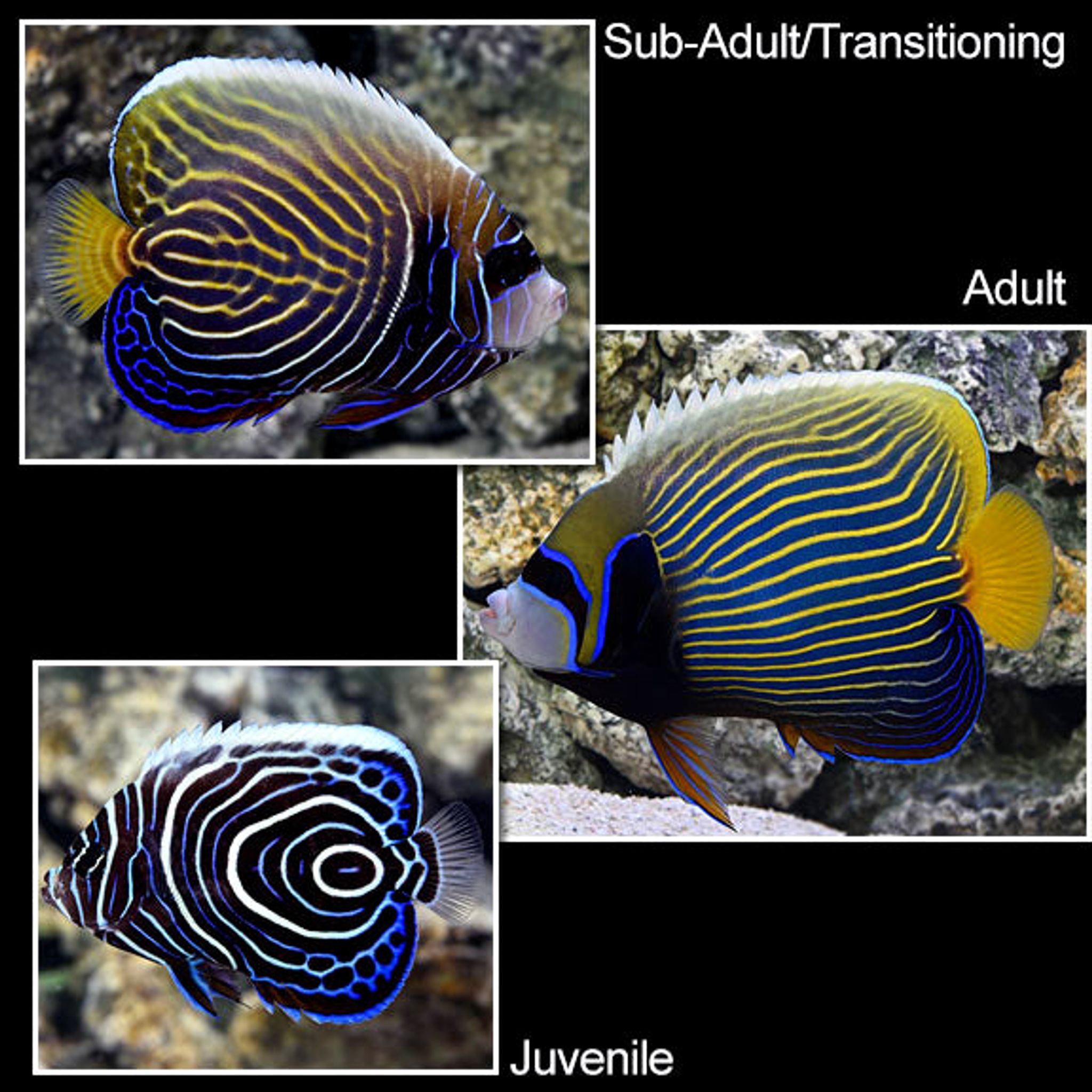
Juveniles look nothing like adults. Young fish wear a dark blue body with concentric white swirl rings, while adults develop bold yellow horizontal stripes, a blue "mask" across the eyes, and a dark saddle patch near the tail. The transition from juvenile to adult coloring takes 2–4 years, and many buyers fall in love with the juvenile pattern without planning for the size and temperament of the adult that eventually shows up.
Tank Size Requirements
Tank size recommendations vary across sources, largely because juveniles and adults have very different needs.
| Life Stage | Minimum Tank Size | Notes |
|---|---|---|
| Juvenile (temporary) | 125 gallons (473 L) | Outgrown quickly; not a long-term home |
| Adult (realistic minimum) | 180–250+ gallons (680–950+ L) | 6+ feet (1.8+ m) of length for swimming room |
A 125-gallon tank is a bare minimum starting point for a small juvenile, not a permanent setup. Anything smaller will be outgrown within a year or two. Long-term, plan for 180–250 gallons or larger with a footprint of at least 6 feet, since this species swims actively along the length of a tank and needs room to establish territory away from other fish.
Is an Emperor Angelfish Reef Safe? The Real Answer
You'll see this species labeled two different ways depending on where you look. Retail-style care sheets often call it "reef safe with caution," implying that a normal reef tank can work with some watchfulness. More reef-specialist commentary is blunter, listing the Emperor Angelfish as a species beginners should avoid in mixed reef displays entirely.
Both takes have some truth to them. Individual variation is real — plenty of keepers report specimens that never bother a coral. But the fish's underlying biology makes it a genuine, not theoretical, risk in any coral-heavy tank. The more accurate framing is: not reliably reef safe, with risk levels that depend heavily on what corals you keep, how well the fish is fed, and how much you're willing to lose if a nipping habit develops.
Why the Risk Exists: Natural Diet
In the wild, Emperor Angelfish are primarily spongivores — sponges make up the bulk of their natural diet, supplemented by tunicates, algae, and some soft coral or coral polyp tissue. That instinct doesn't disappear in captivity. A fish raised on a varied diet may leave coral alone, but a hungry or nutritionally undersupplemented individual will fall back on picking at soft coral polyps, fleshy LPS tissue, zoanthids, and clam mantles — the closest things in an aquarium to its natural food sources.
Older, simpler write-ups tend to mention only the sponge-eating trait and stop there. More detailed reef-specific accounts go further, documenting soft coral predation, LPS nipping, and clam mantle damage as real, recurring problems — not rare exceptions.
Coral and Invertebrate Risk, Category by Category
Rather than a vague "reef safe with caution" label, here's how risk actually breaks down by coral and invertebrate type.
| Category | Risk Level | Notes |
|---|---|---|
| Sponges, tunicates | High (near-guaranteed) | Natural prey items; almost always targeted |
| Soft corals (leathers, mushrooms) | High | Among the most commonly nipped corals |
| Zoanthids | High | Frequently picked at, especially when fish is underfed |
| Clam mantles | High | Exposed fleshy tissue is an easy target |
| Large-polyp LPS (favia, trachyphyllia, plate corals) | High | Fleshy species are especially vulnerable |
| SPS corals | Moderate/variable | Often left alone but not guaranteed, especially in an underfed or pod-poor tank |
| Encrusting SPS with minimal fleshy tissue | Lower | Some individuals avoid heavily-stinging or low-tissue species, though this isn't a guarantee |
| Ornamental shrimp, crabs, snails | Generally low | Emperor Angelfish aren't predatory on mobile crustaceans the way triggerfish or puffers are |
The pattern worth remembering: sessile filter feeders and fleshy coral tissue carry the real risk, while mobile invertebrates like shrimp, crabs, and snails are usually safe. If you're weighing which marine invertebrates to pair with an Emperor Angelfish, crustaceans and gastropods are a far safer bet than clams or sponges.
Soft Corals and LPS Specifically
Because it comes up often: soft corals and zoanthids are among the categories most consistently nipped, which puts them at meaningfully higher risk than hardier, encrusting SPS. If your display leans heavily on soft corals or fleshy LPS hard corals, factor that into your risk tolerance before adding this fish.
What Raises or Lowers the Risk
Individual personality varies enormously — this is the single biggest wildcard with Emperor Angelfish. That said, several factors consistently push risk up or down:
Raises risk:
- Hunger or inconsistent feeding
- A young, small reef with limited grazing algae or pod populations
- Boredom in an understocked tank with little to explore
Lowers risk (but never eliminates it):
- A varied, frequent feeding schedule
- Plenty of live rock for grazing and foraging
- A mature system with established microfauna
Feeding to Reduce Coral Nipping
A well-fed Emperor Angelfish is less likely to sample coral out of dietary need, though feeding never fully removes the risk — it only reduces it. Aim for:
- 2–3 feedings per day
- Marine algae or nori sheets
- Mysis or other meaty frozen preparations
- Sponge-based or angelfish-specific formulas when available
There's also a diet-health connection worth understanding: an underfed or nutritionally stressed Emperor Angelfish is more prone to head and lateral line erosion (HLLE) and marine ich, on top of being more likely to nip coral. Poor diet is a double liability — it hurts the fish's health and raises the odds it damages your coral collection at the same time. Stocking up on a rotation of quality food and supplements is one of the most direct ways to address both problems at once.
Reef Tank Setup Essentials If You Attempt It
If you decide the risk is worth taking, the tank needs to be genuinely mature before the fish goes in — this is not a species for a newly cycled system.
Water parameters:
| Parameter | Target Range |
|---|---|
| Temperature | 72–78°F (22–26°C) |
| pH | 8.1–8.4 |
| Specific gravity | 1.020–1.025 |
| Alkalinity | 8–12 dKH |
| Ammonia / Nitrite | 0 |
| Nitrate | Low |
Setup essentials:
- Mature live rock and a fully established nitrogen cycle before introduction
- A protein skimmer and strong water flow for adequate filtration
- Plenty of live rock for grazing and hiding spots
- A 2–4 week quarantine period for new fish before adding to the display, since Emperor Angelfish are somewhat prone to ich and velvet
- Slow, drip-method acclimation, since this species is sensitive to sudden parameter shifts
- Adding the Emperor Angelfish as one of the last fish to a stable, established system, since it can be aggressive or territorial toward other angelfish and similarly shaped or patterned fish
Common Mistakes to Avoid
- Testing behavior on a young or small reef. Some individuals are fine, but many will damage a substantial coral collection within weeks if the tank isn't mature and well-stocked with grazing options.
- Underfeeding. A hungry Emperor Angelfish is far more likely to sample coral tissue and clam mantles out of genuine dietary need, not idle curiosity.
- Buying on juvenile coloring alone. The striking blue-and-white juvenile pattern doesn't reflect the adult's eventual size, aggression, or space requirements — plan for the fish it will become, not the one you're bringing home.
- Mixing with other large or similarly patterned angelfish in too small a space, which reliably triggers territorial aggression.
- Ignoring early warning signs — small nips on coral polyps, retracted zoanthids, or chewed clam mantle edges are cues to act, not wait and see.
- Letting water quality slip. This species is sensitive to poor water conditions and prone to HLLE and marine ich when diet and water quality aren't dialed in together.
A Decision Framework
Before buying, weigh three things honestly:
- Tank size and maturity — Is your system 180+ gallons, fully cycled, and stocked with established live rock?
- Coral mix — Is your collection SPS-dominant with minimal soft coral, zoanthids, or fleshy LPS? Or would a nipping habit put a significant investment at risk?
- Risk tolerance and exit plan — Do you have a frag tank or a FOWLR (fish-only-with-live-rock) system to move the fish to if it starts causing damage?
If the answer to any of these is no, the safer path is treating the Emperor Angelfish as a fish-only-with-live-rock candidate first. Reef inclusion should be viewed as a deliberate, monitored risk — best attempted only in soft-coral-light, SPS-dominant tanks with a backup plan ready if nipping starts.
Frequently Asked Questions
Will an Emperor Angelfish eat all my coral?
There's no guarantee either way. Some individuals never touch coral, while others will eat soft corals, LPS, and clam mantles. The risk is real enough that it shouldn't be added to a valuable coral collection without accepting that possibility upfront.
Is the juvenile Emperor Angelfish safer for reef tanks than the adult?
Not inherently. Juveniles are smaller and often housed in younger tanks, which can make risk appear lower simply due to size and appetite. The coral-nipping instinct doesn't disappear with age — it can actually increase as the fish matures and needs more food.
What is the minimum tank size for an Emperor Angelfish?
Realistically, 180–250 gallons at 6+ feet long for a full-grown adult. A 125-gallon tank only works temporarily for a juvenile before it needs an upgrade.
Can Emperor Angelfish live with clams, shrimp, and crabs?
Ornamental shrimp and crabs are generally safe, since these fish aren't predatory on mobile crustaceans. Clams are at real risk of mantle nipping, especially from a hungry specimen.
What do Emperor Angelfish eat to reduce coral nipping?
A varied diet with marine algae or nori, mysis and other meaty frozen foods, and preferably sponge- or angelfish-specific formulas fed multiple times daily. This won't eliminate the risk, but it meaningfully reduces it.
Are Emperor Angelfish reef safe with soft corals specifically?
Soft corals and zoanthids are among the most commonly nipped types, carrying noticeably higher risk than encrusting SPS. If your reef is soft-coral-heavy, factor that into the decision.
What's a good reef-safer alternative if I want an angelfish look?
Smaller dwarf angelfish (Centropyge species) are generally considered more reef-compatible, though even these aren't 100% guaranteed reef safe.
How can I tell if my Emperor Angelfish is starting to eat coral?
Watch for fresh nip marks on polyps or mantles, coral retraction, or bleached spots near the fish's usual patrol area. The first fix is to adjust feeding schedule and quantity before the habit escalates.
Ready to plan your stocking list? Browse large marine angelfish on FishyHub to compare species and find the right fit for your tank size and coral mix.


