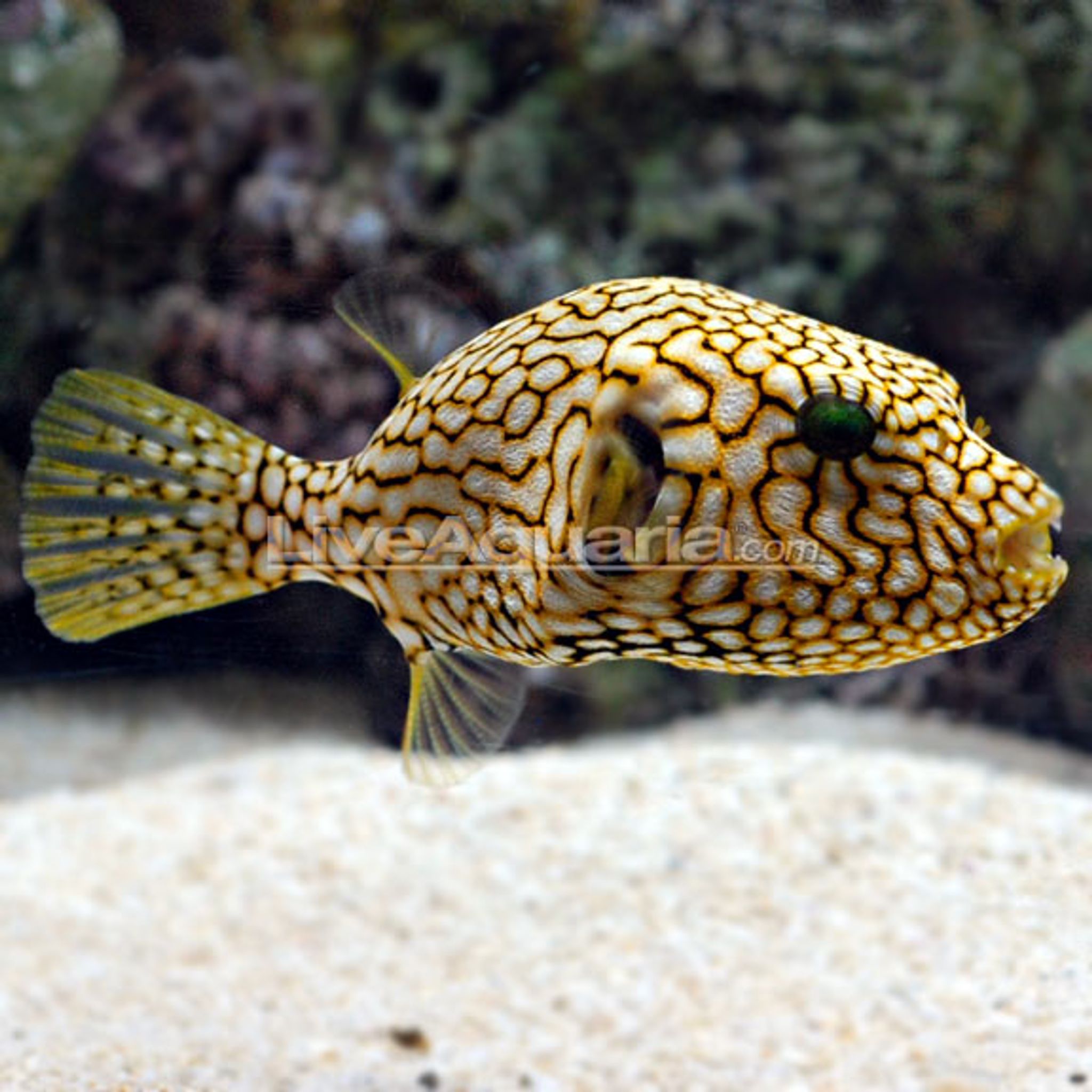

Is Dogface Puffer Reef Safe? Coral and Invertebrate Compatibility Explained
The short answer is no, not in the traditional sense. A dogface puffer (Arothron nigropunctatus) is better described as "reef safe with caution" at best, since its natural behavior is to sample, nip, or eat sessile and motile invertebrates as it grows. This guide breaks down exactly which corals and invertebrates are at risk, what "caution" really means in practice, and how to build a tank around this fish instead of fighting its instincts.
Meet the Dogface Puffer
The dogface, also sold as the blackspotted or dog-faced puffer, is Arothron nigropunctatus, a member of the pufferfish family prized for its expressive face and color morphs ranging from yellow to gray to black-spotted. Adults typically reach 12-13 inches, considerably larger than the juveniles most hobbyists bring home at 2-3 inches.
That growth trajectory matters for reef planning. A young dogface may barely bother a coral frag, but temperament and appetite shift as the fish matures. A puffer that ignored invertebrates as a juvenile can become a determined predator within a year, which is why so many owners report the same story: things were fine, then suddenly they weren't.
The Verdict: Reef Safe or Not?
Sources disagree on how to phrase this. Some call dogface puffers flatly "reef unsafe," while others describe them as "reef safe with precautions." Both are partly right, and the more useful framing is to treat reef compatibility as a spectrum tied to individual temperament rather than a guarantee.
The practical rule for stocking decisions: assume worst-case risk, even if your current puffer has behaved well so far. A fish that leaves coral alone at six months old can start picking at polyps at eighteen months, once it's bigger, hungrier, and bored. Plan your tank for the puffer this fish will become, not the one it is on day one.
Coral Compatibility Breakdown
Not all corals carry equal risk. Fleshy, polyp-heavy corals are the most tempting targets, while corals with less exposed tissue are nipped less often, though never with a full guarantee.
| Coral type | Risk level | Notes |
|---|---|---|
| Zoanthids, xenia, leathers (soft corals) | High | Extended fleshy polyps are frequently sampled or fully eaten |
| Fleshy LPS: acans, scolymia, trachyphyllia, brains | High | Soft tissue draws repeated nipping |
| Hammers and frogspawn | Moderate-high | Extended sweeper tentacles are still attractive targets |
| Encrusting or tougher SPS | Lower, not zero | Less fleshy tissue is ignored more often but still gets tested |
One point worth correcting: zoanthid palytoxin, often assumed to deter predators, is not a reliable puffer deterrent. Some dogface puffers will still pick at zoanthid colonies despite the toxin, so don't rely on it as a built-in safeguard.
If you're building a display around SPS from the SPS coral category, understand you're reducing risk, not eliminating it. Softer, fleshier pieces from the soft coral category or the LPS coral category should be treated as likely casualties in a true mixed system.
Invertebrate and Clean-Up Crew Compatibility
Nearly every motile invertebrate common to reef and FOWLR clean-up crews is at risk with a dogface puffer in the tank:
- Snails — commonly cracked and eaten; puffers use hard shells to help wear down their beak.
- Hermit crabs — same story as snails, targeted both for food and dental maintenance.
- Shrimp (including cleaner shrimp) — very likely to be eaten over time; fast-moving inverts buy some time but rarely escape indefinitely.
- Crabs — larger crabs may survive longer, but small to medium crabs are regularly picked off.
- Clams — soft mantle tissue is an easy target for a beak built to crush shells.
This is a structural problem, not just a behavioral one: dogface puffers actively use hard-shelled snails and hermits to grind down their continuously growing teeth, so a clean-up crew isn't just at risk of harassment, it's a preferred food source. Expect to replace clean-up crew members repeatedly rather than maintain a stable population, which is a real cost to factor in before stocking.
Beak and Dental Health
Like all true puffers, the dogface has a beak formed of fused, continuously growing teeth rather than individual replaceable teeth. Without enough hard material to wear the beak down, it overgrows, and this is a health issue independent of coral compatibility.
Signs of an overgrown beak:
- Trouble picking up food or dropping food repeatedly
- Chewing only with the tips of the mouth instead of the full beak
- Weight loss despite a normal or good appetite
- Teeth visibly protruding past the closed lips
Prevention is straightforward and should be part of the diet from day one: offer hard-shelled foods several times a week, not as an occasional treat. Good options include whole clams on the half shell, mussels, cockles, and cracked crab legs. Skipping these and feeding only soft foods like mysis shrimp, flake, or pellets is one of the most common mistakes that leads to overgrowth months down the line.
If overgrowth does happen, never attempt to trim the beak at home. This requires an aquatic-experienced veterinarian to trim under sedation, and it should be treated as a last resort for a problem that proper diet almost always prevents.
Tank Size and Water Parameters
Minimum tank size recommendations vary. A 90-gallon (340 L) tank is often cited as a floor, but that number really only fits a small juvenile. Given the adult size of 12-13 inches and a heavy bioload, 120 gallons (450 L) or more is the more responsible long-term minimum, with a footprint of 5-6 feet preferred so the fish has real turning room and swimming space.
Standard marine parameters apply:
| Parameter | Target range |
|---|---|
| Temperature | 74-78°F (23-26°C) |
| pH | 8.1-8.4 |
| Specific gravity | 1.020-1.025 |
| Alkalinity/calcium stability | Not critical for the puffer itself, but water quality still matters due to bioload |
Filtration and Husbandry
Dogface puffers are messy, high-waste eaters, and this alone argues for filtration well beyond typical reef-tank standards. Plan for an oversized protein skimmer, strong mechanical and biological filtration, and more frequent water changes than you'd run on a coral-focused system. Underestimating bioload and running reef-level equipment instead of scaling up is a common setup mistake that shows up later as poor water quality and stressed livestock.
Diet Essentials
As a carnivore, a dogface puffer needs variety, not a single staple food:
- Mysis shrimp
- Chopped seafood and squid
- Clams, mussels, cockles
- Crab legs
- Unshelled shrimp and prawns
The hard-shelled items on this list do double duty: they're nutrition and dental maintenance in one.
Choosing Tank Mates
Pair a dogface puffer with fish that are larger, non-aggressive, and not easily harassed: larger tangs from the tangs and surgeons category, larger angelfish, larger wrasses, hogfish, gobies, dottybacks, cardinalfish, and damselfish generally do well.
Avoid:
- Small or slow-moving fish (dwarf gobies, small clownfish)
- Cleaner shrimp and other crustaceans
- Other puffers, unless the tank is large enough for a true single-specimen or multi-puffer setup with broken sightlines and abundant hiding spots
- Eels, since a puffer can nip at eel skin
Keep dogface puffers singly in most home setups. Multiple puffers only work in very large systems with enough visual barriers that individuals aren't constantly in each other's space.
Puffer Behavior and Aquascaping Risk
Puffers inflate as a defense mechanism, and this has real implications for reef aquascaping that often get overlooked. A stressed puffer that inflates near tight rockwork risks getting wedged, and inflating close to stinging or sensitive corals adds another layer of risk to both the fish and the coral. Build hardscape with wide swim-throughs and open sightlines rather than dense, narrow caves, especially in any system that also houses corals.
Alternative "Reef-Safer" Puffer Species
Smaller, less predatory puffers are sometimes marketed as more reef-compatible. Valentini (saddled) puffers are a common example, and true nano puffer species are occasionally suggested as gentler options. Even so, treat these claims with the same caution: no puffer species is 100% guaranteed reef safe, and individual temperament still varies within any species.
Building a Puffer-Safe or Semi-Reef Display
Given the risk profile, three practical setups work better than a traditional mixed reef:
- FOWLR (fish-only-with-live-rock) — the safest and most straightforward route, skipping coral risk entirely while still giving a natural-looking, rock-heavy display.
- A "puffer-proof" system — stocked only with hardier SPS and invertebrates the owner explicitly accepts as sacrificial, understanding losses are likely over time.
- A species or predator-tank concept — built around the puffer itself with decorative macroalgae instead of coral, giving color and texture without the ongoing risk.
A Quick Decision Checklist
Before buying, ask:
- Do I already have an established reef with corals and inverts I'm not willing to lose?
- Can I commit to 120+ gallons for the adult size, not just the juvenile?
- Am I prepared to feed hard-shelled foods multiple times a week, indefinitely?
- Do I have an exit plan (a larger FOWLR tank, or a rehoming option) if this fish outgrows my current setup?
If any answer is "no," a FOWLR or predator-tank approach, or a different fish entirely, is the safer starting point. Replacing a lost clean-up crew or a coral colony repeatedly adds up in both cost and frustration, which is worth weighing honestly before the purchase rather than after.
Frequently Asked Questions
Can a dogface puffer live in a reef tank at all?
Only with major caveats. It's best suited to a FOWLR setup or a reef tank where the owner accepts some coral and invertebrate losses as part of keeping the fish. There's no full guarantee of safety around corals or inverts, regardless of setup.
Will a dogface puffer eat cleaner shrimp?
Very likely, yes, over time. Shrimp and other crustaceans are among the most commonly targeted invertebrates, partly because puffers use them for both food and beak maintenance.
Do dogface puffers eat coral, or just nip at it?
Both happen. Light nipping or sampling is common across most individuals, and some puffers will fully consume fleshy coral polyps, particularly on soft corals and fleshy LPS.
How big of a tank does a dogface puffer need?
A 90-gallon (340 L) tank is a workable minimum for a juvenile, but 120 gallons (450 L) or more is the recommended long-term minimum for an adult, with a longer, wider footprint preferred over a tall, narrow one.
How do I keep my puffer's teeth from overgrowing?
Offer hard-shelled foods several times a week, including clams on the half shell, mussels, cockles, and cracked crab legs. Consistent hard food is the main prevention method and is far easier than treating overgrowth after it happens.
Can I trim my puffer's teeth myself?
No. Teeth trimming should always be done by an aquatic-experienced veterinarian under sedation. Attempting it at home risks serious injury to the fish and should only ever be considered a last resort after prevention has failed.
Whether you're planning a FOWLR display or want to browse compatible tank mates first, you can explore current stock in the marine fish category on FishyHub to plan your stocking list around this fish's real behavior, not just its juvenile good manners.


