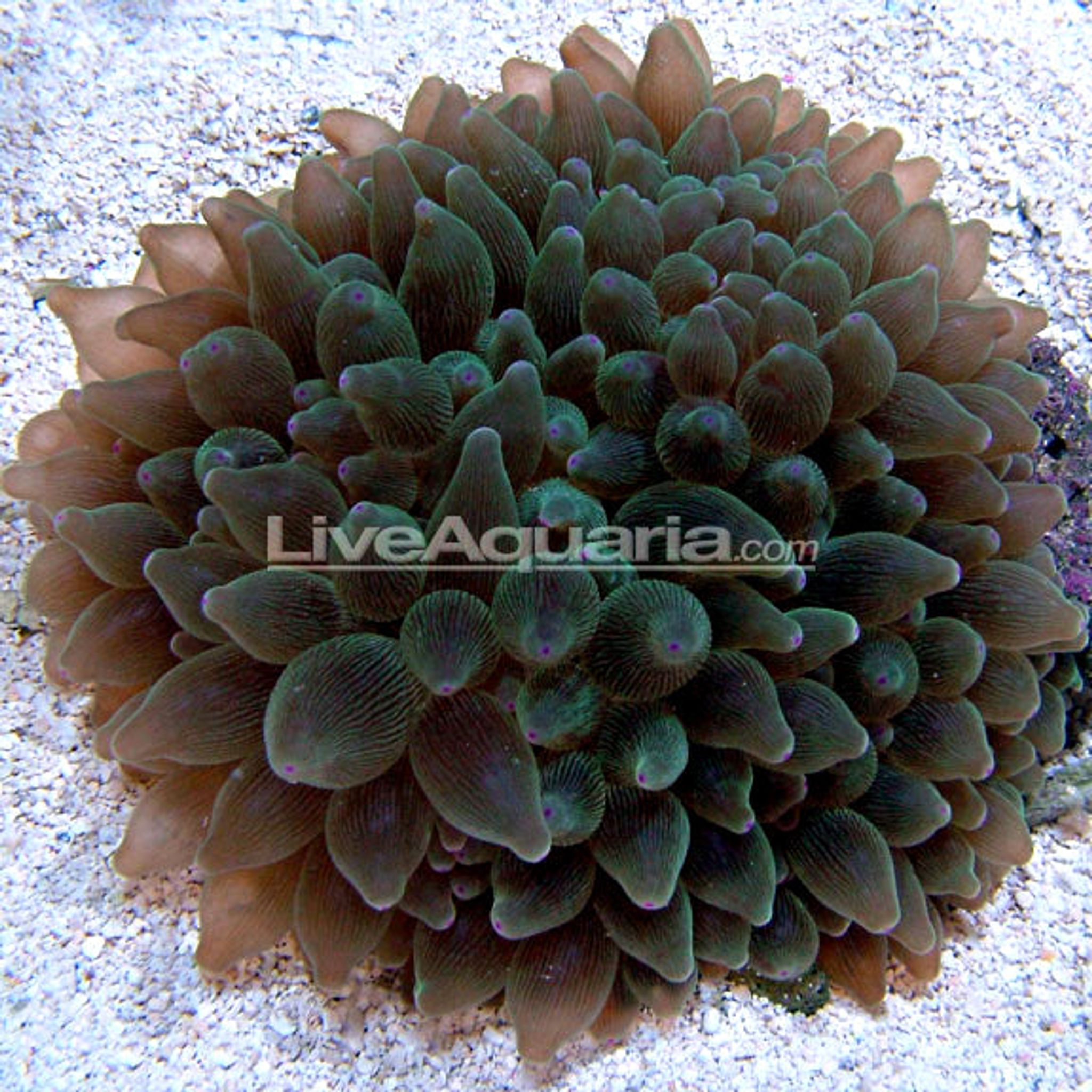

Is Bubble Tip Anemone Reef Safe? Compatibility With Fish, Coral and Invertebrates
A bubble tip anemone (BTA) is reef compatible, not passively "reef safe" — it won't harm your rock or glass, but it is a mobile predator that can sting, eat, or kill small fish, shrimp, and corals it can reach. With the right tank size, placement, and vigilance, most hobbyists can keep one successfully alongside a mixed reef.
What Is a Bubble Tip Anemone?
The bubble tip anemone, scientifically Entacmaea quadricolor, is also sold as the rose bubble tip (RBTA) or bulb anemone. Despite the name confusion, it isn't a coral — but it belongs to the same phylum, Cnidaria, and lives among corals on the reef, which is exactly why compatibility questions matter.
Unlike stony or soft corals, a BTA isn't fixed in place, doesn't stay a predictable size, and actively hunts. That means "reef safe" doesn't apply to it the same way it applies to a coral that simply needs the right light and flow. The better question is compatibility: what can safely live near it, and what can't.
The Verdict: Reef Compatible With Caution
A bubble tip anemone is best described as conditionally reef-compatible rather than reef safe in the passive sense. It won't damage rockwork or destabilize water chemistry on its own, but it is an opportunistic predator that will:
- Sting or consume small, slow-moving fish and invertebrates that make prolonged contact
- Damage or kill sessile coral tissue it touches with its tentacles
- Relocate over time, which can undo careful spacing plans
Some hobbyists treat BTAs as broadly reef safe as long as spacing rules are followed at setup. More experienced reefers push back on that, pointing out that because the animal moves, any spacing guarantee is temporary. The realistic middle ground: a BTA is manageable with ongoing vigilance, not a "set and forget" addition like most corals.
Tank Requirements Before You Add One
Anemones are unusually sensitive to unstable conditions and are often the first animal lost in an immature system. Don't add a BTA until the tank meets these baselines.
| Parameter | Target Range |
|---|---|
| Tank age | Established 6+ months minimum |
| Tank size | 30–40 gallons (114–151 L) minimum |
| Temperature | 74–82°F (23–28°C) |
| Salinity | 1.023–1.026 SG |
| pH | 8.1–8.4 |
| Alkalinity | 8–12 dKH |
| Calcium | 380–450 ppm |
| Magnesium | 1250–1350 ppm |
| Ammonia / nitrite | 0 ppm |
| Nitrate | Under roughly 10–20 ppm |
Stability matters more than any single number. A tank that swings between acceptable readings is riskier for an anemone than one that holds slightly imperfect but consistent parameters.
Lighting and Flow
BTAs need moderate-to-high light, generally in the range of 150–300+ PAR depending on where they settle in the tank, plus moderate, indirect water movement. Under low light, a BTA tends to wander in search of a brighter spot — and every move increases the odds it stings a neighbor along the way. Pairing strong lighting with a reliable LED lamp helps keep a BTA settled instead of constantly relocating.
Placement: Give It Its Own Zone
Plan a dedicated "anemone zone" in the rockscape rather than treating placement as an afterthought. Look for:
- A rock crevice where the foot can anchor securely — this reduces wandering compared with open sand
- Several inches of completely open space around it, since tentacles can extend more than twice the body's diameter
- Distance from powerhead and pump intakes
- Separation from any coral colony you don't want to risk
Because a BTA is one of the few reef inhabitants that can move, many hobbyists find it easier to add the anemone first, or at least reserve its spot, before finalizing coral placement. Asking a coral to work around an anemone's fixed footprint is far simpler than convincing a mobile anemone to avoid a spot it likes.
Fish Compatibility
Low-Risk and Beneficial Pairings
Clownfish are the anemone's natural partners, and pairing the two is one of the main reasons hobbyists keep a BTA in the first place. Ocellaris, percula, tomato, maroon, and clark's clownfish will all readily host E. quadricolor. Larger, faster-swimming fish are generally left alone too, since a BTA can't catch what it can't reach.
Higher-Risk Fish
Small, slow, or bottom-dwelling fish are the ones actually at risk:
- Gobies
- Blennies
- Small wrasses
- Firefish
- Dragonets
These species can get stung or eaten if they brush against tentacles or bed down too close to the anemone at night. If you're stocking a tank that will include a BTA, browsing marine fish with this risk tier in mind — favoring larger or faster swimmers over tiny bottom-dwellers — reduces losses.
Clownfish-Anemone Symbiosis, Explained
The relationship isn't automatic immunity — it's built gradually. A clownfish develops a protective mucus coating through repeated, cautious contact with the anemone's tentacles during an acclimation period. Once that coating is established, the fish can move freely among the stinging tentacles without harm.
In return, the anemone benefits from the fish's waste (a nutrient source), the fanning motion that improves oxygen flow around its tentacles, and the fish driving off polyp-eating predators. The fish gets a defended home and a breeding site.
Not every clownfish species hosts every anemone equally — E. quadricolor is one of the most preferred host species overall, and it's the primary wild host for maroon clownfish specifically. A single healthy BTA typically hosts one to two clownfish comfortably (usually a mated pair). As the anemone splits over time, the resulting group can eventually host more.
A BTA does not need a host fish to thrive. The symbiosis benefits the fish more directly through protection; the anemone gains only modest extra nutrients and aeration, so keeping clownfish is optional, not required for anemone health.
Invertebrate Compatibility
Small invertebrates are consistently the highest-risk group around a bubble tip anemone. Cleaner shrimp, peppermint shrimp, small crabs, and snails can all be captured and consumed if they wander into the tentacles — BTAs are opportunistic predators, not selective ones.
Reports on shrimp specifically are mixed: some hobbyists describe cleaner or skunk shrimp coexisting peacefully near a BTA for years, while others report losses. Given the inconsistency, treat any small shrimp as at-risk rather than counting on coexistence. If you want shrimp in the same system, keep them well away from the anemone's roaming radius rather than assuming a particular species is safe. You can browse marine invertebrates, including marine shrimp, but plan their placement carefully around any anemone in the tank.
Hardier invertebrates like larger hermit crabs and bigger snails are generally lower-risk, since they're less likely to make prolonged, vulnerable contact.
Coral Compatibility
A BTA's tentacles carry nematocysts capable of stinging and killing sessile coral tissue on contact. The complicating factor is mobility: unlike a coral that stays where it's placed, an anemone can migrate directly into a coral's space over time, turning a once-safe distance into a collision.
Recommended clearance is 6–12 inches (15–30 cm) at minimum, with more room preferred whenever your rockscape allows it. Because the anemone can relocate, that spacing isn't a one-time check — re-verify distances periodically, especially after any wandering episode. This is particularly important for prized LPS hard corals or soft corals that you don't want to risk losing.
Anemone Mobility and Splitting
Why It Moves
Relocation is normal behavior, not automatically a sign of illness. A BTA that isn't satisfied with its light, flow, or the security of its crevice will move until it finds a better spot. Frequent wandering is a signal worth investigating — usually pointing to light, flow, or water quality — rather than something to ignore.
Splitting Over Time
Healthy, well-fed bubble tip anemones reproduce asexually through binary fission, splitting into two individuals. Left unchecked, a single anemone can become several over months or years, which has real implications for space and stocking. Plan for growth: a single BTA today may need room for a small colony later, and that colony can eventually host more clownfish than a lone specimen could.
Feeding for a Calmer Anemone
A well-fed anemone is generally a more settled one — wandering and stinging incidents often trace back to hunger as much as lighting. Target feeding 1–2 times per week with meaty foods such as mysis, silverside, or krill, in addition to whatever light-driven nutrition it gets from its zooxanthellae. This matters most in low-nutrient, high-tech reef systems where incidental food is scarce. A gel food formulated for carnivorous inverts can also work well as an occasional addition.
Color Morphs: Rose vs. Standard Brown
Color intensity — the difference between a vivid rose/red bubble tip and a standard brown one — comes down primarily to lighting spectrum and intensity, with genetics and diet playing a smaller role. It is not a separate species and not a compatibility factor. A red BTA behaves the same as a brown one; don't let color drive stocking decisions. Similarly, there's no consistent evidence that captive-bred and wild-collected BTAs differ in temperament — color and origin are cosmetic and sourcing details, not behavior predictors.
Is a Bubble Tip Anemone Beginner-Friendly?
Among anemone species, the BTA is widely considered one of the more tolerant options compared with carpet anemones or long-tentacle anemones, thanks to its comparatively smaller mature size and hardiness. That said, "beginner-friendly" is relative to other anemones — it is not a true beginner species for someone new to saltwater keeping. It still demands a mature, stable, well-established tank before it has a realistic chance of thriving.
Fake Anemones: An Alternative for Clownfish Keepers
Some hobbyists want the visual of clownfish nestled in an anemone without the husbandry demands or reef risk. A plastic or silicone decorative anemone is one option — clownfish will sometimes host these, or even host other objects like a hammer or frogspawn coral, a powerhead, or macroalgae. None of this is guaranteed, and a fake anemone provides no true symbiotic benefit to the fish.
If your tank isn't mature enough, or you can't meet the lighting and flow needs of a real BTA, a fake anemone or simply letting clownfish choose their own host décor organically is a reasonable substitute.
Common Mistakes to Avoid
- Adding a BTA too early — under 6 months of tank maturity or with unstable parameters is the leading cause of anemone decline and death
- Placing it too close to prized coral or directly in an intake's flow path
- Assuming it will stay put — not leaving room for relocation, then losing corals it eventually crawls into
- Underfeeding in a very low-nutrient, high-tech reef, which can cause bleaching or shrinking
- Buying a "split" bargain anemone that's actually two unhealed fragments rather than one intact specimen — look for a fully closed, healed foot before buying
- Forcing clownfish-anemone introductions — most pairs bond on their own over several days; patience beats intervention
- Ignoring stress signs — bleaching, prolonged shrinking or deflation, excessive wandering, or tentacles that won't extend usually trace back to light, flow, or water quality problems
The Intake Danger
A bubble tip anemone that gets pulled into a powerhead or pump intake can be shredded and killed almost instantly. Worse, a dying or decaying anemone releases toxins into the water that can crash an entire tank's water quality. Screen every intake in a tank housing an anemone — this single step prevents one of the most avoidable anemone deaths.
If an Anemone Dies: Treat It as an Emergency
A dead or dying anemone is a genuine tank emergency, not a routine loss. Decaying tissue releases toxins rapidly enough to spike ammonia and threaten every other inhabitant. Respond immediately:
- Remove the anemone (or remains) from the tank as soon as it's identified
- Perform a large water change right away
- Run activated carbon to help pull dissolved toxins from the water
- Monitor ammonia and other parameters closely over the following days
Frequently Asked Questions
Is a bubble tip anemone reef safe?
Conditionally. It won't harm your rock or the tank itself, but it's a predator that can sting or eat small fish and invertebrates and can damage nearby corals. Manage it with spacing and ongoing vigilance rather than treating it as passive the way you would a coral.
Will a bubble tip anemone kill my fish?
It can capture and eat small, slow-moving, or already-sickly fish that make prolonged contact with its tentacles. Fast, larger fish generally aren't at risk, and clownfish are typically immune once properly acclimated.
Can bubble tip anemones live with shrimp?
It's risky. Small shrimp like cleaner or peppermint shrimp can be stung or eaten, though some hobbyists do report long-term coexistence. Because outcomes are inconsistent, treat any small shrimp as vulnerable rather than assuming it's safe.
Do bubble tip anemones sting coral?
Yes. Their nematocysts can damage or kill coral tissue on contact. Keep several inches of clear space around the anemone and recheck that spacing periodically, since the anemone can move over time and close the gap on its own.
How big of a tank do I need for a bubble tip anemone?
Plan for a minimum of 30–40 gallons (114–151 L), established for at least 6 months, with strong lighting and stable, mature water chemistry already in place before adding the anemone.
Do I need a clownfish for a bubble tip anemone to be happy?
No. A BTA thrives without a host fish. The relationship benefits the fish more directly through protection, while the anemone gains only modest extra nutrients and aeration — so a clownfish pairing is a nice bonus, not a requirement.
Why does my bubble tip anemone keep moving?
It's usually searching for better light, flow, or a snugger crevice to anchor its foot. Treat repeated wandering as a cue to reassess its current spot rather than something to ignore, since frequent relocation raises the odds it eventually contacts a fish, invertebrate, or coral it shouldn't.
Can I use a fake anemone instead to keep my clownfish safe?
Yes. An artificial anemone, or simply letting clownfish host a coral or other object on their own, avoids both the husbandry demands and the reef risk of a real BTA. It won't provide the true symbiotic benefits, but it's a practical option in a tank that isn't ready for a live anemone.
A bubble tip anemone can be a rewarding centerpiece for a mixed reef, but it rewards planning more than most corals do. If you're ready to add one, browse marine livestock on FishyHub to compare anemones, host-ready clownfish, and reef-safe tankmates before you finalize your stocking list.


