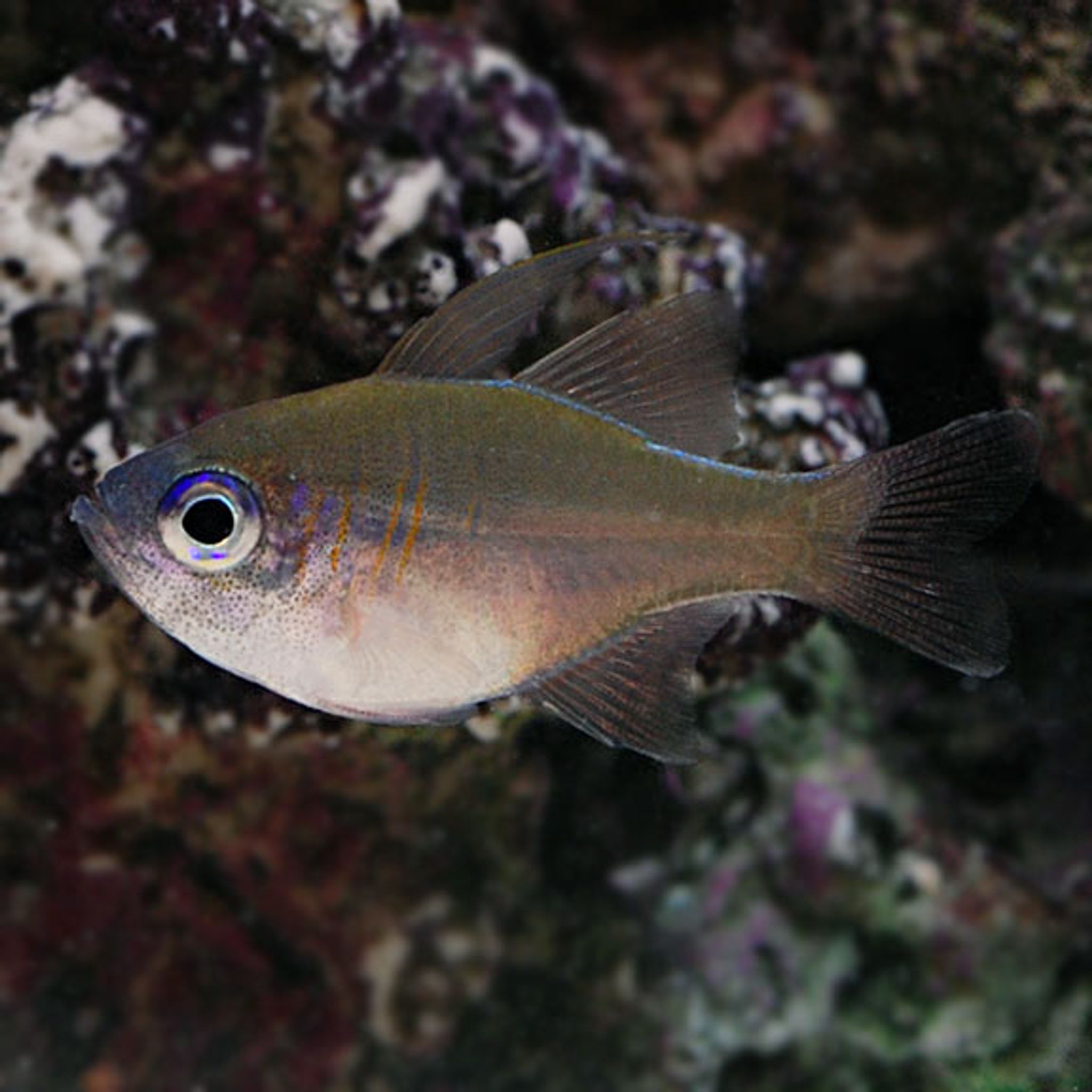
Is Banggai Cardinalfish Reef Safe? Coral and Invertebrate Compatibility Explained
Yes, the Banggai cardinalfish (Pterapogon kauderni) is reef safe. It is a slow, hovering planktivore that has no biological interest in coral polyps, mantle tissue, or clam flesh, which puts it in a different category from nippers like angelfish or some butterflyfish. This guide breaks down exactly how it behaves around corals and each type of invertebrate, plus the tankmate and sourcing choices that determine whether "reef safe" actually holds up in your tank.
The Short Answer: Coral Safety
Banggai cardinalfish do not eat coral. Their natural diet is made up of small crustaceans and zooplankton — copepods, amphipods, mysid shrimp, and similar prey drifting in the water column. In the aquarium, they take frozen mysis, a brine/mysis blend, and quality pellets, and they never graze on algae or peck at coral flesh the way some omnivorous reef fish do.
There is no documented pattern of Banggai cardinalfish nipping polyps or mantle tissue on any coral type:
- SPS corals (Acropora, Montipora, and similar): safe.
- LPS corals (hammer, torch, frogspawn, etc.): safe.
- Soft corals (leathers, zoanthids, mushrooms): safe.
- Clams: safe — cardinalfish show no interest in clam mantles.
In fact, corals and live rock work in the cardinalfish's favor. In the wild, this species hovers near branching coral, urchin spines, or anemone tentacles for shelter rather than actively foraging into a colony. A reef tank with reasonable coral cover and structure satisfies that instinct, giving the fish a place to retreat when it feels exposed. That is a genuine husbandry benefit, not just an absence of harm — a well-aquascaped reef tends to produce a calmer, less stressed cardinalfish than a bare tank.
If you're stocking a display around this fish, browse marine corals for options that also double as shelter structure.
Invertebrate Compatibility, By Category
"Reef safe" is often used as a blanket label, but invertebrate risk actually varies a lot depending on what you're keeping. Here's a category-by-category breakdown.
| Invertebrate type | Compatibility | Notes |
|---|---|---|
| Ornamental shrimp (cleaner, fire, peppermint) | Generally safe as adults | Larger or older cardinalfish may occasionally pick off very small or freshly molted shrimp; shrimp fry and tiny juveniles are at real risk |
| Snails | Safe | No interaction of concern |
| Hermit crabs and larger crabs | Safe | No interaction of concern |
| Copepods and amphipods | Eaten as natural prey | Expected predation, not a compatibility problem — but can reduce pod populations in smaller systems |
| Bristleworms, feather dusters, other sessile inverts | Safe | No interaction of concern |
Ornamental Shrimp: The One Real Caveat
This is where hobbyist opinions genuinely diverge. Some accounts describe Banggai cardinalfish as fully "shrimp safe," while others note occasional predation on very small or molting shrimp. Both are true, just at different life stages. An adult cleaner shrimp or fire shrimp with a hard shell is not prey-sized to a Banggai cardinalfish and is essentially never bothered. A shrimp that has just molted, or a tiny juvenile, is soft-bodied and small enough to be an opportunistic target.
The practical takeaway: treat Banggai cardinalfish as reef and invert safe for adult ornamental shrimp, with the same caveat that applies to most fish this size — shrimp fry and freshly molted shrimp carry some risk, and a nano tank with a small shrimp population is more exposed to that risk than a larger, more established system.
Browse marine shrimp if you're planning a mixed reef with cleaner or fire shrimp alongside cardinalfish.
Pods and Small Crustaceans
Copepods and amphipods are natural prey, not an incompatibility. A Banggai cardinalfish hunting pods off live rock is doing exactly what the species does in the wild. The only practical consideration is population size: in a small or lightly-stocked system, a cardinalfish (or a group of them) can noticeably thin out the pod population over time, which matters if you're relying on pods as a food source for mandarins, dragonets, or other specialist feeders sharing the tank.
Tankmate and Social Behavior Notes
Banggai cardinalfish are peaceful toward other fish. The real aggression risk runs the other direction: faster, more assertive tankmates — larger angelfish, aggressive damsels, or triggerfish — can outcompete or bully a cardinalfish, which is a slow, inefficient feeder by comparison. If a Banggai cardinalfish looks stressed or thin, the tankmate mix is usually the cause, not the cardinalfish itself.
Group Size: Single, Pair, or Group?
Sources disagree here too. Some recommend keeping Banggai cardinalfish singly or as a true bonded pair only, to avoid fighting. Others point to larger established groups of five or six, raised together from juveniles, as more stable over the long term.
Both can be right depending on setup:
- For most home reef tanks, a single fish or an established, bonded pair is the safest choice.
- Groups of two to four unrelated adults in a confined space often trigger fighting, since the fish haven't sorted out a hierarchy or pairing.
- Larger groups (5+) work best in bigger tanks — think 75 gallons (285 L) and up — and ideally start with juveniles growing up together rather than adults introduced as strangers.
Banggai cardinalfish naturally form loose shoals in the wild, so a properly assembled group isn't unnatural — it's just easier to get wrong than a single fish or a known pair.
Tank Size and Water Parameters
A single Banggai cardinalfish or a bonded pair needs roughly 30 gallons (114 L) minimum, with more room required for larger groups. Standard reef parameters apply — this species doesn't need anything unusual:
- Temperature: 75–82°F (24–28°C)
- Salinity: 1.020–1.025 SG
- pH: 8.1–8.4
- Nitrate and phosphate: kept low, as with any coral-focused reef
Feeding for a Reef-Safe Result
No special diet is required to keep this species reef safe — its natural feeding behavior already avoids coral tissue entirely. The practical challenge is different: Banggai cardinalfish are slow, hovering feeders that don't compete well against faster fish for food.
Recommendations range from one feeding a day up to two or three smaller feedings, and the spread comes down to that inefficient feeding style. Two smaller feedings per day of meaty foods (mysis, a brine/mysis mix, or a marine-formulated pellet) is a sensible middle ground — enough to meet nutritional needs without overfeeding the tank or fouling water quality with excess.
In a mixed reef community with faster-feeding fish, target-feeding with a turkey baster, or feeding in a low-flow corner of the tank where the cardinalfish naturally hovers, ensures it actually gets fed rather than losing out every feeding cycle.
Breeding: An Easy Entry Point to Marine Fish Breeding
Banggai cardinalfish are paternal mouthbrooders — after spawning, the male carries the eggs, and later the fry, in his mouth for about 20 to 30 days. What makes this species stand out among marine fish breeding projects is direct development: the fry emerge as tiny but fully formed juveniles, skipping the planktonic larval stage that most marine fish go through.
That matters practically because most marine fish fry need live rotifers and phytoplankton cultured specifically to feed a pelagic larval stage — a significant hurdle for a first breeding attempt. Banggai cardinalfish fry can often be raised on baby brine shrimp and fine foods almost from release, making this one of the more approachable marine fish breeding projects for a hobbyist who hasn't bred fish before.
Breeding pairs still need a reef-safe setup, since many hobbyists keep them directly in a display reef with live rock or in a simpler species tank — either way, the coral and invertebrate compatibility notes above still apply.
Best Cardinalfish for Peaceful Reef Tanks
The Banggai cardinalfish is the standout pick in the cardinalfish family for reef tanks, and the traits that make it reef-compatible — hovering rather than actively foraging, slow and non-territorial behavior, a diet centered on plankton rather than coral or invert flesh — are broadly shared across peaceful cardinalfish species. When comparing cardinalfish options for a reef, prioritize species with this same slow, shoaling, non-aggressive profile over more active or territorial alternatives, since temperament and feeding style matter more to reef compatibility than size alone.
You can view current stock of cardinalfish to compare options for a peaceful reef community.
Reef Tank Basics: Why Compatibility Is Only Half the Equation
A fish being reef safe doesn't mean a reef tank is automatically safe for the fish. Corals need stable water chemistry, cycled live rock, and adequate lighting and flow regardless of what fish share the tank, and a Banggai cardinalfish placed into an immature or unstable system will struggle no matter how peaceful it is. Before adding any reef fish, confirm the basics are in place:
- A fully cycled tank with established live rock
- Stable temperature, salinity, and pH within the ranges above
- Lighting and flow matched to the coral types being kept
- Low, stable nitrate and phosphate
Compatibility answers whether a species can live peacefully alongside corals and inverts. Water stability determines whether the whole system — fish included — actually thrives.
Conservation and Sourcing: Why Captive-Bred Matters Here
Banggai cardinalfish are listed as endangered/threatened in the wild. The species has a naturally restricted range — it's native only to Indonesia's Banggai Archipelago — and decades of over-collection for the aquarium trade have put real pressure on wild populations.
This connects directly to a practical buying decision, not just a conservation footnote. Captive-bred (tank-raised or aquacultured) Banggai cardinalfish are widely available and are the better choice for two separate reasons:
- Hardiness: captive-bred fish are notably more disease-resistant and adjust to aquarium life faster. Wild-caught specimens, by contrast, often arrive stressed and underweight, and are more prone to marine velvet and Uronema-type infections, especially soon after import.
- Conservation: buying captive-bred reduces demand pressure on an already-threatened wild population.
Because this species breeds relatively easily in captivity (see the breeding section above), captive-bred stock is genuinely plentiful — there's little practical tradeoff in choosing it over a wild-caught specimen.
Common Mistakes to Avoid
- Overcrowding unbonded pairs: putting two unrelated adults in a small tank often causes fin-nipping and bullying until a hierarchy forms, if it forms at all. Quarantine and introduce slowly, or keep a single specimen instead.
- Buying wild-caught fish: these arrive more stressed, more prone to disease, and contribute to pressure on an endangered wild population. Source captive-bred whenever possible.
- Letting them get outcompeted at feeding time: their slow feeding style means faster fish can starve them out. Target-feed with a turkey baster or feed in a low-flow area.
- Treating "reef safe" as "set and forget": still watch for occasional predation on molting-stage shrimp in nano tanks with a small shrimp population.
- Pairing with boisterous fish: damsels, triggers, and larger angelfish can stress or outcompete a Banggai cardinalfish. If the fish looks thin or hides constantly, check the tankmates before assuming something is wrong with the cardinalfish itself.
Frequently Asked Questions
Will Banggai cardinalfish eat my coral polyps?
No. They're planktivores and small-crustacean feeders, not coral eaters, and there's no documented pattern of them picking at polyps or mantle tissue. They're considered coral safe across SPS, LPS, soft corals, zoanthids, and clams.
Are Banggai cardinalfish safe with cleaner shrimp and other ornamental shrimp?
Generally yes for adult shrimp. The main risk is to very small or freshly molted shrimp, which are soft-bodied and small enough to be opportunistically picked off — the same caveat that applies to most fish this size.
How many Banggai cardinalfish can I keep together?
A single fish or a bonded pair is safest in typical home reef tanks. Larger groups of five or more can work, but need a bigger tank (75+ gallons) and are more stable when raised together from juveniles rather than introduced as adults.
What size tank do Banggai cardinalfish need?
Around 30 gallons (114 L) minimum for one fish or a pair, set up as a reef with adequate rock and coral cover for hiding and shelter.
Are captive-bred Banggai cardinalfish better than wild-caught?
Yes. Captive-bred specimens are hardier, more disease-resistant, and adjust faster to aquarium conditions, and choosing captive-bred also reduces pressure on a wild population that's currently endangered/threatened.
Do Banggai cardinalfish need special food to stay reef safe?
No. Their coral-safe behavior comes from their natural diet, not from anything you feed them. Mysis, a brine/mysis mix, and quality pellets fed twice daily cover their nutritional needs.
Can Banggai cardinalfish breed in a reef tank?
Yes. They're paternal mouthbrooders and one of the easier marine fish to breed in captivity, and breeding pairs can live safely in a display reef alongside corals and most invertebrates.
Are Banggai cardinalfish aggressive toward other fish?
No, they're among the more peaceful marine fish available. If there's aggression in the tank, it's more often a faster or more assertive tankmate bullying the cardinalfish rather than the other way around.
Ready to build out a peaceful reef community? Browse marine livestock on FishyHub to compare cardinalfish, corals, and reef-safe invertebrates for your setup.

