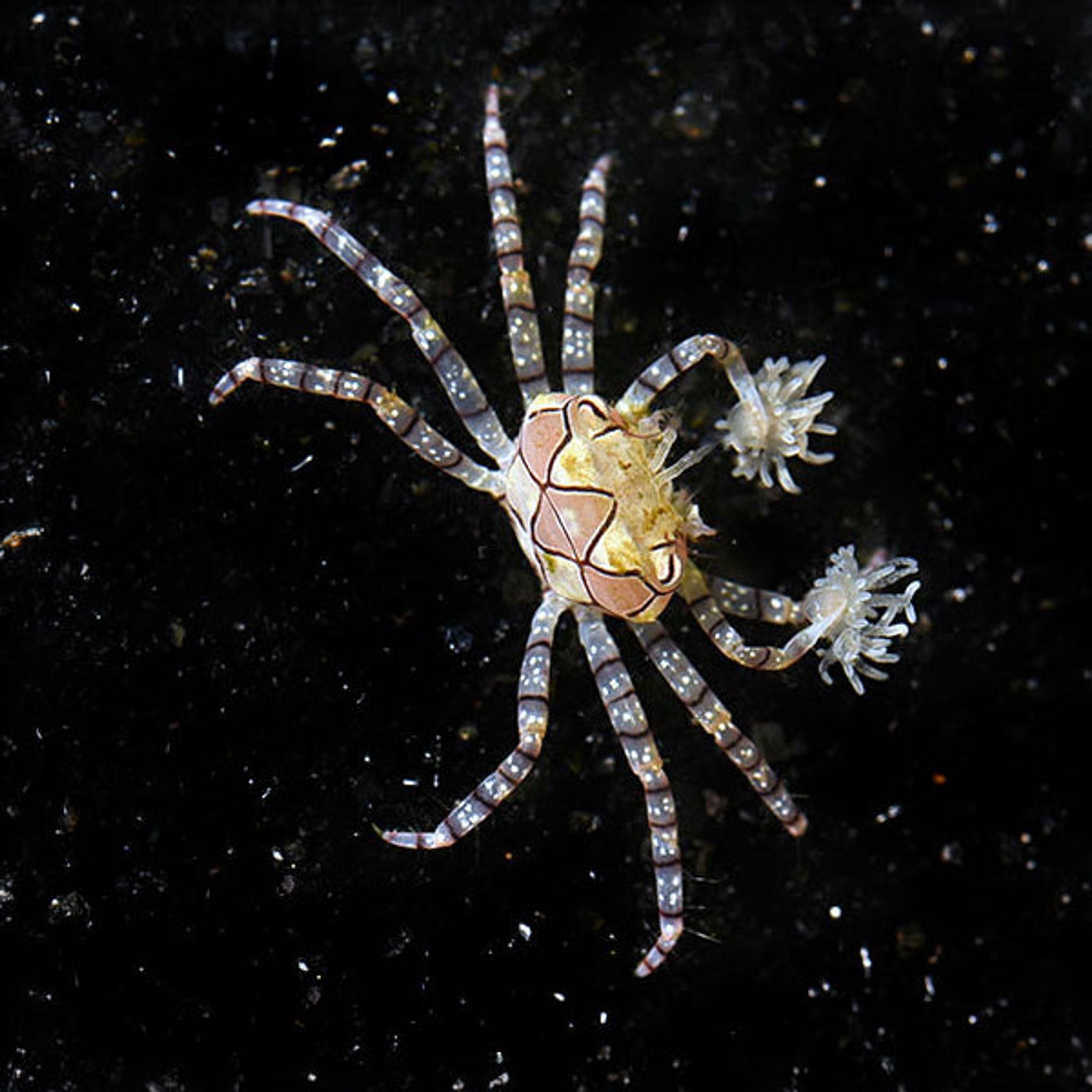

How to Set Up the Ideal Tank for Freshwater Pom-Pom Crab
Freshwater pom-pom crabs are small, fully aquatic crabs that need a properly cycled tank, soft burrowing substrate, and an escape-proof lid rather than the land area many other pet crabs require. This guide walks through tank size, water chemistry, decor, feeding, and molting care so you can set up a stable habitat before you bring any crabs home.
One thing worth saying upfront: solid scientific documentation on this species is thin, and trade names for freshwater crabs are inconsistent. Treat the ranges below as conservative, keeper-tested guidelines rather than settled science, and err on the cautious side whenever your crabs' behavior tells you something is off.
Tank Size and Shape
A 5-gallon (about 20 L) tank is the practical minimum for a small colony of pom-pom crabs. A 10-gallon or larger setup is easier to keep stable and gives you room for a small group without crowding.
Shape matters more than it does for most fish tanks. Pom-pom crabs are horizontal crawlers, not swimmers, so a tank that's longer and wider than it is tall gives them far more usable floor space than a tall, narrow footprint of the same volume.
As a conservative stocking guideline, plan on roughly one crab per 2–3 gallons beyond the 5-gallon base minimum — so a 10-gallon tank comfortably supports a small group of two to three crabs. This isn't a hard rule from any study; it's a cautious starting point that keeps bioload and territorial disputes manageable.
You can browse tank options sized for a small invertebrate setup like this among FishyHub's glass tanks.
Water Parameters
Pom-pom crab water chemistry overlaps heavily with Neocaridina (cherry) shrimp keeping, which makes sense given how often the two are housed together.
| Parameter | Target range | Notes |
|---|---|---|
| Temperature | 72–82°F (22–28°C) | Aim for a stable mid-70s (75–78°F / 24–26°C) |
| pH | 6.8–7.2 | Workable range 6.2–7.6 |
| General hardness (GH) | 6–8 | |
| Carbonate hardness (KH) | 2–6 | |
| TDS | ~150–200 ppm | |
| Ammonia / Nitrite | 0 ppm | Non-negotiable |
| Nitrate | Under 20 ppm |
A note on temperature: some general freshwater-crab guides recommend a cooler range around 68–74°F for crabs as a broad category. That advice isn't specific to pom-pom crabs, and applying it here can undershoot what this species actually prefers — stick with the 72–82°F range and hold steady in the mid-70s rather than borrowing numbers meant for a different species.
Cycle the Tank Before You Buy Crabs
Even though a small crab colony is a low-bioload setup, it still needs a complete nitrogen cycle — "letting it sit a few days" is not the same thing as cycling. Ammonia from waste and uneaten food has to be converted into nitrite and then nitrate by an established colony of beneficial bacteria before any animal goes in.
- Run a fishless cycle for 4–6 weeks, or jump-start the process with mature filter media or a bottled bacterial starter.
- After ammonia and nitrite both read 0 ppm and nitrate is present, wait at least one more week, then retest before adding crabs.
- Once crabs are established, plan on weekly partial water changes of about 20–25% to keep nitrate under control long-term.
Skipping the cycle is one of the most common reasons crabs die within the first weeks of a new tank.
Substrate: Built for Burrowing
Pom-pom crabs dig, and substrate choice affects both behavior and water chemistry:
- Use 2–4 inches (5–10 cm) of sand or fine gravel. This gives crabs room to burrow and feel secure.
- Rinse substrate thoroughly even if the bag says "pre-rinsed" — dust clouds a new tank and can throw off readings.
- Avoid soil-based substrates. They can spike ammonia and pH swings that interfere with molting.
- Avoid a bare-bottom tank. Without something to dig into, crabs show more stress and have nowhere to retreat during a molt.
Fine gravel and sand options sized for a small invertebrate tank are available in FishyHub's gravel and sand substrate category.
Decor, Plants, and Hiding Spots
Give crabs plenty of structure: driftwood, smooth rocks, caves, sections of PVC pipe, and cholla wood all work well. More hiding and climbing options mean fewer territorial standoffs between crabs sharing a small footprint.
Pom-pom crabs are one of the few crab species that tolerate live plants reasonably well, though some grazing and uprooting should be expected. Best performers:
- Floating plants — hard to uproot, and cover reduces stress.
- Java fern and Anubias, tied to driftwood or rock rather than planted in substrate, since the rhizome sits above the roothold and crabs can't easily dig them out.
Filtration and Aeration
Gentle flow is the priority — these are small, weak-swimming crabs that get stressed and physically buffeted by strong output.
- A sponge filter or a well-baffled hang-on-back or canister filter both work. General freshwater-crab guides sometimes warn that crabs will shred or eat sponge media; that warning isn't well documented for pom-pom crabs specifically, but it's reasonable to treat as a judgment call. A shielded sponge or a reduced-flow HOB is the safer default if you want to avoid the risk entirely.
- What matters more than the exact filter type is keeping the tank fully cycled and stable rather than obsessing over hardware.
- An air stone is a worthwhile addition, especially at the warmer end of the temperature range, since warm water holds less dissolved oxygen.
Browse filtration suited to a small planted invertebrate tank in FishyHub's filters category.
Lid and Water Level: Escape Prevention Is Non-Negotiable
Pom-pom crabs are noted escape artists. Despite being fully aquatic, they will climb toward any air gap they can find — up silicone seams, along filter intake tubing, even up power cords.
- Use a tight-fitting, fully secure lid on every tank, no exceptions.
- Keep 1–2 inches (2.5–5 cm) of air gap below the rim, or seal the top completely, to reduce the chance of a crab reaching an escape route.
- Check regularly for gaps around cord and tubing cutouts — these are the most common escape points.
A crab that gets out and dries out on the floor or behind a stand will not survive long. A loose or missing lid is one of the most preventable causes of crab loss.
Diet and Feeding
Pom-pom crabs are omnivorous scavengers. A varied, modest diet works best:
- Sinking algae wafers or pellets as a base
- Blanched vegetables (zucchini, spinach, peas)
- Occasional protein — bloodworms or brine shrimp
Feed small amounts 2–3 times per week, on top of whatever the crabs forage naturally from biofilm and leftover matter in the tank. Overfeeding is a bigger risk than underfeeding: uneaten food fouls the water, spikes ammonia and nitrite, fuels bacterial and algae blooms, and can stress or poison crabs and any tankmates. Feed only what gets eaten within a couple of minutes, and siphon out anything left over.
Molting Care
Molting is the most vulnerable period in a crab's life, and it's easy to accidentally cause harm through good intentions.
- Crabs need to hide — burrowed into substrate or tucked under decor — while molting. Do not move decor or attempt to "check on" a hiding crab during this window.
- A calcium source, such as a piece of cuttlebone or a mineral supplement, supports proper shell hardening after the molt.
- A failed or interrupted molt is often fatal. If you disturb a molting crab or it can't complete the process, the outcome is frequently death rather than a stunted shell.
Sufficient hiding spots (see the Decor section above) make disturbance far less likely in the first place.
Tankmates
Pom-pom crabs are peaceful and generally compatible with:
- Cherry, Amano, and bamboo shrimp — near-identical water parameter needs make this an easy pairing
- Small, calm, peaceful fish that won't chase or nip at crabs
Avoid:
- Predatory or large fish, which will see a small crab as food
- Very small snails, with some caution, since crabs are opportunistic scavengers
If you're stocking shrimp alongside your crabs, FishyHub's shrimp category is a good place to compare species.
Acclimation and Quarantine
Always drip-acclimate new crabs over 30–60 minutes rather than dropping them straight into the tank. A sudden shift in temperature or water chemistry is a common source of early losses.
It's also worth quarantining newly purchased crabs for 1–2 weeks in a separate container before introducing them to a display tank or existing colony. This isn't commonly discussed in crab-care sources, but it's standard good practice across the hobby and gives you a window to spot parasites or disease before they reach an established tank.
Lifespan and Breeding: Setting Realistic Expectations
Be honest with yourself about what's known here. Reported lifespans for pom-pom crabs are short — often cited around a year in keeper reports — though there's little rigorous data behind that number.
Captive breeding has not been reliably achieved. Larvae are believed to require brackish or saltwater conditions to develop, which a standard freshwater tank can't provide. If you see a crab carrying eggs, don't expect a home breeding project to succeed — treat any resulting larvae as a bonus, not a goal.
Why Pom-Pom Crabs Don't Need a Paludarium (Unlike Many Pet Crabs)
This is one of the most important things to get right before you buy equipment, because it can save you real money and effort.
Many popular pet crabs — fiddler crabs, vampire crabs, and some frogs and newts — need a paludarium: a combined land-and-water habitat, because they're semi-aquatic or need to surface to breathe. Fiddler crabs in particular are brackish-water animals that need dedicated land area plus a saline water section.
Pom-pom crabs are different. They're fully aquatic and don't require land access at all. A secure lid still matters (see the Lid section above), but you do not need to build ramps, land platforms, or a brackish water section. A standard aquarium setup, properly cycled and escape-proofed, is all this species needs.
Aquarium vs. Terrarium vs. Riparium vs. Paludarium
These terms get mixed up often enough that it's worth spelling out:
| Setup type | Water/land balance | Typical animals |
|---|---|---|
| Aquarium | Fully water | Fish, fully aquatic crabs and shrimp (pom-pom crabs fit here) |
| Terrarium | Fully land, humid | Reptiles, some amphibians |
| Riparium | Mostly water, with a land/plant shelf | Some frogs, semi-aquatic fish |
| Paludarium | Roughly balanced land and water | Fiddler crabs, vampire crabs, some frogs and newts |
A pom-pom crab tank is essentially a standard aquarium — no hybrid setup required.
Common Mistakes to Avoid
- Adding crabs before the nitrogen cycle finishes
- Using a loose-fitting or missing lid
- Skipping drip acclimation and causing temperature or pH shock
- Choosing bare-bottom or soil substrate instead of sand or fine gravel
- Overfeeding, which fouls water and triggers ammonia spikes
- Disturbing a crab mid-molt
- Housing crabs with aggressive or large fish
- Assuming pom-pom crabs need a paludarium or land area — they don't
Troubleshooting Common New-Tank Issues
Cloudy or persistently murky water
New-tank cloudiness is almost always one of these, and it's rarely an emergency:
- Bacterial bloom — common in the first few weeks as the bacterial colony establishes; self-resolving
- Substrate dust — from incomplete rinsing before setup
- Tannins from driftwood — tints water amber, harmless
- Algae or green water — usually from excess light exposure
Fix it with patience, routine partial water changes, and testing parameters rather than deep-cleaning the filter media, which can actually restart the cycle by wiping out beneficial bacteria.
White foam on the water surface
Usually just harmless surface agitation bubbles or a normal buildup of biofilm and dissolved proteins from waste and food. If the foam is persistent and smells foul, that's a sign a cleaning is overdue — vacuum the substrate, rinse (don't replace) filter media, and do a partial water change.
Can You Reuse a Reptile Terrarium as a Crab Tank?
Only if it's genuinely built with aquarium-grade glass and fully silicone-sealed seams. Most vivariums use thinner glass and lids or sealants that aren't rated to hold water long-term, which creates a real risk of leaking or cracking under sustained water pressure. If you're repurposing one, confirm the construction first, and always run a full nitrogen cycle before adding any livestock — reused equipment doesn't get a pass on cycling.
What a Pom-Pom Crab Setup Typically Costs
For US keepers budgeting a first setup, a basic 5–10 gallon starter kit — tank, lid, light, filter, and heater — generally runs roughly $40–$120. Beyond the kit, expect ongoing costs for substrate, decor, a water conditioner, a liquid test kit, food, and modest electricity use from the heater, filter, and light.
Compared to a typical community fish tank, a small pom-pom crab setup is relatively inexpensive, since bioload and equipment demands stay low for a handful of small invertebrates.
Frequently Asked Questions
Do pom-pom crabs need land or air access?
No. They're fully aquatic, and unlike fiddler or vampire crabs, they don't require a paludarium or land platform. A secure, tight-fitting lid is still essential, since they'll climb toward any air gap they can find.
What size tank does a pom-pom crab need?
A 5-gallon tank is the practical minimum for a small group. More volume and more stable water parameters make ongoing care noticeably easier, so a 10-gallon setup is a reasonable step up if you have the space.
Can pom-pom crabs live with shrimp?
Yes. They're generally considered compatible with cherry, Amano, and bamboo shrimp, which share very similar water parameter needs.
Why is my new tank cloudy?
It's almost always a normal bacterial bloom, leftover substrate dust, or light-driven algae in a freshly set up tank. It typically clears up within days to a couple of weeks with routine maintenance and patience.
How long do pom-pom crabs live?
Reported lifespans are short, often cited around a year, though hobbyist data on this species is limited and not well documented scientifically.
Can pom-pom crabs be bred at home?
Not reliably. Their larvae are believed to require brackish or saltwater conditions to develop properly, which a standard freshwater tank can't provide.
What do I feed a pom-pom crab?
Sinking algae wafers or pellets, blanched vegetables, and occasional protein treats like bloodworms or brine shrimp, offered a few times a week in amounts they can finish quickly.
Is a reptile terrarium okay to reuse as a crab tank?
Only if it's genuinely built with aquarium-grade glass and fully silicone-sealed seams. Most vivariums aren't watertight for long-term water holding, so confirm construction carefully and re-cycle the tank before adding crabs.
Once your tank is cycled, escape-proofed, and stocked with the right substrate and decor, you're ready to shop for livestock. Browse FishyHub's full range of freshwater livestock to plan out your crab colony and any compatible tankmates.


