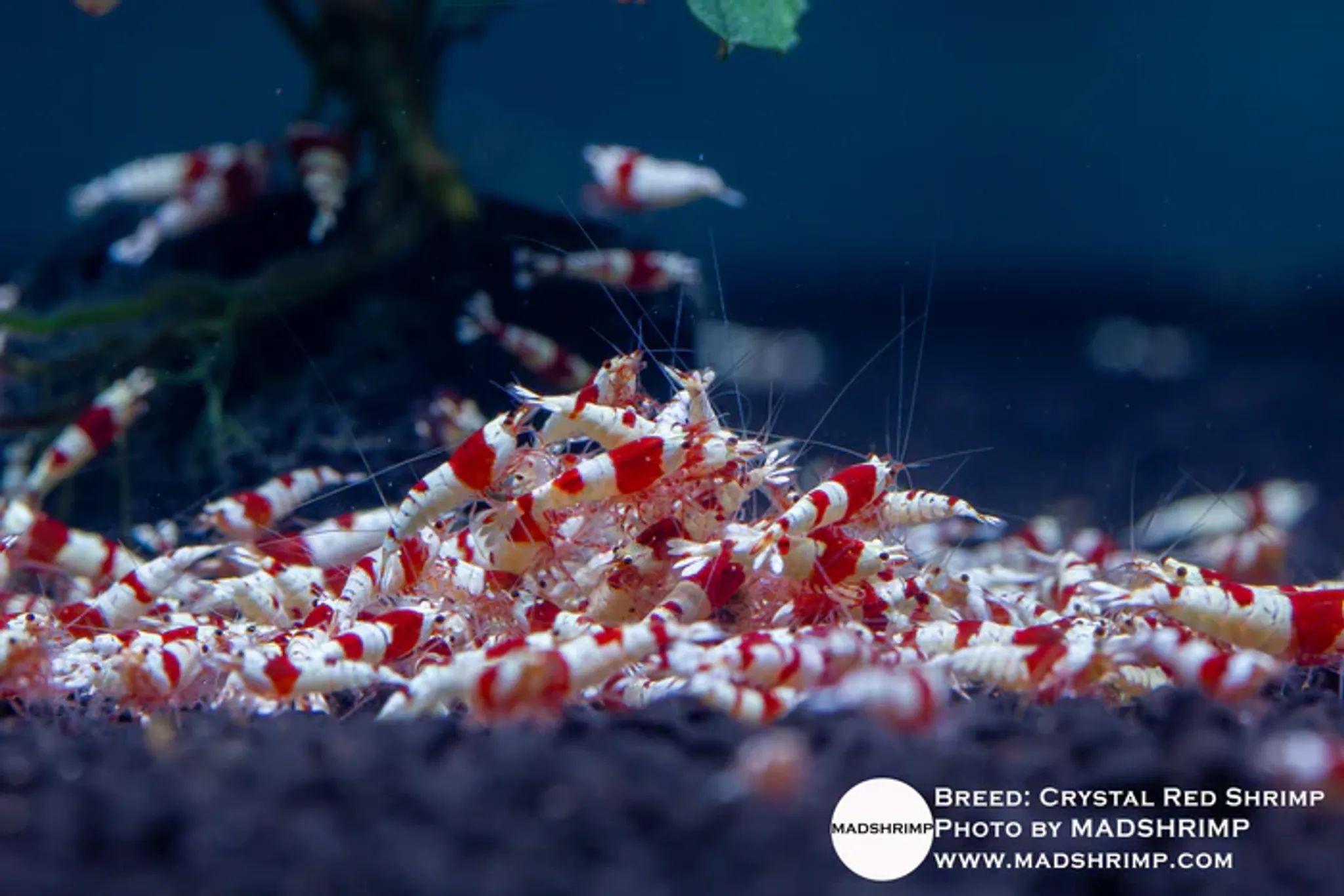

How to Set Up the Ideal Tank for Crystal Red Shrimp
Crystal red shrimp (CRS) are more sensitive to water quality than almost any freshwater fish, which means a setup that "works fine for fish" often fails a shrimp colony within weeks. This guide walks through the tank size, water parameters, substrate, filtration, and first-month routine that give a new colony the best chance of surviving, molting cleanly, and eventually breeding.
Choosing the Right Tank Size
A 5–10 gallon (19–38 L) tank is the workable minimum for a starter colony of crystal red shrimp, since the species is naturally nano-friendly. In practice, most experienced keepers recommend sizing up to 10–20 gallons (38–76 L) for a first attempt, because a larger water volume resists the swings in temperature, pH, and ammonia that kill shrimp faster than fish. More water simply gives you more room for error while you dial in the routine.
A tight-fitting lid is not optional. Shrimp are proficient climbers and will exit a tank via a filter cord, airline tubing, or a gap at the back, often ending up dried out on the floor.
Cycling the Tank Before Any Shrimp Go In
Crystal red shrimp tolerate an uncycled tank far worse than most community fish. Run the tank through a full nitrogen cycle — ammonia and nitrite both reading zero, with a measurable nitrate response — before adding a single shrimp. Skipping this step, or adding shrimp "to help cycle," is one of the leading causes of early die-off in new setups.
Target Water Parameters
Consistency matters more than hitting an exact number, but crystal red shrimp do best within these consensus ranges:
| Parameter | Target Range | Notes |
|---|---|---|
| Temperature | 72–76°F (22–24°C) | Cooler end (low-to-mid 70s°F) favors coloration, longevity, and breeding-focused keepers |
| pH | 6.0–7.2 | Sweet spot around 6.5–6.8 |
| GH (general hardness) | 4–6 dGH | Prioritize a stable number over chasing the exact midpoint |
| KH (carbonate hardness) | 0–2 dKH | Kept intentionally low, unlike most fish tanks |
| TDS | 120–160 ppm | Some keepers run as wide as 80–200 ppm; consistency trumps precision |
| Ammonia / Nitrite | 0 ppm | Non-negotiable |
| Nitrate | Under 20 ppm | Manage with water changes and light feeding |
Source Water: Why Straight Tap Rarely Works
Most U.S. municipal tap water is too hard and too high in carbonate hardness for crystal red shrimp, though hardness varies a lot by region — testing your own tap water before assuming you need extra equipment is a worthwhile first step. If your tap water genuinely tests soft, low-KH, and free of chlorine and chloramine, it may be usable as-is. For everyone else, the standard approach is RO or RO/DI water remineralized with a shrimp-specific mineral supplement. Straight distilled or RO water, used without remineralizing, strips out the trace minerals shrimp need for healthy molting — it's just as much of a mistake as using unmodified tap water.
DIY RO/DI Basics for Shrimp Keepers
Reef hobbyists have used RO/DI systems for years, but most of that advice is written for saltwater volumes and calcium-reactor-scale setups. A shrimp keeper needs far less output and a much simpler system:
- Sediment pre-filter — removes silt and particulates first; pick a 5-micron or 1-micron cartridge depending on how much sediment your local tap water carries.
- Carbon block — pulls out chlorine and chloramine before they reach the membrane.
- RO membrane — strips out dissolved minerals and hardness.
- DI resin cartridge — polishes the output to effectively 0 TDS.
A clogged sediment filter is the most common reason RO output slows to a trickle, so match the micron rating to your water rather than guessing.
When to Change RO/DI Filters
Replace sediment and carbon stages on a rough schedule — every 6–12 months or after a set number of gallons produced, whichever comes first — since a spent carbon stage lets chlorine through and shortens the life of your DI resin. DI resin itself doesn't follow a calendar: it depletes based on usage and incoming water hardness. An inline TDS meter reading the water after the DI stage is how you actually know it's time to replace it — rising output TDS (instead of a flat 0 ppm) is the signal. A manual or automatic flush kit that periodically flushes the membrane clears debris and extends membrane life between replacements.
Substrate: The Most Important Buying Decision
Active, soil-based aquasoil is the single most emphasized requirement in shrimp keeping, because it naturally buffers pH and KH downward instead of sitting inert like gravel or sand. Keepers who use inert substrate and expect fish-tank-style pH stability are usually disappointed — inert material won't pull KH down for you.
- Depth: 2–3 inches (5–7.5 cm) is typical.
- New aquasoil leaches ammonia briefly, so give it a rinse-free soak/cycle period before shrimp go in — this is part of the cycling process, not a separate step.
- Buffering capacity fades over time, often within 1–2 years, at which point the substrate needs replacing even though it looks physically fine. Plan substrate refreshes as part of long-term colony care, and stagger any replacement (swapping half at a time) rather than tearing down an established tank all at once, to avoid crashing your bacterial colony and shrimp population together.
You can browse bagged soil substrates built for this purpose in FishyHub's soil substrate category.
Filtration and Heating
Sponge filters (air-driven) are the near-universal recommendation for shrimp tanks. Their low flow suits shrimp, and the sponge's pore size keeps baby shrimp and molted shells from being pulled into the intake. A canister or hang-on-back filter is an acceptable alternative on larger tanks, but only with a pre-filter sponge covering the intake.
DIY Sponge Filter Build
A sponge filter is one of the cheapest pieces of equipment to assemble yourself: an air pump, airline tubing, and a sponge filter body (or a homemade version using a sponge, a length of rigid tube, and a check valve to stop backflow) is all it takes. It produces gentle flow and is easy to size up for larger tanks by running two.
For heating, use a small aquarium heater to hold a stable temperature — shrimp handle steady conditions far better than swings, even swings a fish would shrug off. CO2 injection is not needed and not recommended for a shrimp-only tank; it's an advanced, plant-growth-focused tool that risks a pH crash if pH and KH aren't watched closely, and beginners should skip it entirely.
Decor, Biofilm, and Plants
Decor in a shrimp tank isn't just aesthetic — it's a food source. Driftwood (Malaysian or spider wood are common choices) adds tannins and a grazing surface. Leaf litter, such as Indian almond (catappa) leaves, breaks down slowly and feeds biofilm growth while adding mild tannins. Moss — Java moss, Christmas moss — creates a dense benthic layer that's especially valuable for baby shrimp to hide and graze in.
Best Plants for a Shrimp Tank
Low-light, easy species do double duty: they host the biofilm and microfauna shrimp graze on, and floating plants shade the water and export excess nutrients.
- Java fern
- Anubias
- Java moss and other mosses
- Cryptocoryne species
- Floating plants (frogbit, water lettuce)
You can find sponge filters and other setup gear sized for nano tanks in FishyHub's filters category.
Acclimating and Feeding a New Colony
Crystal red shrimp are shocked by sudden parameter changes far more easily than most fish, so drip acclimation over an hour or more is worth the time investment. Run an airline with a control valve from the tank to the shrimp's bag or container, and adjust the drip rate so the volume roughly doubles over 60–90 minutes before transferring shrimp into the tank with a net (never pour the transport water in).
Feed sparingly — a few small feedings a week is plenty, since biofilm, algae, and leaf litter already supply much of a shrimp's diet. Supplement with shrimp-specific pellets or wafers, occasional blanched vegetables, and a calcium supplement to support molting. Remove any uneaten food within a couple of hours; overfeeding is one of the fastest ways to crash water quality in a tank with almost no bioload margin for error.
Tankmates and Water Changes
Crystal red shrimp are best kept species-only, or at most with a handful of very small, peaceful nano fish. Most fish marketed as "shrimp-safe" will still eat shrimplets given the chance, which quietly caps colony growth. Snails make a genuinely safe companion since they don't prey on shrimp at any life stage.
For water changes, small and frequent beats large and occasional: roughly 10% weekly, using pre-mixed, remineralized water matched to the tank's existing temperature and parameters. A sudden large change, or water that's off-temperature, can trigger stress and failed molts — sometimes called molting death syndrome — which is a common and preventable cause of losses in otherwise healthy tanks.
Sexing Your Shrimp
Around two months of age, crystal red shrimp are usually mature enough to sex reliably. The one fully dependable sign is a saddle — a saddle-shaped patch visible through the back of a mature female, which is developing eggs. Body shape (a rounder, more curved underside in females versus a straighter line in males), overall size, and color intensity are secondary cues that can help narrow things down but shouldn't be relied on alone.
Improving Shrimplet Survival
Baby shrimp face the highest mortality risk in any colony. A few habits make a measurable difference:
- Dense moss and biofilm cover for hiding and grazing.
- Stable parameters — avoid big swings in the days right after birth.
- Sponge filtration, which keeps tiny shrimplets from being pulled into an intake.
- No predatory tankmates, even ones considered generally peaceful.
- Careful feeding — rotting food fouls water fast in a tank with almost no bioload buffer.
A Note on Grading and Coloration
You'll see crystal red shrimp sold under grade labels like S, SS, and SSS, which refer to the amount and pattern of white coloration relative to red — higher grades generally show more solid white banding and less red. Grading is a cosmetic classification, not a health or hardiness indicator, and grade names aren't fully standardized across sellers, so treat them as a rough visual guide rather than a strict spec.
Common Mistakes and Troubleshooting
| Problem | Likely Cause | Fix |
|---|---|---|
| Cloudy water | New-tank bacterial bloom, unsettled substrate dust, or overfeeding | Test ammonia/nitrite first; cut feeding; avoid replacing all filter media at once; give it a few days |
| Bad odor | Decaying food, a hidden dead animal, or a dirty filter | Water change, clean the filter, find and remove the source |
| Surface bubbles or foam | Protein buildup from organic waste, or excess surface agitation | Partial water change, increase surface agitation or add a skimmer, rule out soap/detergent contamination |
| Early shrimp deaths | Tank added before fully cycled | Always confirm 0 ammonia/0 nitrite before stocking |
| Weak molts, deaths after a water change | Sudden large change or temperature mismatch | Switch to small, frequent, temperature-matched changes |
Also worth flagging: copper is lethal to shrimp at concentrations fish tolerate easily. Check any medication, fertilizer, or trace-element supplement for copper content before adding it to a shrimp tank.
Scaling Up: A Dedicated Shrimp or Fish Room
For keepers running several tanks, a dedicated room simplifies maintenance considerably. Worth planning for: a centralized water source and drain line, an RO/DI unit plumbed to a holding reservoir rather than run fresh each time, adequate electrical circuits with GFCI-protected outlets near any water source, humidity and ventilation control, and shelving or racking rated for the combined weight of multiple filled tanks.
Frequently Asked Questions
Can crystal red shrimp live with fish?
Generally not recommended beyond a few very small, peaceful nano species. Most fish, even ones marketed as shrimp-safe, will eat shrimplets given the opportunity, so species-only tanks give the best survival and breeding outcomes.
Do crystal red shrimp need CO2?
No. CO2 injection is a plant-growth tool, not a shrimp requirement, and it carries a real risk of a pH crash if not monitored closely. Skip it in a shrimp-first setup.
How often should I do water changes?
Small, frequent changes — roughly 10% weekly — using pre-matched, remineralized water beat infrequent large ones. Big swings in volume or temperature are a common trigger for failed molts.
What's the minimum tank size for crystal red shrimp?
A 5–10 gallon (19–38 L) tank can work, but 10–20 gallons (38–76 L) gives beginners more buffer against parameter swings while they learn the routine.
Why is my new shrimp tank cloudy?
Almost always a temporary bacterial bloom or unsettled substrate dust in a fresh setup. It typically clears within a few days without any intervention beyond confirming ammonia and nitrite are still at zero.
How do I know when to replace my RO/DI filters?
Watch the output TDS with an inline meter rather than following a fixed calendar. Rising TDS after the DI stage means the resin is exhausted and needs replacing.
Can I use tap water for crystal red shrimp?
Only if it's naturally soft, dechlorinated, and already lands within the target GH/KH/TDS ranges. Most U.S. tap water needs to be cut with RO/DI water and reconstituted with a shrimp mineral supplement.
How can I tell if my shrimp are male or female?
Look for a saddle — a visible patch of developing eggs — on mature females; it's the only fully reliable sign. Body shape and color intensity offer secondary hints but aren't conclusive on their own.
Once your parameters, substrate, and filtration are dialed in, browse live crystal red shrimp and other nano-friendly shrimp species in FishyHub's shrimp category to start or expand your colony.


