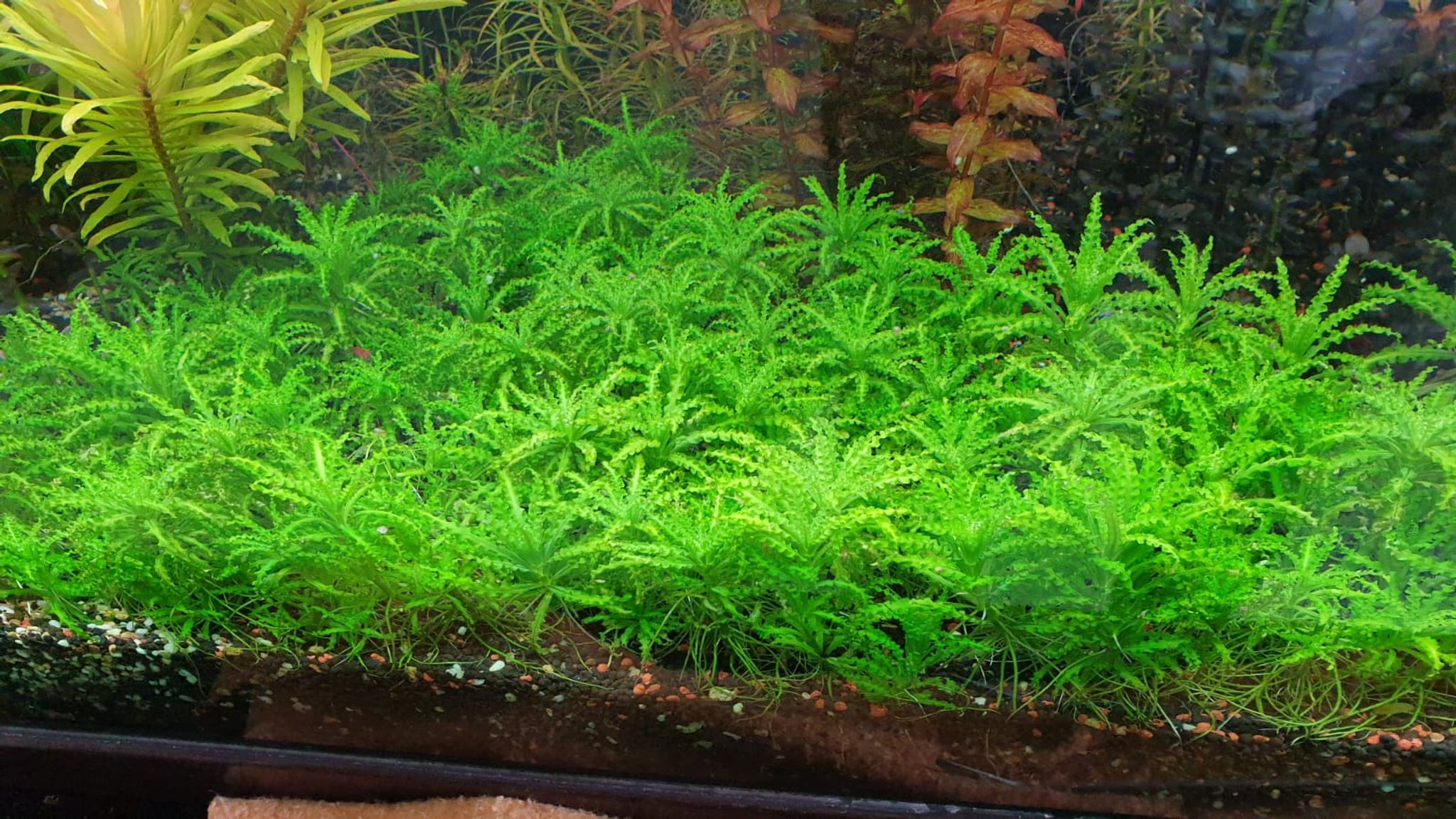
How to Plant and Propagate Pogostemon Helferi in a Freshwater Aquarium
Pogostemon helferi, commonly called downoi, is one of the most recognizable foreground plants in the hobby thanks to its curly, star-shaped leaves — and one of the most commonly lost, because new plantings often melt within days. This guide covers exactly how to plant it so it survives, what it needs to hold its tight curl, and the three reliable ways to multiply it once it's established.
What Is Pogostemon Helferi (Downoi)?
Downoi is Thai for "little star," a nod to the plant's rosette shape and wavy, spade-like leaves. It's native to fast-flowing streams in Thailand, which explains its preference for clean, well-oxygenated water over stagnant conditions.
In the aquarium it stays compact:
- Height: 1–3 in (2.5–7.5 cm)
- Growth habit: rosette-forming, spreading by runners into a low carpet or clump
- Leaf color: bright green, with curl and intensity increasing under stronger light and CO2
- Placement: foreground, midground accent, or bunched near hardscape (it's usually substrate-planted rather than tied to wood or rock the way mosses and anubias are)
How Difficult Is It, Really?
Opinions split here. Some hobbyists call downoi beginner-friendly once it's rooted in; others rate it moderate because of its initial melt phase and sensitivity to light and CO2 balance. The realistic answer sits in between: the water parameters are forgiving, but the transplant shock and the light/CO2 relationship trip up people who've never grown anything more demanding than anubias or java fern. Treat downoi as a good second plant rather than a first one.
Water Parameters and Lighting
| Parameter | Range | Notes |
|---|---|---|
| Temperature | 68–82°F (20–28°C) | Best kept mid-range, around 72–78°F (22–26°C) |
| pH | 6.0–7.5 | Tolerant of soft to moderately hard water |
| Hardness | Not fussy | Stability matters more than the exact number |
| Lighting | Medium to high | Low light causes stretching and loss of curl |
| Water changes | Regular | Fast-flowing native habitat means it dislikes stagnant water |
Under low light, downoi elongates, loses its signature ruffle, and turns pale and leggy — it will still be alive, but it won't look anything like reference photos. Medium to high lighting is what keeps growth tight and colorful. A dedicated LED aquarium lamp makes it much easier to hit and sustain that range consistently, rather than guessing with a generic light strip.
Does Downoi Need CO2?
Not strictly, but this is the single biggest lever for growth quality. Some sources treat CO2 injection as essentially mandatory for a dense carpet; others report it grows fine — just taller and looser — without it. Both are correct for different setups:
- Low-tech (no CO2): Downoi survives and slowly spreads, but growth is looser, leaves are less curled, and melting/algae risk is somewhat higher because uptake is slower relative to light and nutrients.
- High-tech (with CO2): Growth is noticeably denser and faster, propagation speeds up, and the curl and color intensify.
If you're running low-tech, keep light on the lower end of medium and dose nutrients conservatively to avoid outrunning the plant's slower uptake. If you're running high-tech, downoi is a good showcase plant for the extra investment.
Setting Up a Beginner CO2 System
For readers considering the upgrade, a basic high-tech CO2 setup has six parts:
- CO2 cylinder or canister — the gas source
- Regulator — steps down cylinder pressure to a usable level
- Solenoid with a timer — automatically shuts CO2 off with the lights
- Bubble counter — lets you count and set the injection rate visually
- Diffuser or reactor — breaks CO2 into fine bubbles or dissolves it before it reaches plants
- Drop checker — a slow-reacting color indicator that shows dissolved CO2 level in the water column
Start with a conservative injection rate (roughly 1 bubble per second for a modest tank, adjusted to volume) and increase gradually every few days rather than jumping straight to a high rate. Time CO2 to start 1–2 hours before the lights turn on and shut off shortly before lights-off, so plants have dissolved CO2 available throughout the photoperiod without gassing the tank overnight. Watch your fish closely when adjusting: heavy gasping at the surface is a clear sign of overdosing and means you should back off the rate immediately.
Substrate and Nutrients
Substrate Choice
A nutrient-rich aquasoil gives downoi the easiest start, since it's a small, shallow-rooted plant that benefits from fine-grained material it can anchor into. That said, it isn't mandatory — plenty of tanks grow it successfully in inert sand or gravel, as long as root tabs and liquid fertilization are dosed consistently. If you're setting up a new foreground and want the low-maintenance route, browsing aquarium soil substrate is worth doing before planting, since retrofitting substrate under an established carpet is far more disruptive than starting with the right base.
Essential Nutrients
Downoi's most common growth complaints — pale leaves, stalled spread, unexplained melt outside the initial adjustment period — often trace back to nutrient gaps rather than lighting or CO2. Planted tanks run on:
- Macronutrients: nitrogen, phosphorus, and potassium (often listed together as NPK), used in the largest quantities for leaf and stem growth
- Micronutrients: iron, manganese, and other trace elements, needed in small amounts but critical for leaf color and enzyme function
No single nutrient matters more than getting the balance right — an NPK-heavy dose with no iron produces green but dull growth, while heavy micros with starved macros stalls growth outright. Two supplementation routes cover both ends:
- Root tabs, pushed into the substrate near the root zone, feed the roots directly — useful in inert substrates or to supplement aquasoil as it depletes over time.
- Liquid all-in-one fertilizer, dosed into the water column after water changes, covers both macro and micro needs for the whole tank.
Running both together is the most reliable approach for a plant like downoi that depends on steady, consistent feeding rather than occasional heavy doses.
Planting Downoi Step by Step
Downoi is most commonly sold as small plantlets in a tissue-culture cup, which requires a bit more prep than a potted stem plant.
- Remove the gel medium. Rinse the plantlets under lukewarm water, gently working the gel off the roots. Skipping this step is one of the most common causes of faster, more severe melt, since leftover gel can foul the water right at the crown.
- Separate into small clumps. Divide the mass into groups of 2–5 stems or rosettes rather than planting it as one dense block.
- Clean the planting area. Smooth out the substrate and clear debris so the crown makes full contact with the substrate rather than resting on an air pocket.
- Plant with tweezers. Because the root mass is tiny, use aquascaping tweezers to bury only the roots and crown, spacing clumps 1–2 in (2.5–5 cm) apart. Leaves should stay above the substrate line.
- Avoid planting too deep. Burying the crown itself — the growing point where new leaves emerge — is the single most common planting mistake and leads directly to rot.
- Leave it undisturbed. Avoid vacuuming or heavy maintenance right around new plantings for the first week or two, since loosely rooted clumps can float free during cleaning.
Why Is My Downoi Melting?
Some leaf loss and melting in the first 1–3 weeks after planting is normal, not a sign of failure. It's transplant shock — especially pronounced when moving a tissue-cultured, emersed-grown plant into fully submersed conditions. Trim off melted or mushy leaves as they appear, keep water quality stable with regular water changes, and watch the crown: if it's healthy, new growth will emerge from it even while older leaves are dying back. Resist the urge to pull the plant in the first week or two — give it the full adjustment window before judging it as dead.
Growth Habit, Carpeting Timelines, and Trimming
Once established, downoi spreads through lateral runners — side shoots that extend outward, root, and form new rosettes. Under good light, CO2, and consistent fertilization, a planted grid of small clumps can fill in to a fairly dense low carpet over roughly 2–3 months; in a low-tech setup without CO2, expect that timeline to stretch to 4–6 months or longer, with a looser, less uniform result.
As the carpet matures, trim proactively rather than reactively:
- Trim runners that extend past the area you want covered every couple of weeks once the carpet is filling in, to keep growth dense rather than sprawling.
- Snip any rosettes that start growing upward instead of staying low — this is usually a light or nutrient-balance issue, and unchecked it makes the whole carpet look leggy over time.
- Remove old, larger leaves near the base occasionally to keep new curly growth visible instead of shaded out.
How to Propagate Downoi
Downoi doesn't propagate reliably from cut leaf sections or floating fragments — division of an already-rooted portion is the method that actually works. Three approaches, in order of how commonly they're used:
- Runner division: Once a lateral runner has developed a few leaves and small roots of its own, cut it free from the parent plant and replant it as a new clump.
- Crown/rosette division: When an established clump has grown large, gently split it into smaller sections at the base, keeping some root mass with each piece, and replant them with spacing to fill new areas.
- Patience over shortcuts: Because it won't propagate from loose leaves, resist the temptation to scatter trimmed leaf clippings and hope for regrowth — collect only rooted runners or divided crowns.
Placement and Tank Mates
Downoi works as a true foreground carpet, a midground accent plant, or loosely bunched near hardscape for texture. It's compatible with shrimp and most peaceful community fish, making it a common choice in shrimp and nano tanks. The main risk comes from tank mates rather than water chemistry: slow, heavy-bodied bottom feeders and large digging or herbivorous fish can uproot newly planted clumps before they've had a chance to establish, so a calm substrate and non-digging fish give it the best start. It's a solid pick alongside dwarf shrimp if you're stocking a shrimp-focused freshwater tank.
Downoi Troubleshooting Checklist
| Symptom | Likely Cause | Fix |
|---|---|---|
| Melting within first 1–3 weeks | Normal transplant shock | Trim dead leaves, keep water stable, wait for crown regrowth |
| Crown turns mushy/brown and won't recover | Planted too deep | Replant shallower next time; remove badly rotted clumps |
| Leggy, pale, uncurled growth | Low light and/or no CO2 | Increase light intensity or duration; consider CO2 injection |
| Algae on slow-growing patches | Light/nutrients outpacing CO2 or uptake | Rebalance the light-CO2-nutrient triangle rather than just cutting light |
| New plantings keep floating up | Overcrowded planting or maintenance disturbance | Space clumps further apart; avoid heavy vacuuming nearby for 1–2 weeks |
| Roots won't take hold | Debris or uneven substrate under crown | Clear the planting spot fully before replanting |
| Stunted, dull-colored growth despite good light | Nutrient deficiency (macro or micro) | Add root tabs and dose a complete liquid fertilizer |
Sourcing Healthy Plants
Downoi is typically sold as tissue culture (in a sealed cup, free of pests and algae but requiring the gel-rinsing step above), as potted plants, or as bare-root clumps. Whichever form you choose, inspect for firm, green rosettes without slimy or translucent leaves, a visible healthy crown, and no visible algae or pest hitchhikers on the leaves before adding it to your tank. You can browse aquarium plant substrate and setup supplies on FishyHub when preparing a new planted section for downoi or similar carpeting species.
Frequently Asked Questions
Is Pogostemon helferi (downoi) good for beginners?
It's best rated easy-to-moderate. The water parameters themselves are forgiving, but the initial melt period and its sensitivity to the light/CO2 balance make it trickier than truly beginner plants like anubias or java fern.
Does downoi need CO2 to grow?
No. It grows without CO2, just more slowly and with looser, less curled leaves. CO2 injection produces denser, faster, more compact growth and speeds up propagation, but it's an enhancement rather than a requirement.
Why is my downoi melting after planting?
This is typically normal transplant shock, especially for tissue-cultured plants shifting from emersed to submersed growth. Trim the dead tissue, hold water quality steady, and give it 2–3 weeks — new leaves should emerge from the crown if it's still healthy.
How do I propagate downoi?
Let it send out lateral runners, then cut and replant a runner once it has developed its own small leaves and roots. Alternatively, divide an established clump at the base into smaller rooted sections and replant them with spacing.
What lighting does downoi need?
Medium to high lighting keeps growth compact, colorful, and tightly curled. Under low light, it stretches out, fades, and loses the curl that makes it recognizable.
Can downoi grow without special substrate?
Yes. Inert substrate like sand or gravel works fine as long as you dose root tabs and a complete liquid fertilizer consistently. Nutrient-rich aquasoil simply makes the early growth phase easier and more forgiving.
Ready to set up a foreground for downoi or a similar carpeting plant? Explore substrate options in the aquarium substrate category on FishyHub to find a base that matches your setup.


