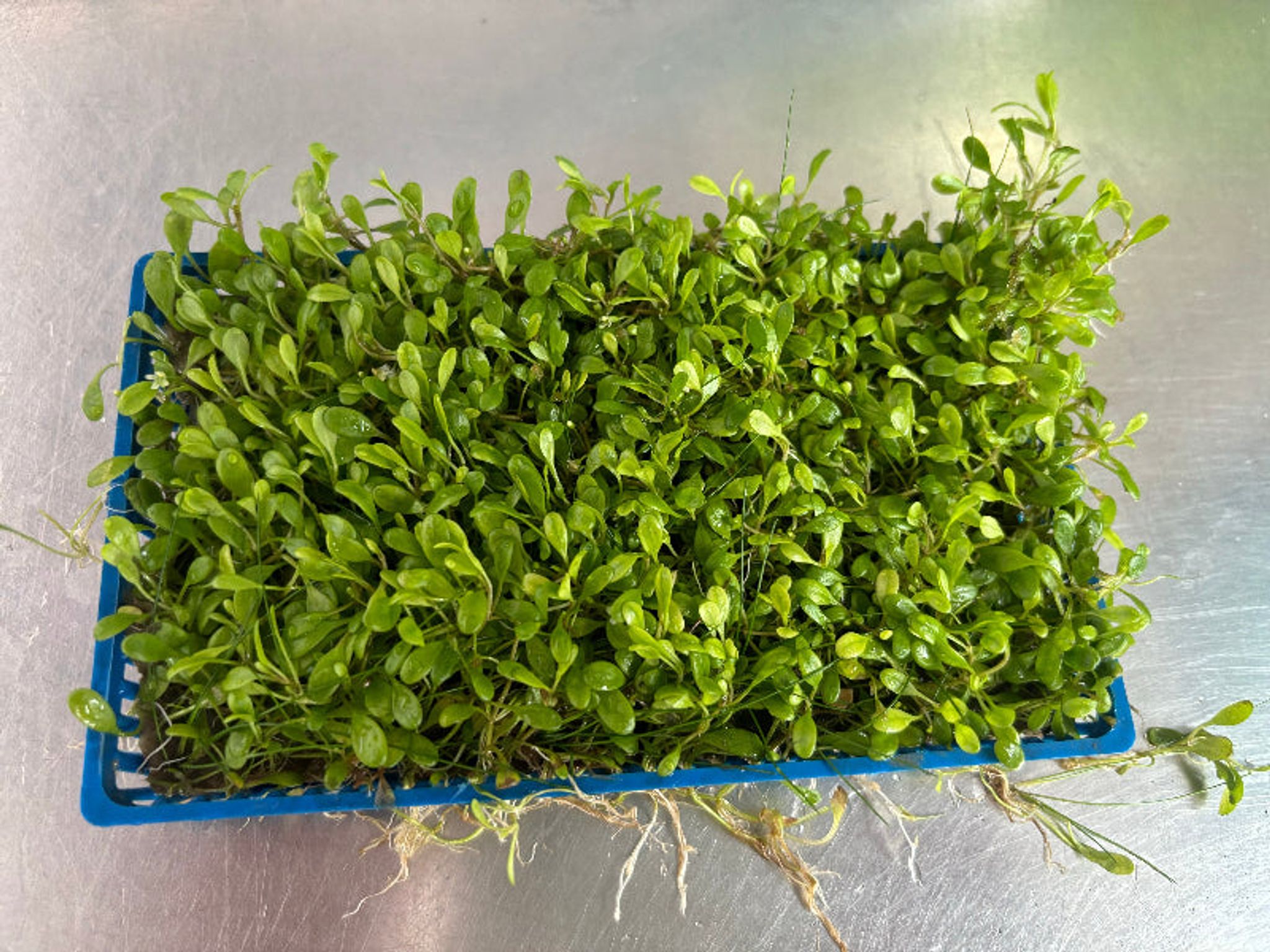
How to Plant and Propagate Glossostigma in a Freshwater Aquarium
Glossostigma elatinoides makes one of the lowest, densest carpets in the freshwater hobby, but it is not a plant that forgives shortcuts. This guide covers the real gear requirements, a tuft-by-tuft planting method that keeps tiny stems from floating away, and the trimming routine that turns a thin green haze into a solid mat.
What Glossostigma Is and Why It's Considered Advanced
Glossostigma elatinoides is a small, round-leaved creeping plant native to Australia, New Zealand, and parts of Asia. In the right conditions it hugs the substrate and spreads into a dense, lawn-like carpet rather than growing upward, which is exactly why it's prized for foreground aquascaping.
It's also widely regarded as one of the more difficult carpeting plants available: its demands for light, CO2, and substrate are high, and its shallow, fine root system makes it prone to uprooting and floating before it establishes. Think of it as a "high-tech carpet plant" — it rewards a well-planned setup and punishes an improvised one.
The Gear Picture Before You Buy Plants
Decide on your equipment first, then buy Glossostigma — not the other way around. At minimum, plan for high light (roughly 50–80+ PAR at the substrate, tied to tank depth), pressurized CO2 injection (treated as mandatory for a true low, dense carpet), nutrient-rich fine-grained aquasoil soft enough for weak roots to anchor into, a complete liquid fertilizer routine covering macro and micronutrients (especially iron and potassium), and good substrate-level flow to prevent detritus buildup and spread CO2/nutrients evenly.
A nutrient-rich soil substrate and a LED fixture capable of high output over the tank depth are the two hardware pieces worth prioritizing first.
Lighting: Match PAR to Tank Depth
Sources differ on the exact number — easier carpets can fill in at 40–50 PAR, while Glossostigma is usually cited at 50–80+. Rather than chasing one fixed figure, think in terms of tank depth: a 12-inch-deep tank needs a stronger fixture than an 8-inch-deep one to deliver the same PAR at the substrate. Run lights 8–10 hours a day; less tends to cause stretching toward the surface instead of lateral spreading.
CO2: Treated as Mandatory, Not Optional
Some general carpet-plant guides treat CO2 as merely helpful, and for easier species like Marsilea hirsuta that's fair. For Glossostigma specifically, the consensus among high-tech keepers is that CO2 is required for a genuinely low, dense mat, not just beneficial — without it, growth turns slow and leggy and the tank becomes far more vulnerable to algae.
Target 20–30 ppm of dissolved CO2. A drop checker filled with a reference solution and pH-sensitive indicator is the simplest way to confirm this visually: lime green means you're in range, blue means too little CO2, and yellow means too much.
Substrate: Soft Aquasoil Over Inert Gravel
Because Glossostigma's roots are weak and shallow, fine-grained, nutrient-rich aquasoil is strongly preferred — soft enough to anchor into and it feeds the roots directly. Inert sand or gravel can work only as a fallback: it's harder to plant into and needs root tabs or a heavier liquid-fert routine to compensate for the lack of substrate nutrition.
A typical foreground soil layer runs 2–3 inches deep. New aquasoil buffers water slightly acidic and can leach ammonia for the first week or two, so cycle the tank carefully before adding livestock.
Water Parameters
| Parameter | Target Range |
|---|---|
| Temperature | 72–82°F (22–28°C) |
| pH | 6.5–7.5 |
| Water hardness | Soft to moderately hard |
| CO2 | 20–30 ppm |
| Light duration | 8–10 hours/day |
| PAR at substrate | 50–80+ (scale to tank depth) |
Glossostigma tolerates a range of parameters but grows most reliably in stable, warm-ish water typical of a CO2-injected planted tank.
How to Plant Glossostigma Step by Step
- Separate the mat into small tufts. Using fine tweezers, break the potted or tissue-cultured mat into tufts of just a few stems each — larger clumps cause problems later.
- Plant shallow, not deep. Insert each tuft just deep enough to anchor the base into the soil; planting too deep smothers the crown and rots the center of the clump.
- Space in a grid. Set tufts roughly 0.5–1 inch apart across the foreground, giving runners room to knit together.
- Reduce flow over new plantings. Until roots take hold, strong flow will lift tufts loose. A brief low-flow period, combined with denser, more heavily rooted tufts, is the most effective anti-float technique — more reliable than tweezers alone.
- Weigh down stragglers if needed. A fine plastic mesh pinned over the carpet, or a light sprinkle of substrate over each tuft's base, can hold plants down until they root.
- Restore normal flow gradually. Once tufts stop lifting, usually within the first week, bring circulation back to normal — the carpet needs it long-term to avoid detritus buildup and distribute CO2 evenly.
Expect Some Melting First
Glossostigma is commonly sold grown emersed (out of water, in a nursery tray). Once submerged, the emersed leaves often melt or brown back over the first 1–2 weeks as the plant converts to its submersed growth form. This is a normal transition, not failure — resist the urge to pull plants during this window; keep parameters stable and be patient.
Growth Habit, Timeline, and Propagation
Glossostigma spreads via horizontal runners (stolons) that root at each node, gradually knitting neighboring tufts into a single mat; new shoots also send fine roots independently into the substrate. Roughly what to expect with dialed-in light, CO2, and nutrients: initial melt over 1–2 weeks, a thin green haze by 2–4 weeks, a short mat by 4–8 weeks with regular trimming, and a full carpet by 8+ weeks depending on starting density and consistency of care.
Once a green haze or short mat forms, trim horizontally with curved carpet scissors to keep it under about 1 inch tall. Cutting the tips forces sideways branching instead of upward growth, producing a dense, lawn-like texture. Frequent trimming is also how you propagate Glossostigma for free: cuttings with a node and some roots can be replanted into bare patches in the same tank, or moved to start a carpet in a different aquarium.
Choosing Plants for a High-Tech Tank
Glossostigma sits in the advanced, high-tech tier: high light, mandatory CO2, nutrient-rich substrate. Pair it only with species that tolerate similar conditions — low-light plants in the same tank tend to melt from the intensity or get smothered by algae that thrives under bright light. Match the whole plant list to one demand tier rather than mixing easy and advanced species.
Building Your First High-Tech Tank
If this is your first CO2-injected planted tank, build the full plan before buying plants: lighting, CO2 system, nutrient-rich substrate, and a fertilizer dosing schedule. Expect a learning curve tuning CO2 and managing early algae — that's normal. From day one, keep a routine of weekly water changes, fertilizer dosing, and scheduled trimming; skipping any of these for a few weeks is usually what turns a manageable tank into an algae-covered one.
Aquarium CO2 System Basics
A pressurized CO2 setup typically includes a cylinder and regulator, a solenoid valve on a timer, a diffuser or in-line reactor to dissolve CO2 into the water, and a drop checker or pH controller to monitor levels. Run the solenoid so injection starts about 1 hour before lights turn on and shuts off about 1 hour before lights off, avoiding overnight buildup when plants can't use it. Watch for fish gasping at the surface — a classic overdose sign — and add surface agitation if it happens.
At minimum, simple timers for lights and the CO2 solenoid are the baseline automation for any planted tank. As budget allows, a drop-checker-based controller, dosing pumps, and a safety cutoff tied to the solenoid add real protection against overnight buildup or a pump failure while you're away.
Comparing Glossostigma to Easier Carpet Alternatives
Not every foreground needs this level of demand. Here's how Glossostigma compares to two common alternatives:
| Plant | Light Needs | CO2 | Difficulty | Notes |
|---|---|---|---|---|
| Glossostigma elatinoides | 50–80+ PAR | Essentially mandatory | Hardest | Fine roots, prone to floating, needs frequent trimming |
| Dwarf baby tears (HC) | Medium-high PAR | Steady CO2 needed | Hardest (tied) | Also melts on conversion, also pops out of substrate easily |
| Marsilea hirsuta | 30–60 PAR | Optional | Easier | Four-leaf-clover look, spreads via stolons, more forgiving |
If Glossostigma's requirements feel like more than you want to manage, Marsilea hirsuta is the usual recommendation as a lower-maintenance starter carpet with a similar look. Dwarf baby tears sits in the same difficulty tier as Glossostigma, not an easier middle ground.
Common Mistakes and Troubleshooting
| Problem | Likely Cause | Fix |
|---|---|---|
| Center of clump rots | Tufts planted too large or too deep | Use smaller tufts, plant shallow |
| Plants float up after planting | Weak roots, too much flow | Denser tufts, reduce flow, mesh or light substrate cover |
| Leggy, vertical growth | Insufficient light or CO2 | Raise PAR, verify CO2 with drop checker, trim more often |
| Melting shortly after planting | Normal emersed-to-submersed transition | Keep parameters stable, wait 1–2 weeks before judging |
| Algae overtaking the carpet | Light/CO2/nutrient imbalance | Balance the light-CO2-nutrient triangle, not just less light |
| Patchy, uneven carpet | Uneven flow or light distribution | Adjust hardscape/flow, replant runners into gaps |
| Thin, pale growth despite good light/CO2 | Fertilization skipped | Dose a complete macro/micro liquid fertilizer routine |
Good circulation across the substrate deserves special mention: without it, low carpets accumulate detritus and receive uneven CO2 and nutrients, showing up as patchy growth even when overall parameters look fine on paper. A reliable filter sized to move enough water across the foreground helps prevent this.
Livestock Compatibility
A shallow-rooted carpet doesn't hold up against fish that dig, root through substrate, or graze heavily on soft leaves. Favor small, non-digging, non-herbivorous species — bottom-dwelling diggers and large cichlids are poor matches, since even casual foraging can uproot tufts before they establish.
Frequently Asked Questions
Can Glossostigma grow without CO2?
It can technically survive without CO2, but it won't form a tight, low carpet — expect slow, upward-leaning growth and a higher risk of algae. If a dense carpet is the goal, CO2 injection is worth the investment.
Is Glossostigma good for beginners?
Generally, no. It's one of the more demanding carpet plants due to its light, CO2, and substrate requirements combined with fragile roots. Beginners are usually better served starting with Marsilea hirsuta or another easier alternative first.
How long does it take to carpet a tank?
Typically several weeks to a couple of months, depending on light intensity, CO2 stability, nutrient dosing, and starting density. Frequent horizontal trimming speeds up lateral spread and shortens this timeline.
Why is my Glossostigma turning brown or melting?
This is almost always the normal emersed-to-submersed adjustment that happens shortly after planting. Keep parameters stable and avoid pulling plants too early — most recover within 1–2 weeks.
Can Glossostigma grow in low light or a low-tech, no-CO2 tank?
It can survive, but it won't stay low and dense — it will stretch and thin out instead. It's not a good fit for a true low-tech setup.
What fish and shrimp are compatible with a Glossostigma carpet?
Small, non-digging, non-herbivorous species that won't disturb the shallow root system work best. Avoid bottom-dwelling diggers and large cichlids, which are prone to uprooting the carpet before it establishes.
How do you propagate Glossostigma to fill bare spots or start a new tank?
Trim mature runners that include roots and at least one node, then replant those cuttings as new tufts in bare patches or another aquarium — the standard way to expand a carpet without buying more stock.
Does Glossostigma need root tabs if it's already in nutrient-rich soil?
Usually not right away, since fresh aquasoil supplies enough nutrition initially. As the soil depletes over several months, supplementing with root tabs or liquid fertilizer keeps growth from stalling.
Ready to start your foreground carpet? Browse substrate options on FishyHub to find a nutrient-rich soil suited to Glossostigma and other high-tech carpet plants.

