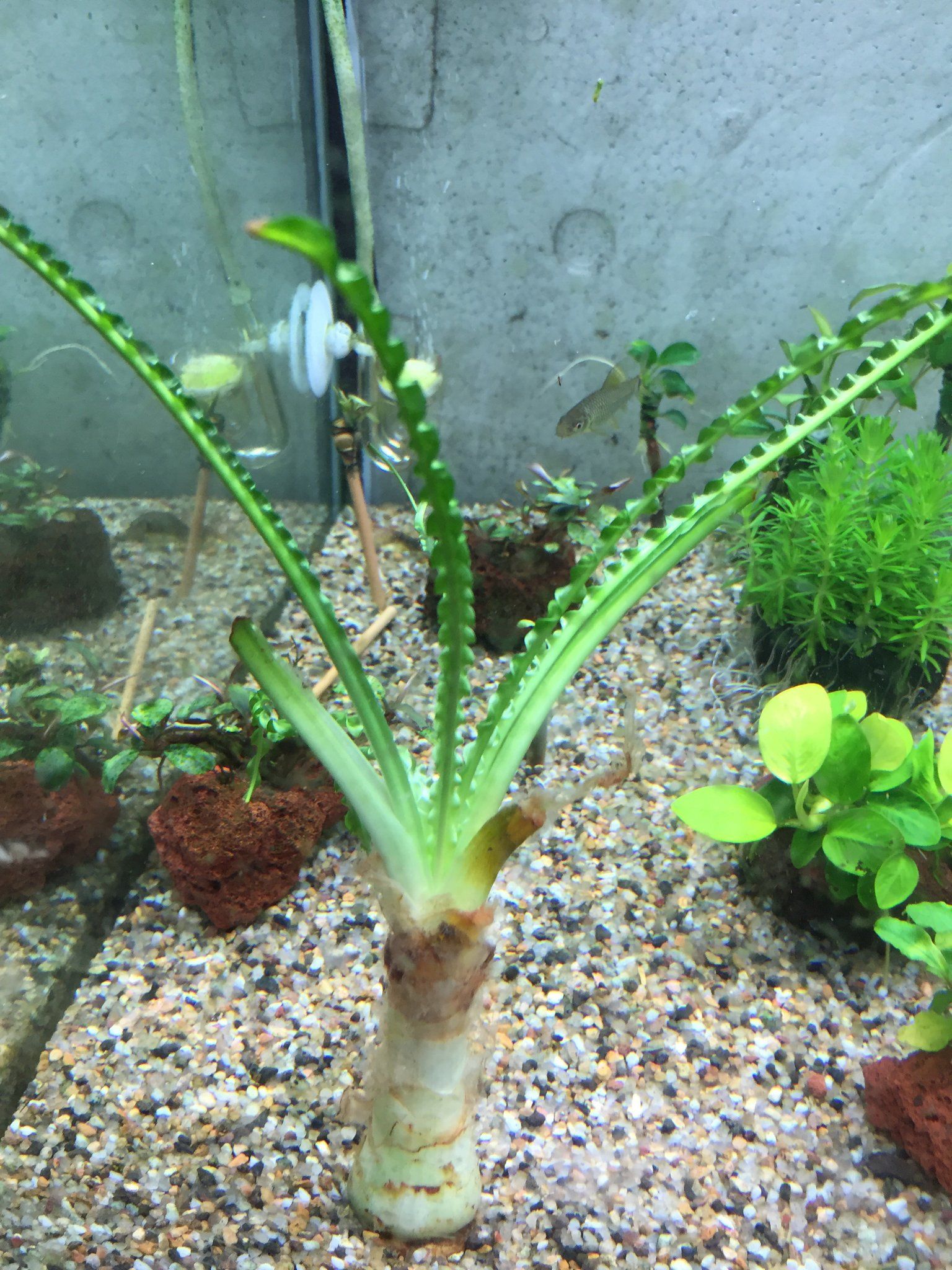

How to Plant and Propagate Crinum in a Freshwater Aquarium
Crinum is one of the most rewarding background plants a freshwater tank can hold, but most failures come down to one mistake: planting the bulb too deep. This guide covers exactly how deep to bury it, what water and light it wants, and how to grow new bulbs from an established mother plant without losing either one.
What Is Crinum, and Which Species Should You Get?
Crinum is a genus of large bulb (rhizome) plants, not stem or rosette plants. Instead of spreading roots through a thin substrate layer like a carpet plant, a Crinum bulb anchors itself with a thick, fleshy root mass and pushes out long strap-like leaves from a central crown. Three species show up most often in the freshwater hobby:
| Species | Leaf Shape | Typical Size | Best For |
|---|---|---|---|
| C. calamistratum ("African onion") | Narrow, wavy, curled leaves | 12–20 in (30–50 cm) | Statement piece in medium tanks; unique texture |
| C. thaianum ("water onion") | Tall, straight, grass-like blades | Can exceed 6 ft (2 m) in ideal conditions | Very tall tanks or tanks where leaves reach the surface |
| C. natans | Broad, ribbon-like leaves | 12–24 in (30–60 cm) | Wide background areas needing bold texture |
All three are background or center-back plants suited to 20-gallon tanks or larger, since their leaf spread and eventual size crowd out smaller layouts.
Water Parameters and Tank Setup
Crinum is forgiving once established, but starting it in a comfortable range speeds up root development:
- Temperature: 68–82°F (20–28°C)
- pH: 6.0–8.0, with a sweet spot around 6.5–7.5
- Hardness: soft to moderately hard, roughly 3–8 dGH
Exact numbers vary slightly by species and source — thaianum is sometimes listed as preferring cooler, softer water than natans — but any tank that sits within the ranges above will suit all three species. Once a bulb is well-rooted, it tolerates modest swings outside these numbers without trouble.
Substrate
Crinum bulbs are root feeders, so substrate quality matters more than substrate brand. Use a nutrient-rich planted aquarium soil, or plain gravel/sand supplemented with root tabs pushed near (not into) the bulb. Depth recommendations vary — some sources say a couple of inches is enough, others push for 3–5 inches — but a safe baseline is at least 2–3 inches (5–7.5 cm), going deeper in larger tanks or where other root-feeding plants share the same substrate bed. You can browse substrate options sized for a Crinum setup, including nutrient-rich soil.
Lighting
Crinum tolerates low light and will survive under it indefinitely, but it grows fastest — and propagates far more readily — under medium-to-high light, roughly 20–35+ PAR, or about 2–4 watts per gallon equivalent in LED output. If producing offsets is a priority, plan lighting toward the higher end of that range rather than the bare minimum needed to keep the plant alive. A dedicated aquarium light fixture makes it easier to dial in that range consistently.
Does Crinum Need CO2?
No. Crinum grows and eventually propagates without injected CO2, so don't treat it as a hard requirement. That said, CO2 does meaningfully help: it speeds overall growth and tends to increase how often a mature bulb throws offsets. Some sources treat CO2 as basically irrelevant to this genus, others frame it as a real propagation booster — the honest middle ground is that it's optional but helpful, not required.
If you do add CO2, keep it in standard planted-tank territory:
- Target concentration: roughly 20–30 ppm, indicated by a drop checker sitting green to lime-green
- Basic setup: a CO2 cylinder, a regulator with two gauges (tank pressure and working/bubble-rate pressure), airline tubing, and a diffuser to break the gas into fine bubbles for faster dissolution
- Safety option: a pH-controller that automatically halts injection once the tank reaches a set low pH (commonly around 6.5), preventing an overnight pH or oxygen crash
- Don't skip gas exchange: surface agitation still matters with CO2 running — good circulation prevents CO2 from stratifying and keeps oxygen levels stable overnight
Planting Depth: The Step That Makes or Breaks It
This is the single most important detail in growing Crinum successfully. Plant the bulb so that only the bottom third to half sits in the substrate — roots and the lower bulb buried, but the crown (the neck where leaves emerge) stays at or above the substrate line. Burying the entire bulb traps moisture and debris against the crown and causes it to rot, which is the most common way a new Crinum dies.
Placement in the Aquascape
Because Crinum eventually grows tall and wide, place it in the background or center-back of the layout, away from the glass and with real space from neighboring plants. It works well as an anchor plant that hides equipment like heaters or filter intakes, and its bold, upright leaves contrast nicely against fine-leaved foreground plants like carpeting species. Give it a permanent spot from the start — Crinum dislikes being dug up and moved repeatedly, and each disturbance resets root establishment.
Inspecting and Acclimating a New Bulb
Crinum bulbs are frequently shipped bare-root and grown emersed (out of water) by the nursery before sale. Before planting:
- Rinse the bulb gently under clean water and inspect it for soft, mushy, or discolored spots, which indicate rot that should be trimmed away with a clean blade before planting.
- Check the roots and leaf axils for snail eggs, which often hide in the leaf folds of bare-root plants.
- Confirm the bulb itself feels firm and is white to cream colored at the base — this is the sign of a healthy bulb, even if the leaves look rough.
The First Two Weeks
- Plant immediately at the correct depth in its permanent spot.
- Expect leaf melt. Old, emersed-grown leaves commonly yellow and die back in the first one to three weeks after submersion — this is a normal transition, not a sign of failure.
- Trim dead tissue close to the bulb as it melts, but leave the bulb itself undisturbed.
- Watch the bulb, not the leaves. As long as it stays firm and light-colored, the plant is fine even with zero visible leaves.
- Don't replant or move it during this period, and don't over-fertilize in a panic response — normal dosing is enough.
- Be patient. New growth can take weeks to a few months to appear while the plant focuses on establishing roots.
Fertilization
Feed Crinum through its roots as well as the water column. Push root tabs into the substrate near — not touching — the bulb, and dose liquid iron or a general micronutrient supplement regularly. Aim for nitrate around 20–50 ppm through routine fertilization; new leaves that come in pale, thin, or nearly transparent are a nutrient deficiency, not a lighting or disease problem, and should be corrected with heavier root and water-column feeding rather than more light.
How to Propagate Crinum by Bulb Offsets
Once a Crinum bulb is settled and well-fed, it produces offsets (also called pups or daughter bulbs) at its base — this is by far the most reliable way to get new plants.
- Timing: a healthy mature bulb typically produces roughly 1–3 offsets per year. There's no fixed schedule; it depends on the plant's condition, nutrition, and light.
- What speeds it up: stronger light and injected CO2 both tend to increase offset frequency, though neither is required for offsets to eventually appear.
- When to separate: wait until the offset has developed its own root system and at least a few of its own leaves, and ideally has reached roughly 1 inch (2.5 cm) or more in bulb diameter. Recommendations vary — some hobbyists separate as soon as any roots are visible — but erring toward a larger, sturdier offset noticeably improves survival odds.
- How to separate: gently uproot the whole cluster, then by hand — or with a clean, sharp blade if it resists — carefully twist or cut the daughter bulb free from the mother, keeping the offset's own roots intact.
- Replanting: plant the offset immediately at its own spot, using the same depth rule (lower bulb and roots buried, crown exposed). Expect a slow start and possibly some minor transition melt, just as with a newly purchased plant.
- Alternative: if you have the space, you can simply leave offsets attached to the mother bulb to form a fuller, clustered clump rather than separating them — this is a perfectly valid choice and requires no extra work.
- Seed propagation: mature Crinum can occasionally flower and set seed, but only in emersed or paludarium conditions, and this method is far slower and less reliable than offset division. It's worth knowing it exists, but it's not practical for most tank setups.
A Bonus: Flowering
If a Crinum's leaves reach the water's surface or grow emergent above it, a mature, well-established bulb can occasionally send up a flower stalk. This isn't something to plan around, but it's a distinctive sign of a thriving, long-settled plant.
Common Mistakes to Avoid
| Mistake | Result | Fix |
|---|---|---|
| Burying the whole bulb | Crown rot, plant death | Keep the crown/neck exposed above substrate |
| Panicking over post-purchase melt | Pulling the plant, over-fertilizing | Trim dead tissue, wait, check bulb firmness |
| Expecting fast growth | Premature troubleshooting or discarding a healthy plant | Judge Crinum on a weeks-to-months timeline |
| Replanting or moving repeatedly | Delayed root establishment | Choose a permanent spot from day one |
| No root tabs or nutrient substrate | Pale, thin, yellow new leaves | Treat as a nutrient deficiency and dose accordingly |
| Too little light long-term | Stunted growth, few or no offsets | Bump toward medium-high light if propagation matters |
| Separating offsets too early | Low survival rate | Wait for visible roots and multiple leaves |
| Overcrowding the layout | Cramped, tangled leaf growth | Give Crinum real space from other plants and glass |
Is Crinum Safe With Fish That Dig?
Its deep, bulb-and-root structure anchors it more securely into the substrate than shallow-rooted stem or rosette plants, which makes it a reasonably good choice for tanks with mild diggers or burrowers. Very aggressive diggers can still expose the bulb over time, so a thicker substrate layer and a stable planting spot away from heavy digging zones help.
Frequently Asked Questions
Does Crinum need CO2 to grow?
No. Crinum grows fine without injected CO2, but adding it speeds up overall growth and can increase how often the plant produces offsets.
How deep should I plant a Crinum bulb?
Bury only the lower third to half of the bulb. The crown — the neck where the leaves emerge — should stay at or above the substrate line, since fully burying it causes rot.
Why did my new Crinum's leaves die right after planting?
This is normal transition melt from emersed nursery growth adjusting to fully submersed tank conditions. Leave the bulb in place, trim dead leaf tissue, and wait for new growth as long as the bulb itself stays firm.
How do I propagate Crinum in an aquarium?
Let a healthy, established mother bulb produce offsets at its base. Wait until each offset has its own root system and a few leaves, ideally around 1 inch (2.5 cm) or more in diameter, then gently separate and replant it at the same depth as the original.
How long does it take a Crinum to produce new plants?
Often many months to over a year for a newly settled bulb to produce its first offsets. Once mature, a healthy plant may then produce roughly 1–3 offsets per year.
What size tank does Crinum need?
At least a 20-gallon tank, given how tall and wide its leaves eventually grow — some species can exceed 6 feet (2 m) in ideal conditions.
Can Crinum grow in low light?
Yes, it tolerates low light and survives without issue, but growth and offset production are noticeably slower than under medium-to-high light.
Ready to start your own Crinum setup? Browse tanks and stands sized 20 gallons and up on FishyHub to give your bulb plant the room it needs to mature.


