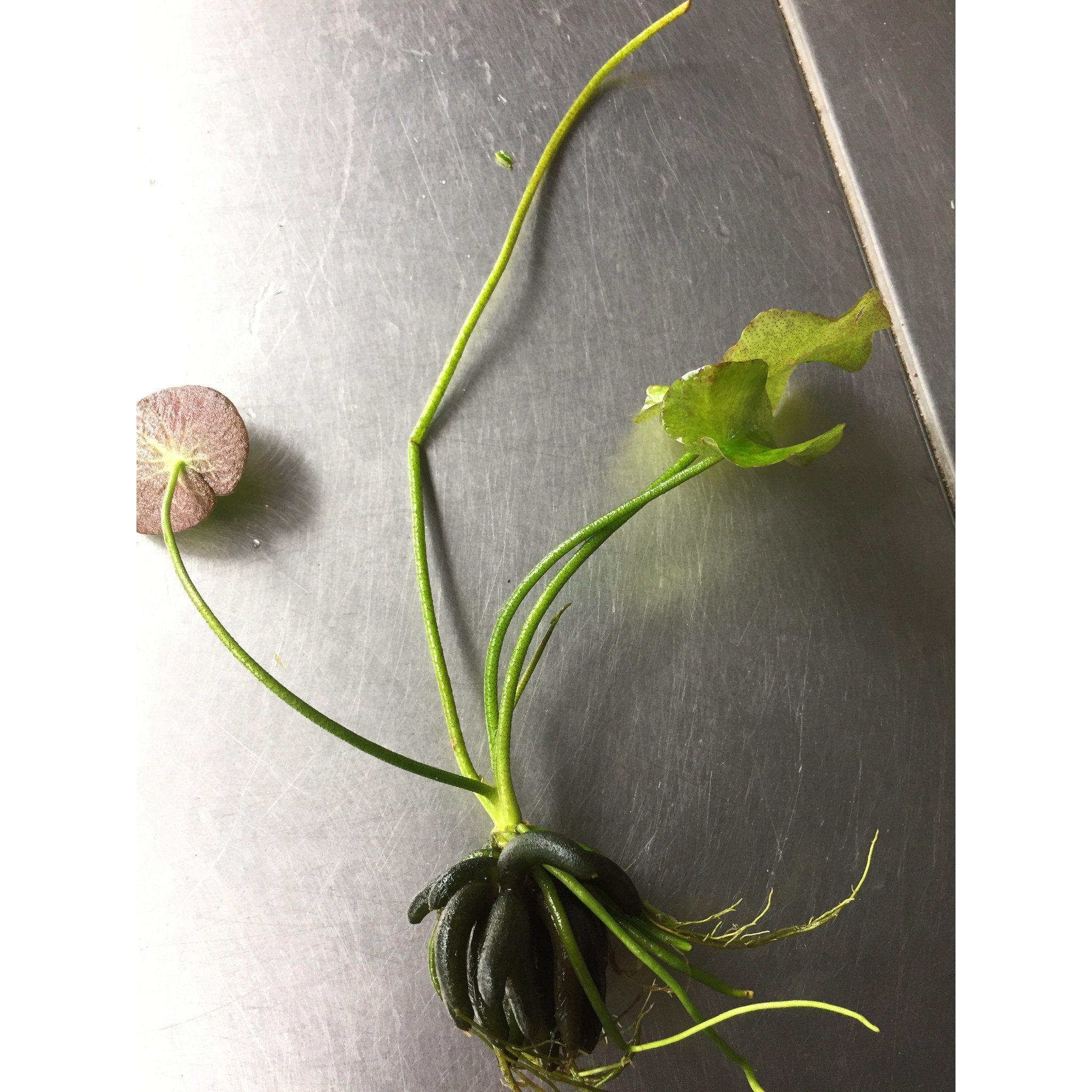
How to Plant and Propagate Banana Plant in a Freshwater Aquarium
The banana plant is one of the most forgiving aquarium plants you can grow, but the single most common way to kill one is planting the tuber too deep. This guide covers correct planting depth, the tank conditions that keep it thriving, and the two easiest ways to multiply it once it's settled in.
What Is a Banana Plant?
Despite the name, this plant has nothing to do with the fruit. Its scientific name is Nymphoides aquatica, and it's native to slow-moving rivers, ditches, and ponds in the southeastern United States — one of the few truly North American plants in the hobby. The nickname comes from its tuber, a cluster of pale, finger-like storage organs that genuinely resembles a tiny hand of bananas.
You'll typically find it sold two ways: as a bare tuber (sometimes labeled a "bulb") or as an already-rooted potted plant. Both work, but a bare tuber requires more careful planting.
| Trait | Typical value |
|---|---|
| Difficulty | Beginner-friendly to keep; moderate patience needed to propagate |
| Mature size (rooted) | 4–6 in (10–15 cm), with runners extending further |
| Growth rate | Moderate; faster under stronger light |
| Placement | Foreground to midground |
| CO2 required | No |
| Flowers | Small white blooms once surface leaves mature |
Tank Setup Requirements
A banana plant isn't fussy about hardware. A tank of roughly 10 gallons (38 L) or larger gives it enough room to spread its root system and send runners without immediately crowding neighbors.
- Substrate: At least 2 inches (5 cm) of gravel or sand. It will grow in almost any substrate — a nutrient-rich aquasoil helps but isn't necessary. If you're setting up from scratch, you can browse substrate options sized for a new planted tank.
- Lighting: Tolerates low light, but grows faster, stays more compact, and colors up better under moderate-to-high light, roughly in the 30–40+ PAR range. Low light won't kill it — it just slows growth and can encourage leggy stems reaching for the surface.
- Flow/filtration: Gentle to moderate flow is ideal. Strong direct current can tug at newly planted tubers before roots anchor them.
Water Parameters
| Parameter | Recommended range |
|---|---|
| Temperature | 68–82°F (20–28°C) |
| pH | 6.0–7.5 |
| GH (hardness) | 1–8 dGH |
| CO2 | Not required |
| Light | Low tolerated; moderate-high preferred |
Sources disagree on how picky this plant really is about water chemistry. Some call it adaptable to nearly any freshwater setup; others insist on soft, slightly acidic water to avoid melting. The practical middle ground: it will survive a fairly wide range, but keeping it in soft-to-moderate, mildly acidic-to-neutral water gives it the best long-term health and lowers the odds of melt, especially right after planting.
How to Plant a Banana Plant Tuber (The Critical Step)
Planting depth is where most banana plants die, so treat this section as the one to get right.
- Rinse and quarantine first. Give any new tuber or potted plant a quick dip or rinse, and quarantine it separately for a couple of weeks before adding it to your display tank. This catches hitchhiking snails, parasites, or pesticide residue before it becomes a tank-wide problem.
- Rest the tuber on top of the substrate. Set it directly on the gravel or sand surface. At most, nestle the very bottom edge into the substrate — no more than about 1/4 inch (0.6 cm) buried.
- Never bury it fully. A fully buried tuber can't exchange gases properly and will rot within days to weeks. This one mistake accounts for the majority of banana plant failures.
- If it floats, weigh it down gently. Rest a small rock or piece of hardscape lightly against it — don't crush it — or simply give it a few days for roots to emerge and anchor it naturally.
- Space it out. Give each tuber roughly 4–6 inches (10–15 cm) of clearance from neighboring plants, since it will eventually send long runners toward the surface.
- Wait before troubleshooting. If you see no new growth after 1 to 3 weeks, the tuber may simply be planted upside down. Gently flip it and give it another week or two rather than assuming it's dead.
What to Expect, Week by Week
Most sources leave timelines vague, so here's a realistic outline for a healthy tuber in stable water:
- Week 1–2: Fine white roots emerge from the base; a small new leaf may appear.
- Week 2–4: First rounded, submerged leaves unfurl; the tuber itself starts to firm up its root connection.
- Month 2–6: The original banana-shaped tuber gradually shrinks and darkens as the plant shifts to relying on true roots — this is normal, not disease.
- Month 3+ (with adequate light): A runner may begin stretching toward the surface, eventually producing heart-shaped floating leaves.
Feeding and Fertilizing
A banana plant is not a heavy feeder, and it doubles as a useful nutrient (nitrate) sink in a planted tank. A simple schedule:
- Root tabs: One tab pushed into the substrate near (not touching) the tuber every 3–4 months. This matters more with inert gravel, since aquasoil already carries nutrients that gradually leach into the water column.
- Liquid fertilizer: A general all-in-one liquid fertilizer dosed weekly, or every 2–3 weeks in a lightly stocked tank.
- Deficiency signs: Pale or yellowing new leaves usually point to a nutrient shortfall — add a root tab or increase liquid dosing slightly.
- Overfeeding risk: Because this plant uses so little, excess fertilizer mostly feeds algae instead. Err on the light side.
If you're running a genuinely low-tech tank with no dosing routine at all, a healthy tuber can coast for roughly 2–3 months on its own stored energy before growth visibly slows — a root tab at that point makes a noticeable difference.
Submerged vs. Surface Growth: Which Should You Choose?
This plant can be kept two ways, and it's worth deciding on purpose rather than by accident:
| Approach | Pros | Cons |
|---|---|---|
| Kept fully submerged (trimmed regularly) | Compact, tidy footprint; leaves stay oval and stay out of the way of lighting for other plants | Requires periodic trimming to prevent runners reaching the surface anyway |
| Allowed to reach the surface | Produces lily-pad-like floating leaves and can flower; attractive natural look | Floating leaves shade the tank below and can block light to other plants if left unchecked |
If your tank is lightly planted or you want the flowering look, let one or two runners through. In a densely planted layout, trim runners as they form to keep the canopy open.
Propagation Methods
Propagating a banana plant takes more patience than simply keeping one alive, but two methods work reliably in a standard submerged tank.
Method 1: Leaf-Cutting Float (Easiest)
This is the most commonly reported method and the best starting point:
- Snip a mature leaf — surface or submerged — using a clean, sterile pair of scissors or a blade.
- Let the cut leaf float freely on the water's surface. Don't anchor or bury it yet.
- Over roughly 1 to 3+ weeks, small roots and a tiny new leaf (sometimes a miniature tuber) form at the base of the cutting.
- Once it has visible roots, plant the new baby the same shallow way as the original tuber — resting on the substrate, barely buried.
Method 2: Runner and Plantlet Division
Established plants send out runners that eventually produce small plantlets along their length:
- Watch for a plantlet on a runner that has developed 2–3 leaves and visible roots of its own.
- Cut the runner with sterile scissors on either side of the plantlet, separating it from the parent.
- Plant the new division into the substrate the same shallow way, and it should establish within a couple of weeks.
Method 3: Emersed Offsets (Advanced, Optional)
In paludariums or emersed (above-water) setups, the plant can also produce offsets near its flowers or occasionally via seed. This works well out of water but is impractical and rot-prone if attempted fully submerged — it's really only relevant if you're running a paludarium rather than a standard aquarium, and most keepers won't need it.
Sources are split on which propagation method is "best." Most agree the leaf-float method is the most reliable for a submerged tank, while a smaller number argue stem fragmentation is more successful when done emersed. For a typical aquarium, lead with leaf-floating and runner division; treat emersed propagation as a bonus technique for paludarium keepers only.
Trimming and Long-Term Maintenance
- Trim surface growth regularly once leaves start covering more than a small portion of the water's surface — this prevents shading other plants and keeps light penetrating to the substrate.
- Thin runners before they tangle with neighboring plants or equipment.
- Replant divisions promptly once cut, rather than letting them float indefinitely, so they establish roots while still healthy.
- Expect the ornamental tuber to fade. Long-term, the "banana" shape isn't permanent — this is one area where the plant is genuinely harder to maintain in its original ornamental form than it is to simply keep alive.
Compatibility With Tank Mates
A banana plant is peaceful and compatible with nearly every community setup:
- Fish: Safe with the vast majority of community fish; even some moderately plant-tolerant cichlids can be kept with it since the tuber and root mass are sturdy. Goldfish and larger cichlids, however, may uproot or nibble at it.
- Shrimp and snails: Excellent choice — the root mass and floating leaves provide cover for shrimp and shelter for fry and juvenile snails.
- Amphibians: Tolerates paludarium and semi-aquatic setups well.
Common Mistakes to Avoid
- Burying the tuber completely — the single most common killer; it causes rot within days to weeks.
- Crushing a floating tuber under heavy hardscape instead of weighing it down gently.
- Giving up too early on a "dead" tuber that's simply upside down or dormant — wait 1–3 weeks before replacing it.
- Panicking when the tuber shrinks or vanishes after a few months — normal once roots and leaves are established.
- Letting surface leaves take over, shading the rest of the tank.
- Keeping light too low for too long, leading to leggy growth or a plant that never reaches the surface.
- Skipping quarantine, which risks introducing pest snails or hitchhikers.
- Overdosing fertilizer, which mostly feeds algae since this plant needs so little.
Is My Tuber Rotting or Just Shrinking Naturally?
It helps to know the difference before panicking:
- Normal shrinking: Gradual, over months; the tuber darkens slightly but stays firm; leaves and roots keep growing normally.
- Actual rot: Happens faster (days to a couple of weeks), the tuber turns mushy or soft to the touch, may develop dark or black patches, and often produces a foul smell. If you see this, trim away the affected tissue and improve flow around the area; if the whole tuber is mushy, remove it.
Frequently Asked Questions
Is a banana plant a true banana or related to bananas?
No. It's an unrelated North American aquatic plant, Nymphoides aquatica, named only for the shape of its tubers. It's harmless in the aquarium and not edible for humans.
Do I need to bury the whole tuber?
No — bury it barely, if at all. Rest it on the substrate surface with at most 1/4 inch (0.6 cm) nestled in. Full burial is the leading cause of tuber rot.
Why did the "bananas" disappear?
This is normal. The banana-shaped tubers are temporary energy stores that shrink and darken as the plant develops true roots, typically over 3–6 months. As long as leaves and roots are still growing, the plant is healthy.
Does it need CO2 or a special substrate?
No. It grows fine in plain gravel or sand without added CO2. A nutrient-rich substrate and supplemental CO2 will speed up growth, but neither is required.
Can it grow fully submerged, or does it need to reach the surface?
Either works. Left alone, it can stay fully submerged with compact, oval leaves, or you can let a runner reach the surface, where it produces heart-shaped floating leaves and can eventually flower.
How do I make more banana plants?
Float a cut leaf until it grows roots and a small new leaf or tuber at its base, then plant it shallowly, or wait for a rooted plantlet to form on a runner and separate it with sterile scissors. Both new divisions get planted the same way as the original tuber.
Is it safe with shrimp, snails, and fry?
Yes. It's compatible with nearly all peaceful community fish, shrimp, and snails, and its dense root mass and floating leaves make good hiding spots for fry and juveniles.
Why is my banana plant melting after I added it?
This is usually transplant or shipping stress, or a sudden change in water parameters. Trim off the melted leaves, keep the tuber and roots intact, and it typically regrows new leaves within a few weeks.
A banana plant rewards patience more than precision — get the planting depth right, keep parameters in a comfortable range, and the propagation will largely take care of itself over time. If you're ready to add one to your setup, browse gravel and sand substrate and aquarium soil options on FishyHub to get your tank ready.


