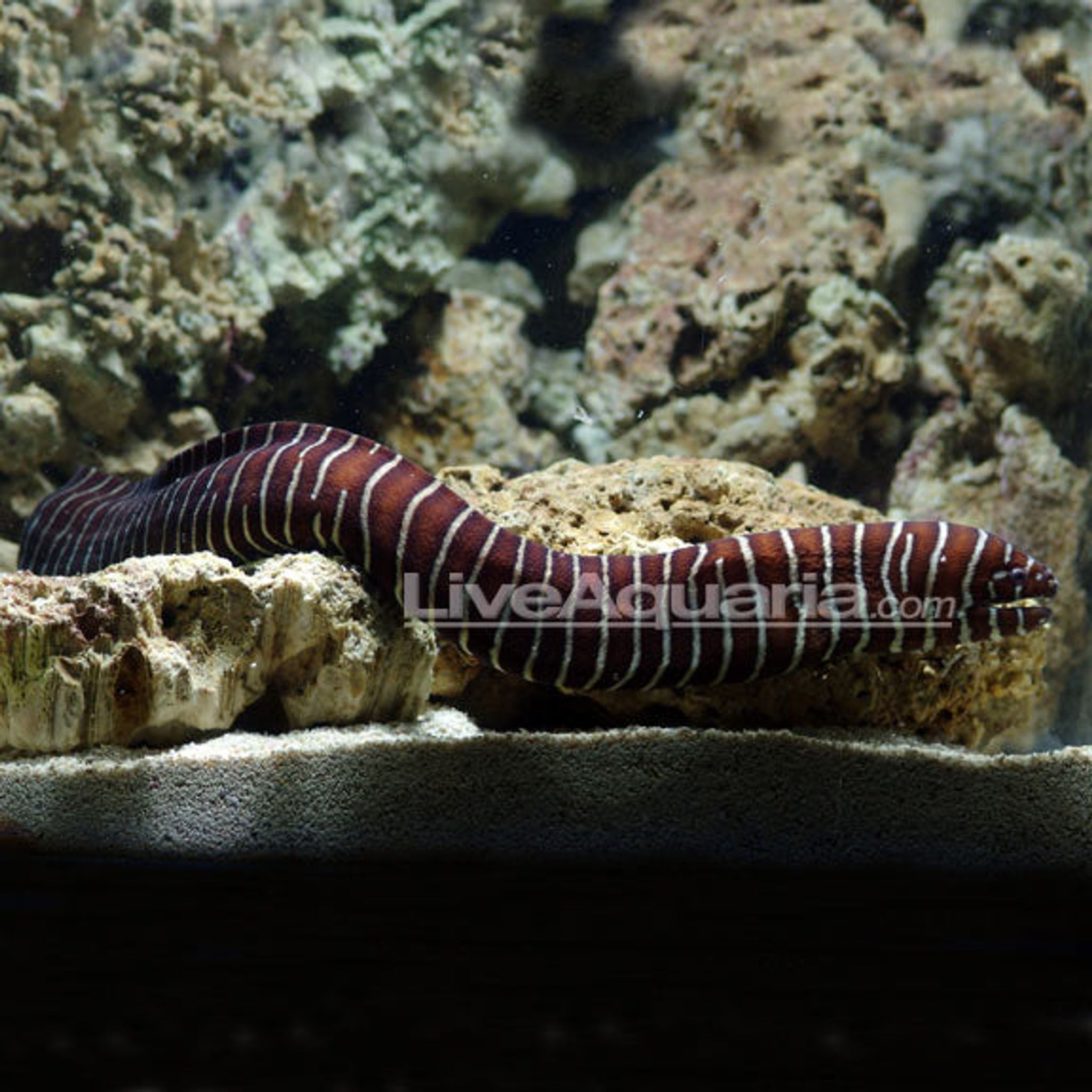

How to Feed Zebra Moray Eel: Foods, Frequency and Common Feeding Problems
The zebra moray (Gymnomuraena zebra) is a shell-crushing specialist, not a fish hunter, so its feeding routine looks different from a typical moray's. This guide covers exactly what to offer, how often, how to feed safely with tools instead of your hands, and how to work through the most common feeding problems keepers run into.
Why the Zebra Moray's Diet Is Different
Most morays have long, needle-like recurved teeth designed to grab and swallow slippery fish whole. The zebra moray has the opposite setup: blunt, rounded, molar-like (nodular) teeth built for crushing hard shells rather than slicing flesh.
This dentition is the entire reason its diet looks unusual compared to other eels in the trade. A zebra moray's jaw and teeth are functionally similar to a nutcracker, not a pair of scissors. Feeding it an all-fish diet doesn't just miss the point of its natural feeding strategy — it also under-uses the crushing mechanism and can lead to nutritional gaps over the long term, since the species' body condition and coloration are tied to a shell-heavy, calcium- and mineral-rich diet.
Core Diet: What to Feed a Zebra Moray
The bulk of every meal should be shelled crustaceans and mollusks. A good rotation includes:
- Shrimp (shell-on, not peeled)
- Crab, whole or in large pieces with shell intact
- Hermit crab
- Crayfish or crawfish
- Clams and mussels, in the shell or on the half-shell
- Squid
- Small lobster pieces
- Sea urchin, offered occasionally as a treat
Fish should stay a minor, occasional item — not the staple. An occasional piece of silverside or smelt is fine for variety, but shelled crustaceans and mollusks should make up the bulk of every rotation, since that's what the dentition and digestive system are built to process.
A Simple Weekly Rotation Example
| Day | Food Offered | Notes |
|---|---|---|
| Feeding 1 | Shell-on shrimp or crab | Dust with a marine vitamin supplement |
| Feeding 2 | Clam or mussel on the half-shell | Good variety, easy to portion |
| Occasional | Squid or small lobster piece | Rotate in every few feedings |
| Rare treat | Sea urchin or a small whole fish | Not a regular staple item |
How Often to Feed a Zebra Moray
Morays have slow metabolisms and are genuinely easy to overfeed, so frequency matters as much as food choice:
- Juveniles and sub-adults: 2–3 times per week
- Adults: 1–2 times per week
Sources disagree on the exact number for adults — some recommend once a week flat, others say twice weekly is fine for a leaner individual. The more reliable approach is to feed based on body condition rather than a fixed calendar: a well-fed adult with a rounded, filled-out body does well on once a week, while a thinner or still-growing eel can handle two feedings a week. Look at the body along the length of the eel — a pinched, visibly ribbed section behind the head signals it's underweight, while a uniformly rounded body means you can back off.
Portion size matters more than frequency. Offer a piece roughly the width of the eel's head per feeding. It's better to feed a slightly larger portion less often than to offer small amounts daily — frequent small feedings just increase waste output without adding much nutritional benefit.
How to Feed a Zebra Moray Safely
Use Tools, Never Your Hands
Morays have poor eyesight and locate food primarily by scent and vibration, not sight. That means a hand near the water at feeding time can be mistaken for food. Always use long feeding tongs or a feeding stick/skewer to present food, keeping your fingers well away from the water's surface.
Target-Feed at the Same Spot and Time
Feed at a consistent spot in the tank and around the same time each session. This builds a predictable feeding routine, reduces blind or erratic strikes, and helps the eel learn to associate that location with food rather than treating every movement near the glass as a potential meal.
Dim the Lights Before Feeding
Zebra morays are largely nocturnal or crepuscular and often feed more readily once the tank lights are off or dimmed. If a healthy eel seems reluctant during the day, try offering food after lights-out instead.
Supplement the Food
A couple of times a week, presoak or dust the food in a marine vitamin supplement (garlic-based or a general multivitamin) before offering it. This helps offset nutrients lost during freezing and thawing and supports immune health and coloration over time. You can browse vitamin-enriched and freeze-dried foods as part of a rotation alongside fresh or frozen seafood.
Sourcing and Prepping Food
A practical, budget-friendly source for shrimp, crab, and clam meat is a standard grocery store seafood counter. A few rules:
- Choose raw, unseasoned seafood only — never garlic butter, breading, or any pre-seasoned product meant for human consumption.
- Buy in bulk when convenient, then portion and freeze individual servings so you're not thawing more than one feeding at a time.
- Keep shells on where possible; the shell itself is part of the value of the meal for a shell-crushing specialist.
Housing Factors That Affect Feeding Success
Feeding problems are sometimes really housing problems in disguise. Keep these basics in mind:
- Tank size: 125+ gallons (473+ L) for an adult, since zebra morays can reach 4–5 feet (120–150 cm).
- Secure, weighted lid: morays are powerful escape artists, especially when actively hunting or during the acclimation period.
- Plenty of rockwork with a den: a secure hiding spot reduces stress and supports normal feeding behavior.
Lessons From Other Large Marine Predator Keepers
The same husbandry cautions that apply to keeping sharks and other large marine predators apply directly to zebra morays:
- Don't overfeed. Slow-metabolism predators build up waste and fat reserves quickly on frequent feedings.
- Don't rely on a single feeder species. Rotating food types avoids both disease risk and nutritional gaps that come from a monotonous diet.
- Always feed with tools, never fingers. This rule holds for any large predatory marine animal capable of a defensive or feeding-triggered bite.
- Give new arrivals time. Days to weeks of adjustment before a feeding problem is assumed is standard across large marine predator keeping, not unique to morays.
- A tight-fitting lid matters as much for a hunting eel as for a shark capable of flipping itself — both can cause serious harm to themselves outside the tank.
Common Feeding Mistakes and How to Fix Them
| Problem | Likely Cause | Fix |
|---|---|---|
| Eel looks fat, water quality declining | Feeding too often/too much | Cut back to once weekly, watch body girth |
| New eel won't eat | Transport stress/acclimation | Give 2–3 weeks of quiet conditions before intervening |
| Got bitten during feeding | Hand-feeding or reaching in near feeding time | Switch to tongs, avoid reaching in right after lights-out |
| Eel striking/jumping at nothing | Strong food-anticipation response | Secure the lid, feed at a consistent time |
| Eel escaped or found outside tank | Gap in the lid, often near cords/tubing | Use eel-proof mesh or clips to seal every gap |
| Missing snails, shrimp, or crabs | Any shelled invert is potential food | Treat cleanup crew members as at-risk, not safe |
| Regurgitated food | Piece too large, fed too soon after last meal, or disturbance right after feeding | Offer smaller pieces, don't disturb the tank post-feeding |
| Refusing food, otherwise normal-looking | Poor water quality | Test ammonia/nitrite and temperature before assuming behavior |
Body-Condition Scoring: A Better Guide Than a Fixed Schedule
Rather than sticking rigidly to a weekly number, check the eel's body shape:
- Pinched or visibly ribbed behind the head → underweight, feed more often or offer a larger portion
- Smoothly rounded, no visible spine → healthy weight, current schedule is working
- Noticeably thick or bulging → overfed, reduce frequency and portion size
Impaction Risk From Oversized Pieces
Because zebra morays swallow shelled prey largely whole, an oversized piece can risk impaction. Keep individual pieces at or below the width of the eel's own head, and cut larger crab or lobster sections down rather than offering them whole.
A Feeding-Response Ladder for a Reluctant Eater
If a newly acquired eel isn't taking food after a couple of weeks, work through this sequence rather than jumping straight to live food:
- Scent trail: Rub a piece of shrimp or crab along the substrate near the den to draw interest without forcing an interaction.
- Live trigger item (short-term only): A single live crab or shrimp can sometimes break a hunger strike. Use this sparingly — relying on live food regularly carries disease risk and can create a habit where the eel refuses anything but live prey.
- Return to tong-fed fresh/frozen routine: Once the eel takes a live item, transition back to tong-feeding fresh or thawed pieces at the same time and spot each session.
Reef and Tankmate Considerations
Zebra morays are considered comparatively more "reef safe" toward fish than most other moray species. That reputation doesn't extend to invertebrates, though — they will readily eat ornamental shrimp, crabs, snails, and other shelled or soft-bodied inverts. Any crustacean or mollusk added to the tank, whether purchased for the aquascape or as part of a cleanup crew, should be treated as a potential meal rather than a safe tankmate. If you're stocking a system around one, it's worth browsing marine invertebrates with this in mind before adding anything you'd rather keep intact.
Frequently Asked Questions
What do zebra moray eels eat in the wild vs. in a home aquarium?
In the wild, zebra morays eat crabs, shrimp, mollusks, and sea urchins — their crushing teeth are built for exactly this diet. A captive diet should mirror this closely, with shell-on shrimp, crab, clam or mussel meat, and occasional squid making up the bulk of meals.
How often should I feed my zebra moray eel?
About once or twice a week for adults, and slightly more often (2–3 times weekly) for juveniles. Use the eel's body condition as the real guide rather than sticking to a fixed schedule.
Why won't my new zebra moray eel eat?
The most common cause is post-transport stress and acclimation, which can take 1–3 weeks to resolve. Also check water quality and tank hiding spots, and try offering food after lights-out with feeding tongs.
Can I feed my zebra moray eel goldfish or feeder fish?
This isn't recommended. Most feeder fish are nutritionally poor, carry disease risk, and don't match the crustacean-based diet this species' dentition is built for.
Will a zebra moray eel eat my other fish or cleaner shrimp?
It's less likely to target fish than most other moray species, but it will readily eat shrimp, crabs, and snails. Any crustacean or mollusk tankmate should be considered at risk.
Is it safe to hand-feed a moray eel?
No. Morays have poor eyesight and strike based on scent and vibration, so a hand near food at feeding time risks an accidental bite. Always use feeding tongs or a skewer instead.
How do I get a stressed or picky moray eel to start eating again?
Dim the tank lights, offer a strong-smelling fresh item like shrimp or crab, and consider a brief live-food trigger if needed. Feed at the same time and spot each session, and minimize other disturbances around the tank.
Do zebra moray eels need vitamin supplements?
Yes — soaking or dusting food in a marine vitamin or garlic-based supplement a couple of times a week helps offset nutrients lost during freezing and supports overall health and coloration.
Ready to add one to your setup? You can browse available eels and stock up on rotation-ready supplements and foods on FishyHub.


