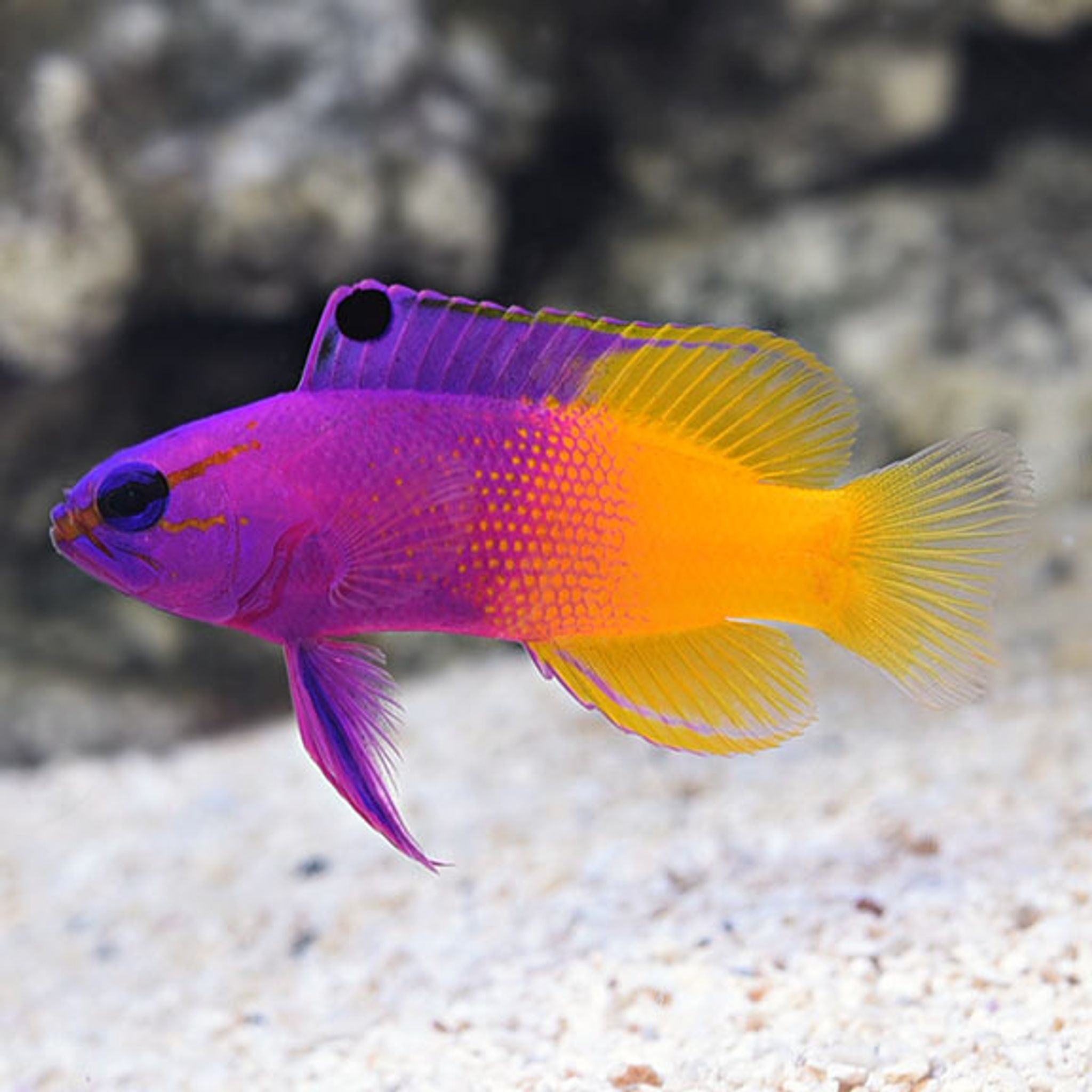
How to Feed Royal Gramma: Foods, Frequency and Common Feeding Problems
A Royal Gramma (Gramma loreto) is one of the easiest saltwater fish to feed, accepting nearly any properly sized frozen or prepared food without fuss. This guide covers exactly what to offer, how often, and how to solve the most common feeding problems, from a new fish refusing food to bullying at mealtime.
What Royal Grammas Eat in the Wild vs. in a Tank
In the wild, Royal Gramma are carnivorous planktivores, hovering in caves and picking zooplankton out of the water column, with the occasional bite of phytoplankton or algae particles drifting by. That natural diet translates well to captivity, since almost every prepared marine food is built around the same small, meaty particles the fish already targets in the ocean. This is a big part of why the species has a reputation as a low-drama beginner fish: it isn't a fussy specialist that needs one exact food type to thrive.
Core Diet: What to Feed a Royal Gramma
Build the daily diet around a rotation of these foods, sized appropriately for a fish that only reaches about 3 inches (8 cm):
- Frozen mysis shrimp – the best all-around staple; good size and protein content.
- Enriched frozen brine shrimp – acceptable and readily eaten, but choose enriched over plain brine whenever possible since plain brine is nutritionally thin.
- Marine flake and marine pellet food – useful supplements, sized small enough for the fish's mouth.
- Chopped fresh or frozen seafood – small pieces of shrimp, squid, or clam add variety.
- Bloodworms – an occasional treat only, not a staple (see below).
- Frozen "reef blend" or carnivore blends – convenient multi-ingredient options that add variety in one product.
| Food type | Role in the diet | Feed how often |
|---|---|---|
| Frozen mysis shrimp | Daily staple | Most feedings |
| Enriched frozen brine shrimp | Daily staple | Most feedings |
| Marine pellet/flake | Supplement | A few times a week |
| Chopped seafood (shrimp, squid, clam) | Variety | 1–2x per week |
| Frozen reef blend/carnivore blend | Variety | 1–2x per week |
| Bloodworms | Occasional treat | Sparingly, not daily |
Bloodworms are a common sticking point: some sources treat them as a normal staple, but since they're freshwater-origin insect larvae, they don't carry the same marine-appropriate fatty acid profile as mysis or brine. Treat them as an occasional variety item rather than a base food. You can browse a range of frozen and prepared options in FishyHub's Food & Supplements category when stocking up.
Portion Size
A practical portion for one Royal Gramma is roughly a thumbnail-sized piece of a frozen cube, or a small pinch of pellets/flake, per feeding. The goal is food that disappears in 2–3 minutes; anything left after that is overfeeding.
Feeding Frequency: How Often to Feed a Royal Gramma
Sources disagree here — some recommend feeding several times a day, others say once daily is enough. Both aren't wrong; the right frequency depends on the fish's age and condition:
- New arrivals and juveniles: 2–3 small feedings per day. Frequent, small meals help a shy or underweight fish build confidence and body condition faster than one large feeding.
- Established, healthy adults: 1–2 feedings per day is adequate maintenance.
- Consistency matters more than the exact count. A steady schedule, appropriately sized portions, and food removed after 2–3 minutes will keep the fish healthy at either frequency.
How Royal Grammas Feed — Why Method Matters
Royal Grammas are mid-water column feeders. In a reef tank they typically hover near a cave or crevice, dart out to snatch a piece of food, and retreat almost immediately. This behavior has direct implications for what food works best:
- Sinking or slow-falling frozen foods work better than fast-floating flake, especially for shy or newly introduced fish that aren't yet confident feeding out in the open.
- Floating flake is often ignored simply because it doesn't reach the mid-water zone where the fish is comfortable. If flake is consistently left uneaten, switch to frozen food or a sinking pellet instead.
- Ample live rock with caves and crevices is essential. A Royal Gramma will only dart out to feed confidently if it has a nearby bolt-hole to retreat to. A bare or under-aquascaped tank suppresses feeding behavior even when food is offered correctly.
Feeding New Arrivals and Quarantine Fish
It's common — and not usually a sign of illness — for a newly acquired Royal Gramma to refuse food for the first few days after transport and acclimation. Tie feeding cadence to the broader quarantine timeline:
- First few days: keep offering small amounts 2–3 times daily without overreacting if it's ignored. Don't panic before day 5–7.
- To trigger a feeding response: try live baby brine shrimp, or soak frozen mysis in a garlic-based appetite stimulant or a vitamin/HUFA enrichment soak. Both can jump-start interest in a stressed fish.
- Check water quality first: unstable parameters, particularly detectable ammonia or nitrite, suppress appetite on their own. Confirm both read zero before assuming the fish is simply being shy.
- Once feeding resumes reliably, gradually increase frequency and portion size toward the normal adult or juvenile schedule described above.
Territory, Tankmates, and Feeding Competition
Royal Grammas are territorial and should generally be kept one per tank, or one per large aquarium with visual barriers between separate territories — they will fight conspecifics and similarly shaped fish over both space and food access. This territoriality also affects feeding in mixed-species tanks: faster or more aggressive tankmates, such as damsels or other basslets, can outcompete a Royal Gramma at mealtime, leaving it underfed even when plenty of food is going into the tank.
Fixes for bullying at feeding time:
- Feed in multiple spots around the tank simultaneously so the aggressive fish isn't guarding the only food source.
- Use a turkey baster or a dedicated feeding tube to target-feed the gramma directly near its cave entrance, bypassing the competition entirely.
- Add rockwork to give the gramma more territory options if bullying persists.
Common Feeding Problems and Fixes
| Problem | Likely cause | Fix |
|---|---|---|
| Fish won't come out to eat | Stress, poor hiding spots, recent transport | Add rockwork/caves, target-feed near the cave |
| New fish refuses all food | Acclimation stress, unstable water | Try live baby brine shrimp or garlic-soaked mysis; confirm 0 ammonia/nitrite |
| Bullied at feeding time | Faster/aggressive tankmates | Feed multiple spots; use a feeding tube |
| Bloating or constipation | All-brine-shrimp diet, low fiber | Rotate in mysis and a nutrient-dense pellet |
| Flake ignored | Floats instead of sinking | Switch to frozen or sinking pellet food |
| Cloudy water, algae blooms | Overfeeding | Smaller, more frequent meals; remove uneaten food promptly |
| Fish is reclusive but seems fine | Normal shyness, not illness | Confirm it's still eating and has normal color/breathing |
A useful rule: uneaten meaty frozen food is a bigger driver of nitrate and phosphate spikes than uneaten flake, because it decomposes faster and more richly. That link between feeding habits and water quality is exactly why the next section matters for anyone feeding frozen foods regularly.
What a Protein Skimmer Does for Feeding
A protein skimmer mechanically strips dissolved organic waste — including feeding residue and fish waste — from the water column through foam fractionation, removing it before it has a chance to break down into ammonia and nitrate. For a Royal Gramma alone, a skimmer isn't strictly required. But it becomes genuinely valuable in any tank being fed meaty foods multiple times a day, since it keeps water clearer, reduces odor, and limits the nutrient load that fuels nuisance algae. This is especially relevant in fish-only or lightly stocked reef tanks, where feeding volume tends to be higher relative to the amount of live rock and biological filtration present to process waste.
Royal Gramma as a First Saltwater Fish
Royal Gramma is consistently ranked among the most popular beginner saltwater picks, alongside clownfish, damsels, and tangs, largely because of its vivid purple-and-yellow coloring, small adult size, hardiness, and easy feeding response. For someone stepping into saltwater for the first time, that's a meaningful advantage: a fish that reliably accepts a wide range of frozen and prepared foods removes one major variable while the rest of the tank (live rock, water chemistry, cycling) is still settling in. You can compare it against other beginner-friendly options in FishyHub's Marine Fish category, or look specifically at the Basslets group the Royal Gramma belongs to.
Feeding Changes When Upgrading from Freshwater
Hobbyists moving from freshwater to saltwater should budget for gear that directly affects feeding success, not just water chemistry:
- A protein skimmer to manage the higher organic load from meatier foods.
- Better lighting if the tank also houses live rock or coral, since lighting quality affects overall tank health, not feeding directly, but is part of the same setup budget.
- A refractometer or hydrometer to keep salinity stable, since salinity swings stress fish and suppress appetite the same way poor water quality does.
- Powerheads for adequate flow, which should be reduced briefly during feeding (see below) rather than run at full strength.
- A longer cycling and acclimation timeline than most freshwater setups, which also means feeding schedules should start conservative and ramp up gradually rather than at full adult frequency from day one.
Saltwater feeding in general shifts away from flake-heavy diets toward frozen meaty foods, which is exactly the pattern a Royal Gramma's diet already follows.
General Feeding Habits for Saltwater Tanks
A few habits apply broadly to saltwater fish, Royal Gramma included, and are worth building into a routine from the start:
- Avoid feeding immediately after a water change or dosing, since fresh chemical changes in the water can add stress right when the fish is trying to eat.
- Turn off strong flow and the skimmer briefly during feeding so food isn't blasted away from the fish or pulled out before it can be eaten.
- Observe appetite daily. A sudden drop in feeding response is often the earliest visible sign of a health or water quality issue, well before other symptoms appear.
- Stock and feed according to temperament and tank size. Many popular saltwater fish, Royal Gramma included, are semi-aggressive or territorial, so adequate rockwork and spacing matter as much for feeding access as for reducing conflict.
With a consistent routine, stable water, and enough rockwork to feel secure, a Royal Gramma is a genuinely low-maintenance eater that can live 5 or more years in a well-fed, stable tank — a good return on a fairly simple feeding routine.
Frequently Asked Questions
How often should I feed a Royal Gramma?
Feed new or juvenile fish 2–3 small meals daily to build confidence and body condition. Established, healthy adults do fine on 1–2 feedings a day. In both cases, feed only what's consumed within 2–3 minutes.
What is the best food for Royal Grammas?
Frozen mysis and enriched brine shrimp make the best daily base, supplemented a few times a week with marine pellets or flake and occasional chopped seafood like shrimp, squid, or clam.
Why won't my new Royal Gramma eat?
New fish are often stressed from acclimation and transport, or lack a secure cave to feel safe feeding from. Give it several days, offer live baby brine shrimp or garlic-soaked frozen food, and confirm ammonia and nitrite are both at zero.
Do Royal Grammas eat algae?
They pick at some phytoplankton and algae particles in the wild, but they're not effective algae eaters in a tank. Don't rely on a Royal Gramma for algae control.
Can Royal Grammas be fed with flake food?
Yes, as a supplement, but they prefer sinking or mid-water frozen foods since they naturally dart out and grab food rather than feed at the surface. If flake is consistently ignored, switch to a sinking pellet or frozen food.
Do I need a protein skimmer just for feeding a Royal Gramma?
Not strictly, for a single fish. But a skimmer is recommended for any saltwater tank fed meaty foods regularly, since it removes dissolved organic waste before it breaks down into ammonia and nitrate.
How many Royal Grammas can I keep together?
Generally just one per tank, unless the aquarium is large enough to offer separate territories with visual barriers. They are territorial toward their own kind and will fight over space and food access.
Is a Royal Gramma a good first saltwater fish, feeding-wise?
Yes. It's rated among the easiest saltwater fish to feed, readily accepting a wide range of frozen and prepared foods without the fussiness some marine species show.
Ready to add one to your setup? Browse available Royal Grammas and other beginner-friendly options in FishyHub's Marine Fish category.

