
How to Feed Queen Angelfish: Foods, Frequency and Common Feeding Problems
Queen angelfish (Holacanthus ciliaris) are harder to feed than most marine angels because adults are natural sponge specialists, not generalist grazers. This guide breaks down what to feed at each life stage, how often, and how to work through the well-known "new adult won't eat" problem without mistaking stress for illness.
Natural Diet and Why It Matters for Feeding
Queen angelfish are native to Western Atlantic and Caribbean reefs, ranging roughly from Florida down to Brazil. In the wild they live on coral reefs and rocky bottoms wherever sponge growth is dense, and their feeding behavior tracks that habitat closely.
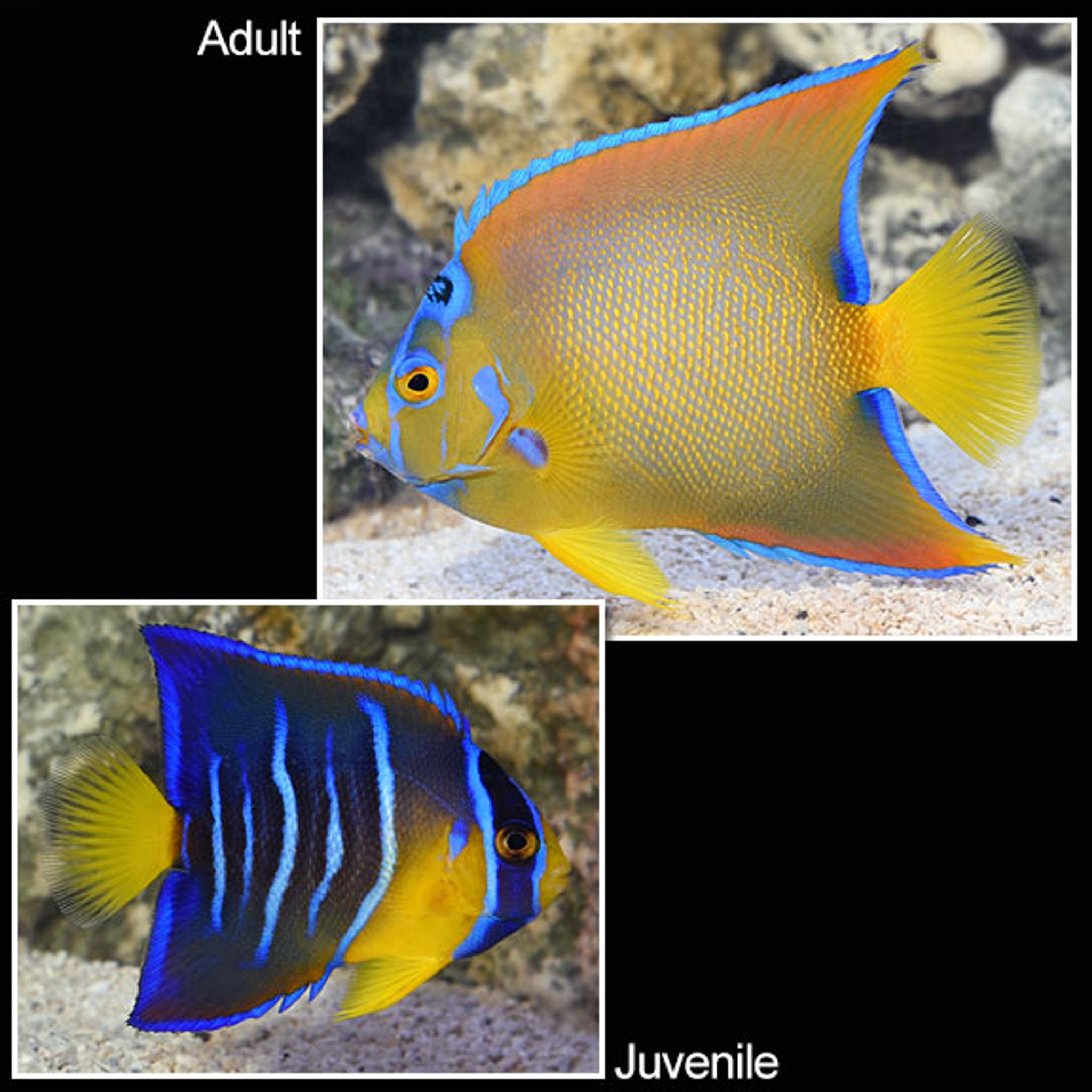
Juveniles behave very differently from adults. Young queen angelfish act as cleaner fish, picking parasites, mucus, and dead scales off larger fish, while also grazing algae and plankton from the reef surface. This generalist, opportunistic feeding style is why juveniles adapt to aquarium foods far more readily than adults do.
Adults shift almost entirely to sponges, which make up roughly 90% of the wild diet. The remainder comes from tunicates, jellyfish, soft coral polyps, hydroids, zoanthids, and bryozoans. None of this is easy to replicate in a home aquarium — true sponge matter is scarce for hobbyists, which is the root cause of most feeding problems with this species.
Understanding this reef-associated, invertebrate-eating lifestyle explains two things: why a captive diet needs to lean toward marine algae and invertebrate-based foods rather than standard flake, and why wild-caught adults are often stubbornly food-selective when they first arrive.
What to Feed: A Rotation, Not One Product
Because no single commercial food fully replicates a 90% sponge diet, the practical approach is a rotation of several foods rather than reliance on one. A reasonable weekly lineup includes:
- Mysis shrimp (frozen) as a core protein source
- Chopped clam, mussel, or shrimp meat for variety and enrichment
- Frozen angelfish/butterfly formula blends, often sponge- or spirulina-based
- Nori or dried seaweed sheets, clipped to the glass for grazing
- Spirulina-based flake or pellet for plant matter
- Marine algae in sheet or frozen form
- High-quality large pellets formulated for angelfish, herbivore, or omnivore blends
Commercial sponge-based frozen formulas are a reasonable core of the diet, but some experienced keepers maintain that mature live rock with natural sponge and algae growth is important for long-term health, not just an acclimation aid. The realistic middle ground: use commercial formulas as the everyday staple, and let the fish graze live rock as a supplement, since a 100% sponge diet simply isn't achievable in a captive system.
A herbivore-leaning ratio matters here. Overfeeding meaty protein without enough marine algae or vegetable matter can cause bloating, poor coloration, and long-term health issues, much as it does with other large angelfish. Alternating a meaty feeding with a nori or spirulina feeding across the week helps keep that balance.
Sample Weekly Feeding Rotation
| Day | Morning | Midday | Evening |
|---|---|---|---|
| Mon | Mysis shrimp | Nori sheet | Angelfish formula |
| Tue | Chopped clam | Spirulina pellet | Mysis shrimp |
| Wed | Angelfish formula | Nori sheet | Chopped mussel |
| Thu | Mysis shrimp | Marine algae | Angelfish formula |
| Fri | Chopped shrimp meat | Nori sheet | Spirulina pellet |
| Sat | Angelfish formula | Mysis shrimp | Nori sheet |
| Sun | Marine algae | Chopped clam | Angelfish formula |
Adjust portion sizes to what the fish clears in a couple of minutes, and swap in whichever foods are on hand — the point of the table is the protein/algae balance across the week, not a rigid script. Browse a selection of freeze-dried and prepared foods on FishyHub to build out a rotation.
Feeding Frequency by Life Stage
Feeding frequency should scale with metabolism and digestive demand, which differ sharply between juveniles and adults.
- Adults: 2–3 feedings per day in generous amounts. They have high metabolic and volume needs to digest sponge-mimicking foods, and skimping on quantity over time shows up as poor body condition.
- Juveniles: smaller portions, 3 times a day, with prompt removal of any uneaten food to protect water quality.
Sources disagree on whether adults need 2 or 3 feedings once fully acclimated. The sensible approach is to start at 2–3 times daily and adjust based on body condition rather than a fixed rule: a well-fed adult should show a rounded belly profile, while a pinched or sunken look behind the head signals underfeeding and calls for larger or more frequent meals.
Tank Size and Bioload Considerations
Minimum tank size recommendations vary — some cite around 100 gallons (379 L) for a juvenile or subadult only, others put a full adult setup at 180+ gallons (681+ L). The sensible planning target is the adult size, not the juvenile: 125 gallons (473 L) minimum, larger if possible, given that adults reach 12–16 inches (30–41 cm), occasionally up to about 18 inches (46 cm).
Tank size isn't only about swimming room. A fish fed 2–3 generous meals daily produces a correspondingly heavy bioload, so filtration and skimming need to match the feeding schedule, not just the fish's adult length. Underestimating this — skipping a protein skimmer upgrade or running undersized filtration for the feeding volume — is one of the more common setup mistakes with this species. If you're stocking or upgrading a system for a queen angelfish, it's worth reviewing large marine angelfish stock and matching your equipment to the adult footprint from day one rather than upgrading later.
Reef Compatibility
Queen angelfish are considered reef-risk, not reef-safe. Their natural sponge- and coral-eating instinct translates directly into nipping behavior in a reef tank: they may pick at soft corals, clams, and some LPS or zoanthid species. Anyone planning to keep corals alongside this fish should weigh that risk carefully, and be aware that a newly introduced specimen may ignore prepared food entirely while grazing on corals or clams — which can mask a feeding problem until damage is already done.
Acclimating a New Adult to Prepared Foods
New adult queen angelfish are frequently wild-caught, and it can take weeks for them to transition onto prepared foods. This is normal, not a sign of a doomed fish, but it does require a deliberate approach:
- Quarantine with live rock that carries natural sponge and algae growth, giving the fish something familiar to graze while it adjusts.
- Offer a wide variety at once — frozen mysis, clam on a feeding clip, nori sheets, and live rock grazing — rather than repeating one food and concluding it "won't eat."
- Try target feeding with a turkey baster, directing food close to the fish rather than dropping it broadly into the tank.
- Dim the lights at feeding time to reduce stress, since a bright, exposed tank can suppress feeding in a skittish new arrival.
- Feed shortly after lights-on, when the fish is naturally more active and alert.
- Enrichment soaks — garlic or vitamin/HUFA (highly unsaturated fatty acid) additives added to frozen food — are commonly used during this period to support appetite and immunity.
Be patient over several weeks before assuming the fish is a lost cause. Also avoid introducing a new queen angelfish alongside other large angelfish species too early; interspecies aggression can suppress feeding just as effectively as acclimation stress, and it's easy to misdiagnose the cause.
When It's Not a Feeding Problem
Not eating isn't automatically a feeding issue. Rule out disease first — ich and marine velvet are common causes of appetite loss in newly imported marine fish — before assuming the problem is purely about food variety or acclimation. Once disease is ruled out, treat the lack of appetite as a stress or transition issue specific to a specialist sponge-eater adjusting to captive conditions, and work through the acclimation tactics above.
Cost and Sourcing Reality
Feeding a queen angelfish properly is an ongoing cost, not a one-time setup expense. Sponge-based frozen formulas and quality marine pellets are a recurring line item given how much an adult eats across 2–3 daily feedings, and that's worth factoring in before committing to the species — not just the upfront cost of the fish and a large enough tank.
Queen, Blue, and Their Natural Hybrid
It's worth knowing that queen angelfish are closely related to the blue angelfish (Holacanthus bermudensis), and the two naturally hybridize where their ranges overlap. Fish sold as "queen angelfish" in the US trade sometimes show intermediate traits from this hybridization. It doesn't change the feeding approach in any meaningful way, but it's useful context if a specimen's coloration doesn't perfectly match reference photos.
Frequently Asked Questions
How often should I feed a queen angelfish?
Adults should be fed 2–3 times daily in generous portions, while juveniles do best on smaller portions fed 3 times a day. Adjust frequency based on body condition — a rounded belly is the target, and a pinched look behind the head means more food or more frequent meals are needed.
What is the best food for queen angelfish?
There's no single best food; a rotation of mysis shrimp, chopped clam or mussel, frozen angelfish/sponge-based formulas, nori, spirulina, and large marine pellets works best. No commercial product fully replicates their natural sponge-heavy diet, so variety is the goal rather than one "ideal" product.
Why won't my queen angelfish eat?
Most often it's stress from wild capture and shipping, or the transition to a new tank, rather than illness. Rule out disease like ich or marine velvet first, then work through live rock grazing, food variety, and target feeding, giving the fish several weeks before assuming a bigger problem.
Do queen angelfish eat coral or are they reef safe?
They're not reliably reef safe. Because of their natural diet of sponges and invertebrates, they may nip soft corals, LPS, zoanthids, and clams in a reef tank, so reef keepers should weigh this risk before adding one.
What do baby or juvenile queen angelfish eat differently than adults?
Juveniles clean parasites and mucus off other fish and graze algae and plankton, giving them a much more generalist diet than adults. This flexibility is also why juveniles adapt to prepared aquarium foods far more easily than sponge-specialist adults do.
How big of a tank does a queen angelfish need?
Plan for a large tank of at least 125 gallons (473 L) for an adult, and larger where possible. Adults reach 12–16 inches (30–41 cm), occasionally up to about 18 inches (46 cm), and their heavy feeding schedule adds a substantial bioload on top of their swimming space needs.
Can I keep a queen angelfish on flake food alone?
No. Flake alone lacks the marine algae and invertebrate-protein balance this species needs, and most adults won't accept flake as a primary food source in the first place. It can be offered as an occasional supplement within a broader rotation, not as the main diet.
Do queen angelfish need vitamin supplements?
Enrichment soaks using garlic or vitamin/HUFA additives on frozen food are commonly used, particularly during the acclimation period for new arrivals. They're intended to support appetite and immune function while the fish adjusts to captive foods.
Ready to plan a feeding setup around a queen angelfish? Browse large marine angelfish and pair your stocking plan with a full range of foods and supplements on FishyHub.


