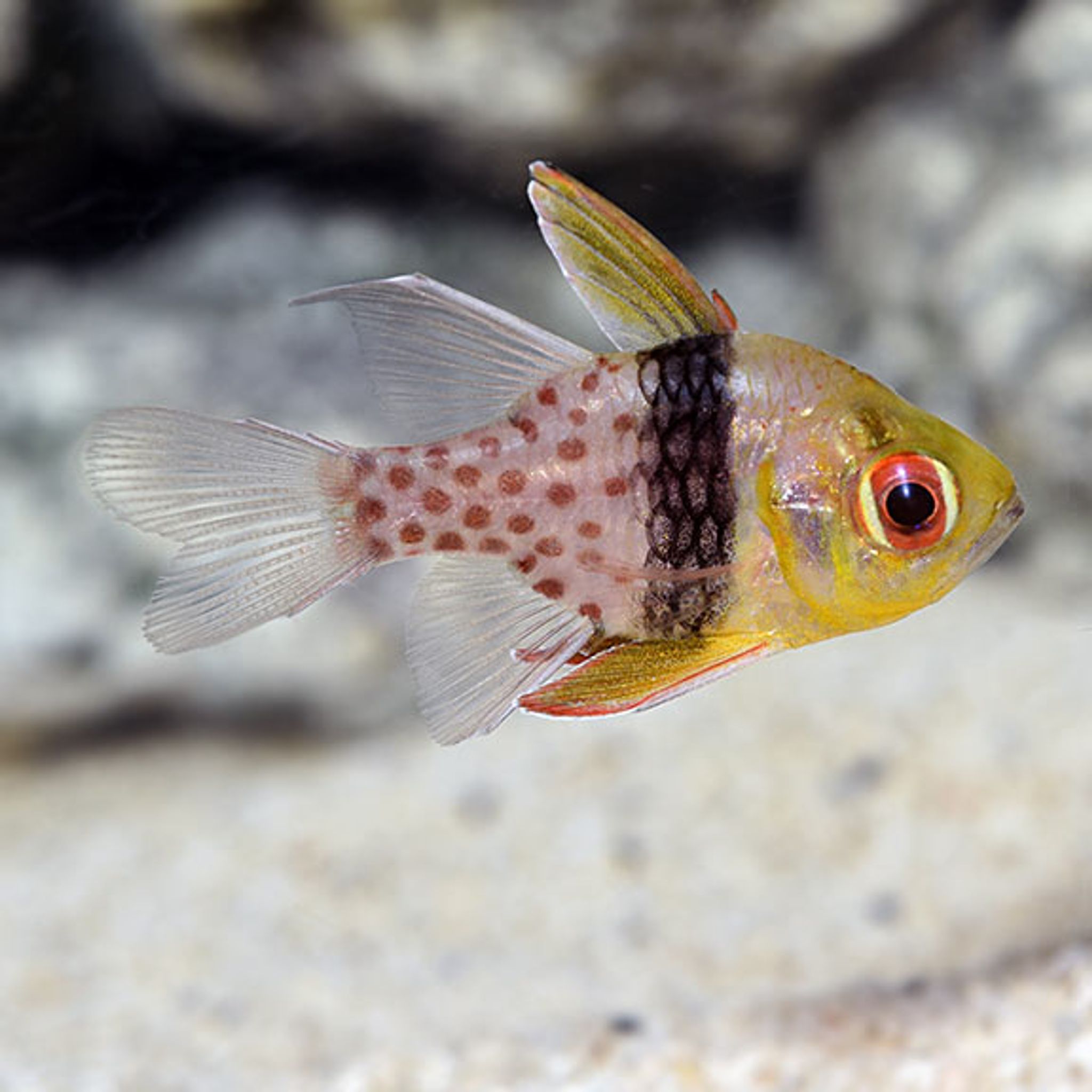

How to Feed Pajama Cardinalfish: Foods, Frequency and Common Feeding Problems
Pajama cardinalfish (Sphaeramia nematoptera) are meaty-food specialists, not flake fish, and getting their feeding routine wrong is the fastest way to end up with a thin, pale, or reclusive shoal. This guide covers exactly what to feed, how often, how much, and how to troubleshoot the most common feeding problems, including the one nobody warns you about: a male that stops eating because he's brooding eggs in his mouth.
Species Snapshot
The pajama cardinal, also called the coral cardinalfish, is a peaceful, hardy, shoaling reef fish popular with both new and experienced marine keepers. A few traits shape how it should be fed:
- Slow, deliberate swimmer — it doesn't dart or chase food the way a damselfish or clownfish does.
- Large, reflective eyes adapted for low-light foraging, a holdover from its nocturnal habits.
- Shoaling by nature — usually sold and kept in small groups rather than singly.
- Small mouth relative to body size, which limits the size of food it can physically take.
Every recommendation below follows from these four facts.
What Pajama Cardinalfish Eat in the Wild
In the wild, pajama cardinals shelter by day among coral branches, Halimeda algae clumps, and even sea urchin spines, using their reflective eyes to stay alert in dim, shaded light. At dusk they emerge and pick zooplankton, copepods, and other tiny crustaceans out of the water column near their shelter. They are nocturnal planktivores and micro-carnivores — grazing on small, soft, drifting prey rather than tearing at large chunks or algae.
This is the key takeaway for captive feeding: their natural diet is small, meaty, and plankton-like, so aquarium foods should mimic that in size and composition, not just in protein content.
Best Foods for Pajama Cardinalfish
Because they're carnivores with a planktivorous background, pajama cardinals need protein-rich, meaty foods as the backbone of their diet. Flake-only or herbivore-oriented food will not sustain them long-term.
| Food type | Role in the diet | Notes |
|---|---|---|
| Frozen mysis shrimp | Staple, top pick | Closest size and texture match to natural prey |
| Frozen or live brine shrimp | Staple / feeding trigger | Especially useful for coaxing a shy or new fish to eat |
| Finely chopped fresh or frozen seafood | Regular rotation | Shrimp, clam, silverside, or marine fish flesh, chopped small |
| Enriched frozen formulas | Regular rotation | Blended meaty preparations for marine fish |
| Marine pellet or micro-pellet | Minor supplement only | Not a primary diet — see disagreement note below |
| Live baby brine shrimp or copepods | Occasional, situational | Best for fry, newly acquired fish, or persistently shy individuals |
You can browse frozen and prepared marine foods, along with live feeder options, in FishyHub's Food & Supplements category.
Is Pellet Food an Acceptable Staple?
Sources disagree here. General marine-fish care guides often list pellets as a normal staple food. Species-specific advice tends to treat pellets as secondary. Given the pajama cardinal's small mouth and planktivorous biology, the sensible middle ground is to use pellets or micro-pellets as a minor supplement, not the backbone of the diet — lean on frozen mysis and brine shrimp instead.
Feeding Frequency and Portion Size
How Often to Feed
- Established adults: 2 small feedings per day is generally sufficient once the fish is settled and eating confidently.
- New arrivals, juveniles, or fish in a competitive shoal: 3 small feedings per day is safer, since small stomachs and faster metabolisms in young fish, plus competition in groups, mean shorter gaps between meals work better.
Sources are split between two and three feedings daily — this split-by-situation approach reconciles both camps rather than picking one number for every fish.
How Much to Feed
There's no need to guess. A simple, visual rule works well for a small reef system:
- Feed only what the fish fully consume in 2–3 minutes.
- If food is still drifting uneaten after that window, you fed too much.
- When in doubt, underfeed slightly rather than overfeed — it's far easier to add a bit more than to fix a water quality crash in a small tank.
Remove any obvious leftover meaty food promptly. Uneaten protein-rich food fouls water quickly, and in a reef tank housing corals alongside cardinalfish, that translates directly into nitrate spikes and nuisance algae — a common, avoidable nutrient problem in coral systems.
Daytime vs. Nighttime Feeding
Despite their nocturnal wild feeding pattern, pajama cardinals adapt well to daytime feeding once settled into a home aquarium. For convenience, default to a normal daytime schedule.
The nocturnal biology still matters for one specific situation: if a specimen is shy, newly acquired, or refusing food, try offering a meal in dim light or just after the tank lights go off. This mimics the dusk feeding trigger the species uses in the wild and often prompts a reluctant fish to start eating.
Feeding a Shoal Without Starving the Shy Ones
Pajama cardinals are almost always kept and sold in groups, yet most general feeding advice is written as if for a single fish — which misses a real problem: dominant individuals eat first and best, and shyer or smaller cardinals in the same group can slowly lose condition if food isn't distributed deliberately.
To feed a shoal properly:
- Spread food across multiple spots and across the water column, not just one drop point.
- Use broadcast feeding (scattering food widely) or target feeding with a turkey baster to direct portions toward specific individuals that seem to be missing out.
- Watch each fish during feeding for a few sessions after adding it to a group, to confirm it's actually getting food rather than just being present at feeding time.
Choosing Tank Mates That Don't Outcompete Them
Because pajama cardinals are slow, deliberate swimmers, they consistently lose out to fast, aggressive feeders in a mixed tank. Pair them with calm tank mates instead:
- Gobies
- Firefish
- Dartfish
- Clownfish
You can browse compatible slow-to-moderate feeders like gobies and dartfish on FishyHub if you're still finalizing tank mates. Avoid stocking pajama cardinals alongside fast, food-aggressive species that will consistently beat them to the first bite.
Supplementation for Color and Immune Health
Periodically enrich frozen foods by soaking them in a vitamin or HUFA (highly unsaturated fatty acid) supplement before feeding. This practice is standard for many reef fish but often under-discussed for pajama cardinals specifically. It's particularly worthwhile for wild-caught specimens, which may arrive with depleted reserves, and supports both coloration and long-term immune health.
The Critical First 1–2 Weeks After Purchase
The acclimation window immediately after purchase is the highest-risk period for feeding problems. A fish that was already eating confidently before you brought it home has a much better survival outlook than one that arrives stressed and refuses food.
During this window:
- Watch feeding behavior closely at every meal.
- Offer live or frozen brine shrimp first — it's often the most effective trigger for a reluctant new fish.
- Try target feeding if a specimen seems to be avoiding open water at feeding time.
- Don't assume a non-eating new arrival is simply "picky" — stress, poor acclimation, or tank-mate competition are far more common causes than pickiness.
Common Feeding Mistakes
- Overfeeding to compensate for a shy eater. This crashes water quality without solving the real problem — fix the behavior, not the portion.
- Feeding only flake or pellet as the entire diet, which leads to poor color and gradual weight loss in this meaty-food specialist.
- Feeding too infrequently. Long gaps between meals cause weight loss in a small-stomached fish with limited fat reserves, especially in a competitive shoal.
- Ignoring group dynamics. Assuming one feeding spot is enough for a shoal lets dominant fish crowd out the rest.
- Using food that's too large. Whole shrimp or large pellets get rejected outright — always chop meaty foods finely for that small mouth.
- Mistaking a brooding male for a sick one (see below) and force-feeding or medicating unnecessarily.
A Male That Stops Eating May Be Brooding, Not Sick
Pajama cardinalfish are paternal mouthbrooders: after spawning, the male holds fertilized eggs in his mouth for roughly a week until the fry hatch and disperse. During this period, he typically eats very little or nothing at all — and that's completely normal, not a sign of illness.
If you notice one male in your shoal suddenly refusing food while otherwise appearing healthy, check for a visibly swollen or full-looking mouth/throat area before assuming disease. Don't try to force-feed him. Normal appetite should resume on its own once the brood is released.
That said, don't use this as a blanket excuse for appetite loss. If reduced eating is paired with clamped fins, hiding, white spots, or labored breathing, treat it as a disease concern and address it separately from normal feeding troubleshooting.
Budget-Friendly Marine Setup Basics
If you're setting up your first marine tank for pajama cardinals, a few cost-saving choices won't compromise their feeding or health:
- Secondhand equipment and tank packages can meaningfully cut upfront cost.
- Prioritize spending on stable heating, lighting, and a quality protein skimmer over cosmetic extras — these directly affect water quality, which matters even more once you're feeding meaty foods regularly.
- Live rock or sand can often be sourced more cheaply from an established tank, or by curing dry rock at home.
- Start with a nano or mid-size reef-safe tank — pajama cardinals don't require a large system.
- Buy salt mix in bulk and consider basic test kits to keep ongoing costs down.
Once your system is stable, browse marine fish and dedicated cardinalfish stock on FishyHub to plan your shoal.
Frequently Asked Questions
How often should I feed my pajama cardinalfish?
Feed small portions 2–3 times a day. Established adults do fine on 2 feedings daily, while new arrivals, juveniles, or fish in a competitive shoal benefit from 3 smaller feedings spread across the day.
What is the best food for pajama cardinalfish?
Frozen mysis shrimp is the best staple, since it closely matches their natural prey in size and texture. Supplement it with frozen or live brine shrimp, finely chopped seafood, and occasional high-quality marine pellets.
Why is my pajama cardinalfish not eating?
In most cases it's stress or poor acclimation during the first weeks after purchase, or competition from faster tank mates. In an adult male, it can also be normal mouthbrooding behavior. If appetite loss comes with clamped fins, hiding, or labored breathing, rule out disease instead.
Can pajama cardinalfish eat flake food?
They can accept flake occasionally, but it shouldn't be a main food source. Their planktivorous, meaty-food biology means flake and pellet foods work best as a minor supplement, not a staple.
Do pajama cardinalfish need to be fed at night since they're nocturnal?
Not strictly. Most pajama cardinals adapt well to daytime feeding once settled in a home aquarium. A dim-light or just-after-lights-off feeding is mainly useful as a trick to coax a shy or newly acquired fish into eating.
Is it normal for my male cardinalfish to stop eating?
Yes, if he's mouthbrooding. A male holding eggs will eat little to nothing for about a week until the fry are released, after which normal feeding resumes on its own without intervention.
What tank mates should I avoid to protect their feeding?
Avoid fast, aggressive feeders that will consistently outcompete a slow-swimming pajama cardinal for food. Calmer species like gobies, firefish, dartfish, and clownfish make better companions.
How many pajama cardinalfish should I keep together, and does that affect feeding?
They do well in small shoals rather than singly. When feeding a group, spread food across several spots and through the water column so shyer or smaller individuals aren't consistently outcompeted by more dominant shoal members.
Ready to add pajama cardinals to your reef tank? Browse live stock in FishyHub's Marine Fish category to find healthy, established specimens for your setup.


