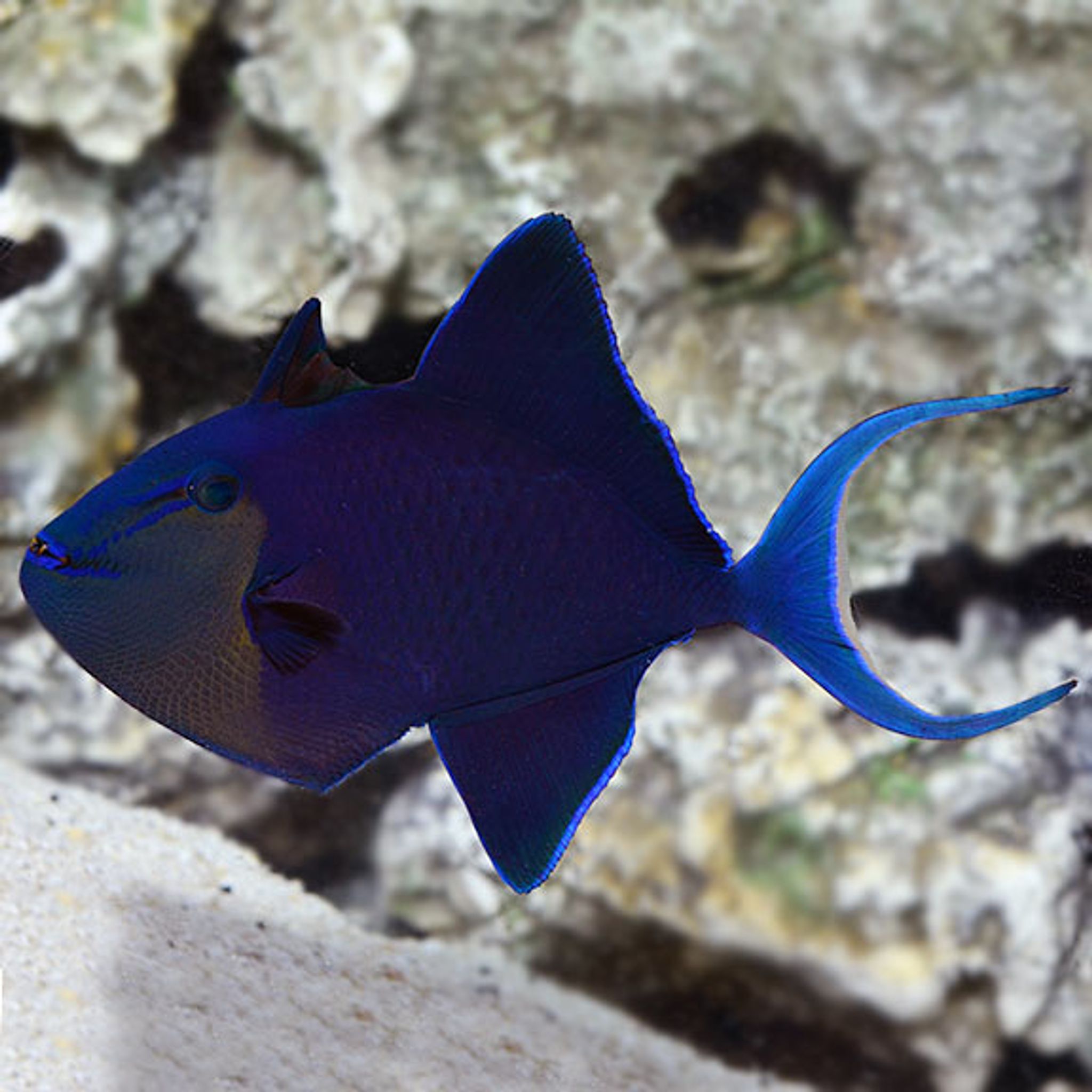
How to Feed Niger Triggerfish: Foods, Frequency and Common Feeding Problems
The Niger triggerfish (Odonus niger) is one of the few triggers that thrives on a diet built around zooplankton and soft invertebrates rather than heavy crushing prey, but it still needs hard, shell-on foods to keep its ever-growing beak in check. This guide breaks down exactly what to feed, how often, in what amounts, and how to solve the feeding problems that come up most often with this bold, food-driven species.
Species Snapshot Before You Feed
Odonus niger, also sold as the redtoothed, blue, or niger triggerfish, is an intermediate-difficulty marine omnivore. Adults commonly reach 10-12 inches (25-30 cm) in home aquariums, though wild specimens have been reported up to 18 inches — plan tank size around the realistic aquarium ceiling, not the wild maximum. A full-grown Niger triggerfish needs a 180-gallon (680 L) or larger tank, since it is active, food-motivated, and produces a meaningful bioload.
Unlike most triggerfish, which are built to crush hard-shelled reef prey, the Niger trigger is unusually planktivorous in the wild — its main natural food is zooplankton, supplemented by small crustaceans, sponges, and filamentous algae. That wild diet is the blueprint for what works well in captivity.
What to Feed a Niger Triggerfish
Protein-Based Foods
Build the core of the diet around frozen and fresh protein sources, including:
- Mysis shrimp — small, easy to eat, close to a natural zooplankton texture
- Krill (frozen and thawed) — denser nutrition and a firmer texture
- Squid, chopped into bite-sized pieces
- Table shrimp, chopped, with shell left on some pieces
- Clams, both meat and shell-on
- Scallops and marine fish/seafood mixes
- Silversides for larger adults
Plant Matter
Because the Niger trigger is more omnivorous than most of its relatives, vegetable matter should be treated as a required weekly component, not an optional extra. Offer:
- Nori or dried seaweed sheets, clipped to a feeding station
- Marine algae
- Spirulina-based frozen or gel foods
A Pellet or Flake Base
A quality marine pellet or flake can serve as a base diet, filling in gaps between frozen feedings. It should not replace fresh and frozen variety, but it does help maintain consistent nutrition on days when a full frozen rotation isn't practical. You can browse pellets, frozen and freeze-dried options formulated for marine fish in FishyHub's Food & Supplements category, including freeze-dried food that works well as a rotation item.
Why Hard, Shell-On Foods Matter
A Niger triggerfish's fused, beak-like teeth never stop growing. In the wild, crunching shelled prey and coral rubble wears them down naturally. In captivity, that job falls to shell-on shrimp, clams in the shell, and krill with shell intact. This is not just a feeding preference — it's dental maintenance. Skip it consistently and the teeth can overgrow to the point where the fish struggles to eat at all, a problem that gets worse the longer it goes unaddressed.
Feeding Frequency and Portion Guidance
Recommendations across sources range from once to three times daily; the practical answer depends on the fish's age and size.
| Life Stage | Feeding Frequency | Portion Guidance |
|---|---|---|
| Juvenile / young | 2-3 times per day | Small amounts, cleared in under 2-3 minutes |
| Subadult | 2 times per day | Moderate portions, cleared in 2-3 minutes |
| Full-grown adult | 1-2 times per day | Larger portions, cleared in a few minutes |
As a general portion rule, offer roughly a pinch of food per feeding for a juvenile a few inches long, scaling up to a small handful of mixed frozen items for a 10-12 inch adult — the actual test is always whether the fish clears the food within two to three minutes. Slower metabolism in adults means fewer, larger meals rather than constant grazing.
Rotate Rather Than Repeat
Feeding one staple food, even a good one, leads to a monotonous diet that has been linked to dulled color and poor long-term condition in this species. Rotate across at least three to four food types weekly — for example, mysis one day, krill the next, then chopped clam or shell-on shrimp, with nori offered two to three times per week regardless of what else is on the menu. This variety also keeps a notoriously food-driven fish engaged and reduces the chance it becomes fixated on refusing anything but one item.
Water Parameters That Affect Appetite
Stable water chemistry supports a consistent feeding response; swings in temperature or salinity are a common, overlooked cause of appetite loss. Target ranges are:
- Temperature: 72-78°F (22-26°C)
- pH: 8.1-8.4
- Specific gravity: 1.020-1.025 (roughly 35 ppt)
Measuring Salinity Accurately
Three tools are used to measure specific gravity in marine tanks, each with a different accuracy-to-cost tradeoff:
- Hydrometer — the cheapest option, but prone to reading errors from air bubbles or mineral buildup on the swing arm.
- Refractometer — the most accurate widely used option and the standard choice for serious reef and marine keepers; it needs periodic calibration with a calibration fluid.
- Electronic conductivity meter — capable of roughly ±0.001 SG precision, but only when calibrated correctly with the proper calibration solution.
For a display tank housing a Niger triggerfish, aim for a stable specific gravity near 1.025 (about 35 ppt). Sudden salinity swings — even ones that stay within a "safe" range — can stress the fish and suppress its appetite around feeding time, so consistency matters as much as the exact number.
Common Feeding Mistakes and How to Fix Them
Overfeeding
Because this is a large, active waste producer, excess uneaten food fouls water faster than it would with smaller fish. Feed only what is cleared in two to three minutes, and err on the side of a slightly smaller portion fed more frequently rather than one large, uneaten pile.
Feeding Only Soft Frozen Foods
Relying exclusively on mysis or krill without shell-on items lets the beak-like teeth overgrow. Over time this becomes self-reinforcing: an overgrown beak makes it harder for the fish to eat, which further limits what it can take in. Work shell-on shrimp, clams, and shelled krill into the rotation every week as a non-negotiable, not an occasional treat.
New Arrivals Refusing Food
It's common for a recently acclimated Niger triggerfish, especially a wild-caught import, to refuse frozen or prepared foods at first. Live or very fresh seafood — a piece of raw shrimp, or clam on the half shell — often triggers a feeding response where frozen cubes fail. Once the fish is reliably eating fresh items, gradually work in frozen and then pellet foods over subsequent weeks rather than switching all at once.
Bullying Tankmates at Feeding Time
As a bold, food-aggressive fish, a Niger trigger can dominate every feeding and effectively starve out shier tankmates. Spot-feed timid fish at a separate point in the tank, or use multiple feeding stations so the trigger isn't the only fish getting fed.
Monotonous Diet
Pellets alone, day after day, are linked to dulled color and declining condition. Rotate at least three to four different food types across the week, with nori included regularly.
Mistaking Normal Crunching for Illness
Hearing a Niger triggerfish grind or crunch on shell-on food is normal and beneficial — it's the mechanism keeping the teeth worn down, not a sign of distress.
Sudden Appetite Loss in an Established Fish
If a fish that has been eating well suddenly stops, check water parameters (temperature, pH, salinity) and look for bullying before assuming illness. Appetite is often the first visible sign that something in the environment has shifted.
Supporting Long-Term Health Through Feeding
A few practices go beyond the basics but matter for a fish kept long-term:
- Soak frozen foods in a vitamin or HUFA supplement occasionally to offset nutrients lost during freezing, supporting color and immune health.
- Watch for deficiency signs specific to this species, such as fading of the red teeth or body color, or fin fraying that isn't linked to aggression — both can point to nutritional gaps rather than disease.
- Adjust diet composition as the fish grows: juveniles benefit from smaller, more frequent, softer feedings; adults need larger portions less often, with a heavier emphasis on hard, shell-on items to match their bigger, faster-growing teeth.
- In mixed aggressive-species tanks, introduce the trigger after establishing feeding stations for other residents, and keep a consistent feeding order so it doesn't associate every feeding cue with chasing tankmates first.
Once you've settled on hand-feeding or target-feeding, most Niger triggerfish become food-tame surprisingly fast — many will take food from tongs or fingers within weeks, which makes spot-feeding shy tankmates and portion control much easier to manage.
Frequently Asked Questions
What is the best staple food for a Niger triggerfish?
There isn't a single best staple — rotate frozen mysis, krill, chopped seafood, and shell-on shrimp or clam through the week, and include nori regularly rather than relying on one food item.
How often should I feed a Niger triggerfish?
Feed young fish 2-3 times a day in small portions, and taper full-grown adults down to 1-2 times a day with larger portions. In both cases, the food should be gone within two to three minutes.
Do Niger triggerfish eat algae or vegetables?
Yes. This species is more omnivorous than most triggerfish, and nori or algae-based foods should be a regular, required part of the weekly diet rather than an occasional extra.
Why does my Niger triggerfish need hard-shelled food?
Its fused, beak-like teeth grow continuously throughout its life. Shell-on shrimp, clams, and krill wear the teeth down naturally; without them, the teeth can overgrow and eventually interfere with normal eating.
Will a Niger triggerfish eat my other fish or invertebrates?
It can. Niger triggerfish are not reef safe and will eat small fish, ornamental shrimp, crabs, and snails, so they're best kept with robust tankmates rather than in a reef or invertebrate display.
Why is my Niger triggerfish not eating?
Check for new-arrival stress, unstable water parameters such as temperature, pH, or salinity, or bullying from tankmates before assuming illness. Offering fresh or live seafood, like raw shrimp or clam on the half shell, often restarts feeding in a stressed fish.
Can I hand-feed or target-feed a Niger triggerfish?
Yes. They're intelligent, highly food-motivated fish that often become tame enough to take food directly from tongs or fingers once they settle into a tank.
How do I measure salinity accurately for this species?
A calibrated refractometer is the most reliable option for hobbyists, more accurate than a hydrometer and easier to maintain than an electronic conductivity meter. Keep specific gravity in the 1.020-1.025 range to support a healthy, consistent appetite.
If you're setting up a system for this species, you can browse marine Triggerfish stock on FishyHub alongside the frozen and freeze-dried foods needed to keep one well fed long-term.


