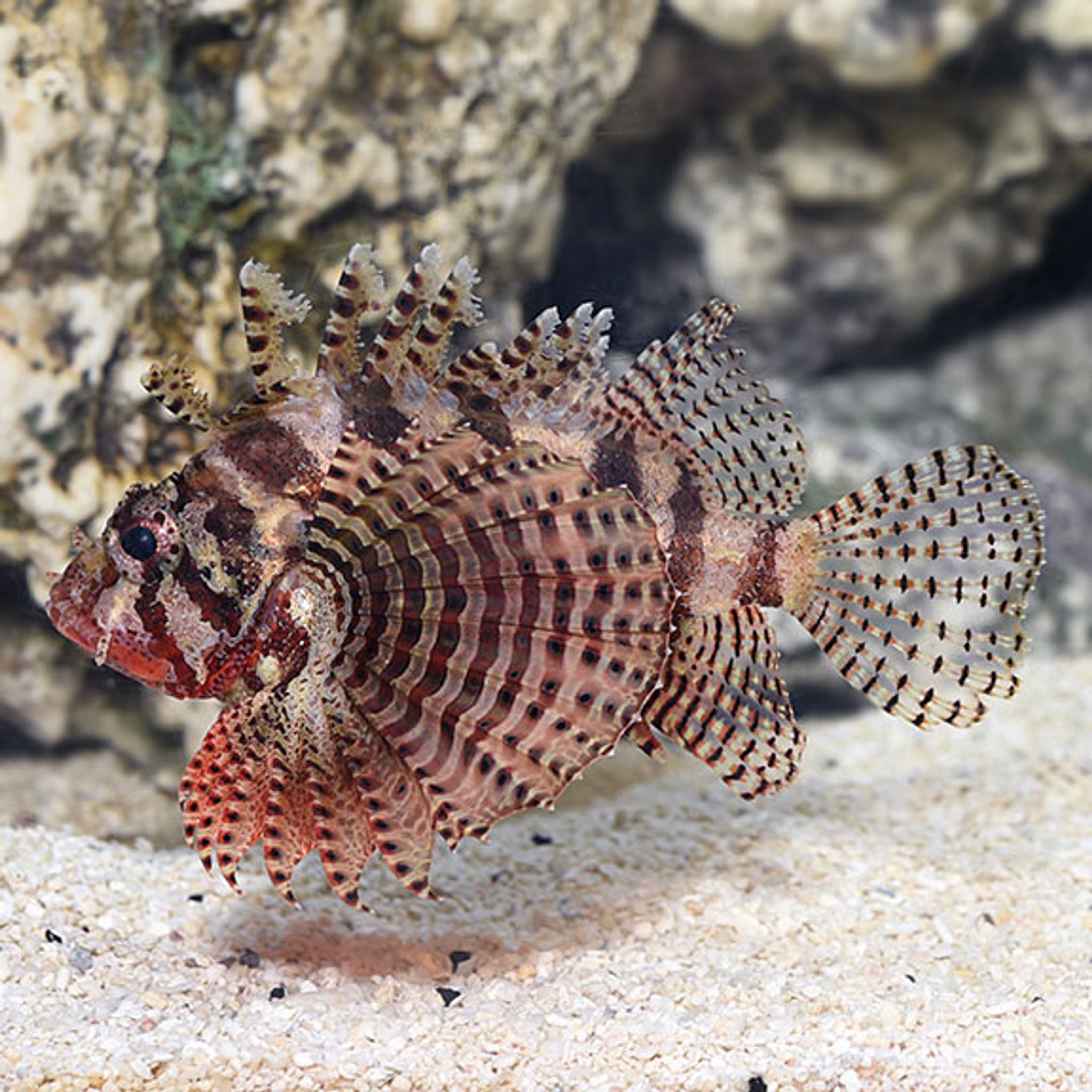

How to Feed Lionfish: Foods, Frequency and Common Feeding Problems
Lionfish are ambush predators that need a very different feeding routine than typical reef fish, and getting it wrong leads to malnutrition, obesity, or a fish that simply won't eat. This guide covers what to feed, how often, how to wean a new lionfish onto frozen food, and how to fix the most common feeding problems keepers run into.
How Lionfish Actually Feed
Lionfish (Pterois volitans, Pterois miles, and related species) don't hunt the way many reef fish do. They are ambush predators: they position themselves near a rock, overhang, or open water column and wait for prey to drift or swim within range, then engulf it in a rapid strike. They rarely chase food across the tank.
This matters for feeding because a lionfish left to find food on its own, especially something resting on the substrate, may simply ignore it. Feeding has to bring the food to the fish, not the other way around.
Best Foods for Captive Lionfish
A healthy lionfish diet is built around whole, meaty marine protein, rotated across several sources rather than repeating the same item every feeding. Good staples include:
- Silversides
- Raw market shrimp (shell-on, unseasoned)
- Krill
- Squid
- Clam or scallop pieces
- Small chunks of marine fish fillet
Avoid an all-shrimp diet. Shrimp fed exclusively, especially over months, carries two problems: it's relatively high in fat compared to other options, and some feeder and market shrimp contain thiaminase, an enzyme that breaks down vitamin B1 (thiamine). A steady thiaminase load can eventually produce B1 deficiency, showing up as poor appetite, weakness, and neurological signs like disorientation. Rotating protein sources dilutes this risk and gives a more complete nutrient profile overall.
Freshwater feeder fish (goldfish, rosy reds) should not be a staple. They're high in fat, low in the nutrients a marine predator needs, carry thiaminase themselves, and can introduce parasites or disease into a marine system. Reserve live freshwater feeders for genuine emergencies — a fish that is refusing every marine food and is at real risk of starving — not as a routine menu item.
A Simple Portion-Sizing Rule
Most feeding guidance skips numeric portions, but a workable rule of thumb is to size each piece of food to roughly the width of the lionfish's mouth gape, and to keep total food per session to what visibly rounds the belly without distending it. A lionfish's mouth stretches far wider than its head looks, so this is a generous size, not a tiny one — but "can technically swallow it" isn't the same as "appropriate portion."
How Often to Feed
| Life stage | Feeding frequency | Notes |
|---|---|---|
| Juveniles / subadults | Every 1–2 days | Smaller portions, more frequent, to support fast growth |
| Healthy adults | 2–3 times per week | Adjust up or down based on belly condition, not a fixed calendar |
| Weaning / newly acquired | As accepted, small amounts | Prioritize getting any food accepted over hitting a schedule |
| Post-obesity recovery | Reduced frequency, temporarily | See the reducing-weight section below |
Sources disagree on the exact number: some recommend a strict twice-weekly schedule for adults, while others feed every other day as long as portions are scaled down accordingly. In practice, either works — what matters more is watching the fish. A rounded but not distended belly is the target; a concave or hollow belly means feed more, a visibly bulging one means cut back.
Target and Tong Feeding
Because lionfish wait for food rather than search for it, target feeding (also called tong feeding) is the standard method:
- Use a long feeding stick or tongs, never fingers.
- Hold the food a few inches in front of the fish's mouth.
- Move it slightly to mimic drifting or swimming prey if the fish is slow to strike.
- Give the fish time — a lionfish may watch food for several seconds before committing to a strike.
Food dropped onto the substrate is often ignored entirely, especially by a fish that hasn't learned to associate it with a meal.
Weaning a Lionfish Onto Frozen Food
Newly acquired or wild-caught lionfish frequently arrive accepting only live food. This is normal, and weaning them onto frozen and thawed food is a standard, expected process that typically takes anywhere from a few days to a few weeks.
A reliable weaning sequence:
- Start with live feeder shrimp (such as ghost shrimp) to confirm the fish is eating at all.
- Once feeding is consistent, briefly stun a live shrimp and present it on a feeding stick so it still shows some movement.
- Gradually mix in thawed frozen shrimp or silversides, moving them with tongs to imitate the motion the fish is used to.
- Over successive feedings, reduce the live component until the fish accepts still, thawed frozen food directly off the tongs with no live movement required.
Soaking frozen food in a vitamin or garlic supplement periodically (a couple of times a week is a reasonable target, not every single feeding) helps replace nutrients lost during freezing and can make food more enticing to a fish that's still transitioning. Treat it as a regular best practice rather than an every-meal requirement.
Some individuals take months to fully convert, and a small number never fully abandon a preference for movement, needing the "wiggle" technique indefinitely. That's a normal outcome, not a sign of a health problem, as long as the fish is eating consistently and holding weight.
When a Relative Won't Convert at All
Not every scorpionfish relative behaves like a common lionfish. Rhinopias and similar rare scorpionfish are far more finicky ambush predators. They often require live food indefinitely, feed much less frequently even in the wild due to an extremely low metabolism and camouflage-based hunting style, and are prone to slow starvation if they never accept prepared or frozen food. If you keep one of these relatives, don't assume the same weaning timeline or techniques that work on a common lionfish will apply — some individuals simply never convert, and a long-term live-food supply plan is a prerequisite before buying one, not an afterthought.
Growth, Adult Size, and Appetite
Appetite and portion size scale with adult size:
- Dwarf species (fuzzy dwarf and other Dendrochirus) stay under roughly 6–7 inches (15–18 cm) and eat proportionally less throughout life.
- Common volitans-type lionfish reach 12–15+ inches (30–38+ cm) and need larger, more frequent meals while young, tapering to the standard 2–3-times-weekly adult schedule as growth slows.
Feeding With Tankmates
A lionfish will eat any fish or shrimp small enough to fit in its mouth, and that mouth stretches much wider than it appears at rest. As a stocking rule, assume any tankmate under roughly half the lionfish's body length is at risk over time, not just at introduction.
In tanks with multiple predatory fish or more than one lionfish competing for food, stagger feeding locations and target-feed each fish individually rather than dropping food in one spot. This reduces feeding-time aggression and ensures a slower or more timid fish isn't consistently out-competed. Avoid housing multiple lionfish together unless the tank is large enough to give each one a separate feeding zone.
Feeding Safety
Lionfish carry venomous dorsal, pelvic, and anal spines, and a sting is a real risk during feeding and maintenance. A few basic rules avoid it:
- Always use a feeding stick or tongs at arm's length — never place food near the fish with bare fingers.
- Be cautious during tank maintenance right after feeding, when the fish may be more active or defensive.
- Have a plan in mind for an accidental sting (hot water immersion is a commonly recommended first step) even if you never expect to need it.
Common Feeding Problems and Fixes
| Problem | Likely cause | What to do |
|---|---|---|
| Won't eat after purchase | Stress, incomplete acclimation | Rule out stress first; try live ghost shrimp; most start eating within 1–2 weeks |
| Stopped eating after feeding well | Water quality, illness, bullying | Check ammonia/nitrite, look for cloudy eyes or spots, watch for tankmate aggression at feeding time |
| Seems to "miss" food | Eye injury or vision loss | Dim tank lighting and hand/tong-feed directly at the mouth |
| Getting visibly fat, lethargic | Overfeeding, shrimp-heavy diet | Reduce frequency and portion size; diversify protein sources instead of shrimp-only |
| Only accepts live food long-term | Slow or incomplete weaning | Keep using the wiggle method; rotate food types; allow months if needed |
| Aggressive at feeding time | Competition with tankmates or other lionfish | Stagger feeding spots; target-feed individually; avoid overcrowding lionfish |
New Fish Won't Eat Yet — Don't Panic
Expect a settling-in period of several days to a week before a newly added lionfish attempts its first meal. This is normal acclimation behavior, not necessarily illness, and pushing food at a stressed fish too aggressively can prolong the adjustment.
Reducing Weight in an Overweight Lionfish
An overfed lionfish can develop visible girth beyond a normal rounded belly, along with lethargy — early signs of fatty liver from chronic overfeeding. The fix is gradual: drop to the lower end of the 2–3-times-weekly range (or skip an extra feeding), reduce portion size per feeding, and shift the diet away from fatty, shrimp-heavy meals toward leaner options like squid and marine fish fillet. Weight comes off slowly in fish; don't fast the animal completely for extended periods in an attempt to speed up the process.
Keeping a Simple Feeding Log
Because appetite decline is often the earliest visible sign of illness in an otherwise hardy fish, a basic log — date, food offered, whether it was eaten, and belly condition — makes it much easier to notice a problem early rather than after several missed meals have gone unremarked.
Sourcing Food and Supplies
A varied, rotating diet is easiest to maintain when you have several protein sources on hand rather than a single bag of shrimp. FishyHub's Food & Supplements category covers marine protein options suited to predatory fish, including freeze-dried food that works well as a supplemental rotation item alongside frozen staples. If you're stocking live feeder shrimp for weaning or emergency feeding, marine shrimp can be sourced there as well.
Frequently Asked Questions
How often should I feed my lionfish?
Feed healthy adults about 2–3 times per week, and juveniles every 1–2 days with smaller portions to support faster growth. Adjust based on belly fullness rather than sticking rigidly to a calendar.
What is the best food for lionfish?
Rotate whole marine protein: silversides, raw shrimp, krill, squid, and clam or scallop pieces. Avoid relying on any single item, especially an all-shrimp or all-goldfish diet, since that raises the risk of nutrient imbalance and thiaminase exposure.
Can lionfish eat goldfish?
Not as a staple. Goldfish and other freshwater feeders are nutritionally poor for a marine predator, carry thiaminase, and risk introducing disease. Use them only as a last-resort emergency measure for a fish that is refusing all marine foods.
Why won't my lionfish eat?
The most common causes are recent stress or incomplete acclimation, poor water quality, illness, or simply not yet recognizing non-live food as food. Try offering live shrimp first, then work on tong-feeding once the fish is reliably eating.
How do I get a lionfish to eat frozen food?
Wean gradually: start with live shrimp, move to a stunned shrimp presented on tongs, then mix in thawed frozen shrimp or silversides moved to mimic live prey. The full transition commonly takes one to three weeks, though some individuals take longer.
How big do lionfish get, and does that change feeding?
Dwarf species stay around 6–7 inches (15–18 cm) and eat correspondingly less. Common lionfish reach 12–15+ inches (30–38+ cm) and need larger portions as juveniles, tapering to a less frequent feeding schedule once they reach adult size.
Is it safe to hand-feed a lionfish?
No. The dorsal, pelvic, and anal spines are venomous, so food should always be offered with a feeding stick or tongs at arm's length rather than by hand.
Do lionfish need vitamin supplements?
Periodically soaking frozen food in a vitamin or garlic supplement, a couple of times a week is a reasonable target, helps replace nutrients lost during freezing and can help stimulate appetite in picky or newly weaned fish. It's a good regular habit rather than a requirement for every single feeding.
Browse FishyHub's Marine Fish selection to see current lionfish and tankmate-compatible species available for your setup.


