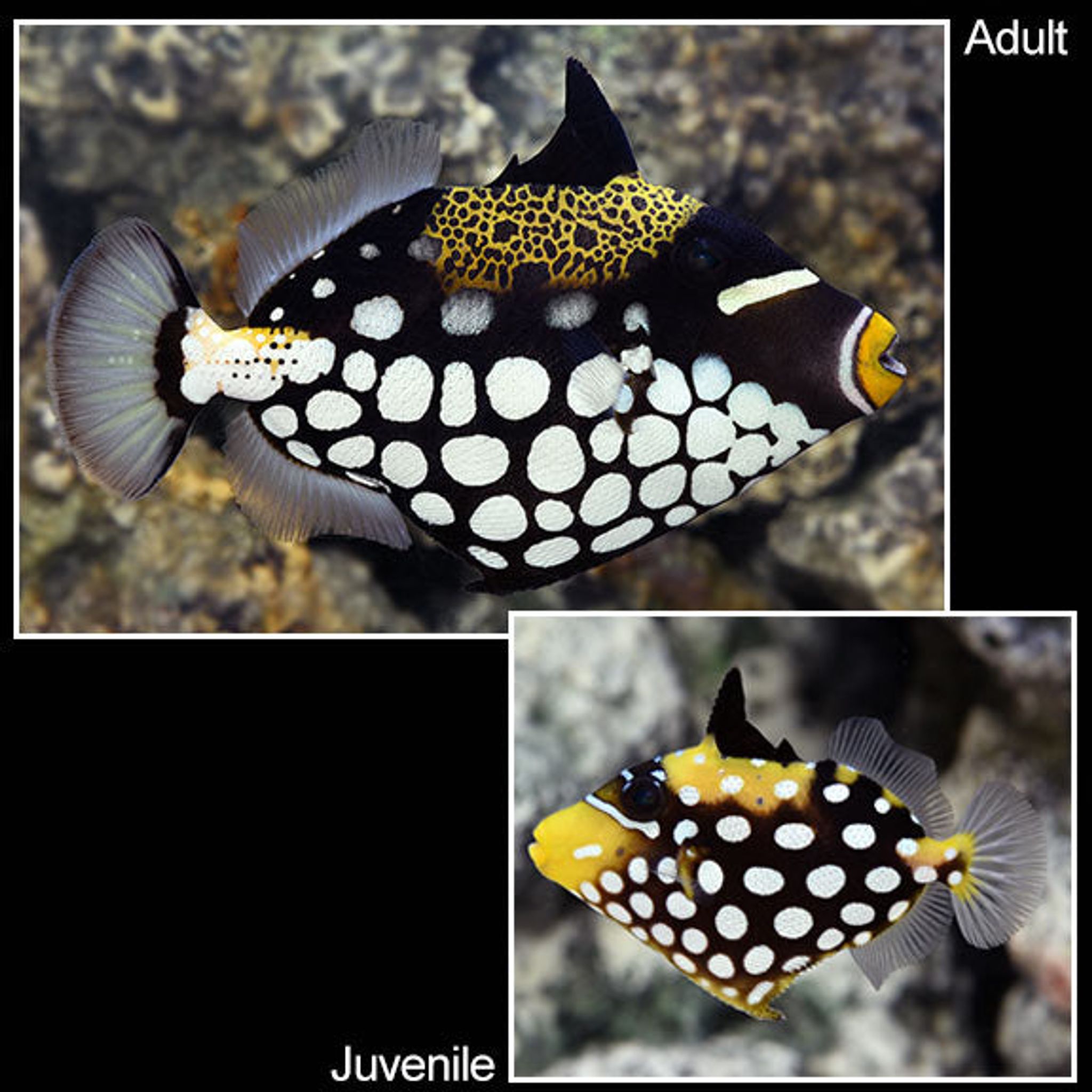
How to Feed Clown Triggerfish: Foods, Frequency and Common Feeding Problems
Clown triggerfish (Balistoides conspicillum) are bold, big-appetite predators that will eat almost anything meaty you drop in the water — which is exactly why so many keepers get the diet wrong. This guide covers what to feed, how often, how much, and how to solve the two problems that trip up most owners: overgrown teeth and feeding-time chaos.
What Clown Triggerfish Eat in the Wild and at Home
Clown triggerfish are primarily carnivorous, though they will opportunistically pick at algae or detritus in the process of hunting — that incidental grazing isn't something to build a feeding plan around. In the wild they crush hard-shelled crustaceans and mollusks with powerful jaws and continuously growing teeth. A home diet should mimic that mix of texture and protein, not just the protein content.
A solid rotation includes:
- Raw shrimp, shell-on
- Squid and scallop
- Clam and mussel, left in the shell
- Crab or crab legs
- Silversides or lance fish
- Marine fish flesh, cut into bite-sized chunks
- Krill (occasionally, not as a staple)
- Mysis shrimp for juveniles and smaller specimens
Avoid building the diet around a single item. An all-soft or single-food diet — feeding only silversides, only feeder fish, or only pellets — is linked to fatty liver disease and nutritional gaps over time. Watch for early warning signs of a poor diet: dull color, clamped or ragged fins, lethargy, or a fish that stops finishing meals it used to devour. These often show up before anything more serious does, and they're usually a diet problem, not a disease.
Freshwater feeder fish like goldfish and minnows should never be part of the diet. They carry a disease risk, offer poor nutrition for a marine species, and simply aren't a natural food source.
Why Hard-Shelled Foods Are Non-Negotiable
This is the part beginners skip, and it's the single most important thing to get right. A clown triggerfish's teeth grow continuously, the same way a rodent's do. In the wild, crushing shells, coral rubble, and crustacean exoskeletons wears the teeth down naturally. In an aquarium, an all-soft diet removes that wear entirely.
Skip hard foods for too long and the teeth overgrow, making it progressively harder for the fish to grip and eat — a downward spiral that can end in mouth deformity or infection. The fix is straightforward: feed clam or mussel in the shell, crab, crayfish, or snails regularly, not as a rare treat. Periodically check the beak and front teeth for length or asymmetry, and if you notice visible overgrowth or the fish struggling to grip food, treat it seriously — consult an experienced marine keeper or aquatic veterinarian rather than waiting to see if it resolves on its own.
How Often and How Much to Feed
Feeding frequency for clown triggerfish comes down to one principle: little and often beats one large meal. As active grazers with a fast metabolism, they do better on multiple smaller feedings than a single big one.
| Life stage | Size | Feedings per day | Portion guide |
|---|---|---|---|
| Juvenile | 3–5 in (7.5–12.5 cm) | 2 | Small pieces, eaten in 2–3 minutes |
| Subadult | 6–10 in (15–25 cm) | 1–2 | Moderate pieces, split into smaller feedings |
| Adult | 12–20 in (30–50 cm) | 1–2, up to 3 lighter feedings | Larger cut pieces, sized to appetite |
As a rough volume guideline, aim for roughly 2–5% of the fish's estimated body weight per day, split across feedings rather than dumped in at once. This is a starting point, not a rule — adjust based on body condition and how quickly food disappears.
The real test in every case is the 2–3 minute rule: feed only what gets eaten within that window. If food is still floating or sinking after that, you fed too much — both for the fish's health and for water quality.
A Sample Weekly Rotation
Rotating protein sources across the week is an easy way to avoid an accidental single-food diet:
- Monday: Raw shrimp, shell-on
- Tuesday: Clam or mussel in the shell
- Wednesday: Squid
- Thursday: Crab or crab legs
- Friday: Marine fish flesh, cut into chunks
- Saturday: Silversides or lance fish
- Sunday: Krill, mixed with a vitamin-fortified pellet
Adjust the order to whatever's available, but keep at least two or three hard-shelled feedings in the mix each week.
Pellets, Vitamins and Supplements
Prepared marine carnivore pellets or formulas are useful as a supplement — they're convenient and can be fortified with vitamins — but they shouldn't replace whole, hard meaty foods. Flake food is inadequate as a primary diet for a fish this size and this active.
Soaking food in a vitamin and garlic supplement periodically supports immune health and appetite, which is especially useful for new arrivals still settling in. FishyHub stocks freeze-dried and prepared foods that work well in a rotation alongside fresh and frozen items, browsable in the Food & Supplements category, including options under Freeze Dried Food.
Feeding Method: Keep Your Fingers Out of It
Clown triggerfish have a genuinely powerful bite, and adults will strike at fingers, tongs, or anything that moves near their feeding zone. Once a fish reaches adult size, drop food directly into the water rather than hand-feeding or using a feeding stick close to the fish. Long tongs are fine for placement from a distance; getting your hand near an adult's mouth is not worth the risk.
Because adults commonly reach 12–20 inches and need systems in the 120–300+ gallon range, feeding logistics change with size too — larger portions need to be thawed fully in advance, and larger cut pieces should be rinsed before feeding.
Water Quality: The Other Half of Feeding
Feeding a large, heavy-eating predator has a direct effect on water chemistry. Meaty foods and any uneaten scraps raise nitrate and phosphate, so feeding practice and water quality management have to be planned together, not separately.
Keep salinity stable at a specific gravity of roughly 1.023–1.025 (about 35 ppt), and use purified RO/DI water for top-off and saltwater mixing to avoid introducing unnecessary phosphate or metals. Fish-only systems tolerate somewhat higher nitrate than reef tanks, but that tolerance isn't unlimited — excess feeding waste still degrades water quality and stresses the fish over time, even without corals in the tank to worry about.
A biological filter and protein skimmer sized for a large, heavy-eating predator matters more here than for a typical reef fish. If you're regularly feeding whole shrimp, crab, and clam to a 15-inch adult, your filtration needs to handle that bioload — not just the bioload of the fish itself. Always remove uneaten food within a few minutes of a feeding, especially in tanks under about 180 gallons, where waste concentrates faster.
Common Feeding Mistakes and How to Fix Them
- Overfeeding or an all-soft diet: Leads to fatty liver, obesity, and poor water quality. Fix by rotating in hard foods and sticking to the 2–3 minute portion rule.
- Skipping hard-shelled foods: Causes overgrown teeth, difficulty eating, and mouth infections. Fix with regular clam-in-shell, crab, or crayfish feedings and periodic checks of tooth length.
- A new arrival refusing food: Usually stress or acclimation, not illness, if water quality and tankmates check out. Try live or fresh-smelling foods like ghost shrimp or silversides, offer garlic- or vitamin-soaked frozen food, and give the tank several days of minimal disturbance before assuming a health problem.
- Appetite loss after quarantine or medication (copper treatment, for example): A common temporary effect. Keep offering variety, hold salinity and water quality steady, and reintroduce feeding gradually.
- Feeding too close to hands or with a feeding stick: Risks a bite from a large adult. Drop food in or use long tongs from a distance instead.
- Bullying at feeding time in mixed tanks: Clown triggerfish are aggressive feeders and will out-compete slower tankmates. Target-feed slower fish separately, or spot-feed the trigger with a turkey baster to control where food lands.
- Uneaten food fouling the water: Remove excess promptly, particularly in smaller systems where waste concentrates fast.
Sourcing Hard-Shell Foods Affordably
You don't need specialty products for most of the hard-shell rotation. A grocery store seafood counter is often the most affordable, accessible source for raw shrimp, clams, mussels, and crab legs — just make sure anything used is unseasoned and free of added salt, oil, or marinade before it goes in the tank.
Transitioning a New or Wild-Caught Juvenile
Compared to many marine species, clown triggerfish juveniles adapt to prepared and frozen foods quickly and usually need little conditioning. If a new juvenile is reluctant at first, a gradual path works well: start with live food (ghost shrimp or small live shrimp) for the first few days, transition to fresh or thawed frozen shrimp and clam once it's feeding confidently, and introduce prepared pellets or gel foods as a supplement after that. Most individuals make this shift within one to two weeks.
Frequently Asked Questions
What is the best staple food for a clown triggerfish?
There isn't a single best staple. The healthiest approach rotates raw shrimp, squid, clam and mussel in the shell, crab, silversides, and marine fish flesh, with prepared pellets used as a supplement rather than the main diet.
How often should I feed a clown triggerfish?
Juveniles do well with about two feedings a day, while adults are typically fed one to two larger meals, or up to three smaller feedings, per day. Size each portion to what the fish clears in 2–3 minutes rather than following a fixed amount.
Why does my clown triggerfish's teeth look overgrown?
This almost always points to insufficient hard-shelled food in the diet. Increase feedings of clam-in-shell, mussel-in-shell, or crab, and if the overgrowth looks severe or the fish is struggling to eat, consult an experienced keeper or aquatic veterinarian.
My new clown trigger won't eat — what should I do?
Give it a few days before assuming a problem; this is usually acclimation stress. Offer live or fresh-smelling foods and vitamin-soaked frozen food, double-check water parameters, and avoid disturbing the tank around feeding times.
Can clown triggerfish eat pellets or flake food?
Pellets formulated for marine carnivores are fine as a supplement, particularly when fortified with vitamins, but they shouldn't be the sole diet. Flake food doesn't provide enough nutrition or bulk to serve as a primary food for this species.
Is it safe to hand-feed a clown triggerfish?
Not recommended for adults, since their bite is strong enough to injure a hand. Drop food into the water or use long tongs from a distance instead; some very tame individuals can eventually be trained to take food more closely, but only by experienced keepers who accept the risk.
Clown triggerfish are rewarding, easy-eating fish once the diet is dialed in — the key is variety, hard-shelled foods for dental health, and small frequent portions rather than one big meal. Browse available specimens and compatible tankmates in FishyHub's Triggerfish category to plan your next addition.


