How Many Fish Can You Keep in a Freshwater Aquarium?
There's no single number that answers this for every tank, but there is a reliable method for finding your own answer. Rather than leaning on the old "1 inch per gallon" shortcut, this guide walks through the factors that actually decide how many fish your aquarium can safely support — filtration, adult size, swimming style, and more — plus real examples for common US tank sizes.
The Old Rule, and Why It Falls Short
Generations of hobbyists learned the same shortcut: 1 inch of adult fish per 1 gallon of water. It's not a scientific formula — it's a rough rule of thumb that's been passed around for decades because it's easy to remember and easy to apply at a pet store counter.
The problem is that it only measures length, and length is a poor stand-in for what actually matters: waste output and space needs. A fish's body mass scales roughly with the cube of its length, not a straight line. A 4-inch goldfish or oscar is far bulkier, eats far more, and produces far more waste than a 4-inch neon tetra or pencilfish. Counting them as equivalent "4 inches" of bioload badly underestimates the goldfish and overestimates how much room the tetra actually needs.
That doesn't make the rule useless — it just means it belongs in a narrow role: a first-pass sanity check for small, peaceful community fish in a filtered, planted tank. It was never designed for large-bodied, messy, or territorial species, and treating it as exact math is one of the most common stocking mistakes new hobbyists make.
What Actually Determines Safe Stocking
A more reliable framework looks at several factors together, roughly in this order of importance:
- Bioload and filtration capacity. Your biological filter houses the bacteria colonies that break down fish waste. The surface area available for that bacteria — not the tank's gallon count alone — sets the ceiling on how much waste your system can process.
- Adult size, not size at purchase. Store specimens are often juveniles. Stock for the size the fish will reach as an adult, not the size it is in the bag.
- Swimming style and space needs. Active swimmers like danios and barbs need horizontal distance to move. A long, low tank of a given volume comfortably houses more active swimmers than a tall, narrow tank of the same volume.
- Territory and aggression. Cichlids, bettas, and other territorial fish need more personal space per individual than peaceful schooling species — territory disputes, not just waste, limit how many you can keep together.
- Schooling requirements. Species like tetras, corydoras, and rasboras need to be kept in groups of six or more to feel secure. A school should be planned as one stocking decision, not counted as six individual "slots" you could otherwise fill differently.
- Surface area for gas exchange. Oxygen enters the water at the surface. A wide, shallow tank exchanges gas more efficiently than a tall, narrow one holding the same number of gallons.
- Live plants and water-change frequency. Live plants absorb some waste compounds, and regular partial water changes dilute what's left. Both effectively raise a tank's usable capacity, though neither replaces adequate filtration.
A Practical Process for Stocking a New Tank
Before adding a single fish, the tank needs a fully established nitrogen cycle — the biological process that converts toxic ammonia into safer compounds. Once cycled, add fish gradually:
- Add a small batch — a few fish, or one school — at a time.
- Wait one to two weeks between additions.
- Test ammonia, nitrite, and nitrate after each addition.
- Don't add more fish until ammonia and nitrite read zero.
Rushing this process is how "new tank syndrome" happens: adding an entire stocking list at once overwhelms a biological filter that hasn't had time to build up enough bacteria, causing an ammonia or nitrite spike that stresses or kills fish.
Rough Starting Points (Treat as Ballpark, Not Gospel)
Some numeric guidelines are worth knowing, but none should be read as hard fact:
| Fish type | Rough guideline | Notes |
|---|---|---|
| Small, peaceful community fish (tetras, rasboras, small livebearers) | Around 1 inch per gallon | Only in a well-filtered, planted tank |
| Messy or large-bodied fish (goldfish, larger cichlids) | 0.5 inch per gallon or less | Much higher waste output per inch |
| Large, heavily planted, well-filtered tanks | Can exceed 1 inch per gallon | Extra capacity from filtration and plants, not a license to max out |
Sources disagree on how far a strong filter and dense planting can push these numbers. Some suggest heavily planted, well-filtered tanks can be stocked well beyond the 1-inch guideline; others favor staying conservative regardless of equipment. For beginners, the conservative approach wins: a lightly stocked, stable tank forgives mistakes far better than one pushed to its limit.
Minimum tank sizes also matter more than any ratio for many species. A single betta needs roughly 5 gallons minimum regardless of the math, and a small school of neon tetras needs 10–15 gallons minimum — the school size and swimming space requirement overrides a simple per-gallon calculation.
Converting Tank Dimensions to Gallons
If you're working from a custom or secondhand tank rather than a listed size, the formula is:
Length (in) × Width (in) × Height (in) ÷ 231 = gallons
Standard US tank sizes to know:
| Tank size (US gal) | Approx. liters | Typical footprint |
|---|---|---|
| 10 gal | 38 L | 20" × 10" × 12" |
| 20 gal long | 76 L | 30" × 12" × 12" |
| 29 gal | 110 L | 30" × 12" × 18" |
| 40 gal breeder | 151 L | 36" × 18" × 16" |
| 55 gal | 208 L | 48" × 13" × 21" |
| 75 gal | 284 L | 48" × 18" × 21" |
Two tanks with identical gallonage can hold very different stocking lists. A 20-gallon long is a better fit for active schoolers than a 20-gallon tall, purely because of the added floor space and surface area.
Worked Example: A 29-Gallon Community Tank
A well-filtered, lightly planted 29-gallon tank might comfortably support one school of six small tetras, one school of six corydoras, a pair of dwarf gouramis, and a handful of shrimp — while a single large, messy cichlid could realistically need the whole 29 gallons to itself. The difference isn't the gallon count; it's bioload, adult size, and behavior. Browsing small community fishes side by side with their adult size listed is a useful way to sketch out a stocking list before buying anything.
Maximum Adult Sizes Are Often Bigger Than You'd Guess
Many popular fish sold at a few inches long grow far larger than their store size suggests:
- Common plecos can exceed 12–18 inches, well beyond what most first tanks can support.
- Oscars commonly reach 10–12 inches and need substantial swimming room and filtration.
- Common goldfish can grow past 10–12 inches in a large enough tank, not the 2–3 inches many buyers expect.
- Certain "tank-buster" barbs and freshwater sharks likewise outgrow the average community setup.
Always check a species' maximum size in captivity, not just its size at the store, and plan the tank around that number from day one — not the size it happens to be when you take it home.
Warning Signs of Overstocking
Watch for these signals that a tank has more bioload than its system can handle:
- Nitrates that stay persistently elevated (often cited around 40 ppm and climbing) despite regular water changes.
- Cloudy water.
- Fish gasping at the surface.
- Frayed or damaged fins.
- Increased aggression between tankmates.
- Recurring algae blooms.
- Unexplained deaths with no obvious single cause.
If you're seeing several of these together, it's worth testing water parameters right away and reassessing filtration relative to your current stocking level. As a rule, size filtration for a tank category larger than your actual tank whenever your stocking plan is on the heavier side.
Species-Only vs. Community Tanks
A species-only (single-species) tank dedicated to one schooling fish lets that species express its natural group behavior at scale, since there's no need to divide bioload capacity or space among multiple species. A mixed community tank needs more conservative stocking because you're accounting for several species' combined waste output, swimming needs, and temperament at once — the more species you mix, the more margin you should leave.
Shrimp Stocking Is a Different Calculation
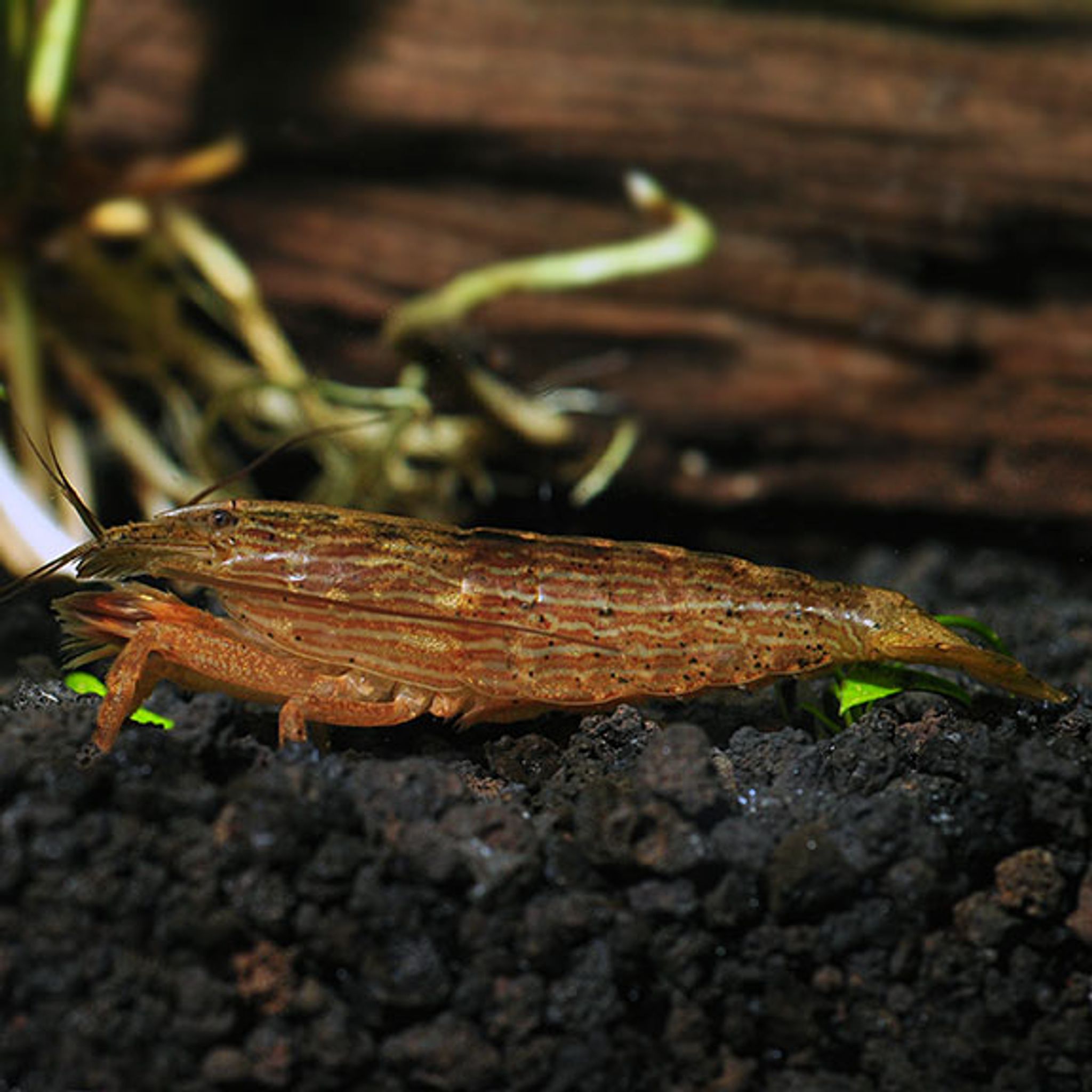
Shrimp produce far less waste than fish of comparable size, so general guidance is more forgiving — often several shrimp per gallon in a mature, planted tank. What matters more for shrimp than raw numbers is water stability and copper-free water, since shrimp are notably sensitive to copper (found in some medications and tap water) and to sudden parameter swings. Anyone building out a dedicated shrimp setup can browse shrimp options once water parameters are stable and tested.
Cramped Tanks Cause Stress, Not Just Water Chemistry Problems
Overstocking isn't only a water-quality issue. Insufficient space triggers chronic stress in fish — elevated cortisol, suppressed immune function, and redirected aggression or fin-nipping, sometimes even among normally peaceful species. This is a separate mechanism from ammonia or nitrate buildup, which is why fish can act aggressive or "off" even when water tests come back clean. Cramped or overstocked conditions can also stunt growth: poor water quality and chronic stress hormones can slow a fish's development, and stunted growth brings organ and health problems with it — it is not a convenient way to fit more fish long-term.
The Golden Rule of Stocking
If there's one principle to keep in mind above all the math: stock conservatively and add slowly. When in doubt, under-stock. A tank with room to spare is more forgiving of a missed water change, an unexpected illness, or a fish that grows larger than expected than a tank already stocked to its limit. Patience during the stocking process prevents the crashes that patience during the cycling process was meant to avoid in the first place.
Acclimating and Transporting New Fish
How you introduce a new fish matters almost as much as how many you add. Two accepted acclimation methods:
- Floating method: Float the sealed bag in the tank for 15–20 minutes to match temperature before opening it.
- Drip method: Slowly mix tank water into the bag or a separate container over 30–60+ minutes, giving the fish time to adjust to water chemistry gradually.
Never dump the store's bag water directly into your tank — it can carry ammonia buildup or pathogens you don't want introduced. When possible, quarantine new arrivals for 2–4 weeks in a separate tank before adding them to your main display.
On the trip home, minimize time in the bag, avoid leaving it in direct sun or a hot car, and get the fish home and acclimating as soon as reasonably possible — oxygen in a sealed bag is limited, so this isn't a step to leisurely delay.
Catching Fish Without Added Stress
Whether you're rehoming a fish, moving it to quarantine, or doing routine maintenance, use a net sized appropriately for the fish and corner it gently rather than chasing it around the entire tank. Minimizing time spent being chased — and time out of water once caught — reduces stress on top of whatever handling is already required.
Efficient Stocking Also Means Less Maintenance
Matching your stocking plan and equipment (filter and heater sized for your actual bioload, not just the tank's gallon rating) avoids the common trap of over-buying gear for fish you don't have yet, or under-buying for fish you plan to add later. A properly stocked tank — not overstocked — with adequate filtration and a basic weekly routine (partial water changes, gravel vacuuming) needs comparatively light upkeep. Overstocking is one of the leading reasons a tank turns into a high-maintenance chore instead of a manageable hobby. It's worth resisting the urge to buy fish on impulse simply because a tank "looks empty" — a sparse-looking tank at six months can look crowded at eighteen, once every fish reaches adult size.
Frequently Asked Questions
Is the 1-inch-per-gallon rule still valid?
It's useful only as a rough starting point for small, peaceful community fish in a filtered, planted tank. For large-bodied, messy, or aggressive species, it consistently underestimates the space and filtration they need.
How do I know if my tank is overstocked?
Watch for persistently high nitrates, cloudy water, fish gasping at the surface, increased aggression or fin damage, and recurring algae blooms. Regular water testing catches these trends before they become a crisis.
Can a strong filter or live plants let me keep more fish?
To a degree — both raise a tank's effective waste-processing capacity. It's safer to treat that extra capacity as a buffer for stability rather than a reason to push your stocking to its absolute limit.
How many fish should I add at once to a new tank?
Add a small batch at a time — a few fish or a single school — then wait one to two weeks and test ammonia and nitrite before adding more. This gives your biological filter time to catch up with the added bioload.
Do I need to count schooling fish differently?
Yes. Plan for the full recommended group size, often six or more, as one stocking decision rather than treating each fish as an individual slot you could fill with something else.
How big will my fish actually get?
Check the adult, in-captivity size for the species — it's often larger than the size at the store and can differ from wild-caught size records. Stock for that full-grown size from the day you bring the fish home, not the size it is when purchased.
Finding the Right Fish for Your Tank
Once you know roughly how much bioload and swimming space your tank can support, matching that to species becomes much easier. You can browse freshwater livestock by category to compare adult sizes, temperaments, and schooling needs before finalizing a stocking list — and revisit that list every few months, since a plan that fits your fish today may not fit them once they've reached full size.


