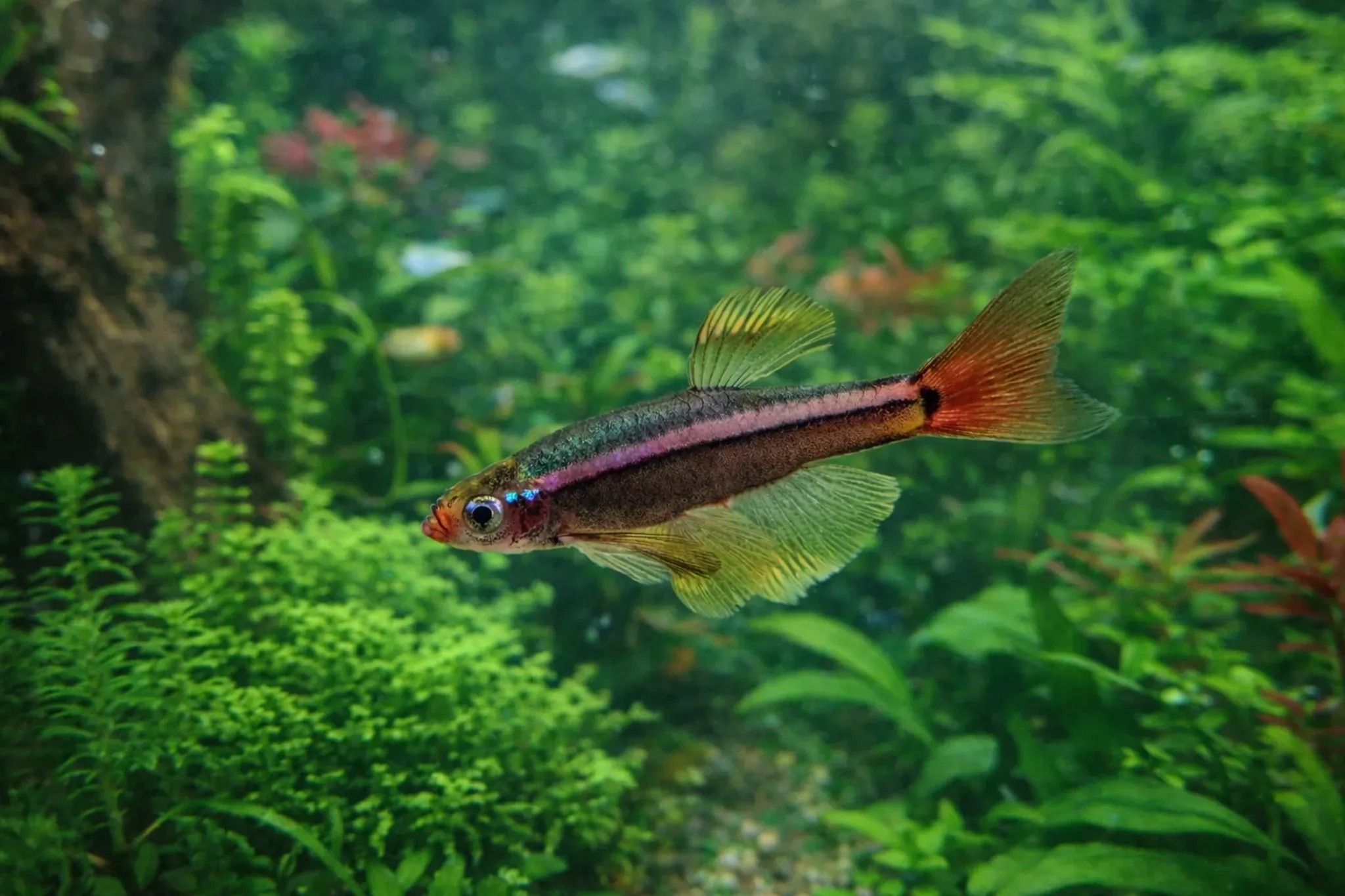

How Big Do White Cloud Mountain Minnow Get? Growth Rate, Adult Size and Tank Planning
A white cloud mountain minnow tops out at roughly 1.5 inches (3.8 cm), with a realistic adult range of 1.2–1.6 in (3–4 cm). They reach that size fast, usually by 6–9 months, and then simply stop growing — which is normal, not a sign of stunting. Here's the full growth timeline, sizing math for real US tank sizes, and why this coldwater cyprinid plans differently than a typical tropical nano fish.
Adult Size: What "Big" Actually Means Here
Most sources converge on about 1.5 in (3.8 cm) as the typical adult length for a white cloud mountain minnow (WCMM), measured nose to tail base. The broader realistic range is 1.2–1.6 in (3–4 cm).
A handful of sources claim adults reaching 2–2.2 in (5–5.6 cm). Treat that as an uncommon upper outlier rather than what to expect — it likely reflects exceptional specimens, measurements that include the tail fin, or occasional confusion with related, larger minnow species. If you're planning a tank, budget for the 1.2–1.6 in range and treat anything larger as a pleasant surprise, not the standard.
Does Sex Affect Size?
Yes, modestly:
- Females tend to be slightly larger-bodied and noticeably deeper through the belly once mature, especially when gravid with eggs.
- Males stay slimmer overall but often show more intense red coloring in the fins, particularly during breeding condition.
So "how big" can shift by a fraction of an inch depending on sex, but neither sex meaningfully outgrows the species' small-fish ceiling.
Growth Timeline: From Fry to Full Adult
Growth is quick and then flattens out — there's no slow, years-long climb the way there is with larger cichlids or catfish.
| Stage | Approximate age | Approximate length |
|---|---|---|
| Newly hatched fry | 2–3 days post-spawn | Nearly microscopic |
| Free-swimming fry | 2–4 weeks | Under 0.25 in (6 mm) |
| Juvenile | ~4 months | About 0.5 in (1.3 cm) |
| Subadult | 6 months | 1–1.3 in (2.5–3.3 cm) |
| Full adult | 6–9 months (up to 12 in slower-growing individuals) | 1.2–1.6 in (3–4 cm) |
Once a WCMM hits its genetic ceiling around 6–9 months, growth essentially stops. If your fish looks the same size at month 10 as it did at month 8, that's expected — not a symptom of poor health or stunted growth. Owners sometimes mistake this natural plateau for a problem; it's simply what a fully grown WCMM looks like.
Lifespan and How Temperature Ties Into Size
A well-kept white cloud mountain minnow typically lives 3–5 years, with excellent, stable, cool conditions pushing some individuals to 5–7 years.
Because these fish are cold-blooded, water temperature drives metabolism, appetite, immune function, and growth rate directly. That connects the size question and the temperature question more tightly than most care guides admit:
- Water kept too warm (consistently 78°F/25.6°C or higher) speeds up metabolism and oxygen demand, which in practice shows up as faster early growth followed by a shortened lifespan and often duller, less vibrant color over time.
- Water kept too cold for extended periods slows appetite and growth, delaying the fish from reaching its normal adult size on the expected timeline.
- Stability matters almost as much as the exact number — try to hold day-to-day swings to roughly 2°F (about 1°C) or less.
In short: correct, stable, cool water is what lets a WCMM reach its natural 1.2–1.6 in size on schedule and live out a full lifespan.
A Coldwater Fish, Not a Tropical One
This is one of the few commonly kept species that genuinely thrives unheated in a typical US home. Key parameters:
| Parameter | Target range |
|---|---|
| Temperature | 64–72°F (18–22°C); tolerates brief dips into the low 60s and even upper 50s outdoors, but 64°F+ is the comfortable everyday baseline |
| pH | 6.0–8.0 (wide tolerance) |
| GH (hardness) | 5–19 dH (soft to moderately hard) |
| Ammonia | 0 ppm |
| Nitrite | 0 ppm |
| Nitrate | Under 40 ppm |
Short trips into the upper 70s°F are tolerated but should be avoided as a normal condition — over weeks or months, sustained warmth is exactly what shortens both growth potential and lifespan, as noted above. This is a genuinely hardy, adaptable species on pH and hardness, which is part of why it suits so many US tap water profiles without much adjustment.
Tank Planning: Turning Size Into Real Numbers
Because WCMM stay small but are active, horizontal swimmers that shoal, the right tank shape and footprint matter more than raw volume.
Minimum Tank Size
- 10 gallons (38 L) is the bare minimum, suitable only for a small group of about 6 fish.
- 20-gallon long (76 L) is the actual recommended starting point for a proper school of 8–10 or more, since the extra length and surface area matter more than extra depth for this mid/top-dwelling swimmer.
Stocking Math for Common US Tank Sizes
A rough rule of one WCMM per gallon works well as a planning shortcut in a dedicated species tank, adjusted downward once you add tank mates, plants, or heavy decor.
| Tank size | Rough WCMM capacity (species-only) | Notes |
|---|---|---|
| 10 gal (38 L) | 6–8 | Minimum viable school; little room for tank mates |
| 20-gallon long (76 L) | 15–20 | Ideal footprint; strong choice for a full school |
| 29 gal (110 L) | 20–25 | Room for a larger school plus light tank mates |
| 40-breeder (151 L) | 30–35 | Generous school size with a mixed community |
Always keep at least 6 fish, ideally 8–10 or more. Shoals smaller than that become skittish, hide more, and show less of their natural color — one of the most common avoidable mistakes with this species.
Tank Mates
Because WCMM don't need warm water, prioritize other unheated-friendly or cool-tolerant, peaceful species over anything requiring 78°F+. Good options include other small peaceful schoolers, corydoras, shrimp, and snails. You can browse compatible options among FishyHub's small community fishes and pair them with a properly sized glass tank built around the 20-gallon-long footprint.
Cold-Weather and Heater Management
Because this species is genuinely coldwater-tolerant, many US keepers run it with no heater at all in a typical climate-controlled home. A few practical notes still apply:
- If your tank sits in a cold room, near a drafty exterior wall, or a home with big winter temperature swings, check temperature daily with an accurate thermometer rather than assuming it's stable.
- A low-wattage heater set near the low 60s°F is a reasonable safety net — its job is to prevent extreme dips, not to turn the tank tropical.
- During a power outage or prolonged cold snap, insulate the tank exterior and use a battery-powered backup air pump if oxygen exchange is a concern. Skip feeding during the excursion — a fish with a slowed cold-weather metabolism won't eat much anyway, and uneaten food just fouls the water.
This tolerance for unheated setups is also a practical selling point: it's a strong candidate for keepers who want to avoid the ongoing cost and failure risk of running a heater year-round, provided they still monitor temperature rather than assuming "coldwater" means "no attention needed."
Diet and Breeding Basics
Diet: WCMM are omnivorous. Feed a quality flake or micro-pellet as the staple, supplemented with live or frozen foods like daphnia, brine shrimp, or small bloodworms, plus occasional blanched vegetable matter. Offer small amounts once or twice daily, sized so everything is eaten within 2–3 minutes — their mouths are tiny, and overfeeding degrades water quality quickly in a small tank.
Breeding: These are egg-scattering fish, not livebearers or mouthbrooders. Adhesive eggs are deposited among fine-leaved plants and typically hatch in 2–3 days. Parents will readily eat their own eggs and fry, so dense planting or removing adults after spawning improves survival if you want to raise a batch.
Common Mistakes to Avoid
- Housing them in a bowl or unfiltered nano container. Small adult size doesn't mean low-maintenance — they still need filtration, a full nitrogen cycle, and real swimming room.
- Running them too warm alongside tropical tank mates (78–82°F/25.6–27.8°C). They'll survive short-term but show stunted growth, faded color, and a shortened lifespan over months or years.
- Understocking the school below 6 fish, which causes stress, hiding, and duller coloration.
- Overfeeding into a small tank, quickly spiking ammonia and nitrite.
- Mistaking a natural growth plateau for illness. After 6–9 months, size leveling off is expected, not a red flag.
- Sudden temperature swings during water changes. Always match replacement water temperature to the tank to avoid stressing a cold-sensitive system.
Frequently Asked Questions
How big does a white cloud mountain minnow actually get?
Typically about 1.2–1.6 in (3–4 cm), with 1.5 in (3.8 cm) as the commonly cited average adult size. Occasional reports of fish reaching 2 in (5 cm) exist but are uncommon outliers rather than the norm.
How fast do they grow?
Fry reach about 0.5 in (1.3 cm) by around 4 months old, then reach essentially full adult size by 6–9 months, occasionally taking up to 12 months in slower-growing individuals.
Do males or females get bigger?
Females are usually slightly larger-bodied and noticeably deeper, especially when carrying eggs. Males stay slimmer but often show brighter red coloring in the fins during breeding condition.
How long do white cloud mountain minnows live?
Commonly 3–5 years in a home aquarium, with well-kept fish in cool, stable water sometimes reaching 5–7 years.
What size tank do they need?
A 10-gallon (38 L) tank is the bare minimum for a small group of about 6. A 20-gallon long (76 L) is the recommended starting point for a proper school of 8–10 or more.
Do they need a heater?
Not always. They do well unheated at typical US indoor room temperatures in the mid-60s to low-70s°F. A small heater set near the low 60s°F is a reasonable safety net in cold rooms rather than a requirement.
How many can I keep together?
Keep a minimum of 6, ideally 8–10 or more, since smaller groups become skittish and show less color. As a rough stocking guide, plan for about one fish per gallon in a dedicated species tank.
Will they outgrow a community tank with tetras or barbs?
No — white cloud mountain minnows stay small permanently. Temperature compatibility matters more than size when choosing tank mates; avoid pairing them with species that require 78°F+ year-round.
Ready to plan your school? Browse freshwater livestock on FishyHub to find white cloud mountain minnows and compatible cool-tolerant tank mates sized right for your setup.


