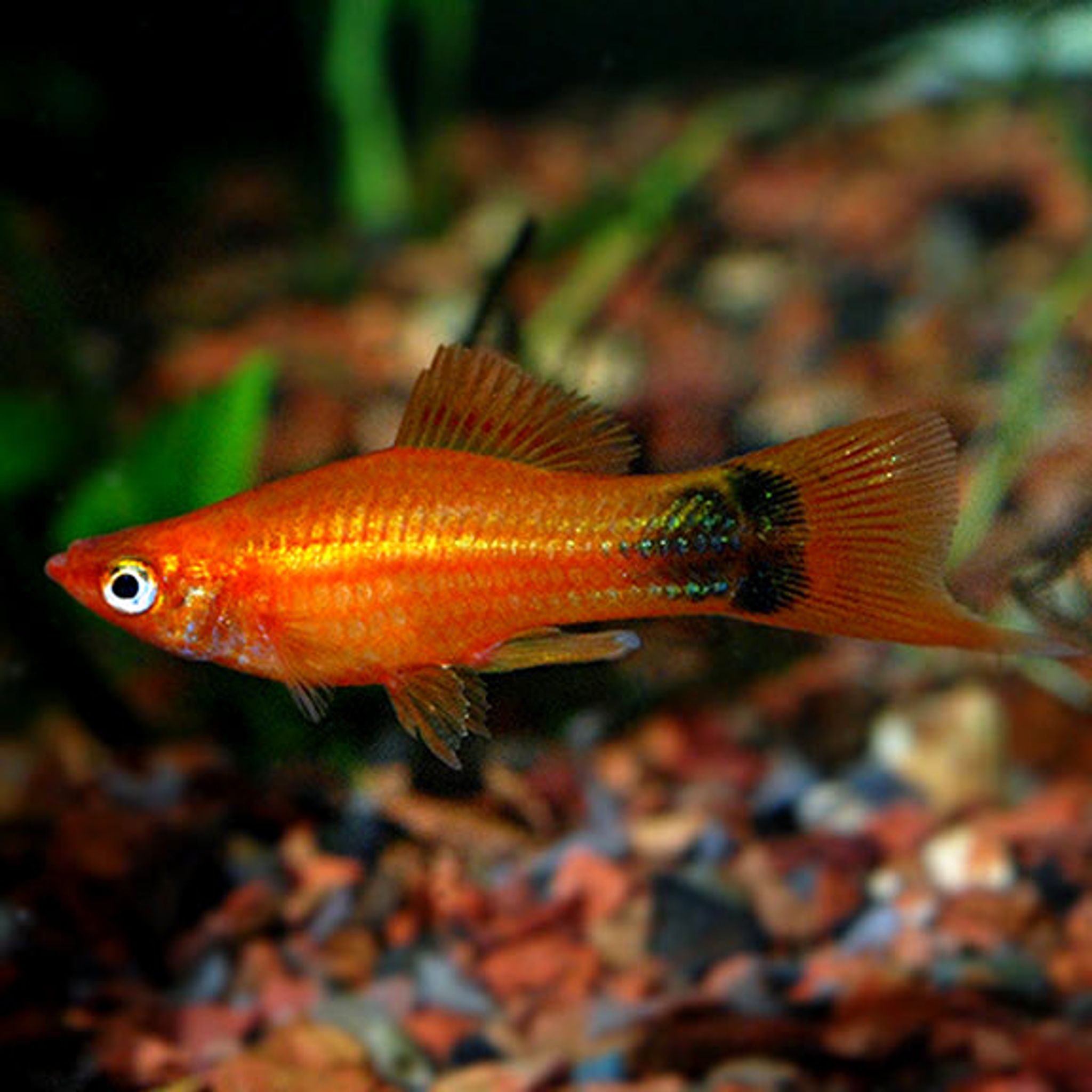

How Big Do Swordtail Get? Growth Rate, Adult Size and Tank Planning
Adult swordtails typically reach 4–6 inches (10–15 cm) including the tail, though full-grown size varies by sex and strain. Reaching that length takes close to a year of steady growth, not the few weeks many new keepers expect, so the tank you buy today needs to fit the fish they become — not the fish they are at the store.
Adult Size: What to Actually Expect
A healthy swordtail from a standard domestic strain lands somewhere between 4 and 6 inches nose-to-tail-tip at maturity. That figure includes the sword extension on males, which is a real driver of the confusion around "how big" these fish get.
Females are the larger sex. They need extra body volume to carry developing fry, so mature females commonly reach 5.5–6.5 inches. Sources vary on the upper end — some cap females at 5.5 inches, others report 6.5 inches — and the gap mostly comes down to strain and lineage rather than a measurement error. Larger, more robust wild-type lines tend to hit the top of the range.
Males stay smaller-bodied even though the sword makes them look longer in photos. A male's body plus sword usually tops out around 5–5.5 inches, with the sword itself accounting for a meaningful chunk of that total. If you're comparing body length only (no sword), males are noticeably shorter than the headline "4–6 inch" number suggests.
Strain matters as much as sex. Fancy varieties bred for fins or color — lyretail, hi-fin, and similar lines — are often smaller or proportioned differently than robust wild-type swordtails. Genetics and lineage are one of the biggest levers on final size, right alongside care.
Growth Timeline: Age by Age
Growth is fast for the first six months, then slows sharply. Most keepers are surprised that full adult size takes close to a year, not a couple of months.
| Age | Approximate size | Notes |
|---|---|---|
| At birth | 0.25–0.3 in (0.6–0.8 cm) | Fully formed, free-swimming immediately |
| ~1 month | ~1 in (2.5 cm) | Generally large enough to move from a grow-out tank into the main tank |
| ~2 months | ~1.25 in (3.2 cm) | Growth still rapid |
| ~3 months | 1–1.5 in (2.5–3.8 cm) | Body shape starting to differentiate by sex |
| ~5–6 months | 2–2.5 in (5–6.4 cm) | Sexual maturity; gonopodium visible on males |
| ~9 months | 3–4 in (7.6–10 cm) | Growth rate noticeably tapering |
| ~10–12 months | 4–6 in (10–15 cm) | Full adult size reached |
A few practical takeaways from this timeline:
- Slowing growth after 6 months is normal, not a sign of illness. Don't assume a fish that grew fast as a fry and then leveled off is stunted or sick.
- Sexual maturity (around 5–6 months) happens well before full size. A swordtail can breed before it's finished growing, which is part of why unplanned litters catch new keepers off guard.
- Genetics, diet, water quality, temperature, and tank size all affect where an individual fish lands within these ranges and how quickly it gets there.
Why Growth Slows or Stalls
Several factors influence both final size and how fast a fish gets there:
- Genetics and lineage — sets the ceiling for potential size regardless of care.
- Diet — a varied, protein-rich diet supports steady growth; a flake-only diet fed sparingly slows it.
- Temperature stability — swordtails do best in a stable range rather than fluctuating swings.
- Water quality — infrequent water changes and rising ammonia/nitrite slow growth and stress fish.
- Stocking density and stress — crowded, high-stress conditions suppress growth.
- Tank volume itself — this is worth separating from "poor water quality." Livebearers kept in undersized tanks can show suppressed growth even when water tests come back clean, an effect linked to crowding and social stress rather than chemistry alone. A too-small tank caps growth even with a diligent water-change schedule.
Water Parameters Swordtails Actually Need
Swordtails are hardier and more alkaline-tolerant than many popular community tropicals, and treating them like a soft-water species is a common source of chronic stress and stunted growth.
- Temperature: 72–79°F (22–26°C). This is slightly cooler than the range often quoted for tropical community fish in general — some guides push to 82°F, but that figure usually describes other livebearers, not swordtail-specific care.
- pH: 7.0–8.4, on the alkaline side.
- General hardness: roughly 12–30 dGH — noticeably harder water than tetras or other soft-water tropicals prefer.
Many US municipal water supplies run naturally soft to neutral, so hitting the upper end of that hardness range may take a small assist: crushed coral in the filter or substrate, or a mineral/remineralizing supplement dosed at water changes, will raise both pH and hardness gradually. Test before and after adjusting rather than guessing.
Tank Size and Stocking Guidance
Because swordtails take a year to reach full size, plan around the adult fish, not the juvenile in the bag.
- 20 gallons long is a sensible floor for a starting trio (1 male, 2 females). Some sources cite 15–20 gallons as workable, but 20 gallons gives more stable water parameters and room to grow.
- 29–40 gallons is the better target once you're keeping a full group or mixing swordtails with platies or mollies — bigger volume also tends to produce healthier, better-grown adults.
- Add roughly 3+ gallons per additional adult swordtail beyond the starting trio.
- Stocking ratio: keep at least 2–3 females per male. Males court persistently, and a lopsided ratio concentrates that attention on too few females, driving stress and fin damage.
Setting Up a Grow-Out Tank for Fry
If you're breeding intentionally or catching fry from a community tank, a small grow-out setup makes the first month much safer:
- Use a 5–10 gallon tank or a floating breeder box with a sponge filter (gentle flow, no intake risk to fry).
- Keep fry here from birth (about 0.25 in) until roughly 1 inch, around the one-month mark.
- Feed finely crushed flake or purpose-made fry food several times a day in small amounts.
- Once fry are close to an inch and holding their own, move them to the main community tank — smaller than that, and larger tankmates may see them as food.
A basic starter setup and a dedicated grow-out container are both easy to source through FishyHub's glass tank category if you're assembling a breeding or grow-out station separate from your display tank.
Diet and Feeding
Swordtails are easy omnivores:
- Staple: a quality flake or small pellet.
- Supplement: live or frozen brine shrimp, daphnia, or bloodworms a few times a week.
- Occasional: blanched peas or zucchini for variety and fiber.
- Schedule: small amounts twice a day, only what's eaten within 2–3 minutes — overfeeding fouls water faster than it speeds growth.
Breeding Basics
Swordtails are livebearers: fertilization is internal via the male's gonopodium, and females give birth to free-swimming fry rather than laying eggs.
- Gestation: roughly 4–6 weeks (some sources cite 28–42 days — these overlap; warmer water shortens the timeline).
- Gravid spot: a darkening patch near the anal vent signals an approaching birth.
- Fry survival: newborns are independent immediately but will be eaten by adults and other tankmates without dense floating plants or a separate grow-out space.
- Frequency: a female can give birth roughly every 4–6 weeks if a male is present, and can store sperm to produce multiple broods from a single mating.
If you're not planning to breed, keep this in mind before adding a "pair" — unplanned litters arrive faster than most new keepers expect, and dozens of fry per batch can overcrowd a tank within weeks.
Sexing Swordtails
- Males: slimmer body, the namesake sword extension on the lower tail, and a gonopodium (modified, elongated anal fin) once mature.
- Females: rounder, larger body, a fan-shaped anal fin, and a visible gravid spot when carrying fry.
Sexing becomes reliable once fish are a few months old and the gonopodium has developed — younger juveniles are harder to sex with confidence.
Behavior Cues Worth Watching
Normal behavior looks like constant active swimming, loose shoaling with tankmates, and fin displays during courtship.
Warning signs include clamped fins, erratic darting, excessive hiding, or lethargy/bottom-sitting — these often show up before other illness symptoms and are worth a same-day water test.
Flashing or Rubbing on Decor
Occasional rubbing against substrate or decorations can mean external parasites (ich, flukes), poor water quality, normal periodic slime-coat shedding, or even courtship-related stress. Before treating for parasites, check for additional symptoms — visible spots, clamped fins, appetite loss — since not every rub is a parasite problem.
Glass Surfing
Repeatedly swimming against the glass is almost always a stress signal, not a personality quirk. Common triggers include poor water parameters, temperature swings, overcrowding, disease, incompatible tankmates, an undersized tank, a skewed male-to-female ratio, or inconsistent lighting. Work through each of these systematically — water test first, then tankmate compatibility, then tank size and ratio.
Fish TB (Mycobacteriosis)
Fish TB, or mycobacteriosis, is a chronic bacterial disease that can affect livebearers along with many other aquarium species. Symptoms include progressive weight loss despite normal appetite, spinal curvature, ulcers, and fin or scale loss. It's difficult to treat and often fatal, and it's mildly zoonotic — it can cause a minor skin infection in humans through open cuts, sometimes called "fish handler's disease," so wearing gloves when handling suspect fish is a sensible precaution. Because there's no reliable cure, prevention through quarantine of new stock and prompt isolation or culling of affected fish is the standard approach.
What Every Livebearer Keeper Should Know
Swordtails and their livebearer relatives (platies, mollies, and their wild cousins including mosquitofish and least killifish, native to parts of Mexico, Central America, and the southern US) are prolific breeders and generally hardy, beginner-friendly fish. Two things to plan for before buying:
- Population control — a single-sex group, prompt separation of fry, or accepting some natural population capping through tank size avoids sudden overcrowding.
- Harder water than typical "soft water" tropicals — this group does better in alkaline, mineral-rich water than the tetras and rasboras often kept alongside them, so check compatibility with existing tankmates.
Tank Mates
Swordtails do well with peaceful to semi-aggressive community fish and other livebearers like platies. Avoid large cichlids, oscars, and known fin-nippers, which will target the male's sword and stress the group.
Lifespan
With stable water and a varied diet, swordtails typically live 3–5 years.
Common Mistakes to Avoid
- Buying a tank sized for the juvenile in the bag instead of the 4–6 inch adult it becomes a year later.
- Keeping too many males relative to females, causing chasing, stress, and fin damage.
- Underestimating breeding speed — a single "pair" can overcrowd a tank within weeks.
- Mistaking slowed growth after 6 months for illness, when it's simply the normal growth curve.
- Treating minor rubbing as an automatic parasite outbreak without checking for other symptoms first.
- Ignoring water hardness and pH, which stunts growth and causes chronic stress over time.
- Waiting too long on stress behaviors like glass surfing or clamped fins before testing water.
Frequently Asked Questions
How big do swordtails get in a 10-gallon tank?
They can survive short-term in 10 gallons, but it's undersized for adults — growth may be stunted and stress or aggression tends to increase as fish mature. Plan for at least 20 gallons for a small group.
Do male or female swordtails get bigger?
Females get larger overall since they need the extra body volume to carry developing fry, often reaching 5.5–6.5 inches. Males have the visible sword extension but a smaller, slimmer body.
How long does it take for a swordtail to reach full size?
About 10–12 months, with the majority of growth happening in the first 6 months before the rate tapers off.
Can I stunt or slow my swordtail's growth on purpose?
This isn't recommended. Deliberately limiting food or keeping fish in an undersized tank to control their size causes health problems and typically shortens lifespan rather than producing a healthy smaller fish.
Why is my swordtail not growing?
Check tank size, water quality and parameters (temperature, pH, hardness), diet variety and feeding frequency, and stress from tankmates or overcrowding — any of these can slow growth well below normal.
How many swordtails can I keep in a 20-gallon tank?
A trio (1 male, 2 females) fits comfortably as a starting point, with roughly 3 additional gallons needed per extra adult you add beyond that.
Are swordtails livebearers, and how often do they breed?
Yes — swordtails give birth to free-swimming fry rather than laying eggs. A female can produce a new batch roughly every 4–6 weeks if a male is present, with dozens of fry per litter.
Is fish TB in swordtails dangerous to me?
It's rare and only mildly zoonotic, carrying a minor skin infection risk through open cuts. Wash your hands or wear gloves when handling suspect fish, and quarantine or cull affected individuals since there's no reliable cure.
Ready to start or expand a livebearer group? Browse available swordtails on FishyHub, along with water conditioners and hardness boosters in the water treatment category to get your parameters dialed in before your fish arrive.


