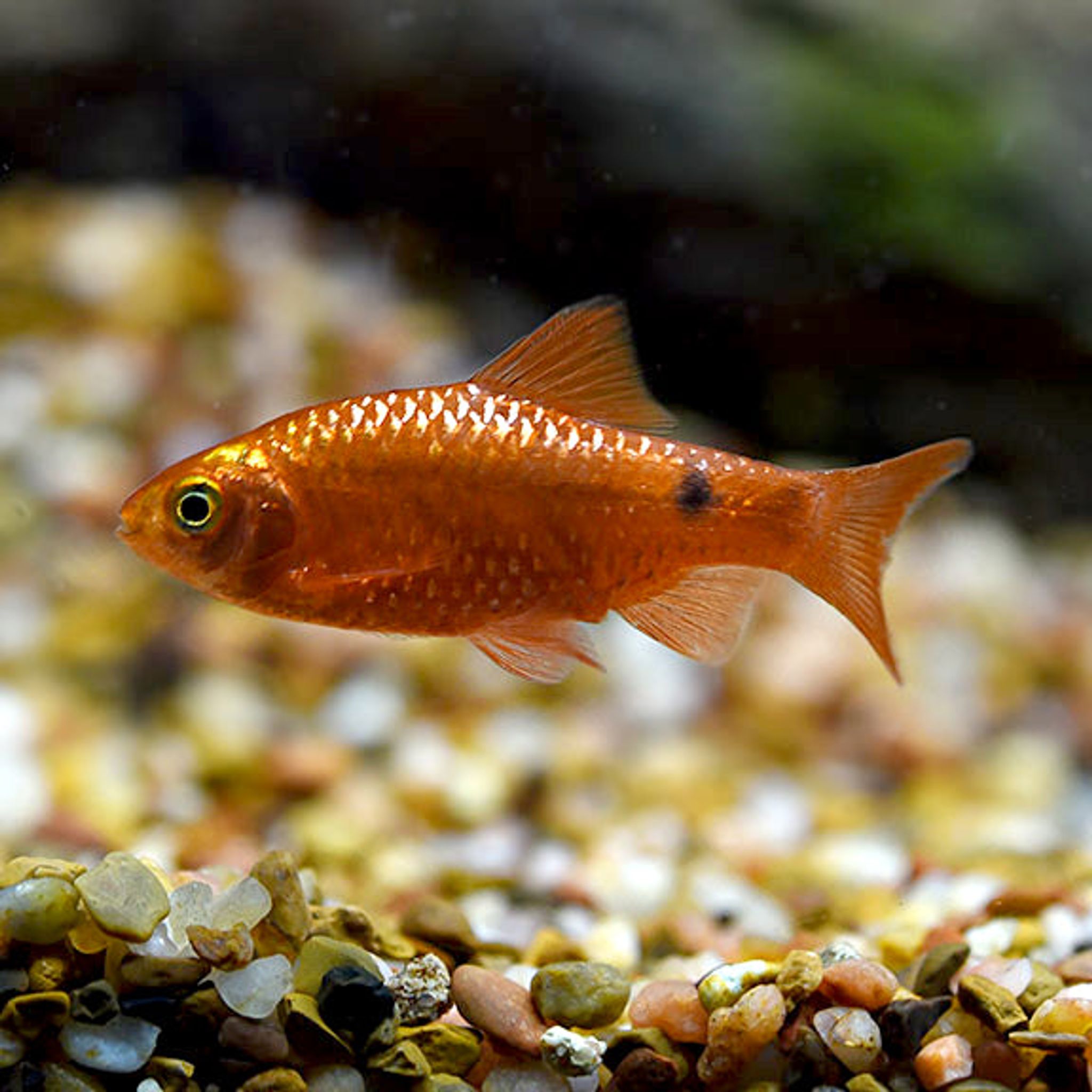

How Big Do Rosy Barb Get? Growth Rate, Adult Size and Tank Planning
A rosy barb bought as a 1-inch juvenile will typically reach 4 to 5 inches (10–13 cm) as an adult, with well-cared-for or wild-type individuals occasionally topping out near 6 inches (15 cm). Most of that growth happens in the first year, which means the small starter tank that suits them at the pet store will not suit them for long. This guide breaks down the real growth curve, what pushes a fish toward the larger or smaller end, and exactly how to size a tank for a full-grown shoal.
Adult Size: Why You'll See Different Numbers
Rosy barbs (Pethia conchonius) are one of the larger commonly sold barb species, and the size range you'll encounter in different care sheets isn't really a contradiction — it reflects two different populations of fish.
- Store-bought, tank-raised strains — including the popular long-fin variety — tend to max out around 4 inches. Generations of captive breeding for the aquarium trade have trended toward a slightly more compact adult size.
- Wild-caught or pond-raised fish, and long-lived specimens kept in spacious, well-maintained tanks, more commonly reach the 5 to 6 inch ceiling.
Genetics, water quality, and diet all factor in, so treat 4–6 inches as the honest full range rather than picking a single number. When you're planning a tank, size for the top of that range, not the average.
Body Shape and Male vs. Female Size
Rosy barbs have an elongated, torpedo-shaped body that's noticeably deeper than a slim tetra's. Females run a bit rounder and plumper through the belly, especially when carrying eggs, and are often very slightly larger-bodied than males — but the difference in overall length between the sexes is minor. The real distinction is color, not size: mature males flush rosy-red to pink (most intense in breeding condition), while females stay gold or silver.
How Fast Do Rosy Barbs Grow?
Rosy barbs are among the faster-growing barbs in the hobby. No source tracks an exact month-by-month curve, so the timeline below is a reasonable estimate built from typical growth milestones — treat it as a planning guide, not a guarantee.
| Age (approx.) | Length | Milestone |
|---|---|---|
| At purchase | ~1 in (2.5 cm) | Juvenile, sold in groups |
| 3–4 months | ~2.5 in (6 cm) | Sexual maturity reached — not full size |
| 6–8 months | ~4 in (10 cm) | Most of the adult body length is in place |
| 10–14 months | 4–6 in (10–15 cm) | Full adult length; growth slows sharply after this |
The most common mistake in that timeline is stopping at the 3-to-4-month mark. Once a rosy barb reaches roughly 2.5 inches, it becomes sexually mature and may start showing breeding color and behavior — but maturity is not the same as being fully grown. Expect another 6 to 10 months of continued filling-out after breeding behavior starts.
What Speeds Up or Slows Down Growth
Beyond genetics, several everyday care factors noticeably change how large — and how quickly — a rosy barb grows:
- Tank size and stocking density: Cramped quarters measurably suppress growth in many cyprinids, rosy barbs included. It isn't just stress — fish in overstocked tanks receive hormonal and chemical cues (partly from their own waste and pheromone-like compounds) that signal "the group has reached carrying capacity," and growth slows as a result. A stunted fish also tends to have a shortened lifespan.
- Water quality: Frequent water changes and stable ammonia/nitrite levels support steady development; fouled water does the opposite.
- Diet variety and protein: A single dry food fed indefinitely produces slower growth and duller color than a varied, protein-rich diet.
- Temperature: Growth runs faster in the upper-middle part of their comfortable range, roughly 72–79°F, than at the cool end of their tolerance.
- Genetics and strain: Long-fin and other selectively bred strains can differ slightly in adult size and finnage from the classic short-fin wild type.
Water Parameters That Support Full, Healthy Growth
| Parameter | Tolerable range | Best for growth and color |
|---|---|---|
| Temperature | 64–79°F (18–26°C) | 72–75°F (22–24°C) |
| pH | 6.0–8.0 | 6.5–7.5 |
| General hardness | Soft to moderately hard | Moderate |
Rosy barbs are unusually cold-tolerant for a "tropical" community fish — they can handle brief dips into the low 60s°F without issue, which is a genuine advantage for anyone running a cooler or occasionally unheated room. That said, treating the cool end of the range as a permanent substitute for a heater isn't ideal: fish kept consistently cool tend to grow more slowly and show less vivid color than those held in the mid-70s.
Tank Size: Planning for the Adult, Not the Juvenile
The single most common mistake with rosy barbs is buying an inch-long juvenile, dropping it into a small tank or bowl, and only realizing months later that a full-grown shoal of active 4-to-6-inch fish needs real swimming room.
Minimum for a small shoal (5–6 fish): 20 gallons (76 L). This is a genuine floor, not a comfortable long-term target. 30 gallons (114 L) is the size most care guides converge on as the better starting point, since it gives the shoal room to establish a natural hierarchy without constant fin-nipping.
From there, scale up:
- Base shoal of 5–6: 20–30 gallons
- Rule of thumb: add roughly 5 gallons per additional fish beyond the base group
- Full-grown school of 8–12: 40–55 gallons
- Larger community built around rosy barbs: 55–75+ gallons
Because rosy barbs are strong, active mid-to-top swimmers, prioritize a long, horizontally oriented tank over a tall one — horizontal swimming space matters more to this species than water depth.
A Practical Upgrade Timeline
If you're raising juveniles in a smaller 10-gallon quarantine or grow-out tank, plan the move to their permanent 20–30+ gallon home by the time they hit roughly 3–4 inches (around the 6-to-8-month mark) — well before they reach full adult size, not after.
You can browse an appropriately sized setup in FishyHub's glass tanks selection when it's time to plan that upgrade.
Shoaling: Why Group Size Affects Growth Too
Rosy barbs should be kept in groups of at least 5 to 6. Smaller groups don't just look sparse — they increase fin-nipping among the barbs themselves and toward tankmates, and the resulting stress can slow growth and contribute to health problems. A properly sized shoal spreads out social behavior instead of concentrating it on one or two individuals.
Feeding for Steady Growth
Rosy barbs are omnivores, and a varied diet supports both size and color:
- Staple: a quality flake or pellet food
- Protein boost: live or frozen bloodworms, brine shrimp, and small crustaceans or insects
- Plant matter: occasional blanched peas or zucchini
Feed small portions once or twice daily, offering only what the group eats within about two minutes. Overfeeding fouls the water and undercuts the water-quality side of healthy growth just as much as underfeeding stunts it.
Tank Mates
Rosy barbs do best with other robust, similarly sized, non-long-finned fish that can keep pace and hold their own — other barbs, danios, larger tetras, mollies, swordtails, gouramis, and rope fish are common pairings. Avoid slow-moving or heavily finned species like fancy bettas, fancy guppies, and angelfish; rosy barbs have a known fin-nipping tendency that gets worse in an understocked or underfed shoal.
Are Rosy Barbs a Good Starter Fish — Including for Kids?
This is where a lot of buyers get the tank-size math wrong. Popular "first fish" recommendations for a family or kid's tank — bettas, goldfish, guppies, platies, mollies, and neon tetras — are chosen for hardiness and low daily maintenance, and several can technically live in smaller setups.
But "easy" doesn't always mean "small-tank-friendly." A single betta can live in a modest tank, but bettas are more finicky about water quality than their reputation suggests and can be aggressive toward tankmates. Goldfish are hardy but produce heavy waste and need serious filtration to avoid stunting. Fish care in general is a good fit for kids — no walks, no grooming, just a few minutes of daily feeding — but the specific fish matters more than the general pitch.
Rosy barbs fit well as a step-up fish: once a family has outgrown a starter betta or a goldfish bowl and is ready for a proper 20–30 gallon setup, rosy barbs offer an active, colorful, genuinely hardy shoal that tolerates temperature swings better than most tropicals. They aren't the smallest possible first fish, but they're a forgiving choice for a bigger beginner tank.
Choosing the Right Starter Tank
Bigger is actually easier for beginners, kids included. A 10–20 gallon tank is more chemically stable than a small bowl or nano tank — swings in temperature, pH, and ammonia happen faster in less water. A complete starter kit sized to the fish you actually plan to keep is worth the upfront size over a tiny impulse-buy tank. Just as important: cycle the tank before buying fish, rather than bringing livestock home the same day as the aquarium.
For the actual shoal, FishyHub stocks rosy barbs and other barb species, along with kid-friendly starter options like bettas if you're building up from a smaller first tank.
Common Growth Mistakes to Avoid
- Buying juveniles for a small tank or bowl without planning for 4–6 inch adults and a shoal of 5 or more — this almost always forces an early upgrade or produces stunted, stressed fish.
- Keeping too few fish, which raises fin-nipping and stress-related health issues.
- Feeding one food type only, which slows growth and dulls adult color.
- Overcrowding relative to tank size, which stunts growth and spikes ammonia and nitrite — compounding the problem further.
- Mixing with long-finned or very slow tankmates, which get nipped regardless of how well-fed the barbs are.
- Assuming maturity means fully grown — a 2.5-inch fish showing breeding behavior still has months of growth ahead.
- Relying on cool water permanently instead of using a heater — fine for a brief drop, not ideal as a long-term substitute for stable mid-70s water.
Frequently Asked Questions
How big do rosy barbs get in a home aquarium?
Typically 4 to 5 inches, with well-cared-for or wild-type fish occasionally reaching 6 inches. Store-bought, tank-raised strains most often settle near the smaller end of that range.
How fast do rosy barbs grow?
Fast for a barb species — they reach near-full size within about 6 to 12 months under good conditions, then growth tapers off sharply after the first year.
What size tank do rosy barbs need once fully grown?
20 gallons is the minimum for a small shoal of 5 to 6, but 30 gallons is the more comfortable recommended starting point. Add roughly 5 gallons per additional fish beyond that base group.
Do male and female rosy barbs grow to different sizes?
Not by much. Females tend to be slightly rounder and plumper-bodied, and can be marginally larger, but the sexes are mainly told apart by color rather than length.
Can rosy barbs live in a cold or unheated tank?
They tolerate a wider range (64–79°F) than most tropical fish and can handle brief dips into the low 60s. For best long-term growth and color, though, a stable temperature in the low-to-mid 70s is preferable to relying on the cool end of their tolerance.
Are rosy barbs good for a kids' first aquarium?
They're hardy, active, and tolerant of a temperature swing, making them a solid family choice — but they need a 20–30+ gallon shoal tank, unlike single-fish beginner options like a betta. They work best as a step-up fish once a family is ready to move beyond a small starter tank.
Why did my rosy barb stop growing or stay small?
Usually an undersized tank, poor diet, overcrowding, or ongoing water quality issues. Occasionally it comes down to individual or strain variation, especially in tank-raised long-fin lines.
How long do rosy barbs live?
About 4 to 6 years with good care, with roughly 5 years being a solid average — a lifespan worth factoring in when planning a permanent tank, since you're committing to years of care at full adult size.
Ready to plan your shoal? Browse rosy barbs and other hardy community fish in FishyHub's barb category and pair them with a properly sized setup from the tanks and stands collection.


