
How Big Do Rope Fish Get? Growth Rate, Adult Size and Tank Planning
A rope fish sold at 3-5 inches will most likely settle somewhere between 15-20 inches (38-50 cm) as an adult, with most captive fish landing around 15-18 inches. Growth is fast and front-loaded, so the tank you buy for a "small eel-like fish" today needs to be sized for a 1.5-foot animal within a year or two, not for what's in the bag.
What a Rope Fish Actually Is
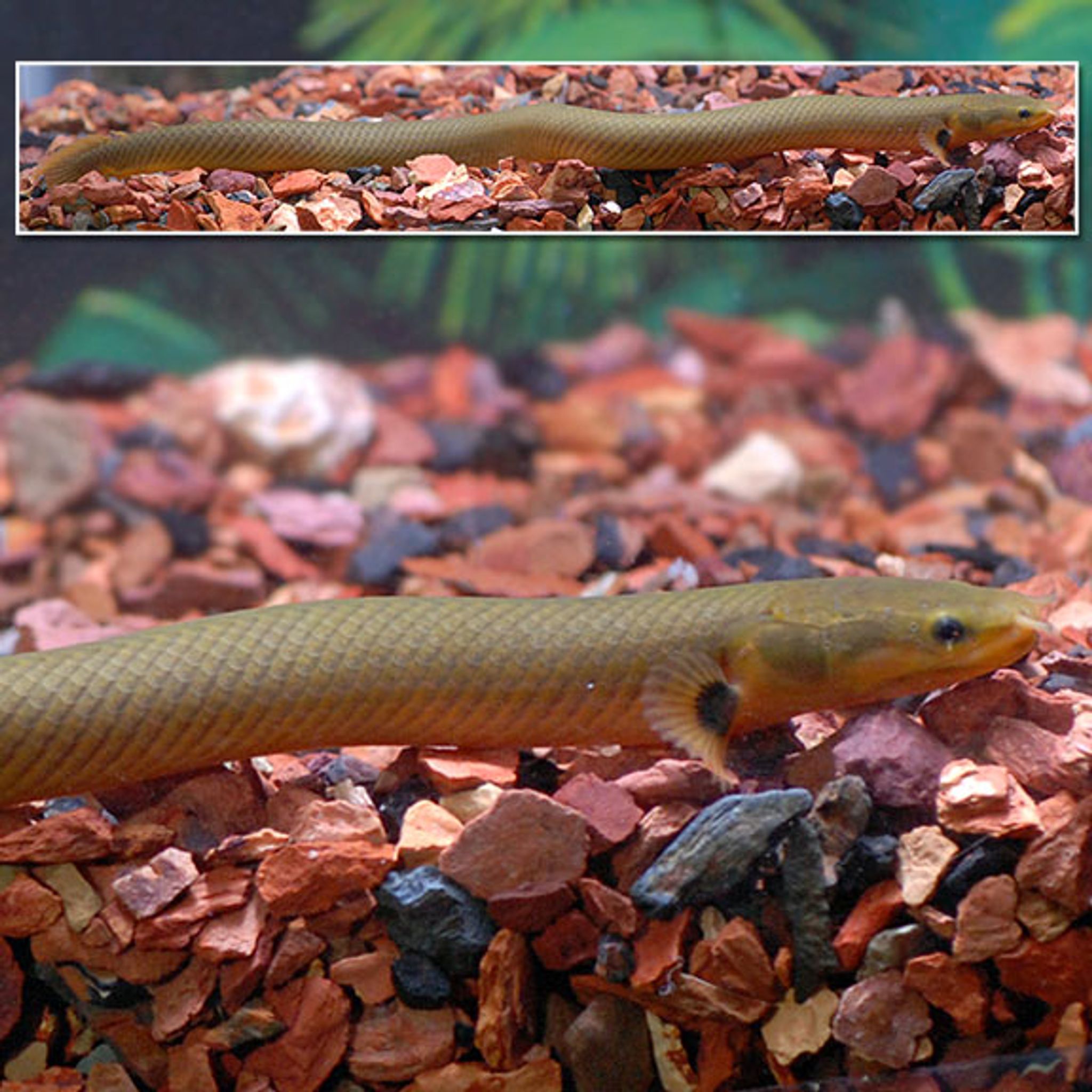
Rope fish (Erpetoichthys calabaricus) go by several common names — reedfish, snakefish — that all describe the same species. Despite the eel-and-snake nicknames, they are neither. They're a bichir relative, part of an ancient group of African freshwater fish with a body plan that hasn't changed much in millions of years.
Key identifying features and traits:
- Elongated, cylindrical body with tiny pectoral fins set close to the head, giving the rope-like appearance.
- Air-breather: a modified swim bladder functions as a lung, letting them gulp air at the surface and survive short periods out of water.
- Nocturnal and ambush-oriented: they look sluggish during the day but hunt actively after dark.
- Native to slow-moving rivers, swamps, and floodplains in West and Central Africa.
Because "ropefish" gets confused with true eels and spiny eels in search results, it's worth being clear: this article is about the bichir relative, not an anguillid eel or a mastacembelid spiny eel — those have different biology, sizes, and care needs entirely.
How Big Do Rope Fish Get as Adults?
The realistic aquarium planning range is 15-20 inches (38-50 cm), with most captive adults settling around 15-18 inches. A well-fed fish in a spacious, stable setup can approach the 20-inch mark, but that's the upper edge, not the expectation.
You'll also see the old claim that rope fish reach "up to 3 feet" in the wild. Treat that as an unverified outlier rather than a planning number. Large-scale field surveys of wild rope fish found essentially none exceeding about 16.3 inches (41.4 cm) — very close to the upper end of what hobbyists see in captivity. The 3-foot figure appears to be a long-repeated myth rather than something backed by consistent measurement. Plan around 15-20 inches; don't undersize a tank expecting a smaller fish, and don't feel obligated to build for a 3-foot animal that almost certainly won't materialize.
They also get longer, not noticeably thicker, as they age. A mature rope fish still has a fairly slender, pencil-like girth — the size increase is almost entirely in length.
Growth Rate: How Fast Do Rope Fish Grow?
Growth is fast in the first year and slows considerably after that. Most of a rope fish's total adult length is added in year one.
| Stage | Approximate length | Notes |
|---|---|---|
| At purchase (store size) | 3-5 in (7.5-13 cm) | Common juvenile sizing |
| 6 months | 8-12 in (20-30 cm) | Rapid early growth phase |
| 1 year | 12-18 in (30-46 cm) | Bulk of adult length reached |
| 2+ years | 15-20 in (38-50 cm) | Growth slows, fish fills out toward final size |
Full maturity is typically reached around 2-3+ years, though some individuals continue very slow lengthening beyond that point. Because the early growth curve is so steep, a fish that looked appropriately sized for a 20-gallon tank at purchase can outgrow it within months — this is the single biggest planning mistake buyers make.
Sexing and Aging by Size
Rope fish are notoriously hard to sex visually, and there's no reliable external marker most hobbyists can use. Once a fish reaches its adult length, size alone stops telling you much about age or sex — a fish could be 3 years old or 8 years old and look about the same. Don't use length as a proxy for either.
Tank Size by Number of Rope Fish
Minimum tank size figures in various sources range from 45-55 gallons for a single adult. The safer number to plan around is 55 gallons with a long, shallow footprint; 45 gallons shows up in some care sheets as a bare-bones minimum, but it doesn't leave much margin for bioload or behavior.
Footprint matters more than height. Rope fish crawl and prowl along the substrate rather than swimming through open water, so a long, shallow tank beats a tall, narrow one of the same volume every time. When comparing two tanks with similar gallonage, pick the one with more floor space.
| Fish count | Recommended tank size | Suggested footprint (L x W) |
|---|---|---|
| 1 adult | 55 gal minimum (45 gal bare minimum) | 48 x 13 in or longer |
| 2 (pair) | 65-75 gal | 60 x 18 in or longer |
| 3 (trio) | 75-90 gal | 72 x 18 in or longer |
Bigger than the minimum is explicitly better here — extra floor space reduces stress, competition for hiding spots, and the odds of one fish cornering another. If you're shopping for a tank sized for an adult rope fish, browsing glass tanks with a long footprint in mind is a good starting point, since standard "tall" tank shapes work against this species.
Signs the Tank Has Been Outgrown
Watch for these behavioral and water-quality red flags as a rope fish grows:
- Repeatedly probing the lid or pushing against the edges of the tank, looking for a way out.
- Restricted swimming or curling — a body too long for the available space starts coiling instead of stretching out.
- Stress coloration, such as duller or blotchy patterning compared to normal.
- Water quality crashing faster than expected given the apparent bioload — a strong early sign the tank is undersized for the fish's actual mass.
Housing Essentials
Beyond raw gallons, a few setup details matter more for rope fish than for typical community fish:
- Substrate: sandy or soft substrate protects their underside as they crawl along the bottom.
- Hiding spots: driftwood, rockwork, caves, and dense or floating plants give them cover to retreat to during the day.
- Flow: moderate — they don't need strong current and can be pushed around by it.
- Lid: a tight-fitting lid with every gap, pipe opening, and cord cutout sealed is mandatory, not optional.
Why the Lid Is Non-Negotiable
Rope fish are strong, flexible, and persistent escape artists. Their slow daytime movement is misleading — don't assume sluggishness means low escape risk; they can push through surprisingly small gaps and squeeze through openings that look too tight to matter. Because they're air-breathers, they can survive out of water for a while, which means a fish that escapes overnight may not be found until it's too late. Loose or gapped lids are widely reported as the single biggest cause of preventable rope fish deaths — check every seam, filter cutout, and cord hole.
Water Parameters
| Parameter | Range |
|---|---|
| Temperature | 72-82°F (22-28°C) |
| pH | 6.0-7.8 |
| General hardness | 5-22 dKH |
| Ammonia / nitrite | 0 ppm |
| Nitrate | Under ~40 ppm |
Stability matters more than hitting an exact number. Rope fish are sensitive to sudden swings even when the new reading is still technically "in range," so gradual water changes and consistent maintenance beat chasing a perfect parameter.
Bioload: Longer Fish, Bigger Waste Output
A single adult rope fish can produce waste closer to what you'd expect from a noticeably larger-bodied fish, simply because of its length. Gallon-per-inch rules of thumb built around typical community fish underestimate this. As the fish grows through its first year, test water more frequently than you would for a same-gallon tank of small community species, and be prepared to step up filtration and water-change frequency ahead of, not after, a bioload problem shows up.
Diet and Feeding
Rope fish are carnivores. A varied diet of meaty foods works best:
- Bloodworms
- Chopped shrimp or fish
- Earthworms or nightcrawlers
- Other meaty frozen foods
- Pellets, as an occasional supplement rather than a staple
Feed adults once daily in the evening or after lights-out, since they're nocturnal and feed more naturally once activity in the tank settles down. Juveniles can be fed twice a day to support their rapid early growth.
Tank Mates
Rope fish do best with peaceful to moderately robust fish that are simply too large to be swallowed. Reasonable options include:
- Larger gouramis
- Rainbow sharks or bala sharks
- Pictus catfish
- Larger barbs or loaches
- Angelfish
Avoid two categories of tank mate. First, small fish, shrimp, and snails — rope fish look slow but are ambush predators, and small tankmates have a habit of quietly disappearing rather than being visibly chased down. Second, aggressive or territorial species like African cichlids, Oscars, Jack Dempsey, and other large aggressive cichlids, which can injure a rope fish that isn't built to defend itself quickly. If you're stocking a tank around a rope fish, it's worth checking a category like other tropical fishes for size-appropriate, even-tempered options.
Lifespan: A Long-Term Commitment
Reported lifespans range from 10-20 years across different sources. 10-15 years is the typical range with reasonable care, and up to 20 years is achievable with excellent, consistent husbandry. Either way, this is a decade-plus commitment tied to a tank that needs to stay at 55+ gallons for its entire life — worth weighing before buying on impulse.
Breeding
Successful breeding in home aquariums is rare. Rope fish are egg layers that need specific environmental triggers — such as a temperature increase paired with dense plant cover — to spawn at all. Even when spawning happens, eggs and fry need to be separated from adults because of cannibalism risk. For nearly all hobbyists, breeding isn't a realistic goal and shouldn't factor into a purchase decision.
Is a Rope Fish Right for You?
Before buying, it helps to be honest about three things:
- Can you commit 10-15+ years of ongoing care?
- Do you have space and budget for a 55+ gallon, long-footprint tank — not eventually, but within the first year?
- Are you prepared for a strict, gapless lid and regular water testing as the fish's bioload increases?
If the answer to all three is yes, a rope fish is a manageable and genuinely interesting long-term species. If any answer is no, it's worth choosing a smaller species now and revisiting rope fish once the setup is in place. Species in a category like bichirs and related fish are worth browsing to compare adult sizes side by side before committing.
Frequently Asked Questions
How big does a rope fish get in a home aquarium?
Most captive adults reach 15-20 inches (38-50 cm), with the majority settling around 15-18 inches. The often-repeated "3 feet" figure is a largely debunked outlier and not a realistic planning number.
How fast do rope fish grow?
Growth is fast in year one, with a 3-inch juvenile potentially reaching 12-18 inches within about a year under good conditions. Growth then slows considerably over the following 1-2 years as the fish fills out toward its final adult length.
What size tank does one rope fish need?
A 55-gallon tank is the safer minimum, though some sources cite 45 gallons as a bare-bones figure. A long, shallow footprint (roughly 48 inches or more in length) matters more than raw height, since rope fish spend most of their time along the substrate.
Can you keep multiple rope fish together?
Yes. A pair does well in 65-75 gallons and a trio in 75-90 gallons, provided there are enough hiding spots to reduce competition between individuals. Bigger than these minimums is always preferable.
Do rope fish need a lid?
Yes, and it needs to be tight and gap-free, with every pipe opening and cord cutout sealed. As air-breathers, rope fish are strong, persistent escape artists that can survive out of water for a while, making loose lids the leading cause of preventable deaths in this species.
How long do rope fish live?
Typically 10-15 years, with up to 20 years achievable given excellent, stable care. This long lifespan is a key reason to plan the tank size around the adult fish from day one rather than the juvenile in front of you.
What can rope fish live with?
Larger peaceful-to-moderately-robust fish too big to be swallowed, such as larger gouramis, bala or rainbow sharks, pictus catfish, larger barbs or loaches, and angelfish. Avoid small fish, shrimp, and snails, as well as aggressive species like African cichlids and Oscars.
Do rope fish get bigger than an eel or true snake?
No — a rope fish is neither an eel nor a snake. It's a primitive bichir relative that only resembles those animals in body shape, and its 15-20 inch adult size is modest compared to many true eel species.
Ready to plan a rope fish setup properly? Start with the tank itself — browse glass tanks sized for an adult's long, low footprint before bringing home the fish.


