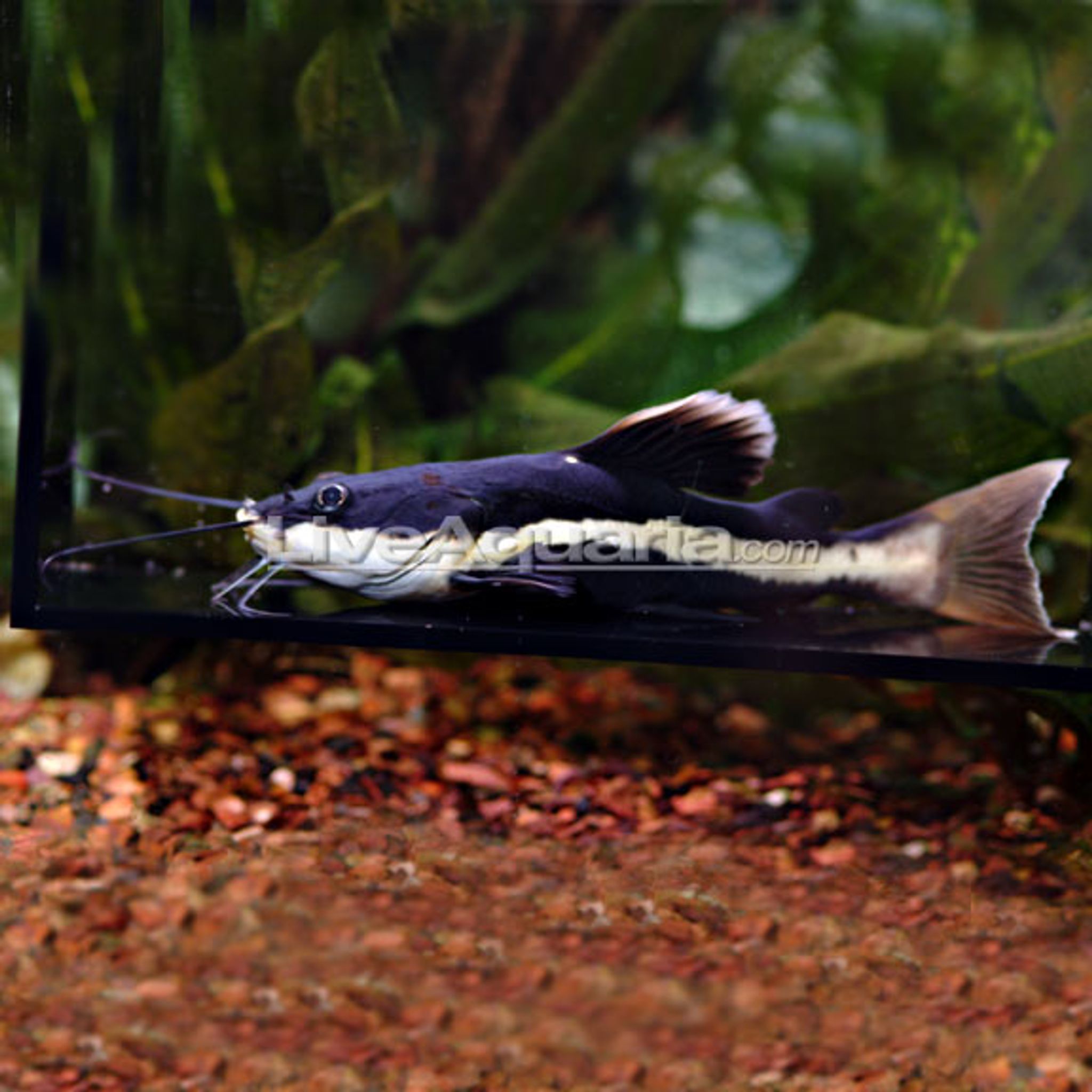

How Big Do Redtail Catfish Get? Growth Rate, Adult Size and Tank Planning
A redtail catfish (Phractocephalus hemioliopterus) sold as a 3-4 inch juvenile can reach 3-4 feet long and 20-80+ pounds as an adult, with a lifespan of 15-20 years. Growth is fastest in the first year, and most keepers who buy one small have no idea how large a system it will eventually require. This guide breaks down the growth timeline, realistic adult size, and the gallon-by-stage tank ladder you need before bringing one home.
What Is a Redtail Catfish?
The redtail catfish belongs to the family Pimelodidae and is native to the Amazon and Orinoco river basins in South America. It's a wide-bodied, bottom-dwelling predator recognizable by its mottled brown-and-cream body and reddish-orange tail. Stores typically sell them as 2-4 inch juveniles, often in the general "oddball" or catfish section, with little indication of how large the species actually gets.
This is one of the most commonly impulse-bought fish in the hobby, and also one of the most commonly regretted. Understanding its trajectory before purchase — not after — is the entire point of this article.
How Big Do Redtail Catfish Get?
Adult length commonly falls in the 3-4 foot (36-48 in / 91-122 cm) range in captivity. Wild specimens, with unlimited space and food, can reach 4-5+ feet, and there are outlier reports of fish approaching 5-6 feet. Treat 3-4 feet as the realistic captive median and anything beyond that as an exceptional case tied to pond-scale or public-aquarium conditions.
Adult weight in home aquaria and ponds typically lands somewhere between 20 and 80+ pounds, depending on diet and system size. Wild adults, which forage across an entire river system, can approach 150-180 pounds — a weight essentially unreachable in home care but useful context for how large this species is capable of getting.
The gap between captive and wild size is normal for this species and doesn't mean captive fish are "stunted" in a healthy way — it reflects a smaller, more limited environment producing a smaller (but still enormous) fish.
Growth Rate: How Fast Do They Get There?
Redtail catfish growth is fast and heavily front-loaded:
- Months 1-12: Roughly 1-3 inches of growth per month is typical, with some individuals adding close to an inch a week during peak growth phases on a rich diet. Most reach approximately 12-18 inches by their first birthday.
- Years 2-4: Growth continues at a slower but still substantial pace — averaging out to roughly a foot or more per year — as the fish works toward adult length.
- Beyond year 4: Growth slows further but doesn't fully stop; fish can continue adding length slowly for additional years before settling near their adult ceiling.
You'll sometimes see growth described as "1 inch per week," "1-3 inches per month," or "a foot a year." These aren't contradictory — they describe different windows of the same curve. Early months can spike faster than the yearly average implies, then the pace evens out as the fish matures.
Do small tanks stunt growth and keep the fish smaller? Not reliably, and you should never rely on this. A cramped tank doesn't safely cap adult size — it more often causes spinal curvature, organ compression, fin and barbel damage from rubbing against glass, and chronic stress that shortens lifespan. A redtail catfish crammed into an undersized tank is not a smaller, healthier version of the species; it's a larger fish in physical distress.
Tank Size Planning by Life Stage
Because growth is so fast and so extreme, planning in stages is far more useful than a single "adult tank size" number. Every stage below except the last is temporary — treat any tank smaller than the adult range as a waypoint, not a destination.
| Life stage | Approximate length | Tank size needed | Duration at this size |
|---|---|---|---|
| Fry / small juvenile | Under 6 in (15 cm) | 20-40 gal (76-151 L) | Weeks only |
| Juvenile | 6-12 in (15-30 cm) | 75-125 gal (284-473 L) | Months, not years |
| Sub-adult | 12-24 in (30-61 cm) | 250-450 gal (946-1,703 L) minimum | Roughly a year or two |
| Approaching/at adult size | 2.5-4+ ft (76-122+ cm) | 1,000 gal absolute floor; 1,500-2,000+ gal or a pond recommended | Lifelong (15-20+ years) |
A few notes on that last row: 1,000 gallons appears in some sources as a workable minimum, but it's a bare, not-recommended floor — adequate for short-term survival, not genuine long-term welfare. Most experienced keepers put the real target at 1,500-2,000+ gallons, or better yet, an indoor or outdoor pond.
Also remember that footprint matters as much as volume. These are wide-bodied bottom fish that need floor space to turn around in, not just water depth. A tall, narrow tank with the "right" gallon number on paper can still be a poor fit if the floor plan is too cramped.
If you're browsing options for any interim stage, you can view large-format tanks in FishyHub's Tanks & Stands category, keeping in mind that even the largest off-the-shelf tanks are only a bridge to eventual pond-scale housing.
Water Parameters
Redtail catfish are fairly adaptable but do best within these ranges:
- Temperature: 68-82°F (20-28°C), with most keepers targeting 75-80°F (24-27°C)
- pH: 6.0-7.5 (slightly acidic to neutral)
- General hardness: roughly 2-20 dGH, with carbonate hardness tolerance around 5-20 dKH
Because this is a large, heavy-bodied predator producing a correspondingly heavy bioload, strong filtration and large weekly water changes aren't optional extras — they're baseline requirements from the juvenile stage onward.
Diet and Feeding
Redtail catfish are omnivorous but predominantly carnivorous, and their appetite scales dramatically with size.
As juveniles, feed:
- Sinking pellets
- Frozen or live worms
- Chopped shrimp or fish
Daily or every-other-day feeding is appropriate at this stage, matching their fast early growth.
As adults, feed:
- Whole fish such as tilapia fillet (avoid feeder goldfish as a long-term staple)
- Shrimp
- High-quality large sinking pellets
Adult feeding frequency should drop to roughly 2-3 times per week, tapering toward about once weekly for the largest specimens. This isn't about withholding food — overfeeding a full-grown carnivore leads to obesity, fatty liver problems, and rapid water fouling. In the wild, redtail catfish are also known to take fruit and seeds opportunistically, though this is a minor part of their diet compared to animal protein.
Why Feeding Time Matters
Redtail catfish are primarily nocturnal or crepuscular feeders. Offering food in low light or shortly after lights-out generally improves acceptance and reduces stress, especially in a tank with other fish present that might otherwise out-compete a daytime-shy catfish for food. A redtail that seems to be refusing food at midday may simply be waiting for dark.
Barbels: More Than Decoration
The whisker-like barbels around a redtail catfish's mouth are chemosensory organs used for taste and smell, not just texture or ornamentation. They let the fish detect food by "feeling" along the substrate in low light or murky water, which is exactly how it hunts in its natural nocturnal window. This is also why substrate choice matters: rough gravel can abrade and damage sensitive barbels over time, while sand or a smooth bare bottom protects them.
Behavior and Tank Mates
Adult redtail catfish are solitary, territorial bottom-dwellers. As a rule of thumb, anything roughly one-third to one-half of the catfish's own body length is at risk of being eaten — and this applies even to fish that look "too big" to a casual observer. They are not reef-safe, not community-safe, and juveniles will already start eating tankmates they can swallow, well before they look intimidating.
In systems large enough to support it, redtail catfish can be housed with other large, robust species of similar size — big cichlids, pacu, arowana, or large plecos — but only in very large setups where the catfish isn't competing for limited floor space or food. If you're building out a large-fish community, FishyHub's Monster Fishes category and the dedicated catfish listings are worth reviewing for compatible large-bodied species.
Handling Precautions
Redtail catfish carry stiff, sharp pectoral and dorsal spines that can puncture skin or tangle in nets. Any handling during tank maintenance, water changes, or moves should be done with a firm, well-supported grip and awareness of where those spines are — a startled adult fish thrashing against bare hands or a flimsy net is a genuine injury risk to the keeper, not just an inconvenience.
General Catfish-Keeping Best Practices
A few habits make life easier and safer for both fish and keeper across the whole redtail-keeping timeline:
- Use sponge or pre-filter intakes on pumps and filter inlets to prevent the catfish from injuring itself or clogging equipment.
- Choose sand or a smooth bare bottom rather than coarse gravel, to protect barbels and the fish's belly from abrasion.
- Secure lids and covers. Large catfish can splash forcefully and, in some cases, jump — an open-top setup risks both mess and escape.
- Size filtration for a heavy waste producer from day one, combining strong mechanical and biological stages rather than relying on undersized hang-on units meant for smaller community tanks.
For filtration sized to a heavy bioload as your fish grows, FishyHub's Filters category covers options from juvenile to sub-adult stages.
Sexing and Breeding
Sexually mature redtail catfish are difficult to distinguish externally, and there's no reliable external sexing method commonly used in the hobby. Breeding essentially doesn't happen in typical home aquarium settings — the size, space, and hormonal triggers required aren't achievable in a residential tank. Nearly all redtail catfish available to hobbyists are either wild-caught or produced in large commercial aquaculture facilities, not home-bred.
Common Mistakes to Avoid
- Buying a 3-inch "cute" juvenile without researching adult size. This is by far the most common source of later regret.
- Underestimating bioload. Ammonia and nitrite spikes from overfeeding or undersized filtration are a real risk from the juvenile stage onward, not just once the fish is large.
- Assuming "it's just a baby" is safe for small tankmates. Juveniles are already capable of eating fish they can fit in their mouths.
- Keeping the fish in a permanently undersized tank, risking spinal curvature, stunted or deformed growth, and fin/barbel damage from repeated contact with glass.
- Handling or netting without care around the spines, risking injury to the keeper.
- Overfeeding a rich carnivore diet as an adult, leading to obesity, fatty liver disease, and fouled water.
- Not planning an exit strategy. Few local stores or public aquariums reliably accept large adult redtail catfish, and rehoming gets dramatically harder once the fish has outgrown its tank.
- Only trying to feed during the day. Since these are nocturnal feeders, midday-only feeding attempts often lead to poor food acceptance and the mistaken impression that the fish is sick.
Before You Buy: A Decision Checklist
This isn't a beginner or "starter" catfish, despite frequently being sold as one. Before purchasing, be honest about:
- Space: Do you have — or can you realistically build — a location for a 1,500+ gallon system or pond within a few years?
- Budget: Large-format tanks, structural floor support, industrial-grade filtration, and heating/cooling for that volume add up well beyond a standard aquarium setup.
- Filtration capacity: Can your system handle the bioload of a many-pound predator eating whole fish, not just a juvenile on pellets?
- Time commitment: This is a 15-20 year commitment, not a multi-year project.
- Exit plan: If circumstances change, do you have any realistic rehoming option lined up — a public aquarium, a large-fish rescue, or an aquatic society contact — before you need one?
- Local regulations: Some US states and municipalities restrict or require permits for large predatory catfish species. Check local exotic/large-fish ownership rules before buying, since this varies by location and can change.
If you can't answer most of these confidently, a redtail catfish is not the right fish yet, regardless of how manageable the juvenile looks in the store tank.
Frequently Asked Questions
How fast do redtail catfish grow?
Growth is fastest in the first year, typically 1-3 inches per month, reaching roughly 12-18 inches by 12 months old. After that, growth continues at a slower but still substantial pace — averaging around a foot or more per year — for several more years until the fish approaches adult length.
What is the maximum size of a redtail catfish?
Captive adults typically reach 3-4 feet, with wild or exceptional pond-raised specimens reaching 4-6 feet. Weight can reach several tens of pounds in home systems and far more — up to 150-180 pounds — in the wild.
What size tank does an adult redtail catfish need?
Realistically, 1,500-2,000+ gallons or an indoor/outdoor pond. A 1,000-gallon system is sometimes cited as a bare minimum, but it isn't recommended for genuine long-term welfare. Standard home aquariums are never adequate for an adult of this species.
Can a redtail catfish be kept in a 100- or 200-gallon tank?
Only temporarily, while the fish is still a juvenile. It will outgrow a tank that size within months to a couple of years, so you need a plan — and the resources — for a much larger system or pond in place before you buy.
Do small tanks stunt a redtail catfish's growth?
Not reliably. Undersized housing is more likely to cause spinal deformity, organ stress, and a shortened lifespan than to safely cap the fish's size. Never use a small tank as a strategy to keep this species small.
What do redtail catfish eat?
Juveniles eat sinking pellets and chopped meaty foods like shrimp or fish, fed daily or every other day. Adults shift to whole fish, shrimp, and large pellets, fed far less often — down to roughly once a week for the biggest specimens — to prevent obesity and water quality problems.
Can redtail catfish live with other fish?
Only with large, robust species in very large systems. Anything close to one-third to one-half of the catfish's body length or smaller is at risk of eventually being eaten, even if it looks too big to be a target as a juvenile.
How long do redtail catfish live?
Typically 15-20 years with proper care, sometimes longer in ideal conditions. That lifespan is itself one of the strongest reasons to plan tank size, space, and a long-term commitment before purchase, not after.
If you're weighing a redtail catfish against other bottom-dwelling species that fit more realistic home tank sizes, browse FishyHub's Plecos, Corys & Bottom Dwellers category to compare options before you commit.


