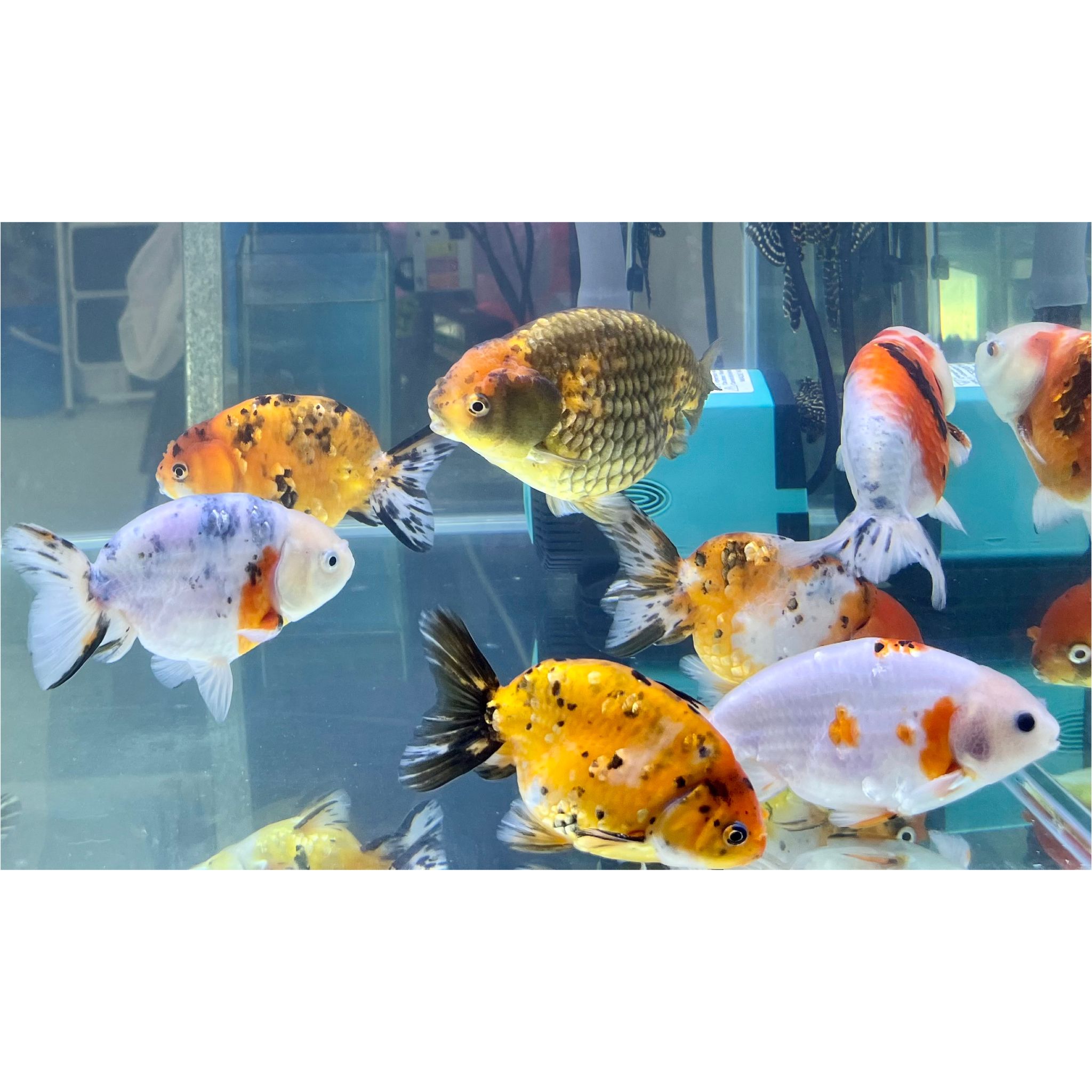

How Big Do Ranchu Goldfish Get? Growth Rate, Adult Size and Tank Planning
A ranchu goldfish kept in a home aquarium typically reaches 5–8 inches (13–20 cm) body and tail combined, with exceptional specimens in large tanks or ponds pushing past 10 inches. Growth is fast in the first year, slows dramatically after that, and how much of it your fish actually reaches depends more on tank size and water quality than on genetics alone.
Adult Size: What "Big" Actually Means for a Ranchu
Ranchu are a fancy, egg-shaped goldfish variety bred for a rounded body, an arched back with no dorsal fin, and a raspberry-like head growth called a wen. Because breeders select for body shape rather than length, ranchu simply don't get as long as slim-bodied goldfish like comets or shubunkins, even with a lifetime of ideal care.
- Typical aquarium adult: 5–8 in (13–20 cm), measured body plus tail
- Large-tank or high-quality specimen: 10–12 in is achievable with a lot of space and years of good care
- Pond-raised outlier: 14–18 in has been reported in outdoor ponds over many years, but this is the upper extreme, not something to plan around
One reason size claims online seem inconsistent is that people measure differently. Some report body length only (nose to base of tail), others report body plus tail, and some fold in wen size, which can add real bulk without adding length. When you compare a size claim to your own fish, check which measurement is being used before assuming something is wrong.
Length Isn't the Whole Story
Because the ranchu standard prizes body depth, back curve, and wen development over length, a ranchu can look and feel "fully grown" while its length has plateaued but its body mass and wen are still filling out for another year or two. A three-year-old ranchu that hasn't gained length since its second birthday isn't necessarily done growing — it may still be deepening through the body and developing wen texture. Judging a ranchu purely by inches undersells what "big" means for this breed.
Growth Rate: How Fast Do Ranchu Goldfish Grow?
Ranchu growth follows a predictable curve rather than a steady straight line:
- First 6–12 months: Rapid growth, from a fry of under an inch to several inches of body length. This is the window where tank size and feeding have the largest long-term impact.
- Year 1 onward: Growth decelerates sharply — expect roughly 1 inch of additional length per year.
- Years 3–5: Length growth is largely finished for most fish, though very slow, incremental growth can continue for years under ideal conditions, and body/wen development often continues after length stops.
This deceleration is normal, not a warning sign. A ranchu that grew fast as a juvenile and then seems to "stop" in year two is usually just following the expected curve, not showing a health problem.
What Determines Final Size
In order of impact, three factors decide how close a ranchu gets to its genetic potential:
- Tank or pond volume and water quality. This is the single biggest driver, and by a wide margin. A cramped, infrequently maintained tank doesn't just produce a smaller fish — chronically stunted goldfish can go on to develop organ and health problems, not merely stay compact.
- Diet and feeding frequency. Consistent, appropriate feeding supports steady growth; underfeeding or feeding a poor-quality diet slows it.
- Genetics and breeding line. Fish from a quality breeding line have more potential size and better body/wen conformation to grow into, but genetics only sets the ceiling — a cramped tank will keep even a great genetic line small.
The Stunting Mechanism Most People Miss
Overcrowding can stunt a ranchu even when ammonia and nitrite test at zero. Fish kept in small, infrequently changed volumes of water are believed to accumulate growth-inhibiting hormones and other chemical signals that suppress development, independent of the standard water-quality tests. This is why "my parameters are fine" isn't the same as "my tank is big enough" — volume itself, and how often that volume is refreshed, matters on its own.
Tank Size Guidance
Plan the final tank before you buy the fish, not after it outgrows a starter setup. A young ranchu can live short-term in a 10–20 gallon grow-out tank, but that housing has to be upgraded as the fish develops — waiting until it looks cramped means the fish has already been stunted.
| Setup | Tank Size | Notes |
|---|---|---|
| Juvenile grow-out (temporary) | 10–20 gal (38–76 L) | Fine short-term only; plan the upgrade in advance |
| Single adult ranchu, absolute floor | 20 gal (76 L) | Minimum for survival, not for full growth |
| Single adult ranchu, realistic minimum | 30 gal (114 L) | Supports long-term health and reasonable growth |
| Single adult ranchu, ideal | 40–55 gal (151–208 L) | Best odds of a thriving, fully-grown specimen |
| Each additional adult ranchu | +10 gal (+38 L) | Round up — goldfish bioload is heavy |
Think of these numbers as "bigger unlocks more growth and fewer health problems," rather than a single hard cutoff. If you're deciding between two tank sizes, the larger one is almost always the better call for a fish that will be with you for a decade or more.
Browsing Freshwater Livestock › Goldfish is a good starting point if you're still selecting stock, and a glass tank sized to the "ideal" row above will save you a stressful upgrade later.
Water Parameters and Filtration
Ranchu are cool-water fish, not tropical fish, and they're heavier waste producers than their slim-bodied cousins.
- Temperature: 65–75°F (18–24°C) — ranchu do best toward the cooler end; avoid running a tropical heater unnecessarily
- pH: 6.5–8.0 acceptable, with 7.0–7.5 as the sweet spot
- GH: 4–20 dGH
- Ammonia and nitrite: 0 ppm, always
- Nitrate: under 40 ppm, maintained with weekly 25–50% water changes
Because ranchu are heavy waste producers and comparatively weak, slow swimmers, filtration should be rated for 1.5–2x the actual tank volume, not just matched to it. Canister filters are commonly used for tanks of 30 gallons and up, since they provide the extra biological and mechanical capacity a rounded, sediment-stirring goldfish needs. A canister-style external filter is worth the upgrade cost on any tank in the 30-gallon-plus range.
Feeding for Healthy Growth
Ranchu have a downturned mouth and limited upward vision, which makes them slower and less efficient feeders than streamlined goldfish. Feed accordingly:
- Offer high-quality sinking or slow-sinking pellets formulated for fancy goldfish as the base diet
- Supplement with blanched vegetables (peas, zucchini) a few times a week
- Add occasional protein such as bloodworm or brine shrimp
- Feed 2–3 small meals a day, giving only what's eaten in about 2 minutes each time
Small, frequent meals suit both the ranchu's feeding style and its digestion better than one large daily feeding, and they reduce the leftover food that drives ammonia spikes. A rotation of freeze-dried foods alongside a staple pellet covers most of this without much extra effort.
Lifespan and Why It Tracks Tank Size
A well-kept ranchu typically lives 10–15 years, and up to 15–20 years in excellent conditions. Lifespan and adult size track the same underlying investment: a spacious, well-filtered, consistently maintained tank supports both a fish that reaches its genetic size potential and one that lives at the long end of that range. Skimping on tank size doesn't just produce a smaller fish — it tends to produce a shorter-lived one too.
Keeping Ranchu in an Outdoor Pond
Ranchu can live outdoors year-round in mild-to-temperate climates, but they are less cold-hardy and weaker swimmers than comets, shubunkins, or koi, so pond design needs to account for that.
Pond Location and Sizing
- Choose a spot visible from an indoor living space so you can watch for problems
- Aim for 5–6 hours of sun; more than that raises the risk of algae blooms
- Site the pond near an electrical and water hookup for pumps, filtration, and top-offs
- Depth of 18–24 in minimum for winter survival; 36+ in is better in cold climates
- Larger ponds are more stable and, counterintuitively, easier to maintain than small ones
Stocking a Ranchu Pond
Ranchu do best sharing a pond with other slow, similarly egg-shaped fancy goldfish. Avoid mixing them with fast comets, shubunkins, or koi, which will out-compete a ranchu for food. As a general goldfish pond baseline, plan on 30 gallons per adult goldfish as a floor, scaling up sharply if you add larger or faster-swimming varieties.
Aeration
An aerator does three jobs in a goldfish pond: it keeps dissolved oxygen in the healthy 6.5–8.5 mg/L range, supports the beneficial bacteria that handle biological filtration, and — in cold climates — keeps an opening in winter ice for gas exchange. Never let a pond surface freeze over completely with fish still in it.
Common Mistakes That Stunt or Sicken Ranchu
- Buying a "small" ranchu for a small tank and blaming later stunting on genetics, when tank size and water quality are almost always the real cause
- Overfeeding, the single biggest driver of ammonia spikes and sudden deaths — small, frequent meals beat one large feeding
- Skipping adequate biofiltration for a fish that produces heavy waste relative to its size
- Adding a juvenile ranchu to an uncycled, newly set-up tank, which causes ammonia poisoning (new tank syndrome) and is a leading cause of "died overnight" reports
- Ignoring temperature swings — sudden heat or cold changes stress ranchu more than steady, moderate temperatures
- Assuming a plateau in length after year one means something is wrong, when it's usually the normal growth curve; body and wen development can continue after length stalls
- Housing ranchu with fast, competitive tankmates that out-eat them, leading to slow, malnourished growth
Goldfish Health Emergencies: Why Ranchu Get Sick or Die Suddenly
- Ammonia or nitrite spikes from overfeeding or insufficient filtration are the leading cause of sudden or overnight deaths
- Temperature swings are a close second — summer heat lowers dissolved oxygen, and winter cold can shock or "hibernate" fish if it drops too fast
- Untreated tap water (chlorine, chloramine, or heavy metals) is a frequent beginner mistake that stresses or poisons fish that otherwise looked healthy
Why Is My Ranchu Sitting at the Bottom of the Tank?
Lethargic bottom-sitting is not normal behavior. Usual causes include poor water quality, low dissolved oxygen, temperature shock, or a swim bladder problem causing buoyancy issues such as sinking, listing to one side, or floating. Test your water parameters first — that single step rules in or out most of the common causes.
What About Seizures?
Seizure-like activity in goldfish is genuinely rare and poorly studied. When it happens, it's more often linked to an acute water-quality crash, a reaction to medication, or, in some fancy strains, a neurological or genetic issue rather than a single well-understood cause. Persistent episodes warrant a consult with a fish-savvy veterinarian rather than a home fix.
Frequently Asked Questions
How big does a ranchu goldfish get in a 10-gallon tank?
A ranchu permanently housed in a 10-gallon tank will be stunted and is likely to develop long-term health problems rather than simply staying small. A 10-gallon tank is only appropriate as short-term housing for a young juvenile — plan an upgrade to at least 20–30 gallons well before the fish needs it.
How fast do ranchu goldfish grow?
Growth is rapid in the first 6–12 months, taking a fry from under an inch to several inches of body length. After that, expect roughly 1 inch of additional length per year, tapering off by years 3–5, though very slow growth and continued body/wen development can carry on for longer.
Do ranchu goldfish get as big as comets?
No. Comets and shubunkins are slim-bodied and can reach 12–14+ inches, while ranchu are bred for body shape rather than length and typically top out at 5–8 inches, with 10–12 inches possible only in exceptional cases. The difference comes down to breeding goals, not care quality.
What's the minimum tank size for one adult ranchu?
Treat 20 gallons as an absolute floor, 30 gallons as the realistic minimum for full growth and long-term health, and 40–55 gallons as the ideal range for a thriving, fully-grown specimen. Add roughly 10 gallons of capacity for each additional ranchu.
Can ranchu live in an outdoor pond?
Yes, in mild-to-temperate climates, but ranchu are weaker swimmers and less cold-hardy than comets or koi. A pond needs calm areas away from strong current, a minimum depth of 18–24 inches (more in cold climates), aeration, and a way to keep the surface from freezing over completely in winter.
Why has my ranchu stopped growing?
In most cases this is the normal deceleration that follows the first year of rapid growth, especially if the fish is otherwise active and eating well. It's worth investigating tank size, water quality, and nutrition only if growth stalled unusually early or the fish shows other signs of poor health.
Can overcrowding stunt a ranchu even if water quality tests fine?
Yes. Stunting appears to be linked to growth-inhibiting hormones and compounds that accumulate in small volumes of water, independent of ammonia and nitrite levels. A tank can test clean on every parameter and still be too small to let a ranchu reach its full size.
Whether you're setting up a first grow-out tank or upgrading to a permanent home for an adult, browsing FishyHub's Freshwater Livestock › Goldfish selection is a solid next step for finding healthy stock and comparing fancy varieties before you commit to a tank size.


