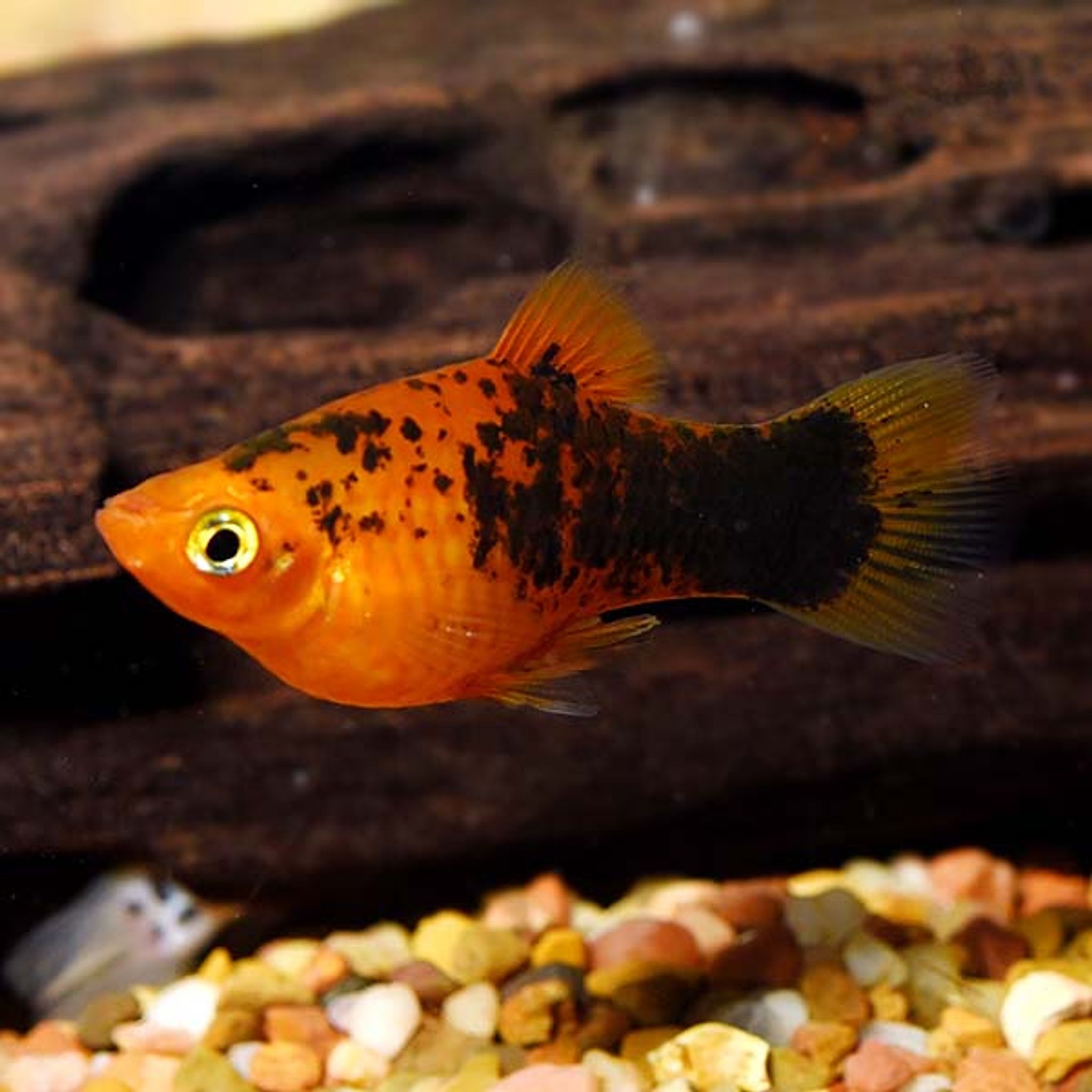

How Big Do Platy Get? Growth Rate, Adult Size and Tank Planning
A full-grown platy typically reaches 2 to 3 inches (5 to 7.6 cm) nose to tail, making it one of the more compact livebearers you can keep. That number shifts a bit by sex and variety, and it takes several months of steady care to get there — this guide breaks down the timeline, the variation across popular strains, and exactly how to size a tank around it.
Adult Platy Size at a Glance
The 2–3 inch figure is the most consistent number across platy care guides, and it holds true for most of the common color strains sold today — wagtail, calico, sunset, and red platies all land in that range. Two things push individual fish toward the low or high end: sex and strain genetics.
- Males: roughly 1.5–2 in (3.8–5 cm)
- Females: roughly 2–3 in (5–7.6 cm)
Females run larger because they carry developing fry internally and need the extra body volume to do it — platies are livebearers, so a mature female is essentially built to be bigger than her male tankmates.
How Fast Do Platies Grow? A Month-by-Month Timeline
Platy growth is front-loaded: fry pack on length quickly in the first couple of months, then growth slows as the fish approaches its genetic ceiling.
| Age | Approximate Length | Notes |
|---|---|---|
| At birth (fry) | 0.25–0.3 in | Free-swimming immediately, no egg stage |
| 1 month | ~1 in | Rapid early growth if well fed |
| 2–4 months | 1–2 in | Steady growth; sex becomes visible |
| 4–5 months | 2–3 in (full adult size) | Growth plateaus; body fills out |
Sexual maturity and full size are two different milestones. Platies can start showing breeding behavior — and females can become pregnant — as early as 2–3 months old, well before they've finished growing. Full adult body length usually isn't reached until 4–5 months. Treat "old enough to breed" and "fully grown" as separate checkpoints; conflating them is a common reason hobbyists overstock a tank too early, assuming a breeding-age platy is already at its adult footprint.
Signs a Platy Has Actually Finished Growing
Rather than guessing from age alone, look for:
- A rounded, filled-out body profile rather than a slim, torpedo-like juvenile shape
- In males, a fully formed gonopodium (the modified anal fin used for breeding)
- Consistent length measurements over several consecutive weeks, even with continued good feeding
Size Differences Across Platy Varieties
Not every platy variety tops out at the same size. If you're choosing between strains for a specific tank, this comparison is more useful than a single blanket number.
| Variety | Typical Adult Size | Notes |
|---|---|---|
| Standard/common platy (wagtail, calico, sunset, red) | 2–3 in | Most widely available; the baseline figure |
| Mickey Mouse platy | 1.5–2.5 in (occasionally to 3 in) | Named for the tail-spot pattern resembling mouse ears; smaller and slightly more forgiving of tight footprints |
| Neon/blue platy strains | 2–3 in | Similar sizing to standard strains; sought after for metallic blue-orange coloring |
| Variatus platy (Xiphophorus variatus) | 2.5–3 in | Runs slightly larger than other strains on average |
Genetics set the ceiling for all of these — a Mickey Mouse platy will not suddenly grow to 3.5 inches no matter how well it's fed, and a variatus won't shrink to 1.5 inches under poor conditions. Care quality determines whether a fish reaches its variety's potential, not whether it can exceed it.
What Actually Determines Final Size
Genetics is the single biggest factor — a platy is capped by its strain regardless of how well you care for it. But several environmental factors decide whether a fish reaches that genetic ceiling or falls short of it:
- Diet quality and protein content — a varied diet supports full growth; a thin, low-protein diet stalls it
- Tank size and swimming room — cramped conditions suppress growth even when water quality tests fine
- Water quality — ammonia, nitrite, and nitrate stress slow or stunt growth
- Overcrowding and food competition — dominant fish out-eating tankmates leaves smaller fish undersized
- Temperature consistency — fluctuating temperatures add stress that diverts energy away from growth
One nuance worth flagging: running a tank warm — toward the upper end of the tolerated range, near 82°F (28°C) — does speed up metabolism and can modestly accelerate growth, but it also shortens lifespan. Chasing faster growth by running hot water is a poor trade for a fish that's already going to reach full size in a matter of months.
There's also a buyer-side factor sources rarely mention: mass-produced, feeder-grade platies from high-volume breeding operations can run noticeably smaller or weaker as adults than platies from more carefully managed breeding stock, due to inbreeding and selection for output over vigor. If you're comparing platies from different sources, source quality is worth weighing alongside price.
Tank Size Guidance Based on Platy Size
Because platies stay compact, they don't need a huge footprint — but they are active, schooling fish, so swimming length matters as much as raw gallon count.
- Minimum starting tank: 10 gallons (38 L) for a single platy or a small starter trio
- Additional platies: add roughly 2–5 gallons per additional fish
- Shape matters: a long, shallow tank generally beats a tall, narrow one of the same volume, since platies spend most of their time swimming horizontally through the water column
On the 2–5 gallon range: a heavily planted, well-filtered tank can run toward the leaner end, since plants absorb some bioload and add cover. A bare-bottom or lightly filtered setup should budget the higher end, since there's less buffer against ammonia and nitrite spikes.
A simple way to translate the folk rule into a working formula: start with your filter's rated turnover (aim for at least 4x the tank volume per hour), then treat each additional platy as needing roughly 2 gallons of effective capacity if the tank is well planted and filtered, or up to 5 gallons if it's bare and lightly filtered. Stocking density should flex with your filtration and planting, not just a fixed number.
Stocking Math in Practice
After the initial 10-gallon base, platies are commonly stocked at roughly one platy per 2–3 gallons, adjusted for filtration capacity and whatever other tankmates share the tank. A 20-gallon tank, for example, comfortably supports a small platy group alongside a few other peaceful community fish once you account for their bioload too.
Water Parameters That Support Full Growth
Platies grow best in stable, slightly mineral-rich water:
- Temperature: 70–78°F (21–26°C), tolerated up to 82°F (28°C)
- pH: 6.8–8.0 — platies do well in slightly alkaline water
- General hardness: 10–28 dGH
For water changes, weekly partial changes of 20–30% are the safest default for most home setups. Easing back to biweekly changes is reasonable only in lightly stocked, heavily planted tanks where nitrate stays low between changes; more heavily stocked tanks should stick with the weekly schedule.
Feeding for Healthy Growth
Feed 2–3 small meals a day, offering only what the group clears in 2–3 minutes. A base of high-quality flake or pellet food should be supplemented with live or frozen protein — brine shrimp, bloodworms, or daphnia — plus occasional blanched vegetable matter. Underfeeding, or feeding flakes exclusively with no protein variety, is one of the more common reasons a platy grows slowly and loses color intensity.
Troubleshooting: Why Is My Platy Not Growing?
Before assuming a fish is simply a small strain, work through this checklist in order:
- Test the water first. Ammonia, nitrite, or elevated nitrate will stunt growth even in a fish with good genetics.
- Review the diet. Confirm protein variety is present, not just flakes.
- Check tank size and stocking. An undersized or overcrowded tank produces stressed, slow-growing fish — a size issue that's often mistaken for a genetic one.
- Rule out illness or parasites. Internal parasites (see the disease section below) can consume nutrition before it supports growth.
Blaming genetics for a small platy is usually premature; a stress, space, or water-quality issue is the more common culprit, and it's fixable.
Platies in the Livebearer Family
Platies belong to the family Poeciliidae, alongside guppies, mollies, and swordtails. Across the group, adult size ranges from about 2 to 6 inches, and platies sit toward the smaller-to-mid end of that spread. Shared traits across the family include:
- Giving birth to live, free-swimming fry rather than laying eggs
- Being easy, prolific breeders with no special spawning triggers required
- A general family lifespan of 3–7 years, though platies trend shorter — typically 2–3 years, occasionally 3–5 with excellent care
Because platies reach full size in their first 4–5 months, size plateaus early and then stays stable for most of the rest of the fish's life.
Platies are commonly recommended as a starter livebearer alongside guppies and mollies — all three are hardy, peaceful, colorful, and easy to feed, which is why they show up together in so many beginner community tanks. They share similar size and water-parameter needs, but hybridization between them does not occur since they belong to different genera.
Livebearer Health and Compatibility Notes
A few issues come up often enough in mixed livebearer tanks that they're worth knowing before you stock platies alongside other species.
Fin Damage from Tankmates
Torn or ragged fins in a livebearer tank are sometimes mistaken for disease, but fin-nipping between tankmates, poor water quality, or general stress are more common causes. Isolate the injured fish, improve water quality, and reconsider aggressive or fin-nipping tankmates. Fins typically regrow on their own in clean water.
Fry Predation
Adult platies — including the mothers themselves — will eat their own fry given the opportunity. If you want to raise fry to adulthood, use a breeder box, dense floating plants, or a separate grow-out tank to shelter them until they reach roughly 1 inch, at which point they're large enough to rejoin the main tank safely.
Shimmies and Wasting Disease
Shimmies — a side-to-side wobble without forward movement — usually trace back to cold water, low pH, or mineral deficiency. Warmer water, a pH of 7.0–8.0, and mineral supplementation (crushed coral or a mineral block) typically resolve it. Mollies are especially prone to shimmies due to their brackish-water ancestry and higher mineral needs, so a shared tank benefits from erring toward mineral-rich, temperature-stable water for everyone in it.
Wasting or "skinny" disease, caused by internal parasites like tapeworms or camallanus worms, calls for a dewormer combining metronidazole and praziquantel, repeated after 2–3 weeks. Quarantining new fish for 2–4 weeks before adding them to a main tank is the single best prevention against introducing either shimmies or internal parasites in the first place.
Bent or Curved Spine
A bent spine (a form of scoliosis) can stem from genetics and inbreeding, a nutrient-poor diet, or Mycobacterium infection (fish tuberculosis). There's no cure once the deformity is structural. Prevention means buying from healthy, unrelated stock and feeding a varied diet; affected fish can often still live out a normal lifespan but should not be used for breeding.
Common Mistakes to Avoid
- Expecting fast growth in an undersized or overcrowded tank, then blaming the fish instead of the setup
- Feeding only flakes with no protein variety, which slows growth and dulls color
- Confusing sexual maturity (2–3 months) with full adult size (4–5 months), leading to overstocking too early
- Housing platies with fin-nipping or aggressive species and mistaking the resulting damage for disease
- Skipping quarantine for new stock, which risks introducing shimmies or internal parasites
- Ignoring mineral supplementation in soft, acidic water, inviting chronic shimmying
- Leaving fry unprotected in the main tank, where adults — parents included — will eat them
Frequently Asked Questions
How big does a full-grown platy get?
A full-grown platy reaches roughly 2–3 inches (5–7.6 cm), with some variation by sex and strain.
How long does it take a platy to reach full size?
Most platies reach full adult size in about 4–5 months from birth under good care. Breeding maturity can begin earlier, around 2–3 months, but that's not the same as being fully grown.
Do male or female platies get bigger?
Females are typically larger, up to about 3 inches, since they need extra body volume to carry developing fry. Males generally stay closer to 1.5–2 inches.
What's the minimum tank size for platies?
A 10-gallon tank is the minimum for a single platy or a small starter group. Add roughly 2–5 gallons for each additional platy, leaning toward the higher end in lightly filtered or bare-bottom setups.
Why is my platy not growing or staying small?
The most common causes are an undersized or overcrowded tank, poor diet lacking protein variety, or stressful water conditions — check water parameters, feeding, and tank size before assuming it's simply a small strain.
Can platies live with guppies and mollies?
Yes. All three are peaceful livebearers with similar size and water-parameter needs, making them common tankmates. Hybridization between them doesn't occur, since they belong to different genera despite the family resemblance.
Do platies stop growing after reaching adult size?
Growth plateaus once a platy reaches maturity, and size stays stable for the rest of its typical 2–3 year lifespan.
Why does my platy have a bent spine or is shimmying?
A bent spine usually traces to genetics, poor nutrition, or a bacterial infection and has no cure once structural. Shimmying is different — it typically points to cold water, low pH, or mineral deficiency, and is fixable with warmer, harder, more alkaline water.
Ready to start or expand a livebearer community? Browse available platies on FishyHub and pair them with a properly sized setup from the glass tanks selection.


