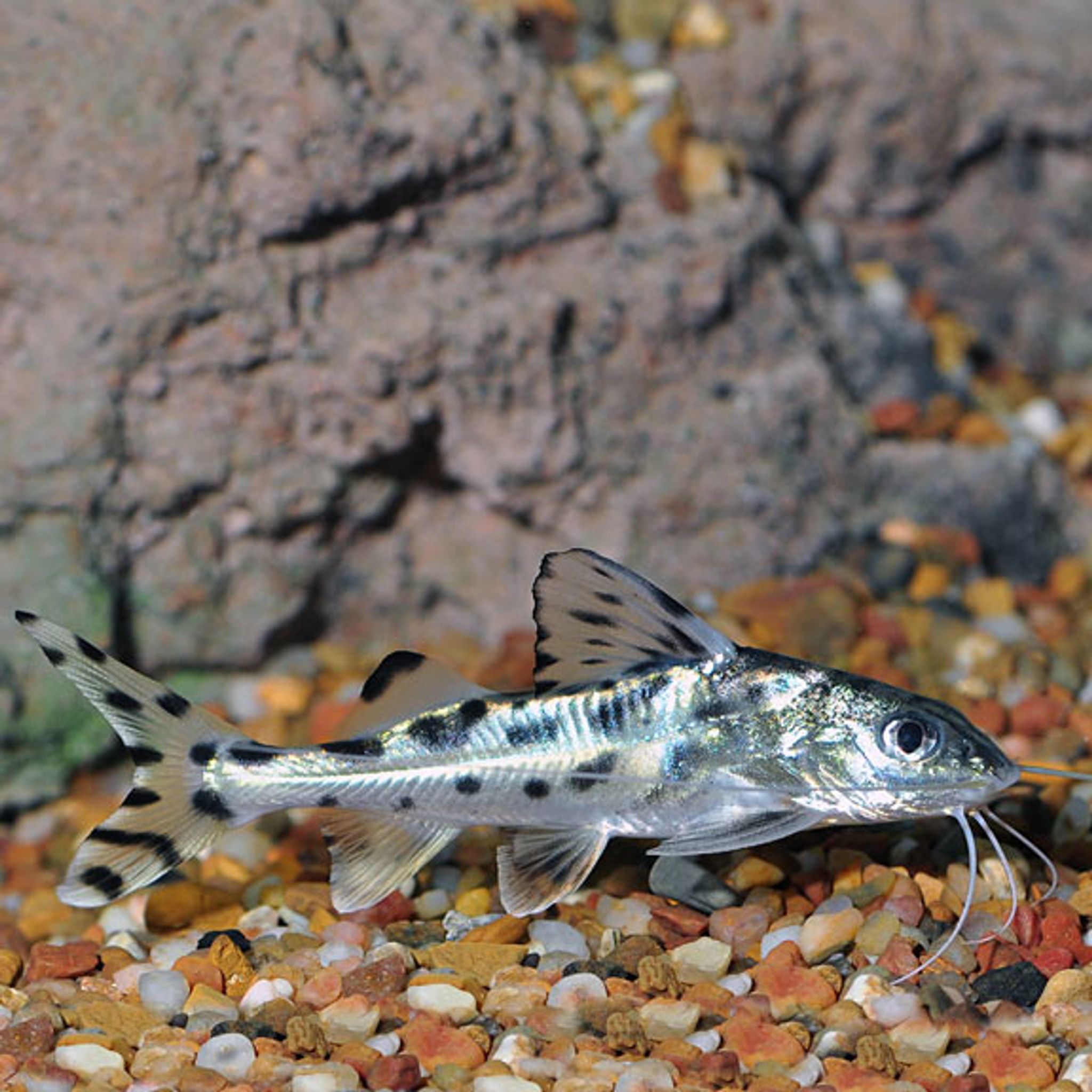

How Big Do Pictus Catfish Get? Growth Rate, Adult Size and Tank Planning
A pictus catfish sold as a 1–2 inch juvenile will not stay that size for long. Most adults settle at 4–5 inches (10–13 cm) in standard length, reaching that size within about a year, which means the tank you buy on day one should already be sized for the fish it becomes, not the fish it is at checkout.
Adult Size: What "Full Grown" Actually Means
Pictus catfish (Pimelodus pictus) are measured as standard length — snout to the base of the tail, not including the long whisker-like barbels that can visually add several inches. Sources vary a bit on the ceiling: some cap adults around 4.3 inches (11 cm), others cite a flat 5 inches. The practical answer is a range: expect 4–5 inches (10–13 cm) for a healthy, well-kept adult, with 5 inches as the outside figure rather than the norm. Reports of larger individuals exist but are uncommon and shouldn't drive your tank-planning math.
For scale, that puts pictus mid-pack among small aquarium catfish:
| Species | Typical adult length |
|---|---|
| Common cory catfish | 2.5–3 in (6–7.5 cm) |
| Bumblebee catfish | ~3 in (7.5 cm) |
| Pictus catfish | 4–5 in (10–13 cm) |
| Glass catfish | ~4 in (10 cm) |
| Common pleco / channel catfish | Well over 12 in (30+ cm) |
Pictus are noticeably bigger than corys but nowhere near pleco or channel-cat territory — big enough to need real swimming room, small enough to still fit a well-planned community setup.
Growth Timeline: Month by Month
Growth is fast early and then tapers off as the fish matures. A rough, commonly observed pace for a healthy juvenile:
| Age | Approximate length |
|---|---|
| At purchase | 1–2 in (2.5–5 cm) |
| 3 months | ~2 in (5 cm) |
| 4–6 months | 3–3.5 in (7.5–9 cm) |
| 7–12 months | Approaching 4–5 in (10–13 cm) |
| 1.5–2 years | Full adult fill-out |
The fish reaches most of its final length within the first year, but body depth and overall "fill" keep improving for another six months to a year after that. A quarantine tank sized for a 1-inch juvenile gets outgrown within weeks, not months — plan a QT of at least 10–15 gallons even for new arrivals, and expect to move the fish along faster than you would a slower-growing species.
What Speeds Up or Slows Down Growth
Four factors drive how fast a given pictus reaches its adult size:
- Tank size — cramped quarters measurably stunt growth; this isn't a myth, it's a documented limiting factor for this species.
- Diet quality and variety — protein-rich, varied meals push growth faster than a monotonous diet.
- Water quality and temperature stability — swings and poor conditions divert energy from growth to stress recovery.
- Starting condition — a stressed or older store specimen grows slower than a healthy, young juvenile, even under identical care afterward.
A useful visual health check as the fish grows: look at the barbels. Intact, actively-used barbels on a fish that's exploring and feeding normally point to good conditions and a normal growth trajectory. Frayed, shortened, or clamped barbels often signal poor water quality well before other symptoms show up.
Tank Size: Plan for the Adult, Not the Juvenile
This is where most new owners get caught out. A pictus bought at 1.5 inches looks perfectly at home in a 10–20 gallon tank — and that's exactly the trap. Buying small and assuming "it'll grow into the tank" is one of the most common mistakes with this species; it doesn't grow to fit a small footprint, it gets stunted and stressed by one.
Minimum tank size for a single adult pictus is 55 gallons. You'll see 50 gallons floated as a floor in some places, but 55 is the safer real-world minimum given how active and fast-swimming these fish are.
Because pictus are shoaling-leaning fish that do noticeably better in groups, solitary housing isn't really recommended — a lone pictus tends to hide more and act skittish, which owners often mistake for illness. Plan for at least three fish, and the gallon math compounds quickly:
| Group size | Recommended tank size |
|---|---|
| 1 pictus (minimum) | 55 gallons |
| 2 pictus | ~95–105 gallons |
| 3 pictus (recommended minimum group) | 75–100+ gallons |
Add roughly 40–50 gallons for each pictus beyond the first. Just as important as raw volume: footprint beats height. These are active mid-to-bottom swimmers that cruise horizontally, so a long, wide tank (a 48-inch-long tank, for example) serves them far better than a tall, narrow one holding the same total gallons.
Browsing options for that footprint is easiest when you can compare dimensions side by side — FishyHub's glass aquarium tanks list length and width specs so you can prioritize floor space over height.
Care Profile Essentials
Water Parameters
| Parameter | Workable range | Comfortable target |
|---|---|---|
| Temperature | 72–80°F (22–27°C) | 75–78°F (24–26°C) |
| pH | 6–8 | 6.5–7.5 |
| Hardness | — | ~5–18 dH |
Stability matters more than hitting an exact number — fluctuating temperature or pH is a common, underrated drag on growth rate, separate from raw tank size.
Diet
Pictus catfish are omnivorous scavengers with a predatory streak. A reasonable feeding approach:
- Sinking pellets or wafers as the everyday staple
- Bloodworms, brine shrimp, and daphnia (live or frozen) as regular supplements
- Occasional other meaty foods for variety
Relying only on flakes, or overfeeding meaty foods without variety, both tend to produce slower or uneven growth. Variety, not volume, is the lever that matters most.
Tankmates: Do's and Don'ts
Pictus are peaceful toward fish their own size or larger and aren't aggressive by temperament, but two things make tankmate choice tricky:
- They eat what fits in their mouth. Small tetras, guppy fry, and other tiny fish are at real risk once a pictus approaches adult size — this isn't aggression, it's simple predation. A community of hardier, similarly-sized tetras chosen at a size pictus won't outgrow works better than pairing them with the smallest, most delicate species.
- They're fast and skittish. Sudden bright lights or quick movement near the tank can trigger panicked darting, and a startled pictus can ram glass or decor — a particular risk in smaller tanks with sharp corners or in newly set-up systems where the fish hasn't settled in.
Handling Caution: Spines
Pictus carry sharp, mildly venomous spines on their dorsal and pectoral fins. Never grab one bare-handed, and avoid netting — the spines snag mesh, which can injure the fish and whoever is handling it. Use a cup or solid container to move a pictus instead.
Sexing and Breeding
There's no reliable external way to sex a pictus catfish by size or markings. Gravid females may look slightly broader-bodied and males occasionally show a marginally larger dorsal fin, but neither trait is consistent enough to use as a sexing method.
Breeding in home aquaria essentially doesn't happen. Between the difficulty of sexing and the scale of the systems and conditions required, virtually every pictus catfish in the trade is wild-caught or commercially farm-bred rather than home-bred — that's a normal, expected part of keeping this species, not a sign you're doing something wrong.
Where Pictus Fits Among Aquarium Catfish
If you're comparing catfish options, pictus occupies a specific niche:
- Corydoras — small, peaceful, schooling bottom scavengers, well under half the adult size of a pictus. Good corydoras picks suit tanks too small for pictus.
- Plecos — grow far larger, kept mainly for algae control rather than activity or pattern.
- Synodontis — African, hardy, mostly nocturnal, a different care rhythm than the day-active pictus.
- Upside-down catfish — similar size range to pictus but a distinct swimming habit.
Pictus earns its spot for activity and striking silver-and-black spotted pattern, not algae duty — it's a display fish, not a cleanup crew. General freshwater catfish listings are a reasonable starting point if you're still weighing pictus against these alternatives.
Lifespan and the Long-Term Commitment
A well-kept pictus catfish typically lives 8–10 years, shorter under poor conditions. That lifespan is the strongest argument for setting up the eventual tank size from day one: this isn't a starter fish you'll rehome in a year once it "gets too big." Anyone buying a juvenile pictus is signing up for close to a decade with an adult fish that needs 55+ gallons — plan the tank around that reality, not the inch-and-a-half juvenile currently sitting in the bag.
Frequently Asked Questions
How big does a pictus catfish get in a 20-gallon tank?
It may survive in a 20-gallon tank, but growth will likely be stunted and welfare compromised over time. A 20-gallon tank is not adequate for a pictus long-term, even for a single fish.
How fast do pictus catfish grow?
Growth is fast in the first six months, typically reaching 3–3.5 inches, then slows as the fish approaches its full 4–5 inch adult size by around 1–1.5 years of age.
Do pictus catfish grow to fit their tank?
Not in any beneficial sense. An undersized tank doesn't proportionally scale the fish down — it stunts growth and adds stress instead of producing a smaller, healthy adult.
What size tank do 3 pictus catfish need?
Plan for roughly 75–100+ gallons. Each additional pictus beyond the first needs meaningful extra swimming space on top of the 55-gallon single-fish baseline.
Can pictus catfish live with bettas or small tetras?
It's risky once the pictus nears adult size. Fish small enough to fit in its mouth can become food, and a pictus's fast, boisterous swimming style can stress a calmer fish like a betta.
How can you tell a pictus catfish's age or sex?
There's no reliable visual method for sexing pictus catfish. Age is better estimated from length and growth stage than from any color or fin marking.
Why is my pictus catfish not growing?
Before suspecting illness, rule out tank size, diet monotony, and fluctuating water parameters — these three factors account for most cases of slow or stalled growth in this species.
How long do pictus catfish live?
About 8–10 years with stable care. That long lifespan is a strong reason to set up the right-size tank from the start rather than planning an upgrade later.
Planning a tank around an adult pictus's real footprint, rather than its juvenile size, is the single biggest factor in keeping this species healthy for the long run. Browse freshwater livestock on FishyHub to compare pictus against other catfish and community species before you commit to a group.


