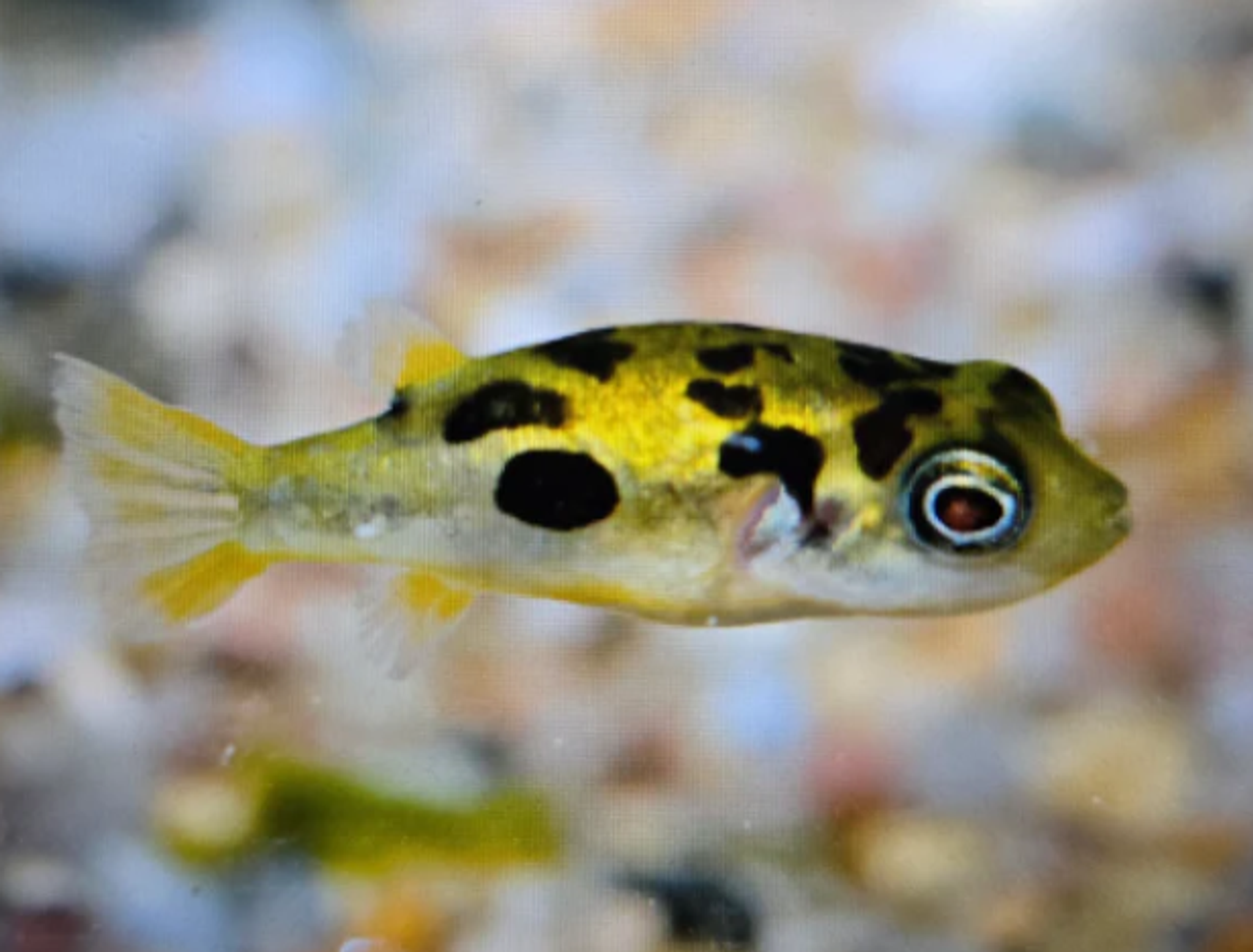
How Big Do Pea Puffer Get? Growth Rate, Adult Size and Tank Planning
A pea puffer (Carinotetraodon travancoricus) tops out at roughly 1 to 1.5 inches (2.5–3.8 cm), making it one of the smallest pufferfish kept in home aquariums. That tiny frame is misleading, though, because this fish behaves like a much bigger predator, and getting the tank size right matters more than knowing the exact adult length.
Adult Size: What to Actually Plan Around
Most healthy adult pea puffers settle around 1 inch (2.5 cm). A realistic range across individuals is 1 to 1.5 inches, and occasional larger specimens have been reported near 1.4 inches (3.5 cm). Because a small number of fish always outgrow the average, treat 1.5 inches as the ceiling you plan a tank around rather than the typical size.
Unlike many nano species, pea puffers don't show a strong size difference between sexes. Males and females grow to roughly the same length; the visible difference is that males develop darker, more defined stripe patterning, especially along the back and through the eye, rather than a bigger body. This is a useful distinction for anyone comparing pea puffers to other nano fish that do show sexual size dimorphism (more on that below).
Growth Timeline: From Fry to Full Size
There isn't a detailed, puffer-specific week-by-week growth chart published for this species. What follows is a general small-fish growth pattern applied to pea puffers, not lab-measured data specific to them — treat it as a planning guide rather than a guarantee.
| Age | Typical milestone |
|---|---|
| 0–4 weeks (fry) | Free-swimming, feeding on infusoria or baby brine shrimp; growth is fastest during this window |
| 1–3 months | Rapid length gain; body shape and coloration start to resemble a miniature adult |
| 4–6 months | Close to adult length; stripe patterning becomes more distinct, especially in males |
| 6–12 months | Full maturity reached, with final size and coloration locked in given good diet and water quality |
Two variables drive where a given fish lands in that window: diet consistency and water quality. Fish fed sparingly or kept in fluctuating water conditions tend to grow slower and may stall below their genetic potential.
With good care, a pea puffer typically lives 4 to 5 years.
Water Parameters That Support Healthy Growth
Stunted growth in small pufferfish is often a water-quality problem before it's a feeding problem. Target these ranges:
- Temperature: 77–79°F (25–26°C)
- pH: 6.5–7.5 (slightly acidic to neutral)
- Hardness: soft to moderately hard, roughly 3–12 dGH
Stable parameters matter more than hitting an exact number — swings in temperature or pH stress a fish this small far more than they would a larger species.
Diet Drives Growth More Than Genetics
Pea puffers are strictly carnivorous and need live or frozen protein to grow and stay healthy — they won't thrive on flake or algae-based foods alone. Suitable foods include:
- Bloodworms
- Brine shrimp
- Daphnia
- Small snails (an important part of their diet and a way to help wear down their teeth)
- Mosquito larvae
Feed 2–3 small meals per day, only as much as the fish clears in a few minutes. Uneaten protein-rich food should be removed within about 15 minutes — in a small volume of water, leftover food spikes ammonia quickly, and ammonia exposure is one of the more common causes of stunted growth and illness in young puffers.
Tank Size Guidance: The Real Planning Question
Body length is only half the story. Pea puffers are territorial and surprisingly nippy for their size, so stocking decisions need to account for behavior, not just how many inches of fish you're adding.
Minimum Tank Size for One Puffer
Sources split here. Some list 5 gallons (19 L) as workable for a single puffer with excellent maintenance and heavy planting. Others recommend 10 gallons (38 L) as the true minimum. Both have merit: 5 gallons can work if you're diligent about water changes and filtration, but smaller volumes swing in temperature, pH, and ammonia much faster than larger ones. For most owners — especially first-time puffer keepers — 10 gallons is the more forgiving starting point.
Adding More Puffers
There are two commonly cited rules of thumb for stocking a group:
| Rule | Formula | Best for |
|---|---|---|
| Conservative minimum | 5 gallons for the first puffer + 3 gallons per additional fish | Experienced keepers with strong filtration and maintenance routines |
| Generous spacing | 5 gallons for the first puffer + 5 gallons per additional fish | Beginners and community/group setups, since extra space reduces territorial clashes |
Given how easily pea puffers spar over territory, the +5-gallon spacing is the safer default for anyone building a group tank, even though +3 gallons is the more frequently repeated bare-minimum figure.
As a reference point, a well-planted 20-gallon (76 L) tank with heavy visual cover can comfortably support roughly 6–7 puffers. If you're planning a breeding group, a trio of 1 male to 2–3 females does best in 10–20 gallons with gentle water flow and dense planting to give females places to retreat.
Standard 5-Gallon Footprint
If you're deciding whether a single-puffer setup actually fits your desk or shelf, a standard 5-gallon glass or acrylic tank measures about 16 in L x 8 in W x 10 in H (40.6 x 20.3 x 25.4 cm). That's a compact footprint, which is exactly why a 5-gallon works only when maintenance is consistent — there's very little water volume to buffer mistakes.
Why Small Fish Don't Mean a Small Bioload
It's tempting to assume a 1-inch fish needs minimal filtration, but pea puffers are messy, protein-heavy carnivorous eaters. Uneaten bloodworms and snail shells decompose and add to the bioload just as they would with a larger fish, just in a much smaller volume of water to dilute the effect. A reliable filter sized for the tank, paired with frequent partial water changes, is non-negotiable even in a nano setup — "small fish, small tank, occasional maintenance" is a mistake that catches up with owners quickly.
Tank Shape Matters as Much as Gallon Count
A pea puffer's territory is measured in sightlines, not gallons. A tall, narrow tank concentrates a fish's field of view and makes every other tankmate visible at once, which increases confrontations. A longer, lower footprint broken up with dense planting, driftwood, and decor gives puffers visual barriers to claim smaller territories, which matters more for reducing aggression than simply adding water volume. When planning a nano puffer build, prioritize horizontal space and clutter over height.
Comparing Size to the Scarlet Badis
Readers comparing nano species often put pea puffers next to the scarlet badis, one of the few other fish that occupies a similar size niche — with one key difference. Male scarlet badis reach about 0.79 inches (2 cm), while females stay smaller still at around 0.51 inches (1.3 cm). That's a clear size gap between sexes, unlike pea puffers, where males and females grow to roughly the same length. Scarlet badis also reach full size a bit slower, typically over 5–9 months depending on diet and water quality. If you're weighing the two species for a nano setup, browse freshwater livestock options to compare footprints and care requirements side by side.
Common Mistakes to Avoid
- Assuming small size means low maintenance. Puffers are messy carnivores; small tanks foul fast without frequent partial water changes.
- Housing multiple males together. This almost guarantees aggression, torn fins, and stress that stunts growth or shortens lifespan.
- Adding shrimp or snails as tankmates and expecting them to survive. Pea puffers actively hunt small invertebrates rather than ignoring them — snails are food, not cleanup crew.
- Overfeeding. Leftover protein-rich food spikes ammonia and nitrate fast in a small volume of water.
- Sourcing wild-caught stock without knowing it. Wild collection adds pressure to native populations; ask about origin when buying and favor captive-bred fish where available.
- Skipping line-of-sight breaks. Dense planting and decor reduce territorial disputes in a fish that's aggressive well beyond its size.
Frequently Asked Questions
How big does a pea puffer actually get?
Adult pea puffers reach about 1 to 1.5 inches (2.5–3.8 cm), making them among the smallest pufferfish kept in the hobby. Plan around 1.5 inches as the upper end rather than the average.
What is the minimum tank size for one pea puffer?
Five gallons is the bare minimum widely cited, but 10 gallons is the safer choice for beginners since smaller volumes are less forgiving of water-quality swings.
How many pea puffers can I keep together?
Budget roughly 5 gallons for the first fish, plus 3–5 gallons per additional puffer. A well-planted 20-gallon tank with heavy cover can comfortably support around 6–7 puffers.
Do male and female pea puffers grow to different sizes?
Not meaningfully. Sex is told apart mainly by stripe pattern and coloration, not size — a contrast with scarlet badis, where males grow noticeably larger than females.
How long does it take a pea puffer to reach full size?
There's no precise published timeline specific to this species. Expect a fish to be close to adult length by 4–6 months, with full maturity reached within about a year given consistent diet and stable water quality.
What do pea puffers eat, and does diet affect growth?
They need live or frozen protein — bloodworms, brine shrimp, daphnia, and small snails. A poor or infrequent diet slows growth and weakens immune response, so consistent feeding matters as much as water quality.
Can pea puffers live with shrimp or snails?
Not safely as adults — pea puffers actively hunt small invertebrates. Fast-moving, similarly sized fish such as ember tetras or rasboras make far better tankmates than shrimp or snails.
How long do pea puffers live?
With proper care, pea puffers typically live 4 to 5 years.
Whether you're setting up a single nano tank or planning a small group, browse freshwater livestock on FishyHub to compare pea puffers against other nano species before you commit to a tank size.


