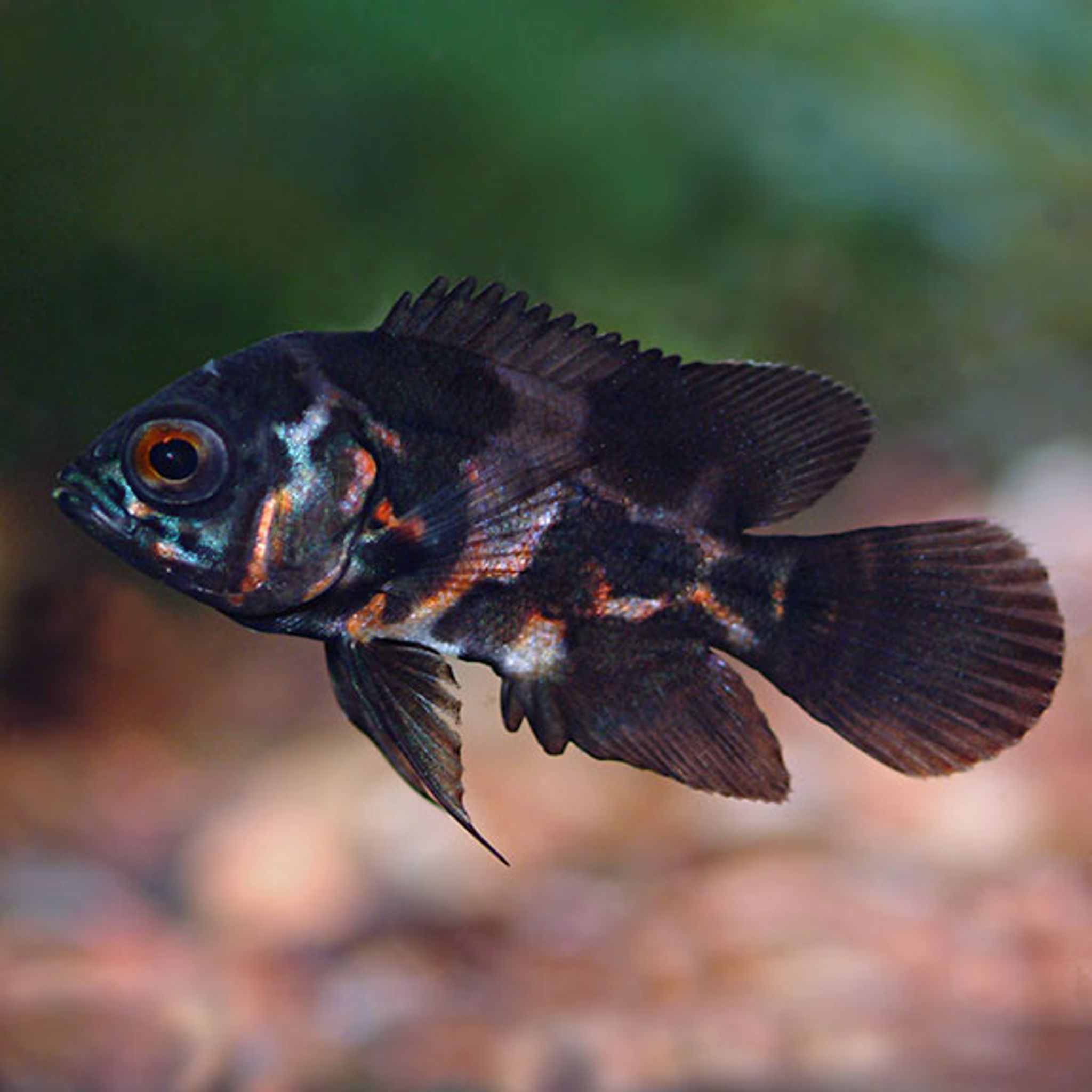

How Big Do Oscar Get? Growth Rate, Adult Size and Tank Planning
Most captive oscars reach 10–12 inches as adults, with exceptional specimens in very large tanks pushing 13–14 inches. That size arrives faster than most new keepers expect, which is why planning the tank around the adult fish — not the 2-inch juvenile at checkout — matters from day one.
Adult Size: What to Actually Expect
An oscar bought as a juvenile is usually 1.5–3 inches long. Under good conditions, that same fish grows into one of the larger commonly kept freshwater cichlids.
- Typical captive adult length: 10–12 in (25–30 cm)
- Exceptional captive specimens: 13–14 in, achievable with a very large tank, excellent water quality, and years of consistent care
- Wild oscars in South American rivers: 15–18 in, rarely more — open water, unlimited space, and a completely different food supply push wild fish past what any home aquarium replicates
- Adult weight: commonly 1.5–3 lbs, with large males approaching 3–4 lbs
Treat 10–12 inches as the reliable planning number. The 13–14 inch range is realistic for a fish kept long-term in 100+ gallons with pristine water — it is not the default outcome of a standard setup, and readers shouldn't size a tank around the high end and hope the fish falls short of it instead.
Do Males or Females Get Bigger?
Sexual dimorphism in oscars is minimal. Males sometimes develop slightly longer, more pointed tips on the dorsal and anal fins at maturity, but this isn't a reliable way to sex the fish on its own, and it has no meaningful effect on final body length. Plan tank size the same way regardless of sex.
Growth Rate: A Month-by-Month Benchmark
Oscars grow quickly in their first year, then taper off. The pattern below gives a rough benchmark for tracking a healthy growth trajectory rather than a guaranteed schedule — individual growth varies with genetics, diet, and tank conditions.
| Age | Approximate length |
|---|---|
| At purchase (juvenile) | 1.5–3 in |
| 3 months | 4–5 in |
| 6 months | 7–8 in |
| 12 months | ~10 in |
| 18 months | 10–12 in (near-adult) |
| 2 years | Full adult size, slow filling out (girth/bulk) continues |
During the first 12 months, expect roughly 1 inch of growth per month under good conditions — quality food, warm stable water, and room to swim. Growth slows noticeably after that first year, and most oscars reach close to their adult length by 12–18 months, with some additional filling out in body depth and girth continuing into the second year.
If a fish is falling well behind this curve despite regular feeding, water quality and tank size are the first things to check — not the fish's genetics.
Does Tank Size Actually Control Growth?
Yes. Oscars are frequently described as fish that "grow to their tank," and this isn't a myth to justify undersized setups — it's a real welfare concern. A cramped tank combined with inconsistent water changes suppresses growth hormonally and physically, producing a stunted fish rather than a naturally small one.
Stunting is not a benign shortcut to a "manageable size" oscar. It correlates with:
- Shortened lifespan
- Organ and health issues later in life
- Higher susceptibility to disease
If you want a healthy fish that simply stays smaller, that isn't something tank restriction reliably delivers — it delivers a compromised fish that happens to be smaller.
Tank Size Guidance for Adult Oscars
This is the part most guides oversimplify into a single number. Here's the fuller picture.
| Setup | Recommended tank size |
|---|---|
| Single juvenile (short-term only) | 55 gallons (bare minimum) |
| Single adult, long-term standard | 75–125 gallons |
| Pair or small group | 100+ gallons |
55 gallons is the widely cited absolute minimum for one adult oscar — but "minimum" is doing a lot of work in that sentence. More current, welfare-focused guidance treats 75–125 gallons as the actual long-term standard for a single fish, especially given how long oscars live.
Why the Standard 55-Gallon Footprint Falls Short
Gallon count alone hides a real problem: shape. A standard US 55-gallon tank measures about 48 in L x 13 in W x 21 in H. That 13-inch width is the limiting factor most sources skip past.
An adult oscar is not just long — it's deep-bodied and a wide-bodied swimmer. A 13-inch-wide footprint gives a 10–12 inch fish very little room to turn around without brushing both panes of glass. A 75-gallon tank (48 x 18 x 21 in), or a 6-foot-long footprint, adds those extra 5 inches of width and meaningfully more usable swimming and turning room — this matters more than the taller, narrower "upgrade" options that only add gallons without adding width.
Buy the Adult Tank First
The single most common planning mistake is buying a 20–30 gallon "starter" tank for a juvenile oscar. At roughly an inch of growth per month, that fish outgrows a small tank within a matter of months — long before most keepers are ready to upgrade.
Buying the eventual adult-size tank from day one avoids:
- A rushed, stressful re-homing or upgrade scramble
- Sudden, large-volume tank transfers, which are hard on a fish sensitive to abrupt water parameter changes
- Paying for two tanks instead of one
A practical proactive upgrade point, if starting smaller is unavoidable, is around the 4–6 inch juvenile mark — moving before the fish looks cramped, not after.
You can browse full-grown oscars and other large cichlids in the Monster Fishes category, and compare tank footprints in the Tanks & Stands section before committing to a size.
Stand and Floor Load Planning
Scaling from a 55-gallon to a 75–125 gallon tank isn't just a water-volume decision — it's a structural one. A filled 75-gallon-plus tank is very heavy once water, substrate, and decor are added, so plan for:
- A stand explicitly rated for the filled tank's weight, not just its footprint
- Floor load capacity, particularly on upper floors of a house or apartment
- Placing the tank along a load-bearing wall or over floor joists where possible
Sort this out before the fish reaches adult size, not after the tank is already stocked and full.
Bioload and Filtration for a Growing Oscar
Oscars are messy, heavy waste producers relative to their size. Filtration should be oversized for the tank volume, not matched to it — undersizing filtration because the fish "still looks small" as a juvenile is a common mistake that leads to ammonia and nitrite spikes as the bioload catches up to growth.
Practical guidelines:
- Combine strong mechanical and biological filtration rated well above the tank's actual volume
- Perform 25–50% weekly water changes regardless of tank size
- Reassess filtration capacity every time the tank size or fish count increases
Browse oversized filtration options suited to heavy-bioload fish in the Filters category.
Diet's Role in Healthy Growth
A varied, protein-rich diet supports steady, healthy growth:
- Quality cichlid pellets as a staple
- Occasional live or frozen protein items in moderation
- Some vegetable matter for digestion and coloration
Overfeeding fatty treats — feeder fish especially — doesn't produce faster healthy growth. It's linked instead to obesity, fatty liver issues, and disease transmission risk from live feeders. Feeding for growth rate is the wrong goal; feeding for steady condition and long-term health is the right one.
Color Varieties Don't Change Adult Size
A common misconception is that color morphs like the blueberry oscar or lemon oscar are smaller or different in some way. They aren't.
- Blueberry oscar: a selectively bred color/pattern morph with a blue-toned body over the standard tiger pattern
- Lemon oscar: a solid bright yellow morph
- Tiger, red, and albino/white varieties follow the same pattern
All of these are cosmetic variations of the same species. They share the same 10–12+ inch adult size, the same growth timeline, and the same tank and care requirements as a standard tiger oscar. Don't expect a "dwarf" oscar based on color — final size comes down to genetics of the individual line, diet, and tank conditions, not coat pattern.
How Long Do Oscars Live?
Size and lifespan are connected, not separate questions. A well-kept oscar in an adequately sized tank commonly lives 10–13 years, with some reports of 15–20 years under excellent long-term care. Undersized tanks and inconsistent water quality don't just stunt growth — they shorten lifespan and contribute to the same organ and health issues linked to stunting.
Since an oscar is realistically a decade-plus commitment, tank size and filtration decisions made in the first year affect the fish's entire life, not just its first year of growth.
Frequently Asked Questions
How big does an oscar fish get in a home aquarium?
Typically 10–12 inches. Occasionally 13–14 inches with excellent long-term care in a very large tank. Wild-caught fish in South American rivers can reach 15–18 inches, but that ceiling isn't realistic for a standard home setup.
How fast do oscars grow?
Roughly 1 inch per month during the first year under good conditions, reaching near-adult size by 12–18 months. Growth slows dramatically after that, though slow filling out in girth can continue into the second year.
What size tank does one adult oscar need?
55 gallons is the bare minimum, but 75–125 gallons is the recommended long-term standard for a single adult, mainly because of the extra width it adds for turning room. Plan for 100+ gallons if keeping a pair or group.
Do oscars ever stop growing?
Growth slows dramatically after 1.5–2 years but can continue very slowly for life. Tank size and diet are the limiting factors on how big and how fast an oscar grows, not a fixed age cutoff.
Are blueberry or lemon oscars smaller than regular oscars?
No. They're color morphs of the same species with identical adult size, growth timeline, and care requirements as a standard tiger oscar. Color pattern has no bearing on final size.
Can two oscars live together, and how much bigger a tank do they need?
Yes, with careful pairing and a gradual introduction, but plan on 100+ gallons rather than simply doubling a 55-gallon single-fish minimum. Oscars kept in pairs need meaningfully more swimming and territory space than the gallon-per-fish math suggests.
Does tank size actually affect how big an oscar gets?
Yes. Undersized tanks combined with poor water quality are the main causes of stunted growth, and stunting is a welfare and health problem, not a convenient way to keep a smaller fish.
How long do oscar fish live, and does that change with tank size?
Typically 10–13 years, with reports of 15–20 years in optimal conditions. Larger, well-maintained tanks with consistent water quality correlate directly with longer, healthier lives.
Ready to plan an oscar setup around its full adult size? Browse available oscars and other large freshwater cichlids in FishyHub's Monster Fishes category.


