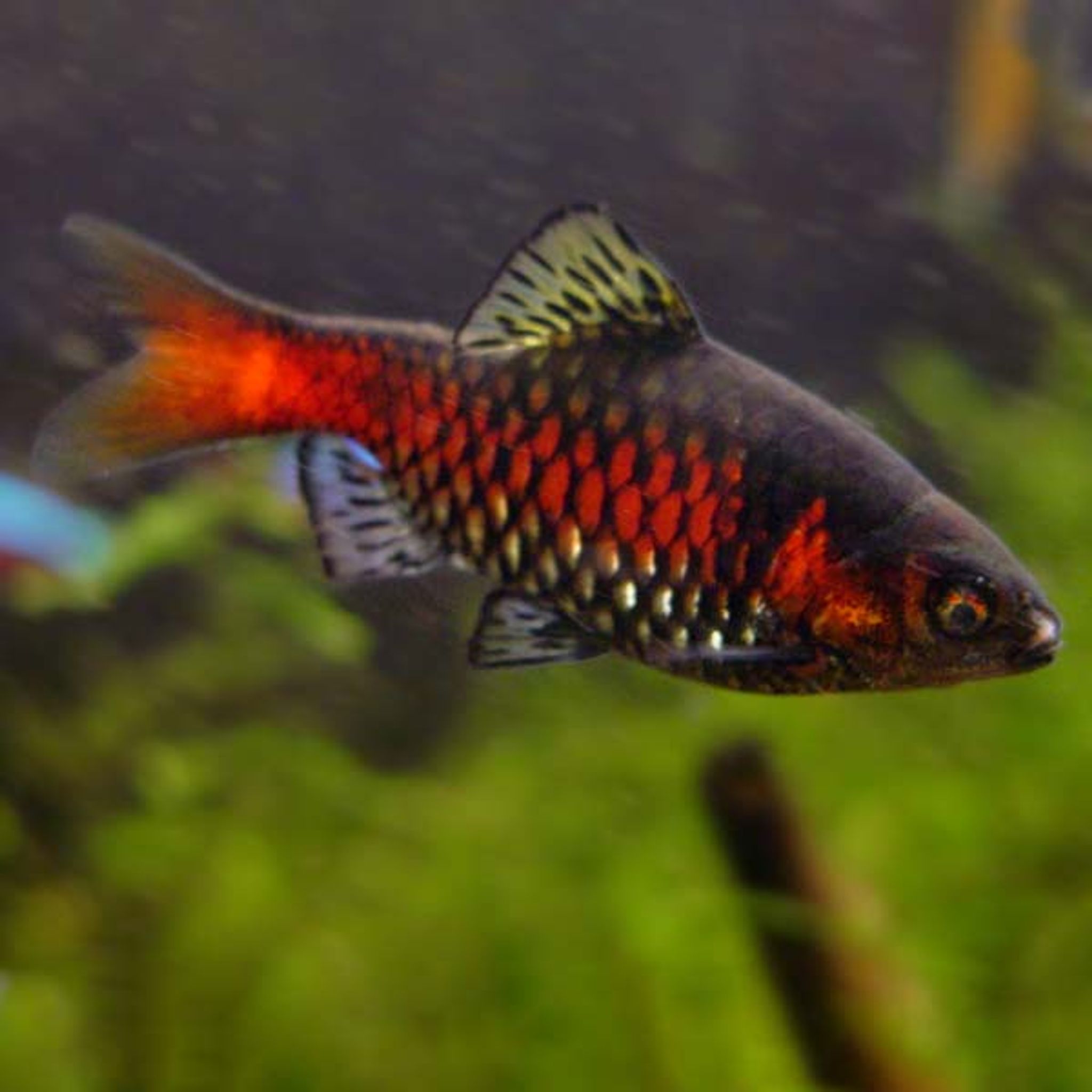

How Big Do Odessa Barb Get? Growth Rate, Adult Size and Tank Planning
Odessa barbs (Pethia padamya) top out at roughly 2 to 2.5 inches (5–6 cm) as adults, with exceptionally well-kept specimens nudging close to 3 inches. That modest size is only half the planning question, though — because these fish must be kept in schools, tank size depends far more on group behavior and swimming room than on the length of a single fish.
Odessa barb size at a glance
The Odessa barb is native to Myanmar and is still sometimes sold under its older scientific name, Puntius padamya. Reported adult lengths vary quite a bit across sources, from as low as 1.5 inches up to 3 inches, which understandably confuses shoppers trying to plan a tank.
The spread mostly comes down to what's being measured: some figures describe typical aquarium-raised size, others cite maximum wild or best-case size, and sex differences blur a single "correct" number.
- Typical adult length: 2–2.5 inches (5–6 cm)
- Maximum under ideal conditions: close to 3 inches (7.5 cm)
- Sex differences: females run slightly larger and deeper-bodied; males are smaller but show the brighter red coloring the species is prized for
Bottom line: plan around 2.5 inches as your working average, and treat 3 inches as the ceiling rather than the norm.
Growth rate: from fry to full adult
Odessa barb fry hatch at just a few millimeters long and grow quickly under good conditions. Here's a general timeline you can use to gauge where a fish sits in its development:
| Age | Approximate length | Life stage |
|---|---|---|
| 0–2 weeks | A few mm | Newly hatched fry |
| 2–3 months | ~1 inch (2.5 cm) | Growing juvenile |
| 5–6 months | ~1.5–2 inches | Sexual maturity reached |
| 12–18 months | 2–2.5+ inches | Full adult size |
If you buy juveniles at a fish store, they're typically sold around 0.5–1 inch. A fish that size is likely only a few months old and still has most of its growing to do — useful to know if you're trying to judge how much bigger your current stock will get before you finalize a tank size.
What speeds up or slows down growth
Growth rate isn't fixed — it responds directly to husbandry:
- Feeding frequency and quality: protein-rich foods (frozen or live brine shrimp, bloodworms, daphnia) accelerate growth compared to a flakes-only diet. Juveniles benefit from three smaller feedings a day rather than one or two large ones.
- Temperature stability: fluctuating temperatures stress fish and slow development; a steady mid-70s°F range supports consistent growth.
- Water quality: frequent water changes and low nitrate keep fish feeding and growing normally; poor water quality suppresses appetite and growth.
- Group size and stocking density: this is the point most care sheets skip entirely. A school kept in a crowded, undersized tank tends to stay smaller and duller-colored than the same fish given a spacious, well-maintained school setup. Crowding stress can functionally stunt growth even when food and water chemistry look fine on paper — so a tank that's "big enough" for six adult-sized fish on paper may still hold back their color and size if it's cramped for a full school swimming together.
Tank size: plan for the school, not the fish
Because Odessa barbs are active, horizontal swimmers that must be kept in groups, tank planning should prioritize footprint and length over height and over the length of a single fish.
| School size | Tank size |
|---|---|
| 6–8 fish | 20 gallons long (absolute minimum) |
| 6–8 fish, recommended | 30 gallons |
| 10+ fish | 40–55+ gallons |
Sources disagree here too — some list 20 gallons as sufficient, others insist on 30. Treat 20 gallons long as a floor for a small group of six, but budget for 30 gallons as the more realistic, comfortable minimum for a proper school. A long, low tank with a wide footprint gives more usable swimming space for schooling behavior than a taller tank holding the same water volume, so when comparing two options with similar gallons, pick the one with more floor area.
Schooling requirements
Keep Odessa barbs in groups of at least 6, ideally 8–10. This isn't just a nicety — under-schooled Odessa barbs are measurably worse pets:
- Increased fin-nipping toward tank mates and each other
- More hiding and reduced overall activity
- Duller male coloration, since red intensity is partly a social/display trait
A single Odessa barb or a pair kept alone is one of the most common beginner mistakes with this species, and it's an easy one to avoid by buying the full group from the start.
Water parameters
Odessa barbs are more temperature-flexible than many popular tropicals, which is worth knowing if your home runs cooler:
| Parameter | Range |
|---|---|
| Temperature | 64–79°F (mid-70s°F is a safe, standard target) |
| pH | 6.0–8.5 (aim for 6.5–7.5) |
| General/carbonate hardness | Soft to moderate (roughly 5–20 dGH / 4–10 KH) |
| Ammonia / nitrite | 0 ppm |
| Nitrate | Under 20 ppm |
The wide reported temperature range (some sources say 64–75°F, others go up to 79°F) reflects real tolerance for cooler water rather than a strict requirement for it. Odessa barbs do fine at standard community tank temperatures — there's no need to run the tank as warm as a discus setup, and doing so unnecessarily just adds heat stress without any benefit to the fish.
Diet
Odessa barbs are omnivorous and easy to feed well:
- A staple flake or micro-pellet for daily nutrition
- Regular live or frozen protein — brine shrimp, bloodworms, daphnia — to support color and growth
- Occasional blanched vegetables for variety
Feed adults once or twice a day; juveniles do better on three smaller feedings to fuel faster growth. Overfeeding juveniles on flakes alone, without protein variety, is a common mistake that slows growth and adds unnecessary waste to the tank, which can trigger ammonia spikes in a young or lightly stocked system.
Temperament and tank mates
Odessa barbs are generally peaceful, but like most barbs they can nip at slow-moving, long-finned fish — especially if the school itself is too small. Bettas, fancy guppies, and angelfish are common victims.
Good tank mates include other barbs, danios, rasboras, corydoras, tetras, bristlenose plecos, and shrimp (with some caution), along with snails. FishyHub's small community fishes category is a good place to browse compatible schooling species, and the barb category is worth checking before you buy, since a few larger barb species get mistaken for Odessa barbs at the store — more on that below.
Avoiding mistaken identity at the store
Odessa barbs can be confused with other similarly patterned barbs, such as ticto or rosy barbs, that grow noticeably larger and need more room. Before buying, confirm the specific species name on the tag or with staff — a fish labeled generically as "barb" isn't necessarily the same compact species you researched, and buying a larger barb by mistake is a fast way to end up needing a bigger tank than planned.
Breeding basics
Odessa barbs are egg-scatterers and considered easy to moderately difficult to breed:
- Eggs typically hatch within 24–48 hours, though some accounts describe it taking a few days
- Adults will eat their own eggs, so they should be removed from the breeding tank promptly after spawning
- Fry need infusoria as a first food, moving on to baby brine shrimp once free-swimming
Failing to separate adults from eggs in time is a common reason home breeding attempts fail.
Lifespan
With stable water and a proper diet, Odessa barbs typically live 3 to 5 years, with excellent care occasionally extending that to around 6 years.
Fishkeeping for renters
A modest adult size and a 20–30 gallon footprint make Odessa barbs a reasonable choice for a rental apartment, but a few practical steps matter:
- Check your lease for weight limits or gallon caps before committing to a tank size
- Place the tank on a load-bearing wall/floor area with a waterproof mat underneath
- Get written landlord approval if your lease requires it, rather than relying on a verbal okay
If you move, stop feeding the fish about 24 hours before transport, bring along filter media and some old tank water to preserve beneficial bacteria, and check water parameters daily for the first week or two in the new setup, since a move can disturb the tank's nitrogen cycle.
Classroom aquariums
Odessa barbs' small size, hardiness, and natural schooling behavior make them a solid option for an educational tank. A few basics matter for a classroom setup specifically:
- Cycle the tank fully before adding any fish — skipping this step is one of the most common classroom and beginner mistakes, and it stresses or kills new arrivals
- Use a 20-gallon or larger tank
- Secure the lid, since barbs are capable jumpers
- Schedule weekly water changes and check temperature daily, since classroom HVAC systems can swing overnight and over weekends
Watching a school interact, grow, and potentially spawn also gives students a genuinely useful, low-cost window into basic biology and ecology concepts.
If your school outgrows the tank
Sometimes a school grows faster than expected, or personal circumstances mean an owner can no longer keep the fish. In that situation:
- Reach out to local hobbyist groups or aquarium clubs, many of whom rehome healthy stock
- Check with pet stores — many accept fish returns or trade-ins
- Consider schools, offices, or other classroom setups that might welcome an established school
- Look at online hobbyist marketplaces or classifieds
Never release aquarium fish into local ponds, lakes, or waterways, and never flush them. Non-native fish generally can't survive long in the wild, and on the rare occasion they do, they can seriously disrupt local ecosystems.
Frequently Asked Questions
How big do Odessa barbs get in a home aquarium?
Most Odessa barbs reach 2 to 2.5 inches (5–6 cm) as adults, with well-fed fish in spacious, well-maintained tanks occasionally approaching 3 inches. Females tend to run slightly larger than males.
How fast do Odessa barbs grow, and when are they full grown?
Fry reach about 1 inch within 2–3 months, hit sexual maturity around 5–6 months, and reach full adult size by roughly 12–18 months given consistent feeding and stable warm water.
What size tank do I need for a school of Odessa barbs?
A 20-gallon long tank is an absolute minimum for a small group of 6, but 30 gallons is the more realistic and comfortable choice for a proper school. Plan on 40–55+ gallons if you want to keep 10 or more.
How many Odessa barbs should be kept together?
Keep at least 6, and ideally 8 to 10. Smaller groups tend to result in more fin-nipping, more hiding, and duller coloration in males.
Do Odessa barbs fin-nip, and what fish should be avoided as tank mates?
They can, particularly when kept in too small a group. Avoid pairing them with slow-moving, long-finned fish like bettas, fancy guppies, or angelfish, and instead look at other barbs, danios, rasboras, corydoras, or tetras.
What water temperature and pH do Odessa barbs need?
They tolerate a fairly wide range of 64–79°F but do best around the mid-70s°F, with a pH of 6.5–7.5 and soft-to-moderate water hardness. There's no need to run the tank as warm as a discus setup.
How long do Odessa barbs live?
Typical lifespan is 3 to 5 years, extending to around 6 years with excellent water quality and diet.
Can Odessa barbs work in a small apartment or classroom tank?
Yes. Their modest adult size and 20–30 gallon footprint suit both settings, provided renters confirm lease weight/gallon rules and classrooms cycle the tank fully before stocking and maintain a consistent maintenance schedule.
Ready to start a school of your own? Browse available stock in FishyHub's freshwater livestock category, or head straight to the barb selection to compare Odessa barbs against similar species before you buy.


