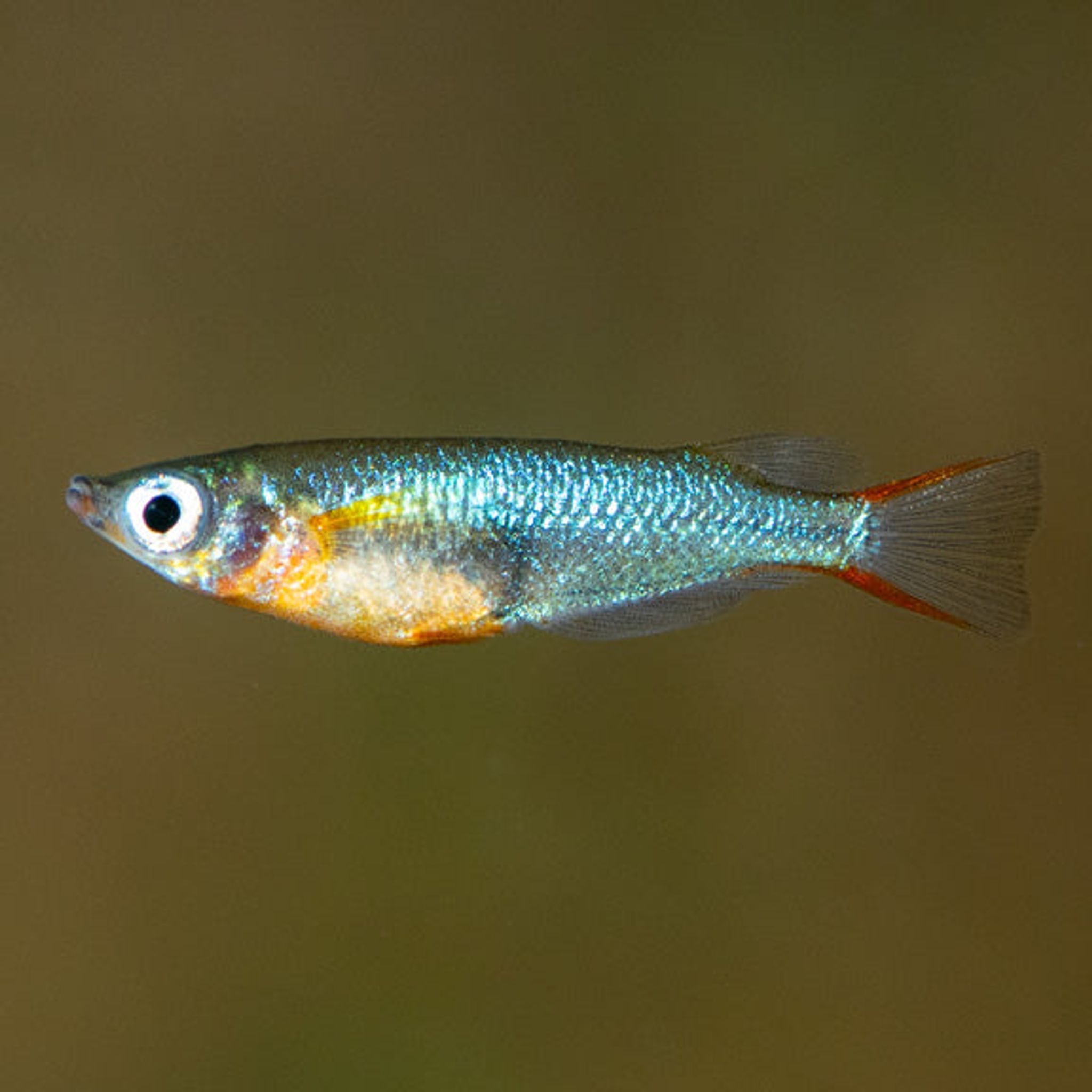
How Big Do Killifish Get? Growth Rate, Adult Size and Tank Planning
There is no single answer to "how big do killifish get," because the group spans roughly 1 inch (2.5 cm) up to nearly 6 inches (15 cm) depending on the species. This guide breaks adult size down by species, explains why killifish grow so fast and live so short, and translates those numbers into gallon-by-gallon tank recommendations.
Why "Killifish Size" Isn't One Number
"Killifish" is not a single species — it's a common name covering hundreds of species across many genera, from inch-long nano fish to predatory 5-inch giants. A size claim for one species should never be applied to the whole group. Before buying, confirm the exact scientific or species name rather than relying on a common name alone, since many overlapping common names describe fish of very different adult sizes.
Quick-Reference Size Table
| Species | Approx. adult length | Suggested tank size |
|---|---|---|
| Least killifish (Heterandria formosa) | 1.0–1.2 in (2.5–3 cm) | 5 gal (19 L) and up |
| Clown killifish / banded panchax | ~2 in (5 cm) | 5–10 gal (19–38 L) |
| Volcano killifish | ~2 in (5 cm) | 5–10 gal (19–38 L) |
| Redspot panchax | ~2 in (5 cm) | 5–10 gal (19–38 L) |
| Gardneri killifish | ~2–2.5 in (5–6.5 cm) | 10 gal (38 L) and up |
| Steel-blue killifish | ~2.5 in (6.5 cm) | 10 gal (38 L) and up |
| Lyretail killifish | ~2.5 in (6.5 cm) | 10–15 gal (38–57 L) |
| Diamond killifish | ~2.5 in (6.5 cm) | 10–15 gal (38–57 L) |
| American flagfish | ~2.5–3 in (6.5–7.5 cm) | 10 gal (38 L) and up |
| Golden wonder killifish | ~3–4 in (7.5–10 cm) | 20 gal (76 L), densely planted |
| Striped panchax | ~4–5 in (10–12.5 cm) | 20 gal (76 L) and up |
| Blue gularis killifish | up to ~5–5.5 in (12.5–14 cm) | 20 gal (76 L) and up |
Exact figures vary by a few tenths of an inch between sources, and wild-caught fish can run slightly smaller than well-fed, captive-bred strains of the same species. Treat these as ranges, not exact specifications, and size your tank toward the upper end of the range for any species you're unsure about.
How Fast Do Killifish Grow?
Killifish grow unusually fast compared to most other freshwater community fish:
- Weeks 1–8: the bulk of body-length growth happens here. Fry can go from barely visible to a noticeable juvenile shape in a matter of weeks.
- 2–4 months: most species reach their full adult body length.
- 9–12 months: full sexual and color maturity (breeding-ready condition) for slower-maturing, non-annual species — though many annual species mature and are ready to breed well before this.
It helps to separate two different milestones: body-length growth (fast, largely finished within a few months) versus full maturity (the color intensity and breeding readiness that can take longer to develop). A killifish that already looks "full grown" by 3 months may still be filling out its adult coloration for several more months.
Why Killifish Grow Fast and Live Short
This rapid growth is tied directly to biology, not just genetics. Many killifish are annual species, native to temporary pools and seasonal wetlands that dry up completely for part of the year. In the wild, these fish have to hatch, grow to full size, breed, and produce the next generation's eggs — all within a single wet season, sometimes just a few months. That evolutionary pressure is why annual killifish grow fast and typically live only 1–2 years in the aquarium.
Non-annual species, which come from more permanent water bodies, don't face the same drying-pool deadline. They grow a bit more gradually and tend to live 3–5 years — closer to what hobbyists expect from other small community fish.
A Simple Way to Tell Annual From Non-Annual Species Before You Buy
Egg-laying behavior is a useful clue at purchase time:
- Species that bury or scatter eggs into soft substrate or peat are usually annual — expect fast growth and a shorter lifespan.
- Species that lay eggs on plants or spawning mops are usually non-annual — expect a somewhat longer lifespan.
This is also why annual killifish eggs are sometimes sold packed in slightly damp peat: the eggs can enter a dormant state (diapause) that mimics the dry season in the wild, letting them be stored and shipped before hatching once rewetted. It's a distinctive part of killifish biology that explains both the "egg trading" side of the hobby and the fast-growth, short-life pattern described above.
What Actually Controls Adult Size
Genetics sets the ceiling, but several factors determine whether a given fish reaches it:
- Diet — a protein-rich diet (live or frozen brine shrimp, daphnia, mosquito larvae, bloodworms) drives faster, fuller growth than a flake-only diet. Flakes alone can leave fish smaller and less colorful than their genetic potential.
- Water quality and stability — clean water and a stable temperature support steady growth; fluctuating conditions can slow it.
- Available space — crowding or an undersized tank can stunt growth, even when food and water quality are otherwise good.
- Sex — in virtually all killifish species, males grow larger and far more colorful than females. A species page listing "2.5 inches" is almost always describing the adult male; females of the same species often run noticeably smaller and plainer.
Translating Size Into Tank Planning
Body length alone understates the space killifish actually need, for two reasons that are easy to miss.
Killifish Are Surface Jumpers First
Most killifish are slim-bodied, surface-oriented fish adapted to skim shallow, oxygen-poor water. That means a tight-fitting lid matters more than raw tank volume — an open-top or loose-lid tank is one of the most common causes of killifish loss, regardless of how appropriately sized the tank is otherwise. Horizontal length and surface area also matter more than depth, since these fish spend most of their time near the top of the water column.
Males Need More Room Than Their Size Suggests
Because males are often aggressive toward each other, the safer stocking ratio is one male to two or three females rather than multiple males in the same small tank. This effectively raises the space requirement beyond what body length alone would suggest — two 2.5-inch males in a 10-gallon tank can cause more stress and fin damage than three fish of mixed sex in the same footprint.
General Stocking Guide
- Nano species (1–2 in): 5–10 gallon (19–38 L) species-only tanks work well.
- Mid-size species (2.5–3 in): aim for 10–20 gallons (38–76 L), especially when keeping a trio or small group.
- Larger species (4 in and up): 20 gallons (76 L) or more, with extra swimming length. Avoid housing them with fish small enough to be treated as food — striped panchax in particular are predatory toward small tankmates.
You can browse appropriately sized setups in FishyHub's glass tanks selection when planning a new killifish tank, and look at live killifish stock to see current species availability.
Common Mistakes to Avoid
- Assuming all killifish stay tiny. Species like striped panchax or blue gularis can reach 4–5.5 inches — a 5-gallon tank bought for a "small colorful fish" can become undersized within months.
- Underestimating jumping ability. A loose or open lid is a top cause of killifish loss at any tank size.
- Keeping multiple males together in a small tank. Body-size numbers can look tank-appropriate while male aggression still causes stress and stunted growth.
- Feeding only dry flake food. This can slow growth and dull color compared with a live or frozen protein-rich diet.
- Mixing larger predatory killifish with small tankmates. Species such as striped panchax will treat small fish as food.
- Expecting a multi-year pet like other nano fish. Many killifish live only 1–2 years; that short lifespan is a normal part of their biology, not a sign something went wrong.
- Generalizing size across "killifish." A number from one species shouldn't be applied to a different genus.
It's also worth checking condition, not just species, when buying: wild-caught killifish are often smaller and thinner on arrival than captive-bred fish of the same species. Give a newly acquired wild-caught fish time — and a steady, protein-rich diet — to reach standard adult proportions rather than assuming it is a smaller variety.
Similar Small Fish for Comparison
Peacock Gudgeon (Not a True Killifish, but Commonly Cross-Shopped)
Peacock gudgeons are a colorful nano fish frequently shopped alongside killifish for similarly sized tanks. Adults reach about 1.5–3 inches, with males running larger (around 3 inches) than females (roughly 1.5–2 inches) — the same male-larger pattern seen in killifish. With good diet, water quality, and space, they reach full size in about 4–6 months, slightly slower than many killifish but still fast compared to typical community fish.
Other Small Freshwater Gobies
Peacock gudgeons belong to a broader group of small freshwater gobies that pair well with killifish-style setups because they share similar space and water needs. If you're stocking a nano or species tank, it's worth browsing FishyHub's small community fishes category for other compact species that fit the same 5–20 gallon range.
Did You Know: Pupfish, the Killifish's Desert Relatives
Pupfish (family Cyprinodontidae) are close relatives of killifish and share the same small-size, fast-life-cycle pattern. They're typically 1–3 inches, extremely hardy, and adapted to some of the harshest, most isolated water bodies in the US Southwest — desert springs, saline pools, and shallow seasonal water that would kill most other fish.
One species stands out as a conservation story: the Devils Hole pupfish, found in a single warm, spring-fed limestone cavern in the Mojave Desert region of Nevada. Adults measure barely 1.2 inches. The wild population has swung dramatically over the decades — from around 550 fish in the 1970s down to as few as roughly 35 in 2013, recovering since to around a couple hundred. It is critically endangered, protected by law, and illegal to collect; it is not and never has been an aquarium species, but it's a striking example of how small and fragile a killifish-relative's entire world can be. Several other pupfish species face similar endangerment from habitat loss across the Southwest.
Killifish Diversity Is Still Being Documented
New dwarf killifish species and rediscovered regional populations — including small West and Central African species, such as newly described Cameroon-region killifish — continue to turn up in isolated seasonal pools. This ongoing discovery reinforces the core point of this guide: adult size truly depends on the exact species, and common names can mask real differences between fish. Many wild killifish populations, including species from small, shallow, seasonal pools in southeastern Africa and similar regions, live in exactly the kind of temporary habitat that explains their small size and fast, compressed life cycle.
Frequently Asked Questions
How big do killifish get on average?
Most popular species land in the 1–3 inch range as adults, with a handful of outliers reaching 5–6 inches. Always check the specific species rather than assuming an average applies.
How fast do killifish grow?
Very fast — most species reach adult body length within 2–4 months, quicker than many other freshwater community fish. Full color and breeding maturity can take a few months longer.
What is the smallest killifish?
The least killifish (Heterandria formosa), at around 1–1.2 inches, is among the smallest fish species kept in the freshwater hobby.
What is the largest killifish?
Species like the blue gularis and striped panchax are among the largest commonly kept killifish, reaching roughly 4.5–5.5 inches.
What size tank do killifish need?
It depends on the species: 5 gallons works for the smallest nano species, 10–20 gallons suits typical 2–3 inch species, and 20 gallons or more is recommended for larger species or for trios and small groups.
Why do killifish have such short lifespans?
Many killifish are "annual" fish, evolved to complete their entire life cycle in temporary seasonal pools before the water dries up. That pressure drives both their fast growth and their short lifespan, typically 1–2 years for annual species and 3–5 years for non-annual species.
Can diet or tank size affect how big a killifish gets?
Yes. Cramped tanks, poor diet, and unstable water can stunt or slow growth, while a protein-rich diet and stable, roomy conditions help a fish reach its genetic size potential.
Do male and female killifish grow to different sizes?
Yes, in most species males grow larger and considerably more colorful than females. Published size figures for a species almost always describe adult males.
Ready to plan a tank around real adult sizes rather than guesswork? Browse current stock in FishyHub's killifish category to match species and size to the tank you already have — or the one you're about to set up.


