
How Big Do Jack Dempsey Get? Growth Rate, Adult Size and Tank Planning
A Jack Dempsey typically reaches 8 to 10 inches (20-25 cm) as a captive adult, with most of that growth happening in the first 18 to 24 months. This guide breaks down the growth timeline month by month, explains the tank size and footprint you need to plan for before you buy, and covers why "keeping them small" in an undersized tank is not actually safe.
Species Snapshot
The Jack Dempsey (Rocio octofasciata) is a Central American cichlid native to freshwater river systems in Mexico and Central America. It's popular for its metallic spangling and bold personality, but its eventual size and territorial nature catch a lot of new keepers off guard when they start out with a 1-2 inch juvenile in a small tank.
- Typical captive adult size: 8-10 in (20-25 cm)
- Wild-population ceiling: up to 15 in (38 cm), though this is rarely seen in home aquariums
- Lifespan: 8-15 years with good care, most commonly 10+ years
- Temperament: territorial, semi-aggressive to aggressive as it matures
Sources vary on the exact adult ceiling, with numbers anywhere from 7-8 in to 10-15 in. The practical takeaway: plan around 8-10 in as the realistic adult size for a well-kept tank fish, and treat anything past that as an upper outlier tied to wild populations or exceptionally large systems, not a typical expectation.
Growth Rate: A Size-by-Age Chart
Jack Dempseys grow quickly compared to many other cichlids, especially in the first year. Growth then slows sharply once they approach adult size. These are approximate benchmarks — individual growth varies with diet, water quality, genetics, and tank conditions.
| Age | Approximate Length |
|---|---|
| Newly free-swimming fry | Under 0.5 in |
| 1-2 months | ~1 in |
| 3-4 months | 2-3 in |
| 6 months | 3-4 in |
| 1 year | 5-7 in |
| 18-24 months | 8-10 in (near full adult size) |
| 2+ years | Very slow thickening/filling out continues |
A common rule of thumb: a 3-inch juvenile can reach roughly 10 inches within about a year to two years under good conditions — that's close to an inch of growth per month during the fastest stretch. Sexual maturity is generally reached around 7-8 inches in body length, typically at 10-14 months old.
After 18-24 months, growth slows dramatically. The fish doesn't keep lengthening indefinitely; instead it continues to fill out and thicken through the body and fins for another year or two before essentially stabilizing.
Male vs. Female Size and Appearance
Sexual dimorphism becomes noticeable as a Jack Dempsey matures, and it's directly tied to eventual adult size:
- Males: typically larger, reaching up to 10 in, with longer, more pointed extensions on the dorsal and anal fins, plus heavier iridescent spangling across the body.
- Females: generally smaller, around 6-8 in, with a rounder body shape and, in many individuals, a dark blotch on the dorsal fin that's less common in males.
A word of caution: don't try to sex a young fish or predict its final size from early coloration or fin shape. These traits develop gradually, and a juvenile that looks like a small, plain female at 3 months may still turn out to be a large, elaborately finned male at 18 months.
Tank Size: Gallons and Footprint
Sources disagree on the minimum, with figures ranging from 40 to 80 gallons for a single adult. Here's how to read that range sensibly:
- 55 gallons — the absolute floor for one adult long-term. Workable, but not generous.
- 75-80 gallons — the recommended standard for one adult or a bonded pair. This is the size to actually plan and shop for.
- 100+ gallons — needed once you start adding tank mates.
- Add roughly 20-30 gallons per additional Jack Dempsey beyond the first.
Gallons alone don't tell the full story, though. Because Jack Dempseys are bottom- and mid-water fish that stake out floor territory, footprint (length and width) matters more than tank height. A tall, narrow tank with the "right" gallon count still cramps a fish that wants to patrol a stretch of floor space. As a practical target, look for a footprint of at least 48 inches long for a single adult, rather than judging a tank by gallons alone.
Buy-for-the-Adult Checklist
Before buying that appealing 1-2 inch juvenile, plan the setup you'll need in 12-18 months, not the one that looks fine today:
- Starter tank: if you're not starting directly in a 55-75 gallon tank, have a clear upgrade timeline mapped to the growth chart above — most keepers need to move up well before the one-year mark.
- Filtration capacity: rate your filter for the adult size and bioload, not the juvenile's current waste output.
- Footprint first: prioritize a long, wide tank over a tall one.
- Tank mate plan: decide up front whether this will be a single-fish tank or a compatible community, since that changes the gallon target significantly.
Shoppers comparing tank options for a growing cichlid can browse glass aquarium tanks sized for the 55-80 gallon range this species needs as an adult.
Water Parameters and Filtration
Stable, warm water with strong biological filtration supports healthy, steady growth:
- Temperature: 72-86°F (22-30°C), with the mid-70s to low 80s°F considered ideal
- pH: tolerant of a fairly wide range, roughly 6.0-8.0, with 6.5-7.5 ideal — stability matters more than hitting an exact number
- Hardness: roughly 9-20 dGH
- Ammonia/nitrite: 0 ppm; nitrate: under 20-40 ppm
Because Jack Dempseys are large, messy eaters, filtration needs to scale with the fish. A filter sized for a juvenile will fall behind within months. Browse filters rated for at least the gallon capacity of the adult setup, and plan to upgrade filtration alongside the tank itself rather than waiting until water quality slips.
Diet's Role in Growth Rate
Diet has a direct, measurable effect on how quickly a Jack Dempsey reaches adult size:
- Staple: high-protein cichlid pellets
- Supplements: bloodworms, brine shrimp, earthworms, chopped shrimp or fish, occasional vegetable matter
- Juveniles: feed 2-3 times per day for faster, more even growth
- Adults: feed 1-2 times per day, with portions the fish clears within about 2 minutes to avoid overfeeding and water quality crashes
A common mistake is feeding a flake-only, low-protein diet and then being surprised by slow or uneven growth. Protein content and feeding frequency are among the biggest levers you have over growth rate, alongside tank size and water quality.
Other Factors That Influence Growth
- Territory and space: cramped quarters slow growth and increase stress.
- Water quality: frequent water changes support consistent growth; poor water quality suppresses it.
- Competition: in a shared tank, a submissive fish can be outcompeted for food and grow more slowly than a fish kept alone.
- Genetics: wild-type lines and different tank-bred lines can show some variation in ultimate size.
Why Stunted Growth Is Not "Staying Small Safely"
A widespread misconception is that keeping a Jack Dempsey in an undersized tank will simply keep it small and manageable. In reality, a fish that stays small in a small tank is usually stunted, not safely miniaturized. Stunting is associated with:
- Curved spine and skeletal deformities
- Compressed or impaired internal organs
- Shortened lifespan
- Increased aggression, rather than a calmer, smaller fish
An undersized tank paired with poor water quality is a common path to stunting — it's a health and welfare issue, not a space-saving shortcut.
Tank Mates and Adult Size
Because adults reach 8-10 inches and hold territory aggressively, tank mate choices have to account for that eventual size from day one, not the juvenile's current size. Peaceful, small community fish that look like fine housemates for a 2-inch juvenile are frequently outgrown, bullied, or eaten once the Dempsey matures. Suitable tank mates need to be similarly robust and sized, with enough tank footprint for everyone to establish their own space. If you're stocking around a Jack Dempsey, it helps to shop within the American cichlids category for species with comparable size and temperament.
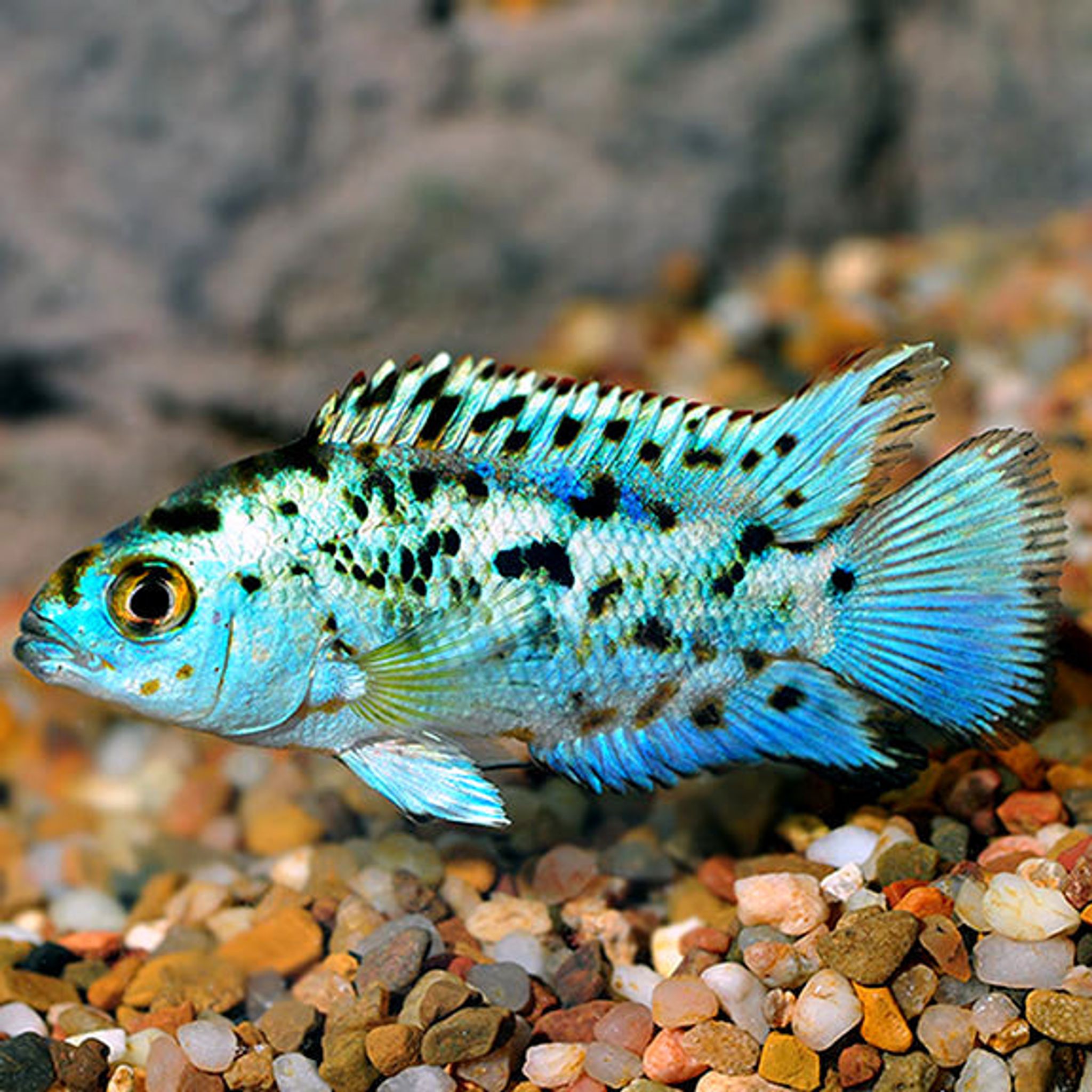
Electric Blue Jack Dempsey: A Smaller, Calmer Variant
The Electric Blue Jack Dempsey is a color morph of the same species, prized for its solid blue-to-turquoise coloration. It's worth knowing this variant differs from the standard/wild-type in more than just color:
| Trait | Standard Jack Dempsey | Electric Blue Jack Dempsey |
|---|---|---|
| Typical adult size | 8-10 in | ~6-8 in |
| Temperament | Territorial, semi-aggressive to aggressive | Generally less aggressive |
| Coloration | Dark body with iridescent spangling | Solid electric-blue coloration |
If a slightly smaller, somewhat calmer cichlid with the same general care needs appeals to you, the Electric Blue variant is worth considering — just don't expect it to be dramatically smaller or fully peaceful.
Frequently Asked Questions
How big does a Jack Dempsey get in a 55-gallon tank?
A single adult can still reach close to its full 8-10 inch size in a 55-gallon tank long-term. However, 55 gallons is the minimum, not the comfortable target — 75-80 gallons gives the fish more usable floor space and an easier margin for water quality.
How fast do Jack Dempseys grow?
They grow relatively fast for a cichlid — roughly an inch per month in good conditions during the first year — and reach near-adult size by 12-24 months. Growth then slows considerably.
Do Jack Dempseys stop growing?
Growth slows dramatically after 18-24 months, once the fish is near full size, though very slow filling-out and thickening can continue for another year or two. They don't keep growing indefinitely.
What's the difference in size between male and female Jack Dempseys?
Males are typically larger, up to about 10 inches, with longer, more pointed fins and heavier spangling. Females are generally smaller, around 6-8 inches, with a rounder body shape.
Can a small tank stunt a Jack Dempsey's growth?
Yes. An undersized tank combined with poor water quality can stunt growth, which harms the fish's health and shortens its lifespan rather than being a safe way to keep it smaller.
How big of a tank does a Jack Dempsey need as an adult?
Plan for 55 gallons as an absolute minimum, with 75-80 gallons recommended for one adult or a bonded pair, and 100+ gallons if you're adding tank mates.
Is the Electric Blue Jack Dempsey a different size than the regular one?
Yes, it generally stays a bit smaller — roughly 6-8 inches as an adult — and tends to be less aggressive than the standard, wild-type coloration.
How long do Jack Dempseys live, and does lifespan relate to size or tank size?
With good care, Jack Dempseys typically live 8-15 years. Undersized tanks and the poor water quality that often comes with them can stunt growth and tend to shorten lifespan as well.
Planning ahead for an adult-sized Jack Dempsey means shopping for the tank, filtration, and tank mates it will need in a year — not just the juvenile in front of you today. You can browse tanks and stands sized for a growing cichlid setup on FishyHub.


