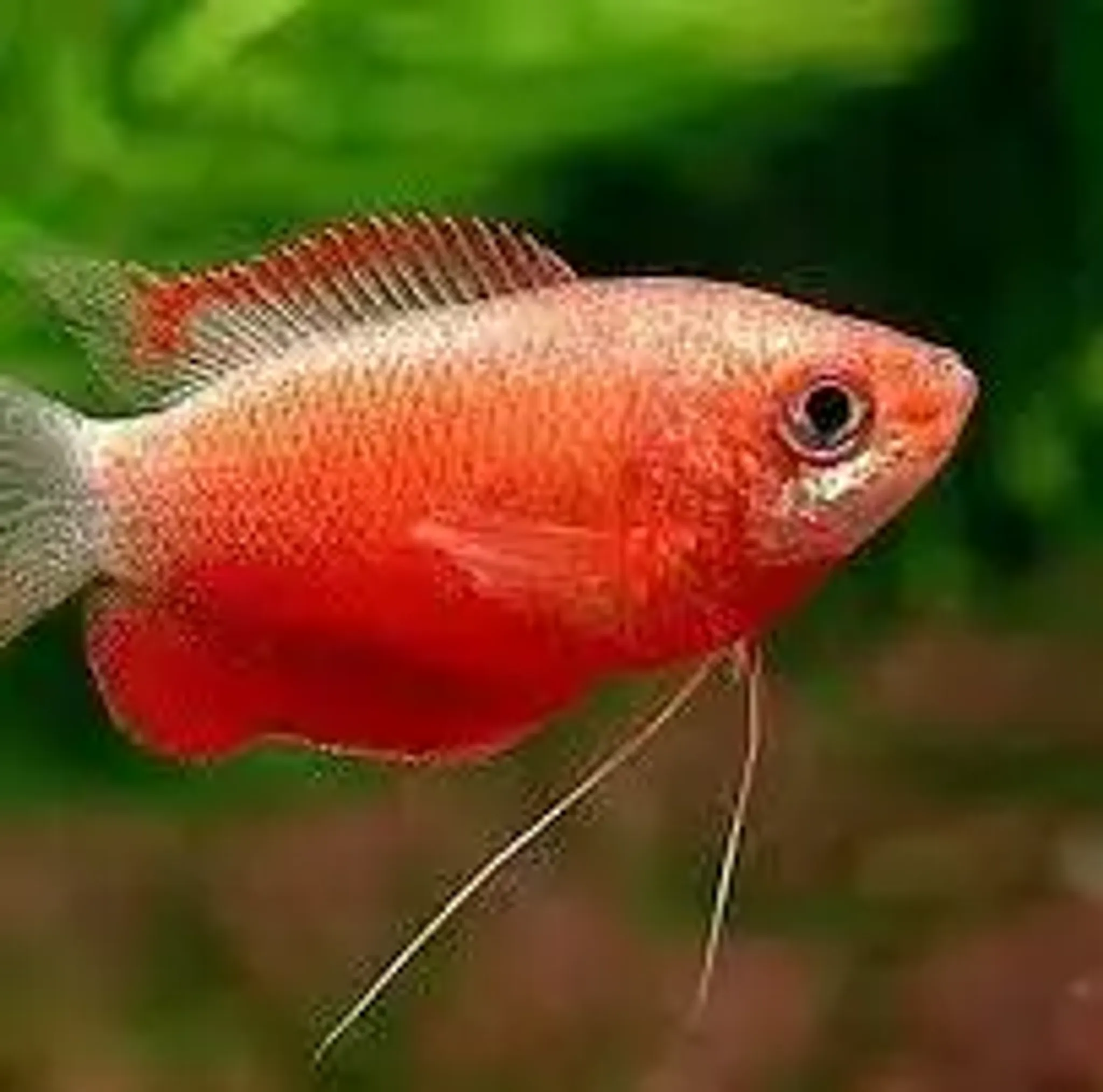

How Big Do Honey Gourami Get? Growth Rate, Adult Size and Tank Planning
A honey gourami tops out at around 2 inches (5 cm), making it one of the smallest members of its genus and a realistic fit for a well-set-up 10-gallon tank. Reaching that size takes roughly 9 to 12 months, and how close a fish gets to its genetic potential depends heavily on diet, water quality, and tank conditions along the way. This guide breaks down the numbers, the growth timeline, and exactly what to set up so your fish grows the way it's supposed to.
Adult Size: What to Actually Expect
Most keepers can expect an adult honey gourami to land right around 2 inches (5 cm) in total length. That figure is the reliable average across the species, but there's a real spread within it:
- Males tend to run slightly smaller and slimmer, typically 1.5–2 inches (3.8–5 cm).
- Females usually finish a bit larger and noticeably deeper-bodied, often reaching 2–2.5 inches (5–6.4 cm).
- Occasional outliers stretch to 3 inches (7.6 cm) under ideal, low-stress conditions with excellent food and space — but treat that as an upper ceiling, not a typical result.
If a source you've read quotes a bigger number across the board, double-check which fish it's describing. "Honey gourami" is sometimes used loosely to cover sunset and robusta gourami color morphs, which can run larger than the standard honey gourami. When you're comparing size claims across different articles or listings, confirm you're comparing the same fish.
Size Comparison With Other Small Labyrinth Fish
Honey gourami are frequently shortlisted alongside other compact labyrinth fish. Here's how they stack up:
| Species | Typical Adult Size | Temperament |
|---|---|---|
| Honey gourami | ~2 in (5 cm) | Peaceful, semi-social |
| Sparkling (pygmy) gourami | 1–1.5 in (2.5–3.8 cm) | Peaceful, shy |
| Dwarf gourami | 2.5–3.5 in (6.4–9 cm) | Peaceful but territorial between males |
| Betta (Betta splendens) | 2.5–3 in (6.4–7.6 cm) | Territorial, especially males |
Honey gourami land on the smaller end of this group, which is exactly why they show up so often in the same searches as betta tank sizing — both fish share a nano-tank footprint and a labyrinth organ, even though their temperaments differ.
Growth Timeline: From Fry to Full Size
Growth isn't linear. A honey gourami's development follows a fairly predictable curve, and knowing where a fish sits on that curve helps you catch problems early.
| Age | Growth Stage | What to Prioritize |
|---|---|---|
| 0–6 weeks | Fastest growth phase | Frequent small feedings of appropriately sized foods; stable, frequent water changes |
| 6 weeks–6 months | Growth slows, steady gains | Increase food variety and protein; keep up regular water changes as bioload grows |
| 6–9 months | Approaching adult proportions | Consistent feeding schedule; monitor for early territorial behavior in groups |
| 9–12 months | Full adult size, sexual maturity | Maintenance-level feeding and water changes; size is largely locked in |
Fry pack on length fastest in the first six weeks, then growth tapers off between six weeks and six months as the fish shifts energy toward filling out and developing color and finnage. By 9 to 12 months, given good food and stable water, a honey gourami has reached both its full adult size and sexual maturity.
What Actually Determines Final Size
Genetics sets the ceiling, but several environmental factors decide how close a fish gets to it:
- Diet quality and protein content — a protein-poor, all-flake diet slows growth and can leave adults visibly undersized.
- Water quality and stability — inconsistent parameters or ammonia/nitrite spikes divert energy toward stress response instead of growth.
- Stocking density and stress — crowded or highly competitive setups can stunt growth, especially in subordinate fish.
- Genetics and stock quality — fish from better-conditioned breeding stock tend to reach fuller size and richer coloration than mass-market stock raised under crowded, high-turnover conditions. This is rarely mentioned, but it's a real factor if you're comparing two fish that look different sizes despite similar care.
- Tank size — an undersized, poorly maintained tank is one of the most common and most preventable causes of stunted growth.
Tank Size: How Much Space Do They Need
The safe floor is 10 gallons (38 L) for a single honey gourami. You'll occasionally see 5 gallons cited for one fish, but that's a bare minimum some keepers report getting away with short-term — it's not a setup that supports full growth or stable water long-term, so it's not what we'd recommend.
For groups, plan around this rough guide:
| Group Size | Recommended Tank | Notes |
|---|---|---|
| 1 fish | 10 gal (38 L) | Absolute floor, not ideal long-term |
| Pair (1 male, 1 female) | 20 gal (76 L) | Common baseline recommendation |
| Small group (3–5) | 20–30 gal (76–114 L) | Add ~5 gal per additional fish beyond the first pair |
| Multiple males | 30+ gal (114+ L) with dense cover | Extra space and visual breaks reduce territorial disputes |
That "add roughly 5 gallons per additional fish" rule is a starting point, not an exact formula — it assumes moderate planting and a peaceful community mix. If you're adding multiple males, budget extra space and plenty of plant cover so they can break line of sight with each other rather than sparring constantly.
Water Parameters and Environment
Honey gourami come from slow-moving, densely vegetated waters, and their ideal setup reflects that:
- Temperature: 71–82°F (22–28°C)
- pH: 6.0–7.5 is the sweet spot; they'll tolerate up to about 8.0
- Hardness: soft to moderately hard, roughly 4–15 dGH
- Flow: slow-moving — avoid pointing a strong filter outflow directly into the water column
- Lighting: moderate, not intense
- Cover: dense planting plus floating plants for both security and comfortable surface breathing
They're adaptable within these ranges, which is part of why they're recommended alongside bettas and other nano-tank fish, but stability matters more than hitting an exact number.
Diet
Honey gourami are omnivorous and do best on a mixed diet:
- A quality flake or pellet as the base
- Live or frozen protein a few times a week — bloodworms, brine shrimp, tubifex
- Some vegetable matter for balance
Feed 1–2 times daily, offering only what the fish clear in 2–3 minutes. Skimping on protein variety is one of the more common mistakes — an all-flake diet can slow growth and dull adult coloration.
Setting Up the Right Tank
A good nano or 10–20 gallon all-in-one kit for a small labyrinth fish should have:
- Gentle, adjustable filtration — a sponge filter or a hang-on filter with flow you can turn down works well; avoid anything that creates strong current
- A tight-fitting lid — labyrinth fish breathe warm, humid air just above the waterline, and a drafty gap can chill that air and stress the fish
- A reliable heater — to hold a steady temperature within the 71–82°F range
You can browse tank-appropriate stock in FishyHub's gourami category, and gentle-flow options in the filters category if you're building a setup from scratch.
Temperament and Tankmates
Honey gourami are peaceful and not strictly a schooling fish — they do fine alone or in a small group. Good tankmates include corydoras, otocinclus, small tetras and rasboras, small barbs, danios, guppies, kuhli loaches, and small rainbowfish. Avoid fin-nippers and larger or aggressive species. They can share a tank with bettas in a large-enough, well-planted setup with slow flow, though it's worth watching both fish since each displays bright color and finnage that can trigger territorial posturing.
Reading Surface Behavior Correctly
Like bettas, honey gourami have a labyrinth organ that lets them breathe atmospheric air — so gulping air at the surface is completely normal, not a sign of a struggling fish. What isn't normal:
- Clamped fins
- Lethargy or resting vertically/head-down
- Rapid gilling or constant surface-gasping with red, inflamed gills
The first list is just labyrinth-fish biology. The second points to poor water quality, low oxygen, or a gill issue and warrants a water test. A fish hovering near the filter outflow is usually just enjoying the current or seeking better-oxygenated water — but if you're seeing several fish crowd the outflow at once, it's worth checking your stocking level and surface agitation.
Color Changes
A honey gourami (or a betta) losing its usual vivid color is commonly linked to stress, poor water conditions, illness, age, or simply non-breeding "resting" coloration. It's not automatically an emergency, but it's a signal to check parameters rather than ignore.
Acclimating a New Fish
Whether you're adding a honey gourami or any other labyrinth fish, use the drip or float-and-add-water method over 15–30-plus minutes. Floating the bag to match temperature, then gradually adding small amounts of tank water, lets the fish adjust to both temperature and chemistry slowly and cuts down on shock — especially important for smaller, more sensitive juveniles.
Breeding Basics
Honey gourami are bubble-nest builders. A dedicated breeding tank of 10–20 gallons at a slightly warmer 79–84°F encourages spawning. Females release roughly 20 eggs per clutch and may spawn repeatedly; fry become free-swimming about 3 days after hatching.
Common Mistakes to Avoid
- Undersized tanks (under 10 gal) — leads to stunted growth and unstable water.
- Overcrowding without upsizing — especially with multiple males, this drives aggression.
- Too much flow from an oversized filter — use a sponge filter, spray bar, or baffle instead.
- Skipping acclimation — causes pH or temperature shock, particularly in juveniles.
- All-flake diets with no protein variety — slows growth and dulls color.
- No lid — labyrinth fish need warm, humid surface air; a drafty tank stresses them.
- Misreading normal air-gulping as illness, or the reverse — ignoring genuine gasping tied to a real water-quality problem.
Frequently Asked Questions
How big does a honey gourami get?
About 2 inches (5 cm) on average as an adult, with occasional individuals reaching up to 3 inches (7.6 cm) under ideal conditions.
How fast do honey gourami grow?
Growth is fastest in the first 6 weeks, then slows and continues steadily until the fish reaches full adult size and sexual maturity around 9–12 months.
What size tank does a honey gourami need?
A 10-gallon (38 L) tank is the minimum for one fish, and 20 gallons (76 L) is the common recommendation for a pair or small group, with roughly 5 gallons added per additional fish.
Do male or female honey gourami get bigger?
Females typically finish slightly larger and deeper-bodied, often 2–2.5 inches, while males stay more slender at around 1.5–2 inches.
Can honey gourami live with bettas?
Generally yes, in a large-enough, well-planted tank with slow flow, since both are peaceful labyrinth fish — but keep an eye out for territorial displays since both species show bright color and finnage.
Why is my honey gourami not growing?
The most likely causes are an undersized tank, inconsistent water quality, insufficient dietary protein, or stress from tankmates or overcrowding.
Is it normal for my fish to gulp air at the surface?
Yes — labyrinth fish like honey gourami and bettas breathe atmospheric air this way. It only becomes a concern alongside clamped fins, lethargy, vertical resting, or rapid gilling.
What causes a betta or gourami to lose its color?
Stress, poor water quality, illness, age, or simply a non-breeding resting state can all dull normal coloration.
Once your tank and water parameters are dialed in, browse FishyHub's small community fishes and bettas categories to find compatible tankmates for your honey gourami setup.


