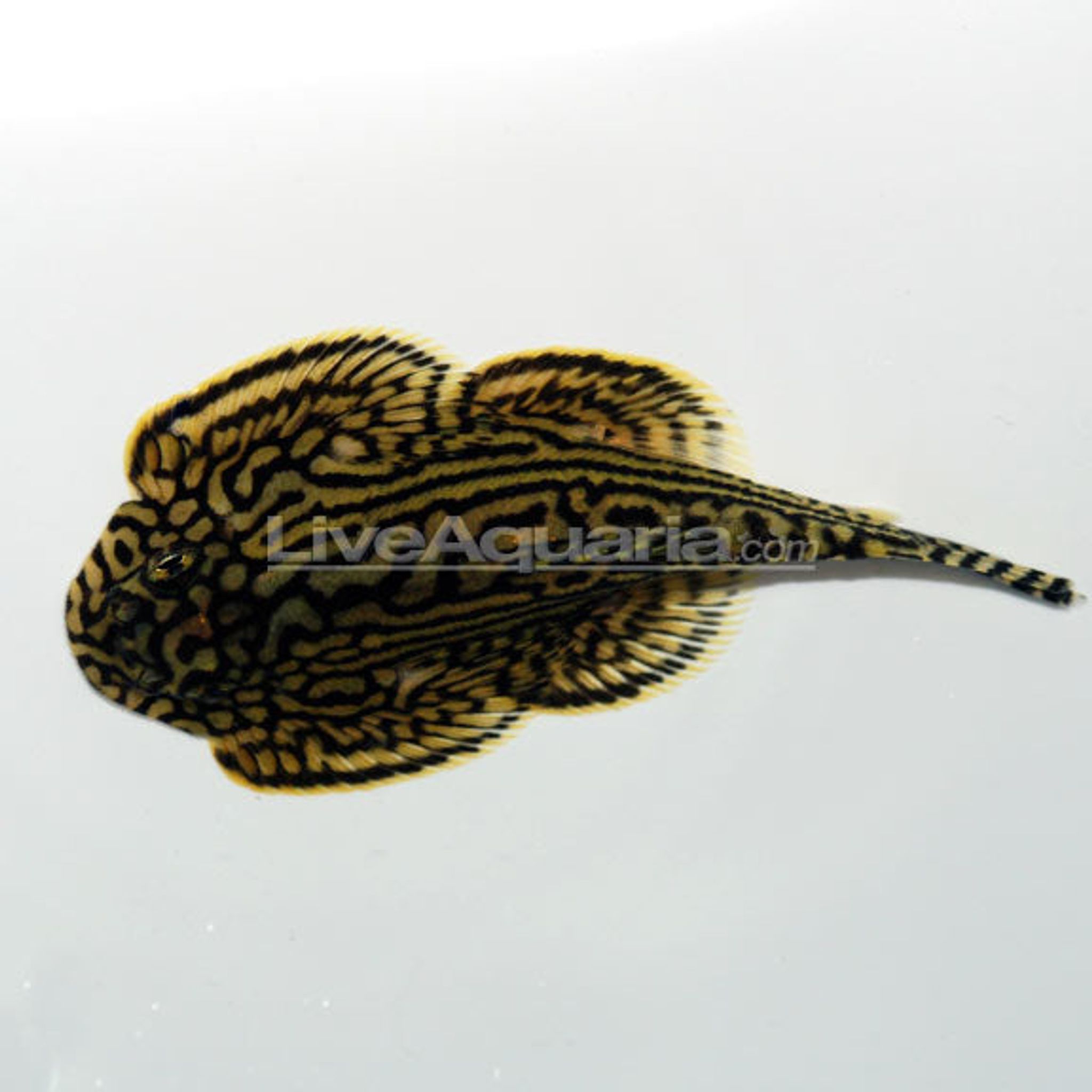

How Big Do Hillstream Loach Get? Growth Rate, Adult Size and Tank Planning
Most hillstream loaches top out around 2–3 inches (5–7.5 cm) as adults, and they get there slowly, usually over 12–18 months. Because they stay small, the real planning challenge isn't volume — it's giving them enough flat, flowing, cool water to actually thrive.
Adult Size: What "Full Grown" Really Looks Like
"Hillstream loach" is a trade name that covers several different genera, and their sizes vary slightly:
| Species (common trade name) | Typical adult length |
|---|---|
| Sewellia lineolata (reticulated/butterfly loach) | 2–2.5 in (5–6 cm) |
| Beaufortia kweichowensis (butterfly hillstream loach) | 2–2.5 in (5–6 cm) |
| Gastromyzon spp. | 2.5–3 in (6.5–7.5 cm) |
| Pseudogastromyzon spp. | 2–2.5 in (5–6 cm) |
For planning purposes, treat 2–3 inches (5–7.5 cm) as the safe range and design your tank around the top end. A few individuals, especially well-fed Gastromyzon, can run slightly larger than the low-end figures you'll see quoted elsewhere.
Sexing them at full size is subtle: males tend to develop slightly larger pectoral fins with more pronounced fin rays, and females often look a bit rounder-bodied when carrying eggs. Neither difference is large enough to change your tank math.
Growth Rate: How Fast Do They Actually Grow?
Hillstream loaches are slow, steady growers rather than fish that shoot up in a few months. Juveniles are usually sold around 1 inch (2.5 cm) and need roughly 12–18 months of stable, cool, high-flow, well-oxygenated water to approach full size.
A rough growth-stage guide, assuming good husbandry throughout:
| Age from purchase | Approximate length |
|---|---|
| At purchase (juvenile) | ~1 in (2.5 cm) |
| 3 months | 1.25–1.5 in (3–4 cm) |
| 6 months | 1.5–2 in (4–5 cm) |
| 12 months | 2–2.5 in (5–6 cm) |
| 18 months | 2–3 in (5–7.5 cm), near-final size |
These are approximate and will shift with genus, feeding, and water quality — but the trend holds: expect a slow build, not a growth spurt.
Growth stalls under poor conditions. Weak flow, low dissolved oxygen, or water that's consistently too warm are the three most common reasons a hillstream loach stays undersized or stops growing altogether. This is one of the most searched questions about the species, so it's worth repeating: if your loach isn't growing, look at husbandry before assuming it's just a small individual.
Why Footprint Matters More Than Volume
Hillstream loaches have a flattened, sucker-mouthed body built to cling to rocks and glass in fast-moving water. They spend almost all their time grazing horizontal and vertical surfaces rather than swimming through open water. That means:
- Floor space and glass surface area determine how many fish a tank can comfortably support — not gallons alone.
- A tall tank wastes space they'll never use for grazing, while a long, shallow, wide tank maximizes usable surface.
- Rockwork, slate, and driftwood add grazable surface area without expanding the tank's actual footprint.
When comparing two tanks of similar gallon capacity, always pick the one with the larger floor and back-wall surface area for this species.
Tank Size: A Tiered Answer
Recommendations for hillstream loach tank size vary a lot online, from 20-gallon minimums to 50-gallon "recommended" figures. The gap makes more sense once you account for group size:
| Group size | Minimum footprint |
|---|---|
| 2–3 fish | 20 gallons long (absolute minimum) |
| 5–6+ fish (recommended group) | 40–55 gallons long or larger |
Hillstream loaches are social, shoaling grazers that do noticeably better in groups of five or six or more — a pair or trio kept alone is more prone to hiding and stress. Since footprint scales with group size rather than with adult body length, plan the tank around how many fish you want long-term, not just the fact that each one only reaches a few inches.
A long, low-profile glass tank with generous floor and back-wall area is a better match for this species than a taller tank with the same water volume.
Group Size and Territory
Males can spar over algae patches and favored rock perches. More surface area and more hiding spots (rock caves, driftwood, PVC sections) spread that territorial behavior out and reduce squabbles. If you're seeing repeated chasing or nipped fins among males, the fix is usually more flat surface and more visual breaks, not fewer fish.
Temperature: A True Cool-Water Species
This is where hillstream loaches diverge sharply from most tropical community fish. Their ideal range is roughly 65–75°F (18–24°C), and they should generally be kept below 78°F (25.5°C). A standard heated community tank running 78–82°F (25.5–28°C) is too warm for them long-term and commonly leads to stress, poor appetite, and a shortened lifespan.
Because they're one of the few true cool/cold-water algae grazers available in the hobby, they're a good fit for:
- Unheated or lightly heated setups
- Subtropical planted tanks
- Paludariums with a cooler water section
This sets them apart from typical tropical algae eaters like otocinclus or common plecos, which need standard tropical heat and can't be substituted into a cool-water setup the same way.
Do You Need a Chiller?
Only if your room or tank regularly runs above about 78–80°F (25.5–27°C). Options, roughly cheapest to most precise:
- Room air conditioning or a portable AC unit in the fishroom
- Fans blowing across the water surface to increase evaporative cooling
- Frozen water bottles or ice packs floated temporarily — useful in a heat wave, but add slowly and monitor closely so you don't shock the fish with a rapid temperature drop
- Moving the tank out of direct sunlight
- Switching to cooler-running LED lighting
- Improving circulation so heat doesn't stratify in one area
An inline or sump-mounted refrigeration chiller is the most precise fix and the most expensive: budget units run roughly $200–400, mid-range $400–800, and premium units $800+, sized by tank volume and BTU/HP rating rather than a flat number. For most US homes with reasonable climate control, fans plus placement changes are enough; a chiller becomes worthwhile mainly in consistently hot climates or rooms without AC.
Flow and Oxygen: Non-Negotiable
Hillstream loaches come from fast-flowing streams and rivers, so they need strong current and high dissolved oxygen to feed and behave normally. Without it, they graze poorly, become lethargic, and are more prone to disease.
Practical setup notes:
- Use powerheads, wavemakers, or a filter output angled to create noticeable current across grazing surfaces, not just gentle water movement.
- Don't assume their small size means light filtration is fine — high flow and high oxygen demand mean they still need real filtration capacity despite a modest bioload.
- Surface agitation from flow also helps with oxygenation and, as a side benefit, assists cooling.
Diet and Its Link to Growth
Hillstream loaches are primarily biofilm and algae grazers. A tank with an established, algae-productive surface supports steadier growth than a brand-new, sterile setup.
- Established tanks with some algae growth on rocks and glass give them a constant food source between feedings.
- New tanks without biofilm yet are a starvation risk — supplement immediately with sinking algae wafers or blanched vegetables rather than waiting for algae to develop on its own.
- Even in mature tanks, supplemental feeding helps steady growth, especially for a larger group competing for the same grazing surfaces.
Lifespan Changes the Planning Math
Well-kept hillstream loaches commonly live 8–10 years, sometimes longer. That's a long-term commitment on par with many community fish that grow much larger, so the footprint, flow, and temperature setup you choose should be one you can maintain for years, not just accommodate a batch of juveniles.
Common Mistakes to Avoid
- Keeping them in a standard 78–82°F community tank — leads to stress, poor appetite, and a shortened lifespan.
- Treating them like a typical calm-water loach — insufficient flow and oxygen cause lethargy and poor grazing.
- Choosing a tall tank over a long one — wastes surface area they'd otherwise use.
- Adding them to a brand-new tank with no supplemental feeding — risks starvation before biofilm establishes.
- Overcrowding without enough flat surface or hiding spots — triggers territorial squabbles between males.
- Assuming small size means low filtration needs — their oxygen and flow requirements demand strong filtration regardless of bioload.
Is My Loach Stunted, or Just Naturally Small?
A naturally small adult still looks alert, feeds actively, and has normal body proportions — just at the lower end of the size range. A stunted fish typically shows a pinched or thin body, reduced activity, and a history of poor flow, low oxygen, or warm water. Correcting flow, oxygen, and temperature can improve condition and activity level, though a fish that stalled early in development may never fully catch up in length.
Frequently Asked Questions
How big does a hillstream loach get?
Most hillstream loaches reach 2–3 inches (5–7.5 cm) as adults, with some species-to-species variation. Planning your tank around the top of that range is the safer approach.
How fast do hillstream loaches grow?
They grow slowly, typically reaching near-full size over 12–18 months under stable, cool, high-flow, well-oxygenated conditions. Growth slows further or stalls if flow, oxygen, or temperature aren't right.
What size tank do hillstream loaches need?
A 20-gallon long tank is the minimum for two or three fish, while 40–55 gallons long or larger suits a proper group of five or six-plus. Prioritize a long, wide footprint over tank height.
Can hillstream loaches live in a cold water (unheated) tank?
Yes — they do well roughly between 65–75°F (18–24°C) and are one of the few true cool-water algae grazers in the hobby. Just avoid sudden temperature swings, even within that range.
Do hillstream loaches need a chiller?
Only if ambient room or tank temperatures regularly climb above about 78–80°F (25.5–27°C). Otherwise, surface fans, room air conditioning, or moving the tank out of direct sun are usually enough.
How many hillstream loaches should be kept together?
A group of five or six or more is ideal, since they're social grazers that establish a more natural pecking order in larger numbers. More surface area and hiding spots reduce territorial conflict between males as the group grows.
Why is my hillstream loach not growing?
Check flow rate, oxygenation, and temperature first, then confirm there's enough biofilm or supplemental food available. Slow growth is normal for this species, but growth that stalls completely usually points to one of those husbandry factors.
If you're planning a cool-water grazing setup, you can browse available hillstream and other loaches and compare them with other algae-eating species on FishyHub to find the right fit for your tank's temperature and flow.


