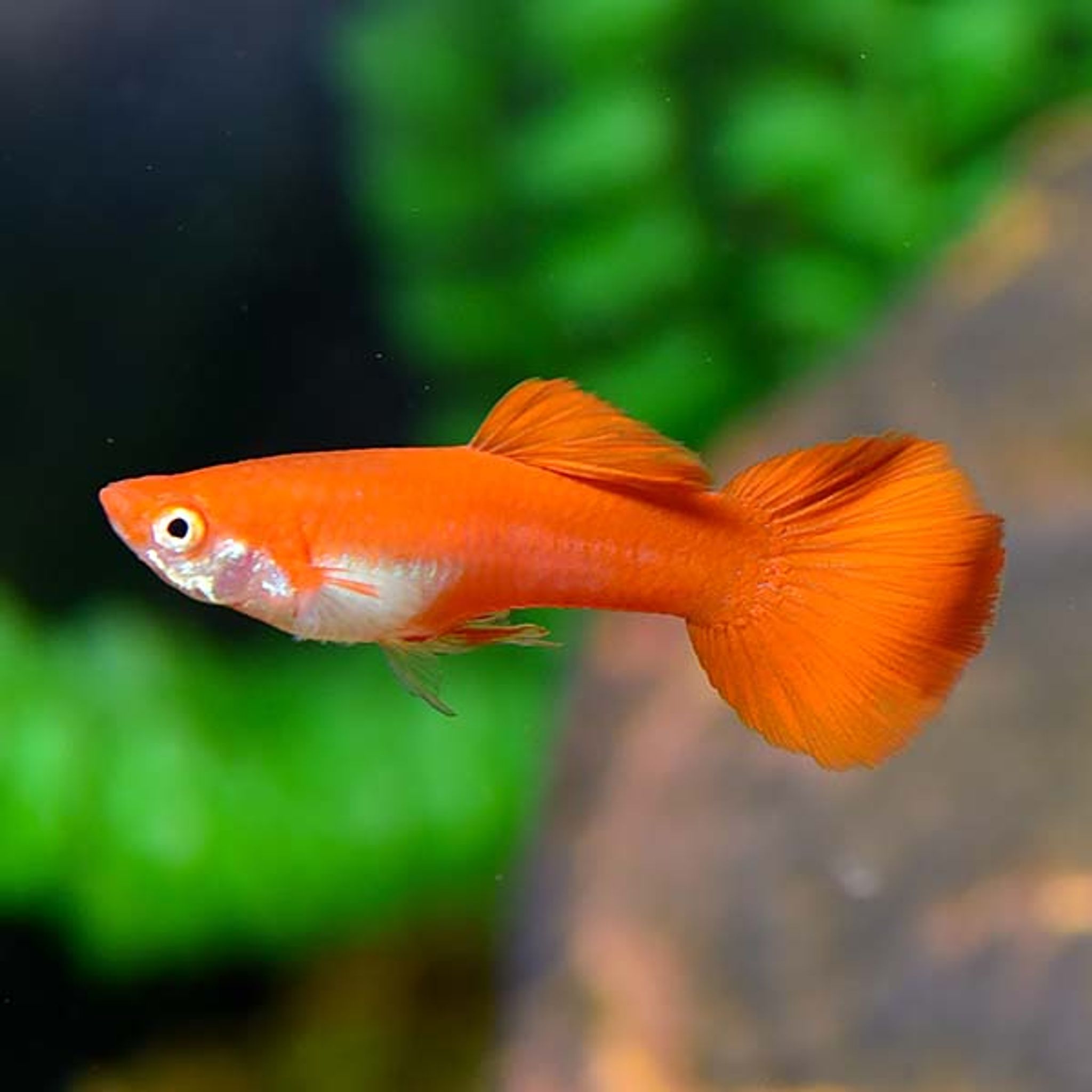

How Big Do Guppy Get? Growth Rate, Adult Size and Tank Planning
Adult guppies stay small overall, but there's a real size gap between males and females, and how big any individual fish gets depends heavily on genetics and early care. This guide breaks down exact size ranges by sex and strain, a growth timeline from fry to full adult, and the tank, filter, and stocking numbers to plan around.
How Big Do Guppies Get?
Guppies are one of the smaller community fish, but "small" covers a real range once you factor in sex and strain.
- Males: roughly 0.6–1.4 in (1.5–3.5 cm) in body length, not counting the tail and fin extensions.
- Females: roughly 1.2–2.4 in (3–6 cm) in body length.
- Large fancy-strain females: up to about 3 in (7.5 cm) total, tail included.
Females are consistently larger than males. That extra body volume isn't incidental — females need the space to carry developing fry, since guppies are livebearers. Males stay smaller and more streamlined, which helps with speed and agility during mating pursuits and predator evasion.
Fancy or show strains — veiltail, delta tail, lyretail, and similar varieties — often look noticeably larger than standard strains, but that's mostly the fins talking. Body length in a fancy male or female is usually similar to a standard-strain fish of the same sex; the oversized fins just add visual bulk without adding much true body size.
Because reported maximum sizes vary by source (some cite closer to 2.5 in for combined male/female ranges, others push to 3 in for big females), it's more useful to think in ranges by sex and strain rather than chase one universal number.
Size at a Glance
| Category | Body length (in) | Body length (cm) | Notes |
|---|---|---|---|
| Standard male | 0.6–1.4 | 1.5–3.5 | Streamlined, smaller fins |
| Standard female | 1.2–2.4 | 3–6 | Larger, rounder body |
| Fancy-strain male | ~0.6–1.4 (body) | ~1.5–3.5 (body) | Fins add visual size |
| Fancy-strain female | 1.2–2.4+ (body) | 3–6+ (body) | Up to ~3 in / 7.5 cm with tail |
Growth Timeline: From Fry to Full Adult
Guppy fry are born fully formed and swimming, not as eggs or larvae, since guppies give live birth.
- At birth: about 0.1–0.25 in.
- First 4–8 weeks: the fastest growth phase — fry pack on size quickly if conditions are good.
- 8–10 weeks: sexual maturity. Males can mature and start breeding here even though they haven't finished growing their full body length.
- 2–3 months: noticeable size and color maturity — fin shape and coloring start looking like an adult.
- 4–6 months: full adult size, typically. Some fast-growing individuals in ideal conditions reach full size closer to 3 months, but 4–6 months is the safer expectation since growth rate depends so much on conditions.
What Speeds Up or Slows Down Growth
Several factors interact to determine how quickly — and how large — a guppy ultimately grows:
- Genetics/strain: some lines are simply predisposed to grow larger or faster than others.
- Water temperature: guppies grow best in the mid-to-upper 70s°F, with a commonly cited range of about 74–82°F (23–28°C) and an optimum near 77–79°F (25–26°C).
- Diet: protein-rich, varied food fed in multiple small meals per day supports faster, healthier growth than one large feeding of a single food type.
- Water quality/stability: consistent parameters and regular partial water changes reduce stress, which supports normal growth.
- Stocking density: crowding is one of the most common causes of stunted growth in guppies.
Why Stunting Happens — and Why It Often Doesn't Reverse
Stunting is one of the most common reasons a guppy "just stays small." It's typically caused by a combination of:
- An undersized tank for the number of fish in it.
- Infrequent water changes, letting waste products build up.
- Poor genetics or inbreeding in the fish's background.
The important caveat: stunting is often permanent. Once a young guppy's growth has been suppressed by cramped or poor conditions, improving those conditions later usually won't let the fish "catch up" to the size it should have reached. This is exactly why a fish that looks small isn't automatically a small strain — it may be a normal-strain fish that never had the chance to grow properly.
Tank Planning for Guppies
Group Size and Sex Ratio
Guppies are active shoalers and should be kept in groups, not as a single fish. A few guidelines:
- Keep at least 4–6 guppies as a starting group.
- Favor more females than males — roughly 2–3 females per male — to spread out male mating attention across more fish and reduce stress on any individual female.
Minimum Tank Size
- 10 gallons (38 L): workable minimum for a small starter group of guppies.
- 20 gallons (76 L): recommended once breeding is likely, since guppy populations grow fast and a 10-gallon tank fills up quickly with fry.
As a rule of thumb, plan for roughly 1 gallon per adult guppy as a starting point. Adjust that down (i.e., leave more buffer room) if breeding is uncontrolled, since the population can climb faster than the math suggests.
Worked Example: Stocking a 20-Gallon Tank
Using the 1-gallon-per-adult guideline as a starting point for a 20-gallon (76 L) tank:
| Item | Amount |
|---|---|
| Tank size | 20 gal (76 L) |
| Baseline adult capacity (1 gal/fish) | ~20 adult guppies |
| Recommended starting group | 6–10 adults (e.g., 2 males, 6–8 females) |
| Buffer reserved for fry survival | Remaining ~10–14 "gallons" of headroom |
| Adjustment if breeding is uncontrolled | Reduce starting adult count further, or plan to rehome fry regularly |
The gap between the baseline capacity and the recommended starting group is intentional — it's the buffer that keeps a breeding tank from becoming overcrowded as broods arrive roughly every month.
Filtration: Gentle Flow Matters
Filter choice affects both adult comfort and fry survival:
- Strong outflow stresses adult guppies and can overwhelm or physically injure fry, which are weak swimmers.
- Sponge filters, or a hang-on-back filter with its flow adjusted or baffled, are commonly recommended over a powerful filter run at full force — especially in any tank where breeding is happening.
You can browse filters sized and rated for smaller freshwater setups when choosing gentle-flow options for a guppy tank.
Water Parameters
- Temperature: roughly 72–82°F (22–28°C).
- pH: roughly 7.0–8.0 — guppies tolerate slightly hard, slightly alkaline water well.
- Water changes: regular partial water changes support both healthy growth and general fish health.
Keeping Guppies Healthy (and Growing Normally)
Growth and general health are closely linked in guppies. The same conditions that support full adult size also keep fish resistant to disease:
- Stable, warm water within the ranges above.
- A varied diet — flake food plus live or frozen protein sources.
- Regular water changes to keep waste products from accumulating.
- Adequate tank size and low stocking stress, avoiding both overcrowding and aggressive tankmates.
Stunting in youth doesn't just produce a smaller adult — poor early conditions can also leave a fish more susceptible to disease and may shorten its overall lifespan, since the same stressors (crowding, poor water quality) that suppress growth also weaken immune resilience over time.
Guppy Fry: Numbers, Feeding, and Raising Them
How Many Fry Per Brood?
A single brood typically ranges from a couple dozen to 50+ fry, depending on the female's size, age, and condition. Because female guppies can store sperm, they can produce repeated broods roughly monthly without needing to re-mate each time.
Left alone, adult guppies — including the parents — will eat their own fry. To protect a brood, keepers typically rely on dense live plants for cover or a dedicated breeder box/net to separate fry until they're large enough to be safe.
Raising Fry to Full Size
Since early conditions determine final adult size, fry-rearing practices matter a lot:
- Feed small, frequent meals several times a day — crushed flake, baby brine shrimp, or powdered fry food all work.
- Keep water pristine with frequent small water changes; fry are especially sensitive to ammonia.
- Provide floating plants or a breeder net for cover and reduced stress.
- Keep the tank warm, stable, and low-stress — the same conditions that speed growth in juveniles apply directly to fry.
When to Cull or Rehome Fry
Because broods arrive roughly monthly and each one can add dozens of fish, a home breeding setup needs a plan before fry numbers get out of hand. As fry approach the point where they're competing for space and food, thin out the group by rehoming extras — this keeps stocking density low enough to avoid the same crowding that causes stunting in the first place. Waiting until the tank is visibly overcrowded is usually too late to prevent it.
Guppy Gender Identification
Telling males from females is straightforward once you know what to check:
- Males: smaller body, more vividly colored, with a modified anal fin called a gonopodium used for mating.
- Females: larger, plainer or duller in color, with a fan-shaped anal fin.
- Gravid spot: a dark patch near the vent on a female signals pregnancy.
Guppy Diseases and General Sick-Fish Signs
Common issues in guppies include ich (white spot disease), fin rot, and other livebearer-specific ailments. Watch for these general warning signs:
- Clamped fins
- Faded color
- Lethargy
- Bottom-sitting
- Rapid breathing
- Loss of appetite
Address these with water testing, water changes, and appropriate treatment rather than assuming a size-related cause. A guppy that looks like it's "shrinking" or getting thin is almost always dealing with illness, not a normal growth pattern — don't mistake sickness for slow growth and delay treatment.
Guppy Fish Facts
Guppies are livebearers native to freshwater and brackish streams in South America and the Caribbean. They're now farmed worldwide in countless color and fin-type strains, prized for being hardy, prolific breeders. Average lifespan runs around 2–3 years.
Common Mistakes to Avoid
- Judging size from one pet-store fish. A single juvenile doesn't tell you much — always separate expectations for males, females, and fancy strains.
- Crowding fry or juveniles in a small, cool, or poorly maintained tank, which causes stunting that later gets mistaken for "just a small guppy."
- Overstocking a small tank because guppies look tiny, then being surprised by rapid, unplanned population growth.
- Running a high-flow filter in a breeding or fry tank, which can injure fry or pull them into the intake.
- Mistaking illness for slow growth — clamped fins, color loss, and bottom-sitting mean it's time to test water and treat, not wait and see.
- Confusing a torn or split tail from fin nipping with a genetic fancy-tail trait, which leads to misdiagnosing a health issue as a cosmetic one.
Guppy with a Split or Torn Tail
A split or torn tail in a standard-strain guppy is usually physical damage — fin nipping from tankmates, fin rot, or catching fins on decor — rather than a genetic trait. With clean water and good nutrition, minor damage can heal over time, though severe or repeated damage may not regrow to its exact original shape.
Frequently Asked Questions
How big does a full-grown guppy get?
Males typically reach about 0.6–1.4 in (1.5–3.5 cm) and females about 1.2–2.4 in (3–6 cm) in body length, with large fancy-strain females reaching up to roughly 3 in (7.5 cm) including the tail. Fin length on fancy strains adds apparent size beyond the actual body measurement.
How fast do guppies grow?
Growth is fastest in the first 4–8 weeks of life, with noticeable size and color maturity by around 2–3 months. Full adult size is typically reached by 4–6 months, though this depends heavily on temperature, diet, and water quality.
Why is my guppy not growing or staying small?
This is usually stunting caused by a small tank, poor water quality, insufficient feeding, overcrowding, or genetics. Unfortunately, stunting is often irreversible — once growth has been suppressed early on, improving conditions later typically won't let the fish reach its full potential size.
Do male or female guppies get bigger?
Females get bigger. They need the extra body volume to carry developing fry, since guppies are livebearers, while males stay smaller and more streamlined.
What size tank do guppies need?
A 10-gallon (38 L) tank works as a minimum for a small starter group, while a 20-gallon (76 L) tank is recommended once breeding is in the picture, since fry numbers grow fast. A rough starting guideline is about 1 gallon per adult guppy.
How many babies do guppies have at once?
A single brood typically ranges from a couple dozen to 50+ fry, depending on the female's size, age, and condition. Because females store sperm, they can produce another brood roughly every month without needing to re-mate.
How can I tell if my guppy is male or female?
Males are smaller and more colorful with a pointed anal fin called a gonopodium, while females are larger, plainer in color, and have a fan-shaped anal fin. A dark gravid spot near a female's vent signals she's pregnant.
Why does my guppy have a split or torn tail?
It's usually caused by fin nipping from tankmates, fin rot, or catching fins on decor rather than genetics. Improving water quality and removing aggressive tankmates typically allows the fin to heal, though severe damage may not fully regrow.
Ready to start or expand your group? You can browse available guppies along with other small community fishes suited to the same gentle, warm-water setup.


